The Best Pelvic Floor Exercises for Bladder Control in Women Over 50
As we age, maintaining bladder control becomes a top priority for staying active, confident, and independent. If you are experiencing occasional leaks when you laugh, sneeze, or lift groceries, you are not alone. Up to half of women over 50 experience some form of urinary incontinence. The good news is that targeted pelvic floor exercises for bladder control in women over 50 are highly effective, non-invasive, and can be done right at home.
Building strength in your pelvic region is just like building strength in your arms or legs. It requires consistency, proper form, and a smart progression. As a strength and conditioning coach, I have guided many clients through this exact journey. This guide will walk you through the anatomy, the best exercises, and a practical routine to help you regain control and confidence.
Quick Answer
The most effective pelvic floor exercises for bladder control in women over 50 include classic Kegels, diaphragmatic breathing, glute bridges, and bird-dog variations. Aim for 3 sets of 10 repetitions, holding each contraction for 3 to 5 seconds, performed daily. Consistency over 6 to 12 weeks typically yields noticeable improvements in bladder control and core stability.
Understanding the Pelvic Floor and Bladder Control
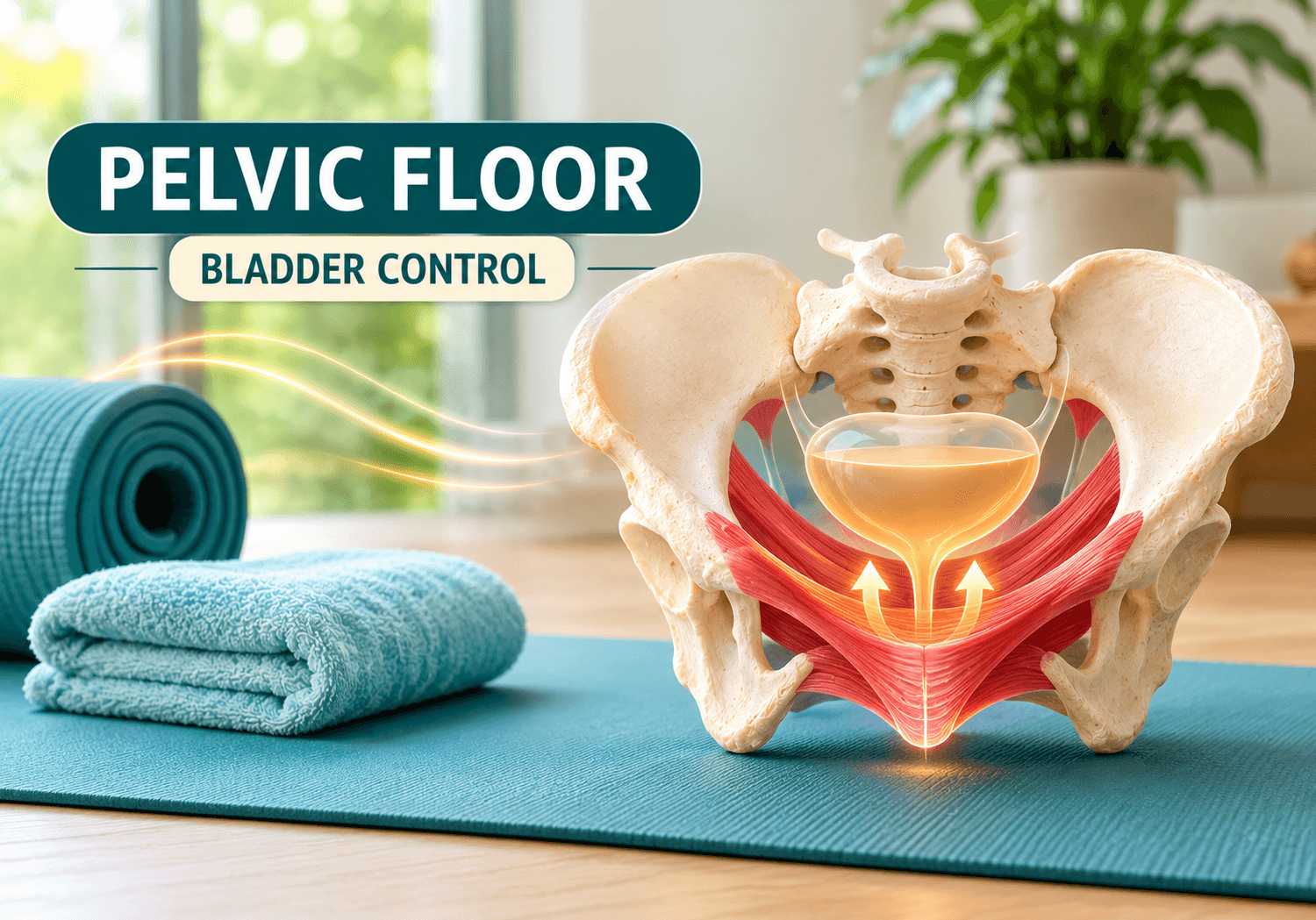
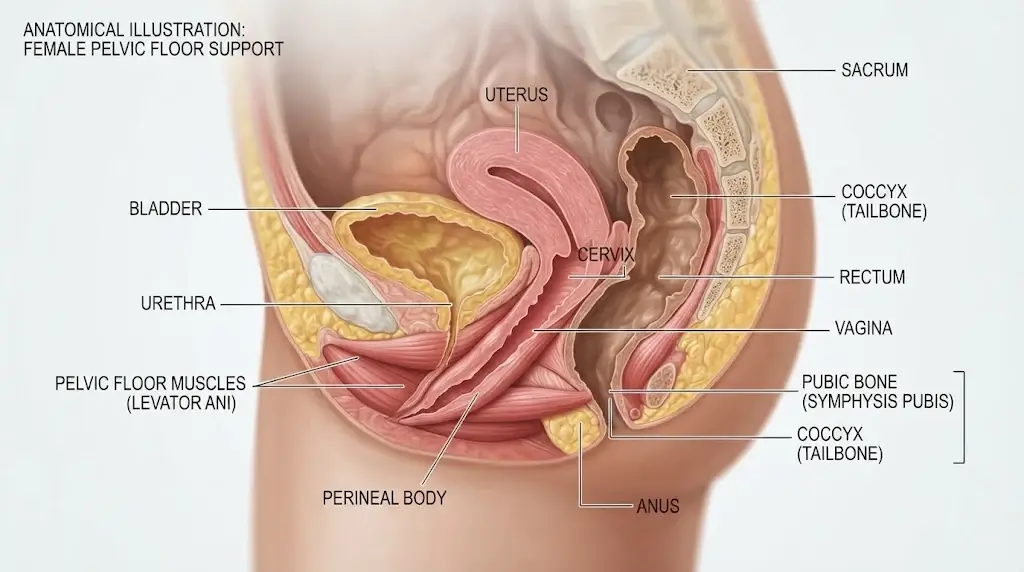
Your pelvic floor is a hammock-like group of muscles, ligaments, and connective tissues that stretch from your pubic bone to your tailbone (coccyx). These muscles support your bladder, uterus, and rectum. The primary muscle involved is the levator ani, which includes the pubococcygeus muscle.
When these muscles are strong, they stay tightly closed to prevent urine leakage during physical stress, like coughing or jumping. However, factors like menopause, childbirth history, chronic coughing, or heavy lifting can weaken this hammock. Estrogen decline during menopause also thins the urethral tissue, making postmenopausal bladder health a critical focus.
Research from the National Institutes of Health (NIH) confirms that structured pelvic floor muscle training significantly reduces urinary incontinence episodes in older women. By strengthening these muscles, you improve both stress incontinence (leaks from pressure) and urge incontinence (sudden, strong needs to go).

Benefits of a Dedicated Bladder Control Workout
Committing to a core and pelvic floor routine offers benefits that extend far beyond the bathroom.
- Reduced Bladder Leakage: Strengthening the pubococcygeus muscle improves urethral closure pressure, directly reducing accidents.
- Improved Core Stability: The pelvic floor works in tandem with your transverse abdominis and diaphragm. A strong pelvic floor means a stronger, more stable core for daily activities.
- Better Posture and Balance: A stable core translates to better balance, which is vital for preventing falls as we age.
- Enhanced Intimacy: Stronger pelvic muscles can improve sensation and comfort during sexual activity.
- Support for Pelvic Organs: Regular training helps prevent or manage mild pelvic organ prolapse by providing better structural support.
Pairing this targeted training with overall healthy habits, such as maintaining a healthy weight and supporting your body with adequate protein intake, ensures your muscles have the building blocks they need to repair and grow stronger.
Top 8 Pelvic Floor Exercises for Bladder Control
Here are the most effective, evidence-based movements to strengthen your pelvic floor. Perform these in a quiet space where you can focus on your breathing and muscle engagement.
1. Classic Kegel (Isometric Contraction)
This is the foundational movement for kegel exercises for women over 50. It isolates the pelvic floor without engaging the glutes or thighs.
- How to do it: Sit comfortably or lie on your back with knees bent. Imagine you are trying to stop the flow of urine or hold in gas. Squeeze and lift the muscles inside your pelvis upward.
- Tempo: Squeeze for 3–5 seconds, then fully relax for 5 seconds.
- Sets/Reps: 3 sets of 10 repetitions.
- Regression: If holding for 5 seconds is too hard, start with 2-second holds.
- Progression: Increase the hold time to 8–10 seconds as you get stronger.
- Coach’s Cue: “Lift and squeeze, like an elevator going up. Then, let the elevator all the way back down to the lobby. Full relaxation is just as important as the squeeze.”
2. Diaphragmatic Breathing with Pelvic Drop
Many women unknowingly hold tension in their pelvic floor, which can cause spasms and worsen urge incontinence. This exercise teaches relaxation and coordination.
- How to do it: Lie on your back with knees bent and feet flat. Place one hand on your chest and one on your belly. Inhale deeply through your nose, letting your belly rise. As you inhale, imagine your pelvic floor gently dropping and expanding like a parachute. Exhale through pursed lips, letting your belly fall, and gently draw the pelvic floor up.
- Sets/Reps: 2 sets of 8–10 slow breaths.
- Regression: Practice this sitting in a chair if lying down is uncomfortable.
- Progression: Add a light resistance band around your thighs to engage the outer hips while breathing.
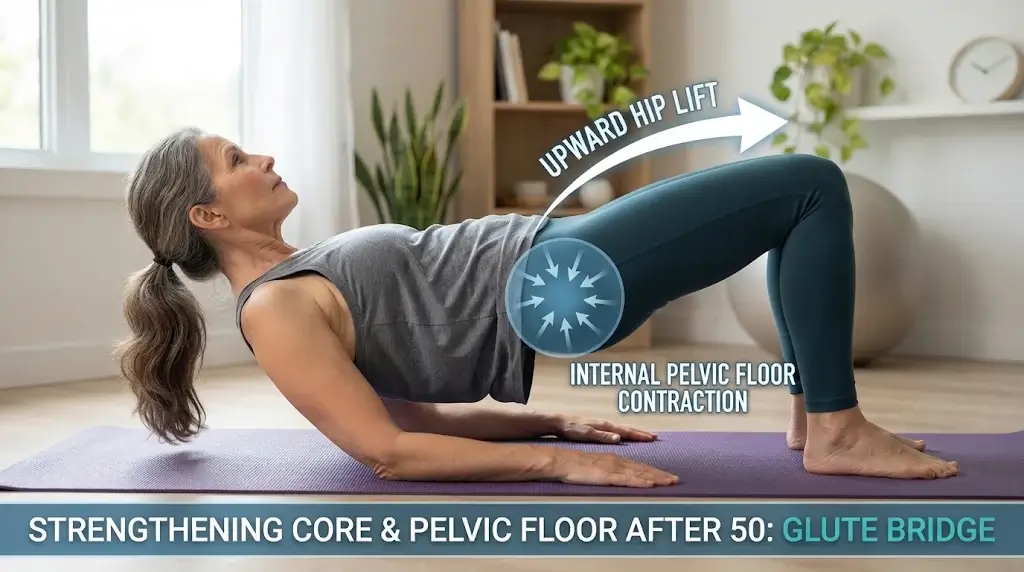
3. Glute Bridge with Pelvic Floor Engagement
This functional movement strengthens the glutes, hamstrings, and pelvic floor simultaneously, promoting functional strength for standing and walking.
- How to do it: Lie on your back, knees bent, feet hip-width apart. Inhale to prepare. As you exhale, squeeze your glutes, lift your hips toward the ceiling, and simultaneously perform a Kegel lift. Hold at the top for 2 seconds. Inhale as you lower your hips and release the pelvic floor.
- Sets/Reps: 3 sets of 10–12 repetitions.
- Regression: Perform the bridge without the Kegel lift until you master the hip hinge.
- Progression: Place a light resistance band just above your knees to activate the gluteus medius.
4. Bird-Dog with Core Bracing
This exercise builds dynamic core stability, teaching your pelvic floor to work while your limbs are moving, which mimics real-life activities like walking or carrying groceries.
- How to do it: Start on your hands and knees (tabletop position). Keep your back flat like a table. Inhale to prepare. As you exhale, extend your right arm forward and your left leg back. Simultaneously, gently draw your pelvic floor up and brace your core (like zipping up a tight pair of jeans). Hold for 2 seconds, then return to the start and switch sides.
- Sets/Reps: 3 sets of 8 repetitions per side.
- Regression: Only extend the arm, or only extend the leg, until balance improves.
- Progression: Add a light ankle weight (1–2 lb / 0.5–1 kg) or hold a light dumbbell (3–5 lb / 1.5–2.5 kg) in your hand.
5. Supine Heel Slides
Heel slides train the transverse abdominis and pelvic floor to stabilize the spine during leg movement, a common trigger for stress incontinence.
- How to do it: Lie on your back with knees bent. Flatten your lower back gently into the floor. Inhale. As you exhale, slowly slide one heel out until the leg is straight, keeping your pelvis perfectly still. Inhale to slide it back. Add a gentle pelvic floor lift as the leg extends.
- Sets/Reps: 3 sets of 10 repetitions per leg.
- Regression: Slide the heel only halfway.
- Progression: Perform the movement with both legs simultaneously (double leg lowers), but only if you can keep your lower back flat.
6. Squat with Pelvic Floor Lift
Squatting is a vital daily movement. Learning to coordinate a Kegel with a squat protects your pelvic floor from downward pressure.
- How to do it: Stand with feet shoulder-width apart. As you inhale and lower into a shallow squat (like sitting in a chair), allow your pelvic floor to relax and descend slightly. As you exhale and push through your heels to stand up, squeeze and lift your pelvic floor.
- Sets/Reps: 3 sets of 10 repetitions.
- Regression: Perform a “sit-to-stand” from a sturdy chair instead of a full squat.
- Progression: Hold a goblet weight (8–12 lb / 3.5–5.5 kg) at your chest.
Common Mistake Callout:
Holding Your Breath. Many people hold their breath or bear down (like having a bowel movement) when trying to do a Kegel. This increases intra-abdominal pressure and pushes down on the pelvic floor, which is the exact opposite of what you want. Always exhale on the effort (the lift) and keep your jaw and glutes relaxed.
7. Clamshells with Resistance Band
Weak hips can force the pelvic floor to overcompensate. Strengthening the outer hips (gluteus medius) provides a stable foundation for the pelvis.
- How to do it: Lie on your side with hips and knees bent at a 45-degree angle. Place a light resistance band around your thighs, just above the knees. Keep your feet touching. Exhale, lift your top knee like a clamshell opening, and gently engage your pelvic floor. Inhale to lower.
- Sets/Reps: 3 sets of 12 repetitions per side.
- Regression: Remove the resistance band and focus on the movement pattern.
- Progression: Use a heavier resistance band or add a 2-second pause at the top.
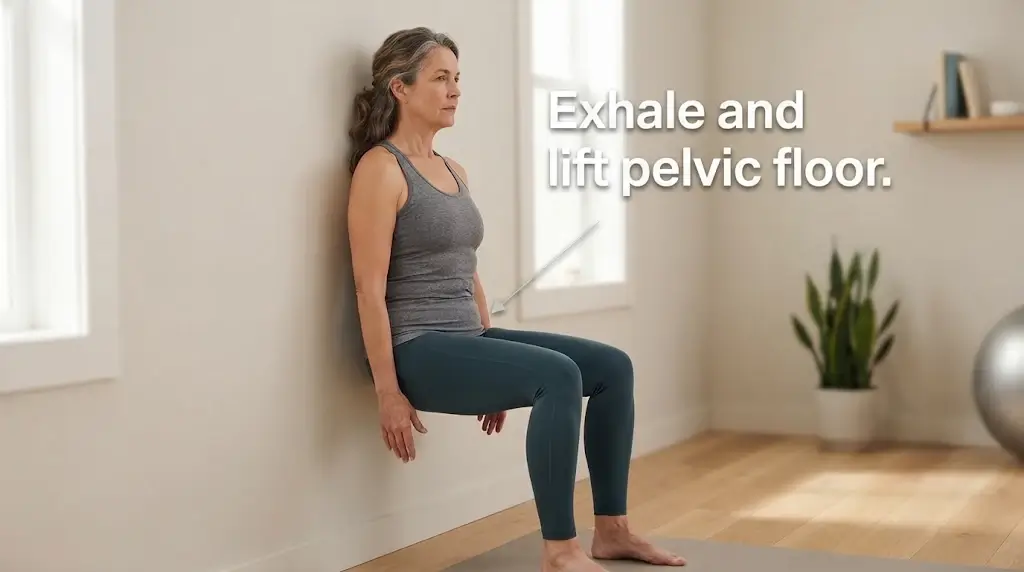
8. Wall Sit with Kegels
This isometric exercise builds endurance in the legs and the pelvic floor simultaneously.
- How to do it: Stand with your back against a wall. Slide down until your knees are bent at about a 45-degree angle (do not go to 90 degrees if you have knee pain). Keep your feet about 12 inches (30 cm) from the wall. Hold this position. While holding, perform 5–8 slow, controlled Kegel lifts and releases.
- Sets/Reps: 3 sets of 30–45 second holds.
- Regression: Stand higher up the wall (shallower squat).
- Progression: Hold a light weight or increase the time to 60 seconds.
How to Build a Pelvic Floor Workout Routine
Consistency is the key to success. You do not need to spend hours in the gym. A focused bladder control workout takes just 10 to 15 minutes a day.
| Goal | Frequency | Sets per Exercise | Reps / Hold Time | Rest Between Sets |
| Beginner (Weeks 1-4) | 3–4 days/week | 2 sets | 8–10 reps (2-3 sec hold) | 30 seconds |
| Intermediate (Weeks 5-8) | 4–5 days/week | 3 sets | 10–12 reps (5 sec hold) | 45 seconds |
| Advanced (Weeks 9+) | 5–6 days/week | 3 sets | 12-15 reps (8-10 sec hold) | 60 seconds |
Sample Weekly Schedule:
- Monday: Full routine (Exercises 1, 3, 4, 6)
- Tuesday: Active recovery (Brisk walking for 20 minutes + Diaphragmatic breathing)
- Wednesday: Full routine (Exercises 1, 2, 5, 7)
- Thursday: Active recovery (Gentle stretching or yoga)
- Friday: Full routine (Exercises 1, 3, 4, 8)
- Saturday: Light activity (Gardening, swimming, or a 1-mile / 1.6 km walk)
- Sunday: Rest
Integrating these movements supports overall functional fitness. Just as you might focus on how to increase metabolism naturally after 40 to maintain healthy body composition, targeted pelvic training maintains your structural integrity and comfort.
Exercises and Habits That Make Incontinence Worse
While strengthening is crucial, knowing what to avoid is equally important. High-impact activities can place excessive downward pressure on a weakened pelvic floor.
- Avoid High-Impact Jumping: Box jumps, jump rope, or intense plyometrics can overwhelm the pelvic floor. Opt for low-impact cardio like cycling, swimming, or elliptical training.
- Avoid Heavy, Unbraced Lifting: Lifting heavy weights without exhaling and engaging your core creates a spike in intra-abdominal pressure.
- Limit Bladder Irritants: Caffeine, alcohol, artificial sweeteners, and spicy foods can irritate the bladder lining, worsening urge incontinence.
- Do Not “Just in Case” Pee: Going to the bathroom when you do not actually feel the urge trains your bladder to hold less urine over time. Try to space bathroom visits to every 2.5 to 3 hours.
Maintaining good energy levels and avoiding fatigue is also important, as tired muscles do not contract as effectively. Ensuring you get quality sleep affects recovery and muscle function, including the subtle, endurance-based contractions of the pelvic floor.
Who Should Be Careful (Safety Notes)
While pelvic floor exercises for bladder control in women over 50 are generally very safe, certain conditions require professional guidance.
- Pelvic Organ Prolapse: If you feel a heaviness or bulging in your vagina, consult a pelvic floor physical therapist before starting. Some exercises may need modification.
- Overactive Pelvic Floor (Hypertonic): If your pelvic floor is too tight, doing endless Kegels can make pain and urgency worse. You may need to focus entirely on diaphragmatic breathing and relaxation (Exercise 2) first.
- Recent Surgery: If you have had recent pelvic, abdominal, or back surgery, get clearance from your doctor before beginning any core or pelvic routine.
If you experience pain, sharp pulling sensations, or worsening leakage during these exercises, stop immediately and consult a healthcare provider or a specialized pelvic floor physical therapist.
Sample 15-Minute Daily Pelvic Floor Routine
Here is a streamlined, equipment-free routine you can do every morning or evening.
- Warm-up (2 mins): Diaphragmatic breathing (Exercise 2) – 10 slow breaths.
- Activation (3 mins): Classic Kegels (Exercise 1) – 2 sets of 10 reps (3-second hold).
- Strength (5 mins): Glute Bridges (Exercise 3) – 2 sets of 10 reps, coordinating the lift with the exhale.
- Stability (3 mins): Bird-Dog (Exercise 4) – 2 sets of 6 reps per side, focusing on a still pelvis.
- Cool-down (2 mins): Child’s pose or gentle seated forward fold, focusing on relaxing the pelvic floor completely.
To support your body’s overall repair processes during this training, ensure you are consuming essential vitamins support overall vitality, particularly Vitamin D and magnesium, which play roles in muscle contraction and nerve function.
FAQ: Pelvic Floor Exercises for Bladder Control
1. How many kegels should I do a day over 50?
Aim for 30 to 50 total contractions per day, broken into 3 sets of 10 to 15 repetitions. Consistency matters more than doing hundreds of reps in a single day, which can lead to muscle fatigue and worsening symptoms.
2. How long does it take to see results from kegel exercises?
Most women notice a reduction in bladder leakage after 6 to 12 weeks of consistent, daily practice. Muscle hypertrophy and neuromuscular re-education take time, so patience and strict form are essential.
3. Can walking help strengthen the pelvic floor?
Walking is excellent for overall health and gentle core engagement, but it does not directly strengthen the pelvic floor muscles. However, combining a daily 1-mile (1.6 km) walk with your targeted Kegel routine is a highly effective strategy for how to increase energy and stamina naturally while supporting bladder health.
4. How do I know if I am doing kegels correctly?
You should feel a gentle lifting and squeezing sensation inside your pelvis, around your urethra and vagina. Your stomach, thighs, and buttocks should remain completely relaxed. If you are unsure, a pelvic floor physical therapist can provide biofeedback to confirm your technique.
5. What are the best pelvic floor exercises for postmenopausal women?
Postmenopausal women benefit most from a combination of isometric Kegels, diaphragmatic breathing, and functional movements like glute bridges and squats. This combination addresses both muscle weakness and the tissue changes associated with lower estrogen levels.
6. Can pelvic floor exercises cure bladder leakage?
For many women, especially those with mild to moderate stress incontinence, dedicated pelvic floor muscle training can completely resolve or significantly reduce leakage. For severe cases, it is a highly effective first-line treatment that may reduce the need for medication or surgery.
Conclusion
Regaining control of your bladder is entirely possible with the right approach. By committing to these pelvic floor exercises for bladder control in women over 50, you are investing in your independence, comfort, and confidence. Start with the basics, focus on your breathing, and prioritize proper form over high repetitions.
Remember that your pelvic floor is part of your entire core system. Supporting it with smart strength training, healthy nutrition, and how to boost metabolic flexibility without crash dieting creates a resilient, healthy body that can handle whatever your day throws at it. Be patient with your progress, celebrate small victories, and do not hesitate to seek guidance from a pelvic floor physical therapist if you need personalized support.