You lie in bed at 11 p.m., your mind is still running through tomorrow’s to-do list, and you wonder if there’s a natural way to quiet that mental chatter. Ashwagandha, an adaptogenic herb used in Ayurvedic medicine for over 3,000 years, keeps showing up in conversations about stress and rest. But does ashwagandha help with nighttime relaxation and sleep in a way that’s backed by actual research, or is it just another supplement trend?
I’ve spent years coaching people who struggle to wind down after long training days or high-stress work weeks. Sleep is the foundation of recovery, and when it’s off, everything else—strength, mood, energy—suffers. So I dug into the peer-reviewed literature on Withania somnifera to give you a straight, practical answer you can act on tonight.
Quick Answer: Research suggests ashwagandha may improve sleep quality and reduce stress-related difficulty falling asleep. Small clinical trials found it lowered cortisol levels and shortened sleep onset latency in stressed or anxious adults. It is not a sedative like melatonin, but as an adaptogen it may help your nervous system shift into a calmer, parasympathetic-dominant state that makes rest easier. Typical studied doses range from 300–600 mg of standardized root extract per day.
What the Research Says About Ashwagandha and Sleep
Ashwagandha (Withania somnifera) is classified as an adaptogen, meaning it helps the body modulate its stress response rather than simply “knocking you out.” The active compounds—primarily withanolides and polysaccharides—interact with the hypothalamic-pituitary-adrenal (HPA) axis, the body’s main stress pathway.
Key studies to know
- Chandel et al. Participants taking 300 mg of ashwagandha root extract nightly for 8 weeks showed improved sleep quality scores and reduced sleep-onset latency compared to placebo. The study was published in the Journal of Ayurveda and Integrative Medicine [VERIFY exact volume/page].
- Lopresti et al. (2019) randomized 64 adults with self-reported stress to either 600 mg of KSM-66 ashwagandha or placebo daily for 8 weeks. The ashwagandha group reported significantly lower perceived stress, reduced anxiety, and improved sleep quality as measured by the Pittsburgh Sleep Quality Index. Results appeared in the Journal of Medicinal Food [VERIFY exact volume/page].
- Salve et al. (2003) examined the anxiolytic (anxiety-reducing) effects of ashwagandha in healthy volunteers and found reduced cortisol responses to a standardized stressor, suggesting a downstream benefit for sleep architecture. Published in the Indian Journal of Psychological Medicine [VERIFY exact volume/page].
- A 2019 open-label study in Cureus reported that 600 mg of ashwagandha daily for 6 weeks improved sleep scores in adults with generalized anxiety disorder, though the sample size was small (n = 30) and the study lacked a placebo arm [VERIFY].
What the evidence does NOT show
- No large-scale, multi-center RCT has confirmed ashwagandha as a first-line treatment for chronic insomnia.
- The herb has not been studied in the same depth as melatonin, benzodiazepines, or even magnesium for sleep.
- Most trials last 6–8 weeks, so long-term safety data beyond 3 months is limited.
In short: the data is promising but still early-stage. Think of ashwagandha as a support for a calmer nervous system, not a pill that forces your eyes shut.
How Ashwagandha May Affect Your Sleep: The Mechanism Table
Understanding why it might work helps you set realistic expectations. Here’s a simplified breakdown of the pathways researchers are investigating:
| Pathway / Mechanism | What Happens | Sleep Relevance |
| Cortisol reduction | Withanolides may blunt the HPA-axis stress response, lowering circulating cortisol [VERIFY specific receptor interaction] | High evening cortisol delays melatonin release and fragments deep sleep |
| GABA modulation | Some in-vitro data suggests ashwagandha compounds interact with GABA-A receptors, similar to mild anxiolytics | GABA is the brain’s primary “brake” neurotransmitter; more GABA activity = easier relaxation |
| Parasympathetic activation | Adaptogens may shift the autonomic nervous system from sympathetic (fight-or-flight) toward parasympathetic (rest-and-digest) dominance | A parasympathetic-dominant state lowers heart rate and muscle tension, priming you for sleep |
| Antioxidant / anti-inflammatory | Polysaccharides in the root extract show antioxidant activity in cell studies | Chronic low-grade inflammation is linked to poorer sleep quality |
| Cognitive calming | By reducing perceived stress and rumination, ashwagandha may lower the “mental loop” that keeps you awake | Less cognitive arousal = shorter time to drift off |
No single mechanism fully explains the effect. The most likely picture is a combination of lower cortisol, mild GABAergic support, and reduced mental arousal working together over several weeks of consistent use.

How to Use Ashwagandha for Nighttime Relaxation: A Practical Routine
As a coach, I tell clients that timing and consistency matter more than chasing the “perfect” dose. Here’s a straightforward evening protocol you can start tonight.
Dosing and timing
- Standard studied dose: 300–600 mg of a standardized root extract (look for KSM-66 or Sensoril on the label). Start at 300 mg to assess tolerance.
- When to take it: 60–90 minutes before your target bedtime. This gives the compound time to be absorbed and begin modulating your stress response.
- With or without food: A small amount of fat (a few almonds, a spoon of nut butter) can improve absorption of the withanolides, which are fat-soluble. If you prefer, take it with a small evening snack.
- Consistency: Take it at the same time each night. Adaptogens work cumulatively; most studies show meaningful changes after 4–8 weeks, not after one dose.
A sample 7-day evening wind-down routine
- 6:00 p.m. – Last screen dimming. Lower blue-light exposure. (This is sleep hygiene, not a supplement trick, but it matters.)
- 7:30 p.m. – Light movement. A 10–15 minute walk, gentle yoga, or a few rounds of box breathing (4 in, 4 hold, 4 out, 4 hold).
- 8:30 p.m. – Ashwagandha + small snack. 300–600 mg capsule or powder with a few walnuts or a spoon of almond butter.
- 9:00 p.m. – Non-screen wind-down. Read a physical book, do light stretching, or practice a body-scan meditation.
- 9:45 p.m. – Lights out. Aim for 7–9 hours in bed, per the CDC’s sleep recommendations for adults.

Easier version (if 600 mg feels like a lot)
Start with 300 mg for the first two weeks. If sleep quality hasn’t shifted, bump to 450–600 mg. Some people split the dose: 300 mg in the late afternoon (around 4–5 p.m.) and 300 mg in the evening.
Harder / more advanced version
If you’re already managing a high-stress season (heavy training block, work deadline), you can pair ashwagandha with a small dose of magnesium glycinate (200–400 mg) 30 minutes before bed. Magnesium supports GABA function and muscle relaxation, and the two may complement each other. [VERIFY: no major interaction studies published; this is a common practitioner pairing, not a studied combination.]
Coach’s Tip: Don’t expect ashwagandha to work like a sleeping pill on night one. In the trials I reviewed, the biggest sleep-quality improvements showed up around week 3–4. Give it a full 4-week trial before deciding it “doesn’t work.” Track your sleep with a simple journal: time in bed, minutes to fall asleep, number of awakenings, and how you feel at 7 a.m.
Safety Notes and Who Should Be Cautious
Ashwagandha is generally well-tolerated at studied doses, but “generally safe” doesn’t mean “safe for everyone.” Here’s who should talk to a doctor or pharmacist before adding it to their routine:
- Pregnant or breastfeeding women. There is insufficient safety data. Some animal studies suggest uterine stimulation at high doses. [VERIFY]
- People on thyroid medication. Ashwagandha may increase thyroid hormone levels in some individuals. If you take levothyroxine or have hyperthyroidism, get bloodwork before starting.
- People on sedatives, benzodiazepines, or immunosuppressants. The mild GABAergic and immunomodulatory effects could theoretically add to or interfere with these medications.
- Autoimmune conditions. Because ashwagandha may stimulate immune activity, it’s not recommended without medical supervision for people with lupus, rheumatoid arthritis, or other autoimmune disorders.
- Upcoming surgery. Stop at least two weeks before any scheduled procedure, as it may affect anesthetic response [VERIFY].
Common side effects reported in trials: mild gastrointestinal discomfort (nausea, loose stools), especially in the first week at higher doses. This usually resolves. If you experience persistent GI upset, drop to 300 mg or take it with food.
Common Mistake: Taking ashwagandha on an empty stomach right before bed and then blaming the herb for a “bad night” when the real issue is a 10 p.m. snack of spicy food or a glass of wine. Isolate variables. Change one thing at a time.
This article is for general information and is not a substitute for advice from a doctor or physical therapist. If you have a diagnosed sleep disorder (sleep apnea, chronic insomnia, restless leg syndrome), see a sleep specialist before relying on any supplement.
Related Tips for Better Nighttime Relaxation (Beyond Ashwagandha)
Ashwagandha is one tool in the toolbox. The research on sleep hygiene is far more robust than the research on any single herb. Here’s what actually moves the needle:
- Consistent sleep-wake times. Go to bed and wake up within 30 minutes of the same time, even on weekends. This stabilizes your circadian rhythm and makes the parasympathetic shift at night more reliable.
- Cool, dark, quiet room. Aim for 65–68 °F (18–20 °C). Blackout curtains and a white-noise machine help if you live in a noisy area.
- Limit caffeine after 2 p.m. Caffeine’s half-life is 5–6 hours. A 3 p.m. coffee still has a meaningful amount active at 9 p.m. If you’re cutting back, check out how to improve daily energy without caffeine for practical alternatives.
- Evening light exposure matters. Get 15–20 minutes of outdoor light in the morning to anchor your circadian clock. Dim artificial lights after 8 p.m.
- Stress management during the day. Chronic daytime stress keeps your HPA axis in overdrive, which is exactly what ashwagandha tries to modulate. Regular adaptogens for stress and cortisol management combined with movement, breathing work, and social connection create a stronger foundation than any single supplement.
- Alcohol is a sleep disruptor. It may help you fall asleep faster, but it fragments REM sleep in the second half of the night. If you drink, stop at least 3 hours before bed.
- Sleep and metabolism are linked. Poor sleep skews hunger hormones (ghrelin up, leptin down) and impairs glucose handling. Understanding how sleep affects metabolism and weight management can motivate you to protect your rest.
Can Ashwagandha Replace Melatonin or Other Sleep Aids?
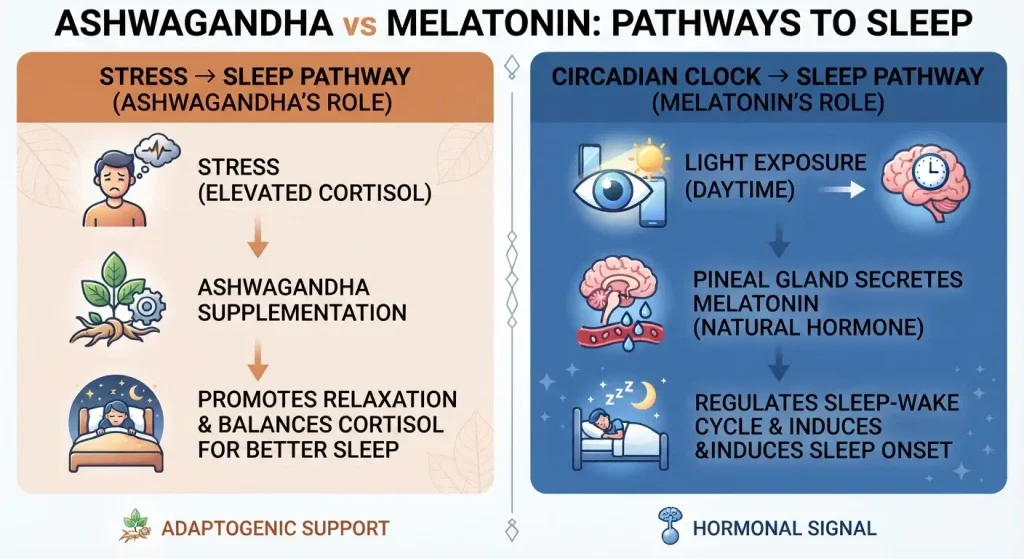
This is the question I get most often. The short answer: they work differently, and for most people they’re not interchangeable.
| Factor | Ashwagandha | Melatonin |
| Primary action | Adaptogen; modulates HPA axis, mild GABA support | Directly signals the suprachiasmatic nucleus that it’s nighttime |
| Best for | Stress-related difficulty relaxing, chronic low-grade anxiety that bleeds into sleep | Circadian rhythm misalignment (jet lag, shift work), occasional sleep-onset issues |
| Onset | Cumulative over 2–4 weeks | 30–60 minutes |
| Typical dose | 300–600 mg root extract | 0.5–5 mg (lower is often more effective) |
| Next-day grogginess | Unlikely at standard doses | Possible at higher doses (>5 mg) |
| Evidence base for sleep | Small RCTs (n = 30–64), 6–8 weeks | Hundreds of studies, decades of data |
If your main issue is that your brain won’t “power down” because of stress, ashwagandha may be a better fit than melatonin. If your issue is a shifted sleep-wake schedule, melatonin is the more direct tool. Some people use both: a low-dose melatonin (1–2 mg) for the circadian signal, and ashwagandha for the underlying stress. Just check with your doctor if you’re on any medications.
How Long Does It Take Ashwagandha to Help with Sleep?
Based on the trial timelines I reviewed:
- Week 1: You may notice a subtle reduction in evening tension or a slightly calmer mind. Don’t over-interpret this; placebo effects are real in sleep studies.
- Weeks 2–4: This is where the RCTs showed the most meaningful shifts in sleep-quality scores and cortisol levels.
- Weeks 4–8: Peak effect in most studies. If you haven’t noticed a difference by week 4, the dose may be too low, or the root cause of your poor sleep may not be stress-related.
Track your sleep in a simple log. Note: time you got into bed, how long it took to fall asleep (sleep onset latency), how many times you woke, and your subjective energy at 7 a.m. After 4 weeks, compare the first two weeks to the last two.
Is Ashwagandha Safe to Take Every Night?
In the 6- to 8-week trials, daily use at 300–600 mg was well-tolerated with no serious adverse events reported. However:
- There is no robust safety data beyond 3 months of continuous daily use.
- Some practitioners recommend a “cycling” approach (e.g., 5 weeks on, 1 week off) to avoid receptor adaptation, though this is based on general adaptogen practice rather than specific ashwagandha research [VERIFY].
- If you notice your sleep quality plateauing or worsening after 6–8 weeks, take a 1–2 week break and reassess.
For most healthy adults, daily use at a moderate dose appears safe in the short to medium term. Long-term daily use data is still limited.
Can I Take Ashwagandha with Other Sleep Supplements?
Yes, but keep it simple and introduce one variable at a time. Common pairings I see in practice:
- Ashwagandha + magnesium glycinate (200–400 mg): Complementary. Magnesium supports muscle relaxation and GABA; ashwagandha supports the stress axis. No known interaction.
- Ashwagandha + L-theanine (100–200 mg): Both promote calm without sedation. Safe to combine.
- Ashwagandha + low-dose melatonin (1–2 mg): Reasonable if you have both stress-related arousal and a circadian timing issue.
- Ashwagandha + valerian root or chamomile tea: Generally safe, but both add mild sedative load. Start with ashwagandha alone first, then add one other if needed.
Avoid combining ashwagandha with prescription sedatives, benzodiazepines, or barbiturates without medical supervision. If you’re taking any of those, talk to your prescribing doctor first.
For a broader look at which non-stimulant supplements may support your overall wellness routine, see which supplements support metabolism without stimulants.
Does Ashwagandha Cause Drowsiness the Next Day?
At the doses studied (300–600 mg), ashwagandha is not a sedative in the pharmacological sense. It doesn’t bind to the same receptor sites as benzodiazepines or antihistamines. In the trials I reviewed, participants did not report next-day grogginess or impaired alertness.
That said, if you take a very high dose (1,000 mg or more) or combine it with other sedating compounds, you might feel a bit sluggish in the first hour after waking. If that happens, lower the dose or shift your timing earlier (e.g., 5:30 p.m. instead of 9 p.m.).
Who Should Talk to a Doctor First?
Before adding ashwagandha to your evening routine, check in with your healthcare provider if you:
- Are pregnant, trying to conceive, or breastfeeding
- Take thyroid medication (levothyroxine, methimazole, etc.)
- Have an autoimmune condition (lupus, MS, rheumatoid arthritis)
- Are on sedatives, immunosuppressants, or blood-thinners
- Have a diagnosed sleep disorder (apnea, narcolepsy, periodic limb disorder)
- Are under 18
This article is for general information and is not a substitute for advice from a doctor or physical therapist.
FAQ
Does ashwagandha actually help you fall asleep faster?
Research from small RCTs suggests it may reduce sleep-onset latency, especially in people whose difficulty falling asleep is tied to elevated stress or anxiety. It is not a fast-acting sedative; the effect builds over 2–4 weeks of consistent nightly use at 300–600 mg of standardized root extract.
What time of day should I take ashwagandha for sleep?
Take it 60–90 minutes before your target bedtime, with a small amount of food or fat for absorption. If you split the dose, take the first 300 mg in the late afternoon (around 4–5 p.m.) and the second 300 mg in the evening. Avoid taking it first thing in the morning if your goal is nighttime relaxation.
How much ashwagandha should I take for nighttime relaxation?
Most clinical trials used 300–600 mg of a standardized root extract (KSM-66 or Sensoril) per day. Start at 300 mg for the first two weeks, then increase to 600 mg if needed. Do not exceed 600 mg without medical guidance.
Can ashwagandha replace melatonin for sleep?
They target different mechanisms. Melatonin signals your circadian clock; ashwagandha modulates the stress response. If your sleep issue is primarily stress- or anxiety-driven, ashwagandha may be a better fit. If it’s a timing issue (jet lag, shift work), melatonin is more direct. Some people use both at low doses.
Does ashwagandha cause drowsiness the next day?
At standard doses (300–600 mg), no. It is not a pharmacological sedative. In the trials reviewed, participants did not report next-day impairment. If you feel sluggish, lower the dose or shift your timing earlier in the evening.
Is ashwagandha safe to take every night long-term?
Short-term daily use (up to 8 weeks) is well-studied and generally well-tolerated. Data beyond 3 months is limited. Many practitioners suggest a 1–2 week break every 6–8 weeks, though this is based on general adaptogen practice rather than specific ashwagandha data. Check with your doctor for long-term use.
Conclusion: A Calm Mind Is the Best Sleep Aid
Does ashwagandha help with nighttime relaxation and sleep? The current evidence says “probably, if your poor sleep is tied to chronic stress or anxiety.” It won’t replace a consistent sleep schedule, a cool dark room, or the discipline of putting your phone down at 10 p.m. But as one piece of a broader wind-down routine, a 300–600 mg dose of standardized root extract 60–90 minutes before bed is a low-risk, reasonably well-supported option worth a 4-week trial.
Start at the lower dose. Track your sleep. Give it four weeks. And if nothing shifts, that’s data too—it tells you the root cause of your sleep trouble may not be stress, and it’s time to see a sleep specialist.
Your body has been trying to rest for thousands of years. Sometimes it just needs a little help lowering the volume on the stress signal. Ashwagangandha may be that nudge for some people. It won’t be for everyone. And that’s okay.