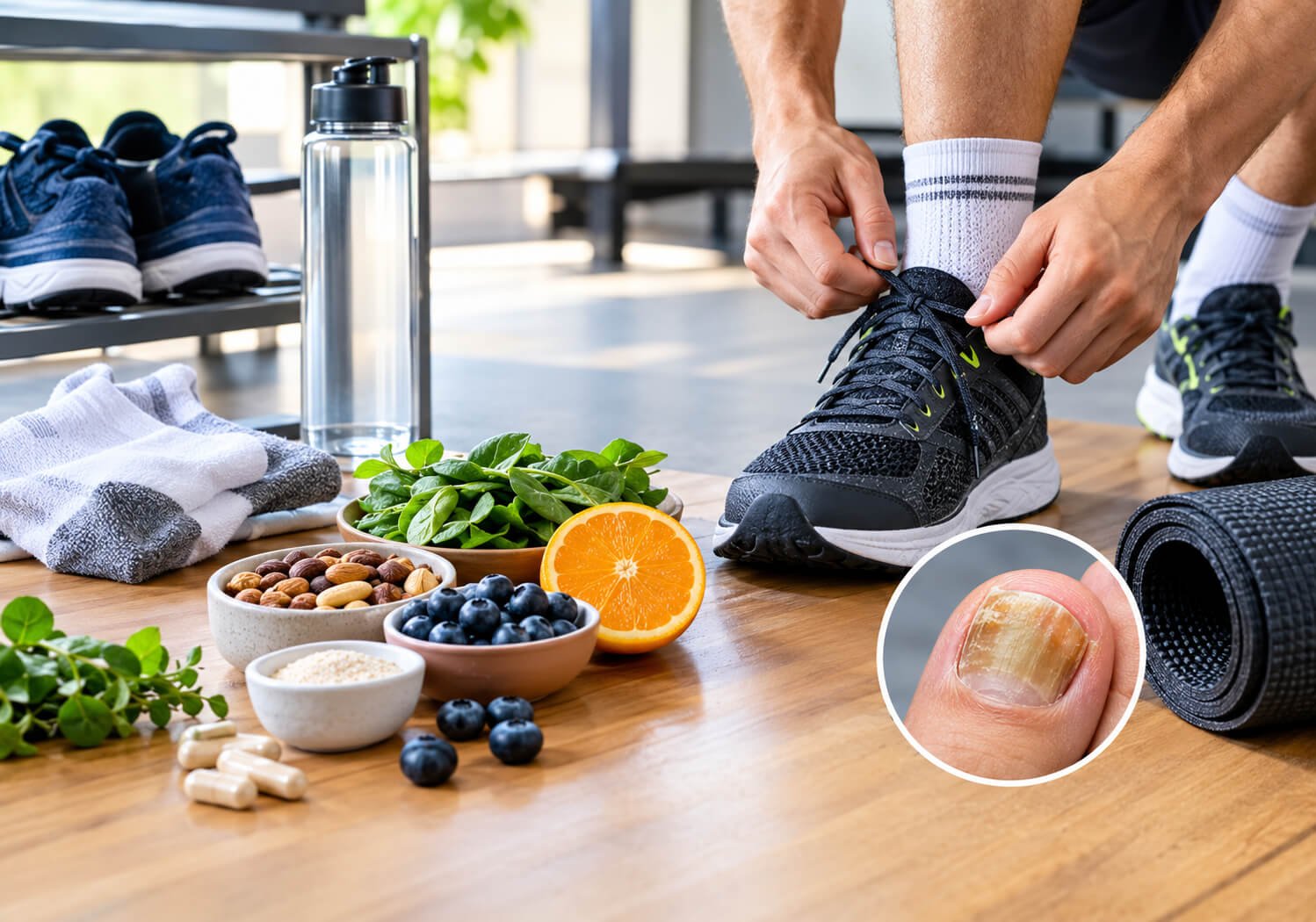
Having spent years coaching clients in dusty weight rooms and barefoot movement spaces, I have seen almost every physical challenge imaginable. Among the most stubborn issues athletes and gym-goers face isn’t a stalled squat max—it is a lingering, unsightly fungal nail infection. Athletes and active individuals often ask me: can supplements help with toenail fungus, or are those heavily advertised pills just wasting money?
When your toes spend hours inside sweaty training shoes, fungal spores thrive. It is completely natural to look for a quick oral pill or natural remedy to clear up discoloration and thickness. In this guide, we will break down the science of fungal nail infections, evaluate what dietary supplements can and cannot do, look at critical safety considerations, and build an actionable routine to keep your feet healthy for life.
Quick Answer
While dietary supplements cannot directly kill or cure a localized fungal nail infection (onychomycosis), targeted nutrients like zinc, vitamin C, biotin, and probiotics can strengthen your body’s immune defenses and support healthier keratin growth as the infection clears. For complete eradication of toenail fungus, proven medical treatments—such as prescription topicals or oral antifungal medications prescribed by a doctor—remain essential.
Understanding Onychomycosis: What Causes Toenail Fungus?
Toenail fungus, clinically known as onychomycosis, is primarily caused by a group of microscopic fungi called dermatophytes—most commonly Trichophyton rubrum. These microscopic organisms thrive in dark, warm, and damp environments. Think about sweaty gym socks, moist locker room floors, and tightly laced athletic shoes.

Once dermatophytes establish themselves under the nail bed, they feed on keratin, the tough protein that forms your nails and outer skin layer. As the fungi multiply, they cause classic symptoms:
- Yellow, brown, or white discoloration starting at the edge of the nail
- Thickening and distortion of the nail plate
- Brittle, crumbly, or ragged edges
- Debris building up underneath the nail body
- Foul odor or slight pain when wearing closed-toe shoes
Unlike a superficial skin rash, a nail infection is buried deep within and beneath the hard nail plate. This anatomical structure makes toenail fungus notoriously resistant to simple surface wash-offs or superficial treatments.
The Root Cause vs. Immune Defense: Can Supplements Help with Toenail Fungus?
To answer the core question—can supplements help with toenail fungus?—we must distinguish between killing an active fungal colony and supporting host defense and tissue regeneration.
Supplements do not possess systemic antifungal properties potent enough to penetrate the tough nail bed and destroy dermatophyte cell walls on contact. However, your immune system relies heavily on specific micronutrients to fight off pathogens and clear out damaged tissue.
When your micronutrient status is optimized:
- Immune cell function improves: Neutrophils and T-cells can better suppress spreading micro-organisms.
- Keratin synthesis speeds up: A faster-growing, stronger nail plate helps push infected tissue outward faster when paired with antifungal care.
- Peripheral circulation supports delivery: Good systemic health ensures oxygen and nutrients reach the toes, which naturally receive less blood flow than hands or upper limbs.
Micronutrients and Nutrients Evaluated
If you are considering adding dietary supplements for nail fungus support, it helps to understand what individual ingredients actually do inside your body.
| Nutrient / Supplement | Proposed Mechanism | Research Evidence |
| Zinc | Supports immune cell development and tissue repair | Strong evidence for immune function; indirect benefit for nail health |
| Vitamin C | Antioxidant; required for collagen and keratin matrix synthesis | Essential nutrient; supports structural integrity of growing tissues |
| Biotin (Vitamin B7) | Increases keratin infrastructure and nail thickness | Moderate evidence for brittle nails; no direct antifungal action |
| Probiotics | Balances gut microbiome; competes with systemic yeast | Strong evidence for gut-immune axis; indirect support against fungal overgrowth |
| Tea Tree Oil (Topical) | Natural antifungal properties against dermatophytes | Moderate evidence for mild surface cases; requires months of consistent application |
| Probiotic Strains (L. acidophilus) | Enhances mucosal immunity and gut barrier | Indirect immune benefit; does not replace medical antifungals |
Key Supplements and Their Role in Foot & Nail Health
Let us take a closer look at the key nutrients most commonly included in dietary supplements targeting foot and nail vitality.
1. Zinc and Vitamin C
Zinc is an essential mineral responsible for maintaining immune cell integrity. A zinc deficiency can compromise your body’s ability to resist superficial infections. According to research published in the Journal of Trace Elements in Medicine and Biology, adequate zinc levels are crucial for T-lymphocyte maturation and wound healing.
Pairing zinc with vitamin C gives your body the building blocks needed to build strong extracellular matrices and boost collagen production near the nail matrix.
2. Biotin (Vitamin B7)
Biotin is famous for supporting hair and nail growth. Clinical studies hosted on PubMed demonstrate that high-dose biotin supplementation can increase nail thickness and reduce splitting in individuals with brittle nails. While biotin does not kill Trichophyton rubrum, growing a thicker, resilient nail plate makes it harder for surface fungi to crack and invade deeper tissue layers.
3. Probiotics and Gut Microbiome Support
Your gut microbiome dictates a large portion of your systemic immune response. When gut flora becomes imbalanced—often due to poor diet, high stress, or frequent broad-spectrum antibiotic use—systemic opportunistic organisms can thrive more easily.
Taking quality probiotic supplements for foot health helps maintain a balanced intestinal barrier, reducing systemic inflammation and ensuring your immune system remains ready to combat peripheral fungal invaders.
Medical Antifungals vs. Dietary Supplements
It is critical to contrast over-the-counter supplements with validated medical options. Understanding these differences prevents wasted time and money when treating an active infection.
Oral Antifungal Medications
Prescription oral antifungals—such as terbinafine (Lamisil) or itraconazole—travel through your bloodstream directly into the nail matrix and bed. They kill the fungal cells by inhibiting enzyme production required for their cell membranes. As highlighted by clinical guidelines from the American Academy of Dermatology, oral antifungals remain the gold standard treatment for moderate-to-severe onychomycosis, boasting the highest success rates.

Topical Treatments
Over-the-counter and prescription topical lacquers or solutions (such as ciclopirox or efinaconazole) are applied directly to the nail surface. They work best on mild, superficial cases that have not yet reached the base (cuticle area) of the nail bed.
Dietary Supplements
Supplements sit entirely in the prevention, recovery, and structural support category. They provide raw building blocks to help your toe grow a clean, strong replacement nail after or alongside medical intervention.
Nutrition, Metabolism, and Fungal Vulnerability
Your overall metabolic health plays a surprisingly direct role in how susceptible you are to fungal nail infections. Fungi thrive in environments where blood circulation is poor and tissue glucose levels are elevated.
For instance, individuals with sluggish metabolic rate or poor blood sugar management frequently suffer from poor peripheral circulation. When blood flow to your feet is limited, immune cells and nutrients cannot travel down to the toes efficiently.
Improving your overall metabolic efficiency through smart dietary habits helps ensure healthy peripheral delivery. For an in-depth look at how cellular energy production works throughout your body, read our guide on which nutrients support normal energy metabolism.
Additionally, maintaining balanced blood sugar levels reduces available tissue glucose that opportunistic organisms thrive on. You can explore practical strategies for optimizing your daily metabolic health in our guide on how to support metabolism naturally for weight management.
Lifestyle Guidelines for Healthy Feet and Strong Nails
Nutrition and supplements work best when paired with rigorous foot hygiene. If you train hard in the gym, run, or play court sports, follow this daily hygiene checklist to keep your toes dry and clear:
- Change socks twice daily: Never sit around in damp training socks after a tough workout.
- Rotate athletic shoes: Allow your gym shoes to air out for at least 24 hours before wearing them again.
- Wear footwear in public areas: Always wear flip-flops or shower shoes in gym locker rooms, public pools, and sauna spaces.
- Clip nails straight across: Avoid rounding the edges too deep into the corners, which creates micro-tears in the skin barrier where fungal spores land.
- Keep feet dry: Thoroughly dry between your toes after showering before putting on clean socks.

Practical Action Plan: Combining Medical Care, Nutrition, and Hygiene
If you are dealing with a discolored or thickened toenail, here is a step-by-step approach to restore your foot health safely and effectively.
Step 1: Get a Formal Diagnosis
Before spending money on random products, visit a podiatrist or dermatologist. They can take a small nail clipping to confirm whether your issue is actually a fungal infection or a non-fungal condition like nail psoriasis, trauma dystrophy, or lichen planus.
Step 2: Begin Targeted Medical Treatment
Follow your physician’s recommended regimen. If prescribed an oral antifungal, ensure you complete the full course. If using a prescription topical lacquer, apply it consistently every single day as directed.
Step 3: Optimize Your Internal Nutrient Intake
Support your body’s healing capacity from within:
- Ensure adequate daily protein intake to supply amino acids (cysteine, methionine) for keratin synthesis. To learn more about protein’s structural roles, see our article on protein intake metabolism weight loss.
- Consider a basic multivitamin or targeted mineral supplement containing zinc (15-30 mg/day) and vitamin C (250-500 mg/day).
- Incorporate a multi-strain probiotic to keep your gut microbiome resilient.
Step 4: Enforce Strict Foot Hygiene
Pair internal nutrition with a clean external environment so that newly growing nail tissue remains protected as it pushes past the old damaged areas.
A Note on Exercise and Foot Fitness
As a strength coach, I always remind clients that foot health directly impacts training performance. If you have tender, thick toenails, your gait changes—leading to altered mechanics in your ankles, knees, and hips during heavy squats or runs.
Beyond hygiene and nutrition, keeping your feet strong through barefoot mobility drills on clean, sanitized mats helps promote localized blood flow. Elevated circulation ensures that both your natural immune cells and any prescribed medical treatments reach the furthest tips of your toes.

Coach’s Tip
Toenails grow extremely slowly—averaging just 1.5 to 2 millimeters per month! Clear, healthy nail tissue appears at the base (eponychium) first. Do not expect oral supplements or topical solutions to clear up an entire toe overnight. Expect 9 to 12 months for a complete toenail replacement cycle.
Common Mistake
Stopping treatment or hygiene habits as soon as you see a millimeter of clear nail growth. Fungal spores can linger deep within the nail bed. Continue your care routine until the infected area has completely grown out and been clipped away!
Frequently Asked Questions
Can oral vitamins clear up nail fungus on their own?
No. Oral vitamins and dietary supplements do not possess direct fungicidal properties capable of eradicating an established nail infection. They support overall immune health and nail growth rate, but medical antifungal treatments are necessary to eliminate the root fungal colony.
Do probiotics help kill toenail fungus?
Probiotics do not directly destroy fungal spores in your toes. However, they help maintain a healthy gut microbiome, which supports your overall immune system response against opportunistic infections throughout the body.
What supplements target toenail fungus from the inside out?
While no supplement directly kills toenail fungus, nutrients like zinc, vitamin C, biotin, and collagen support your body’s keratin matrix production and immune defense. This helps your toes grow stronger, healthier nails as medical treatments eradicate the fungus.
Why do supplements fail to cure toenail fungus?
Supplements fail to cure toenail fungus because they lack targeted antifungal agents that break down dermatophyte cell membranes. Additionally, toenails receive limited direct blood supply, making it difficult for non-targeted compounds to reach effective therapeutic concentrations at the nail bed.
Should I take zinc for fungal nail infections?
Taking zinc can be beneficial if you have an underlying micronutrient deficiency, as zinc plays a crucial role in immune cell function and skin tissue repair. However, it should be used as a complementary wellness step alongside proven medical antifungal treatments.
How long does it take for a toenail fungus to grow out completely?
A full toenail replacement cycle typically takes between 9 and 12 months. Consistent adherence to hygiene, dietary support, and physician-guided treatments throughout this entire duration is essential for clean results.
Conclusion
So, can supplements help with toenail fungus? The honest answer is that while dietary supplements cannot serve as a primary cure or kill dermatophyte spores directly, they play a valuable secondary role. By filling micronutrient gaps with zinc, vitamin C, biotin, and gut-supporting probiotics, you create an internal environment that supports immune defense and rapid keratin regeneration.
For complete, reliable relief from nail discoloration and thickness, always pair smart internal nutrition and rigorous foot hygiene with an accurate medical diagnosis and proven antifungal treatments from a qualified healthcare provider. Treat your feet with the same care and respect you give to your athletic training, and you will stay healthy, comfortable, and active for years to come.