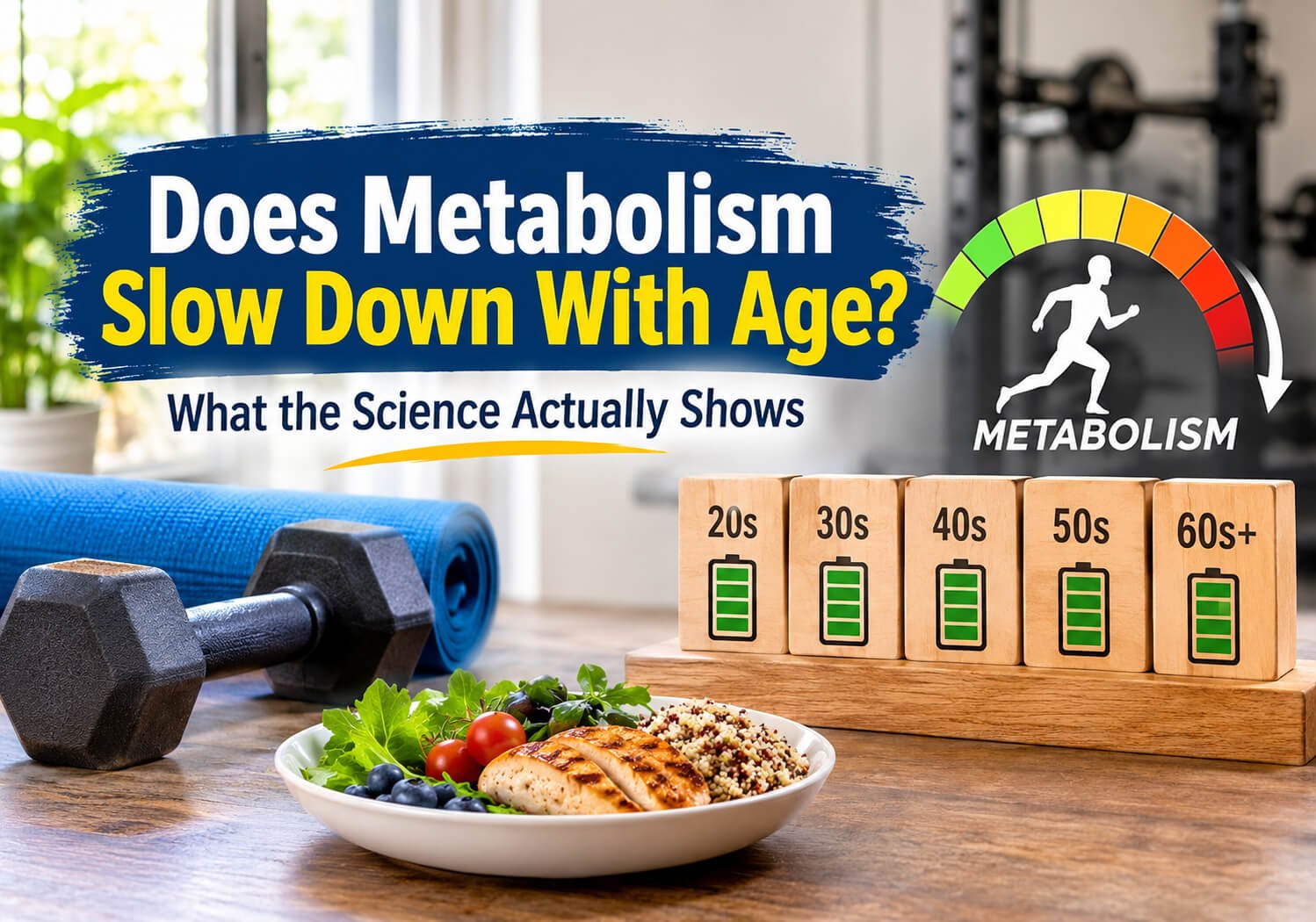
When clients walk into my coaching office in their 40s, 50s, and beyond, they almost always share a common frustration. They notice that the exact same diet and exercise routine that kept them lean in their twenties no longer works, leading many to wonder: does metabolism slow down with age? It is one of the most persistent fitness myths that aging automatically condemns us to an unstoppable metabolic slowdown and inevitable weight gain. As a coach who has spent over a decade helping clients navigate midlife body composition changes, I hear this concern daily. Fortunately, landmark physiological research reveals a much more empowering reality about how our internal engines operate over time. Understanding the exact mechanisms of metabolic aging allows you to take back control, build sustainable strength, and maintain peak vitality through every decade of life.
Quick Answer
Landmark research published in Science shows that your metabolic rate remains remarkably stable from age 20 to 60 before experiencing a gradual, natural decline of about 0.7% per year. Much of the perceived slowdown with age stems from declining muscle mass, lower daily movement (NEAT), and reduced structured exercise rather than an irreversible cellular failure.
What the Science Says About Aging and Metabolism
For generations, conventional wisdom assumed that once you hit middle age, your cellular engine simply began to idle at a fraction of its former speed. People blamed mysterious hormonal shifts and inevitable physiological decay for unwanted weight gain. However, a massive global study published by Pontzer et al. in Science shattered these old assumptions by analyzing the total energy expenditure of over 6,400 people ranging from newborns to 95 years old.
The researchers discovered that after adjusting for body size and lean mass, our basal energy expenditure is rock-solid throughout young adulthood and middle age. Specifically, resting metabolic rate stays remarkably consistent between the ages of 20 and 60. The real metabolic shifts do not even begin in earnest until after age 60, and even then, the decline averages less than 1% per year.
This means that if you are 45 years old, your internal metabolic machinery is operating at nearly the same efficiency as it did when you were 25. When individuals experience midlife weight gain, it is rarely a sudden collapse of cellular chemistry. Instead, it is usually the downstream result of lifestyle shifts: sitting longer at a desk, sleeping fewer hours, letting muscle mass slowly atrophy, and eating processed foods that disrupt natural satiety cues. To understand why your body changes, you must examine how your total daily caloric burn is actually distributed.
The Four Pillars of Total Daily Energy Expenditure
Your body burns calories through four distinct mechanisms, collectively known as Total Daily Energy Expenditure (TDEE). Knowing how these four pillars function helps you pinpoint exactly where your daily energy output might be slipping.
| Energy Expenditure Pillar | Percentage of Daily Burn | What It Controls |
| Basal Metabolic Rate (BMR) | 60% – 75% | Breathing, blood circulation, cell repair, organ function at rest. |
| Non-Exercise Activity (NEAT) | 15% – 30% | Fidgeting, walking to your car, standing, gardening, daily chores. |
| Thermic Effect of Food (TEF) | ~10% | Energy required to chew, digest, absorb, and process nutrients. |
| Exercise Activity (EAT) | 5% – 15% | Structured workouts, weightlifting sessions, intentional cardio. |
As we age, subtle changes occur across these four pillars. While BMR remains stable for decades, people tend to unconsciously reduce their NEAT. You might take 3,000 fewer steps per day than you did in college, sitting in meetings or working from a home office. Over a week, that drop in spontaneous movement accounts for hundreds of unburned calories. Furthermore, as muscle mass naturally declines—a process known as sarcopenia—your BMR edges downward because muscle tissue requires more energy to maintain than fat tissue.
Recognizing what affects metabolism and body weight gives you the roadmap to counteract these natural tendencies. By intentionally increasing your protein intake, you can elevate the thermic effect of food while protecting your precious lean tissue.
The Muscle Factor: Why Muscle Mass Dictates Metabolic Health
Muscle tissue is your body’s primary metabolic engine. Pound for pound, active muscle tissue burns significantly more calories at rest than fat tissue, keeping your resting metabolic rate robust. Unfortunately, beginning around age 30, adults who do not engage in regular resistance training can lose 3% to 8% of their muscle mass per decade.
This gradual loss of muscle is insidious because it often happens quietly behind the scenes. Scales may show the exact same total body weight, but internal body composition shifts unfavorably as muscle is replaced by visceral and subcutaneous fat. Because fat tissue has a much lower metabolic demand, your overall daily caloric expenditure drops. This is why two people weighing 160 lb [72.6 kg] can have vastly different daily calorie burn rates: the person with higher lean muscle mass burns considerably more energy while sitting on the couch.
To prevent this metabolic drift, progressive resistance training is non-negotiable. Lifting weights signals your body to retain and build muscle proteins, keeping your hormonal profile optimized and your metabolic fires burning bright. When you combine smart lifting with a tailored approach to how to support metabolism naturally for weight management, you neutralize age-related muscle loss entirely.
Practical Action Plan: Strength Training to Fight Metabolic Slowdown
Building and preserving muscle requires stimulus, tension, and progressive overload. You do not need to live in a commercial gym for two hours a day, but you do need to challenge your muscles with compound movements that recruit large muscle groups. Below is a foundational lower-body and core strength routine designed to stimulate muscle protein synthesis, elevate your heart rate, and protect your metabolic rate.

The Metabolic Preservation Strength Circuit
Perform this routine 3 times per week on non-consecutive days (e.g., Monday, Wednesday, Friday). Rest for 60 to 90 seconds between sets.
- Dumbbell Goblet Squat
- Sets & Reps: 3 sets of 10–12 repetitions.
- Tempo: 3 seconds down, 1-second pause at the bottom, explosive drive up.
- Weight Guidance: Choose a dumbbell that feels challenging by rep 10 (e.g., 20 lb to 40 lb [9 kg to 18 kg]).
- Form Cues: Hold the dumbbell vertically against your chest like a chalice. Keep your chest tall, drive your knees outward in line with your toes, and sit your hips back as if lowering into a chair positioned 16 inches [40.6 cm] behind you.
- Regression (Easier): Box Squat—sit down completely onto a sturdy bench or chair, pause for one second, and stand back up.
- Progression (Harder): Pause Goblet Squat—hold the bottom position for a full 3 seconds before ascending.
Coach’s Tip
When executing lower-body lifts like squats or deadlifts, focus on exhaling forcefully as you push through the floor. This stabilizes your core intra-abdominally and protects your lower spine, allowing you to recruit maximum muscle fibers safely.
Common Mistake
Rushing through repetitions using momentum rather than muscular control. Always maintain a strict eccentric (lowering) phase. Slowing down the lowering portion creates microscopic muscle tension that drives the adaptation needed to preserve metabolic tissue.
- Dumbbell Romanian Deadlift (RDL)
- Sets & Reps: 3 sets of 10–12 repetitions.
- Tempo: 3 seconds lowering, smooth reversal, 2 seconds rising.
- Weight Guidance: Moderate to heavy dumbbells (e.g., two 25 lb to 45 lb [11.3 kg to 20.4 kg] dumbbells).
- Form Cues: Stand tall with feet hip-width apart. Keep a soft bend in your knees (about 15 degrees) and hinge strictly at your hips, pushing your glutes back toward the wall behind you. Slide the dumbbells down the front of your thighs until you feel a deep stretch in your hamstrings.
- Regression: Bodyweight Hip Hinge—practice the movement pattern using a PVC pipe or broomstick along your spine to groove the hip hinge mechanics.
- Progression: Single-Leg Dumbbell RDL—perform the movement on one leg to challenge balance and stabilizer muscles.
Nutrition, Protein, and Calorie Adjustments for Midlife
As physical activity patterns shift and natural hormonal landscapes evolve, your nutritional strategy must adapt accordingly. Many adults make the mistake of slashing calories drastically when they notice weight creeping up. Severe caloric restriction triggers a survival response, causing your body to downregulate non-essential energy expenditure, sacrifice muscle tissue, and cling stubbornly to fat stores.
Instead of starving your system, focus on nutrient density and strategic macronutrient distribution. Protein is your greatest metabolic ally. The thermic effect of protein means your body burns roughly 20% to 30% of protein calories just processing the nutrient, compared to only 5% to 15% for carbohydrates and fats. Furthermore, adequate daily protein intake is vital for maintaining lean body mass as you age.
- Prioritize High-Quality Protein: Aim for roughly 0.8g to 1.0g of protein per pound of target body weight daily, spread evenly across 3 to 4 meals.
- Embrace Whole, Fiber-Rich Foods: Vegetables, legumes, and whole grains provide essential micronutrients and support healthy gut microbiota, which research links to metabolic efficiency.
- Maintain Hydration: Mild dehydration impairs cellular energy production and can mask itself as fatigue or false hunger cues.
By combining smart nutrition with an understanding of how to increase metabolism naturally after 40, you create a sustainable physiological environment where your body burns energy efficiently without extreme dieting.
Safety Notes and When to Consult a Professional
Before launching into a new heavy resistance training program or altering your daily caloric intake significantly, safety always comes first. If you manage chronic conditions such as osteoarthritis, cardiovascular disease, severe hypertension, or metabolic disorders like type 2 diabetes, schedule a thorough checkup with your physician or physical therapist.
A qualified medical professional or sports dietitian can run comprehensive blood panels—checking thyroid function, fasting glucose, lipid panels, and key vitamin levels—to rule out underlying medical causes for fatigue or stubborn weight plateaus. Exercise and proper nutrition are powerful tools, but they should always be implemented in collaboration with your healthcare provider when managing preexisting health conditions.
Frequently Asked Questions
At what age does metabolism actually start to slow down?
Extensive scientific data demonstrates that basal metabolic rate remains remarkably stable between ages 20 and 60. The biological slowdown does not begin in earnest until after age 60, where it declines by roughly 0.7% per year. Most midlife changes in weight are driven by lifestyle factors like reduced daily movement and muscle loss.
Can you reverse a slow metabolism as you get older?
Yes. Because much of the perceived metabolic slowdown is caused by loss of muscle mass and decreased daily activity rather than permanent cellular failure, you can actively boost your daily energy expenditure. Engaging in progressive resistance training, increasing daily step counts, and eating adequate protein will reignite your metabolic capacity.
Does building muscle really boost your resting metabolic rate?
Absolutely. Muscle tissue is metabolically active and requires calories to maintain itself 24/7. Adding 3 lb [1.4 kg] to 5 lb [2.3 kg] of lean muscle mass through structured strength training increases your baseline caloric expenditure, making weight management significantly easier over the long term.
Why do women notice more metabolic changes in their 40s and 50s?
The transition through perimenopause and menopause brings shifts in estrogen and progesterone, which often promote visceral fat storage and changes in sleep quality. Poor sleep and hormonal shifts can increase appetite-regulating hormones and reduce spontaneous daily movement, indirectly slowing down total daily energy expenditure.
How much protein do I need daily to protect my metabolism?
To preserve lean muscle tissue and support muscle protein synthesis as you age, research suggests consuming between 0.8g and 1.0g of protein per pound [1.8g to 2.2g per kg] of body weight daily. Distributing this protein evenly across your meals maximizes muscle repair and keeps your metabolism functioning smoothly.
Conclusion
The fear that your metabolism is doomed to fail as you age is entirely unfounded. While biological shifts do occur later in life, your daily habits—how much muscle you build, how many steps you take, and how you fuel your body—play the dominant role in your metabolic health. By swapping crash diets for consistent strength training, prioritizing protein, and moving your body daily, you can keep your internal engine humming efficiently through every chapter of your life.