Green tea extract shows up in fat burners, pre-workouts, and “metabolism boosters” with big promises on the label. So how does green tea extract support metabolism, and does it matter enough to spend your money on? Research suggests the effect is real but small, and it comes with safety questions that a cup of tea does not.
As a coach, I want you to know exactly what you’re buying. This guide covers what the studies found, how green tea compares with concentrated extract, who should skip it, and the daily habits that move the needle far more. Please check with your doctor before taking any supplement.
Quick Answer: Green tea extract contains catechins and caffeine, which may have a modest effect on body weight. Studies show small differences at best, and results vary by product and activity level. Liver injury has been reported mainly with extract capsules, not brewed tea, so talk with your doctor before trying it.
How Does Green Tea Extract Support Metabolism? The Short Version
Your metabolism is the total energy your body burns in a day. It includes the energy you use at rest, the energy you spend digesting food, and the energy you burn through movement. Green tea extract tries to nudge that total upward a little.
The National Center for Complementary and Integrative Health (NCCIH) says catechins and caffeine in green tea may have a modest effect on body weight, and that results depend on the product’s makeup and the person’s activity level. Notice the careful words: “may,” “modest,” and “depends.”
That is the honest starting point. Green tea extract is not a switch that turns on fat burning. It is, at best, a small helper that works inside a bigger routine.
What is in green tea extract?
Green tea extract is a concentrated form of the plant. The two ingredients that matter most for metabolism claims are catechins and caffeine. NCCIH notes that green tea contains caffeine, and that some weight loss products combine green tea with other ingredients.
That last point is important. A bottle labeled “green tea fat burner” may hold several stimulants, so you may not know which ingredient is doing what.
Where caffeine fits in
Caffeine is the easiest part of the story to measure. The NIH Office of Dietary Supplements (ODS) professional review reports that a 100 mg dose of caffeine raised energy use by about 9.2 calories per hour for three hours or more in healthy people, compared with placebo.
That is a small bump, similar to the energy in a few bites of fruit. It also comes with possible sleep trouble, nervousness, and jitteriness, which can cancel out any benefit if you sleep badly.
What the Studies Actually Found
Let’s look at the numbers. They explain why scientists and health agencies use cautious language.
The big review of 14 trials
The ODS review describes a Cochrane review of 14 trials with 1,562 participants. It found about 0.95 kg (2.1 lb) more weight loss with green tea than with placebo. That is less than a pound of difference per month if it happened over a few months, and the trials did not all last the same time.
The same review adds an important detail: six of the studies done outside Japan showed no significant difference. So the benefit may not show up equally in every population.
Catechins plus caffeine
Two more analyses in that review looked at the catechin and caffeine combination. A meta-analysis of 15 trials found catechins plus caffeine cut weight by about 1.38 kg (3.0 lb) compared with caffeine alone. A separate meta-analysis of 11 trials found EGCG plus caffeine led to about 1.31 kg (2.9 lb) more weight loss, per the ODS professional fact sheet.
These findings are more encouraging than the first, but they still amount to a few pounds in studies. None of them show dramatic fat loss.
What the NIH consumer page concludes
The ODS consumer sheet says green tea might help you lose a small amount of weight. It also draws a clear line: drinking green tea is safe, but taking green tea extract might not be. We’ll look at why in the safety section.
NCCIH’s separate weight control page goes further in its caution. It lists green tea extracts among ingredients that have been studied but not shown to be effective for weight loss, and says each has side effects. Agencies describe the evidence differently, so the safe reading is “small and uncertain.”
Does green tea add anything to exercise?
This is a question I get from gym-goers a lot. A 2024 systematic review and meta-analysis in the Journal of the International Society of Sports Nutrition pooled 10 randomized trials with 476 participants. It compared exercise plus green tea with exercise plus placebo in people with overweight or obesity.
The authors found small differences in weight, BMI, and fat in favor of green tea. They concluded that green tea could have “quite minimal additive benefit” over weight loss from exercise alone, and that green tea did not improve blood fats beyond what exercise did. They also noted the evidence is limited and needs more research.
Put simply, if you already train and eat well, green tea extract is unlikely to be the reason you see change.
How Does Green Tea Extract Support Metabolism in Real Life? Setting Expectations
Numbers from studies can feel abstract, so let’s translate them into everyday terms. The largest review above found roughly 0.95 kg (2.1 lb) of extra weight loss compared with placebo. The catechin-plus-caffeine analyses found about 1.3 to 1.4 kg (2.9 to 3.0 lb). Those are averages across many people, and the trials ran for different lengths of time.
That means some people in the studies lost more, some lost less, and some saw no difference. If a friend tells you green tea “melted” their belly fat, remember that their routine, sleep, and food changes probably did most of the work.
Why small effects get overhyped
Supplement marketing often takes a result that is real but tiny and describes it with big words like “clinically proven.” Here is how to read the claims with a coach’s eye:
- “Placebo-controlled” matters. It means the study compared the extract with a look-alike pill. A result only counts if the extract group did better than that comparison group.
- A meta-analysis combines many trials. That is useful, but if the trials are small or low quality, the combined result can still be shaky. The ODS review points out this problem with other ingredients, such as green coffee bean extract, where the pooled trials were poor quality.
- Statistical significance is not the same as importance. A difference can be real and still too small to notice on a scale or in the mirror. The Cochrane review of chromium, for example, was described by its authors as being of “debatable clinical relevance.” The same lens applies to green tea.
- Results may not carry across groups. In the green tea review, the six studies done outside Japan showed no significant difference. Be wary of claims that assume the same effect for everyone.
A realistic way to think about it
Picture a three-legged stool. The three legs are food, training, and recovery (sleep and stress). Green tea extract, at best, is a small cushion on the seat. If one of the legs is missing, no cushion will keep the stool from tipping over.
The ODS consumer page says the same thing in plain language: the proven ways to lose weight are eating healthful foods, cutting calories, and being physically active. It also advises following a healthy eating pattern, reducing calories, and exercising regularly with the guidance of your health care provider.
Common myths, checked against NIH sources
Myth: “Natural means safe.” NCCIH says “natural” does not necessarily mean “safe.” The liver cases tied to green tea extract are a good example.
Myth: “A fat burner works without diet or exercise.” The ODS professional review says claims like “lose weight without dieting or exercising” are usually too good to be true, and the consumer page says if a claim sounds too good to be true, it probably is.
Myth: “More caffeine means more fat loss.” Caffeine’s calorie-burning bump is small, about 9.2 calories per hour from a 100 mg dose in the review above. Meanwhile, higher amounts raise the odds of sleep trouble, nervousness, and jitteriness, and the NIH sources describe 400 to 500 mg a day as the upper end for healthy adults.
Myth: “If one cup helps, five capsules help more.” Concentrated extract is where the liver reports come from. More is not better, and it may be worse.
A four-week experiment if you’re curious
If your doctor says drinking green tea is fine for you, you can run a simple test. Change only the tea, so you can tell what is working.
| Week | What to do | What to track |
| 1 | Replace one sugary drink a day with unsweetened green tea | Bedtime, sleep quality, energy 1-10 |
| 2 | Keep the tea; add a 10-minute walk after a meal | Steps or minutes walked, hunger |
| 3 | Keep both; add two strength sessions | Weights lifted, soreness, mood |
| 4 | Review the notes and your waist measurement | Did anything change? What helped? |
You will probably find that the walking and lifting changed more than the tea did. That is useful information, and it costs you nothing. Keep the notes in your phone or a small notebook, because they also give your doctor a clear picture if you ever decide to ask about stronger options.
Quick Comparison: Green Tea vs. Green Tea Extract
| Feature | Brewed green tea | Green tea extract capsule or powder |
| Form | Drink | Concentrated pill, powder, or liquid |
| Evidence for weight | Small effect at most | Small effect at most |
| Safety record per NIH/NCCIH | No safety concerns reported for adults drinking it | Liver injury reported, mainly with extracts |
| Caffeine amount | Varies by tea and brew time | Varies by product; check the label [VERIFY on each label] |
| Other benefits | Hydration, routine, flavor | Convenience |
| Best for | Most healthy adults | Only people cleared by their doctor |
Safety: The Part Labels Don’t Mention
Safety is where tea and extract part ways, so read this section carefully.
Liver concerns
NCCIH reports that liver injury from green tea is uncommon, but has been reported, mainly with extract tablets or capsules. It adds that people with a specific immune-related gene variant, found in about 5 to 15 percent of Americans, appear more susceptible.
The ODS professional review adds more detail. In the Minnesota Green Tea Trial, liver enzymes rose significantly in people taking the extract. The U.S. Pharmacopeia (USP) judged that green tea probably caused 7 cases of liver damage and possibly caused 27 more, according to the ODS review.
Most people will never have a problem. But because you cannot predict who will, many experts advise caution with concentrated products.
Common Mistake: Taking extract on an empty stomach, doubling the dose “to speed things up,” or stacking it with other fat burners. If you notice dark urine, yellow skin or eyes, severe stomach pain, or unusual tiredness, stop and call your doctor right away.
Caffeine limits
Because many extracts also contain caffeine, add it to your daily total. The ODS review says the FDA and the European Food Safety Authority state that up to 400 mg a day does not raise safety concerns for healthy adults. The American Medical Association suggests a limit of 500 mg.
Coffee, soda, energy drinks, and pre-workouts all count. If you drink two coffees and take a caffeinated extract, you may go over without noticing.
Pregnancy and breastfeeding
NCCIH says pregnant people should keep caffeine to moderate levels, and that high caffeine intake while breastfeeding can make infants fussy and disrupt their sleep. If you are pregnant, planning to be, or nursing, talk with your doctor before using any extract.
Label accuracy
NCCIH warns that labels may not match contents in weight loss supplements. Analyses have found differences between what is listed and what is inside, and the FDA has found weight loss products tainted with prescription drug ingredients. The same page reminds readers that “natural” does not necessarily mean “safe.”
How to Use Green Tea Wisely (If You Choose To)
Here is a simple, low-risk approach that I’d use with a client who asks about green tea. Check with your doctor first, especially if you take medicines or have a liver, heart, or blood pressure condition.
- Start with the drink, not the pill. Brewed tea has the safest track record in the NIH and NCCIH pages. Use water that is hot but not boiling, around 175°F (80°C), and steep for two to three minutes so it doesn’t turn bitter.
- Keep it early in the day. Caffeine can linger for hours. A cup in the morning or after lunch is easier on your sleep than one at night.
- Treat it as a swap, not an add-on. Replace a sugary drink with unsweetened green tea. The calorie saving is a sure benefit, even if the metabolic effect is small.
- Skip extracts unless a doctor agrees. If you and your doctor decide to try one, read the label for the amount of each ingredient, and avoid products that stack multiple stimulants.
- Give it a fair test, then re-check. Track your sleep, energy, and waist measurement for four weeks. If you feel worse or see nothing, stop.
Coach’s Tip: Pair your cup of tea with a habit you want to build, like a 10-minute walk after breakfast. The tea becomes a cue for movement, and the movement is what actually changes your body.
Questions to bring to your doctor
- Does anything I take interact with green tea or caffeine?
- Should I have my liver enzymes checked before and after starting an extract?
- Is my caffeine total from all sources safe for my heart and blood pressure?
The Real Metabolism Boosters: Muscle and Movement
If you want to know how to support metabolism, start with the habits that have strong evidence. The CDC adult physical activity guidelines call for at least 150 minutes of moderate-intensity activity each week, or 75 minutes of vigorous activity, or an equal mix. They also call for muscle-strengthening activity on at least two days a week that works all major muscle groups.
The CDC adds that doing more than those minimums provides even greater health benefits. That is a far better return than any capsule.
Strength training also builds and protects muscle, which is the tissue that helps your body use energy all day long. It makes stairs, groceries, and long days feel easier too.
Sample weekly plan
| Day | Activity | Time |
| Monday | Full-body strength | 35-40 min |
| Tuesday | Brisk walk | 30 min |
| Wednesday | Rest or easy stretching | 10-15 min |
| Thursday | Full-body strength | 35-40 min |
| Friday | Brisk walk or easy bike ride | 30 min |
| Saturday | Longer walk, hike, or favorite sport | 45-60 min |
| Sunday | Rest | – |
This schedule gives you about 150 minutes of moderate activity and two strength days. Adjust it to your current fitness level.
Full-body strength workout
Rest 60 to 90 seconds between sets. Choose a weight that leaves you about two reps short of failure, so the last reps are hard but your form stays clean.
| Exercise | Sets | Reps | Starting weight guide |
| Goblet squat | 3 | 10-12 | 10-25 lb (4.5-11 kg) dumbbell |
| One-arm dumbbell row | 3 | 10 each side | 10-20 lb (4.5-9 kg) |
| Incline push-up | 3 | 8-12 | Bodyweight |
| Romanian deadlift | 3 | 10 | 15-30 lb (7-14 kg) per hand |
| Plank | 3 | 20-40 sec | Bodyweight |
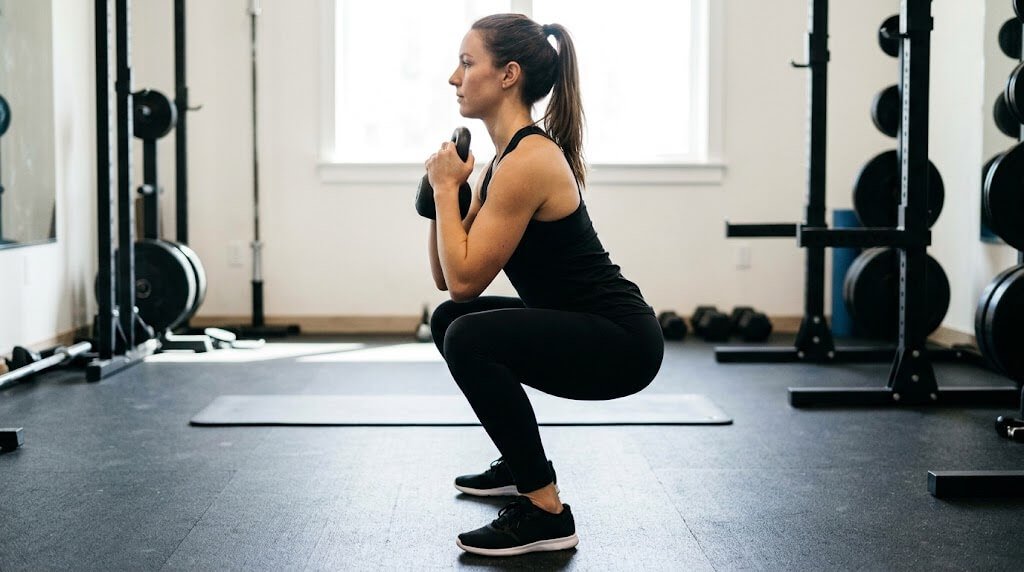
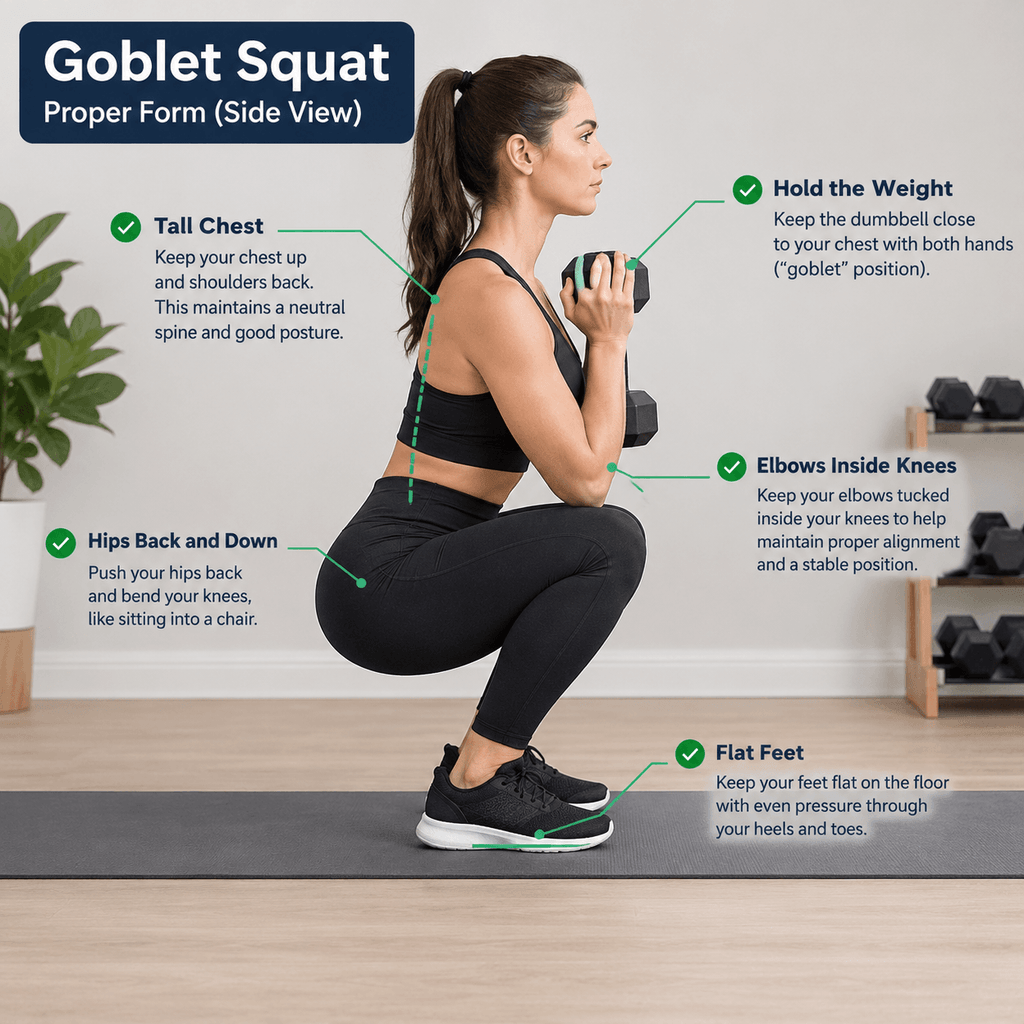
How the goblet squat should feel: Hold one dumbbell against your chest. Stand with your feet slightly wider than your shoulders and your toes turned out a little. Sit down between your hips, keep your chest tall, and push through your whole foot to stand. You should feel work in your thighs and glutes, not pinching in your lower back.
Easier version (regression): Squat to a bench or box, use no weight, and do 2 sets of 8. Raise your hands higher on a counter for push-ups, and hold the plank on your knees.
Harder version (progression): Add 5 lb (2.3 kg) once you finish every set with good form, lower for three seconds, or move to full push-ups and a full plank. After four weeks, add a fourth set to your big lifts.
Common Mistake: Rushing the lowering phase and letting your knees cave in. Slow down to a three-second descent, and think about pushing your knees gently toward your pinky toes.
[PHOTO: Dumbbell row set-up with a flat back, one hand on a bench, and the elbow pulling toward the hip]
Walking counts
A brisk pace is one where you can talk but not sing. Start with 20 to 30 minutes, which at a typical brisk speed covers roughly 1 to 1.5 miles (1.6 to 2.4 km). Add five minutes each week until you reach 45 minutes.
Who Should Skip Green Tea Extract or Ask First
Talk to your doctor before using green tea extract if any of these apply:
- You have liver disease, or a history of liver problems.
- You take prescription medicines, especially for blood pressure, heart rhythm, mood, or blood thinning.
- You are pregnant, planning to become pregnant, or breastfeeding.
- You have heart rhythm problems, anxiety, trouble sleeping, or high blood pressure.
- You have a history of an eating disorder. NCCIH notes that some people with eating disorders misuse weight loss supplements.
- You already drink a lot of coffee or energy drinks.
Also, tell every provider and your pharmacist about all supplements you take. Interactions are easy to miss when your care is split across several offices.
Related Tips for Metabolism and Steady Energy
A few smaller habits help more than most people expect.
Protect your sleep. Poor sleep makes you hungrier and more tired, which undoes the effort you put into training. Aim for a steady bedtime and a cool, dark room.
Eat protein at each meal. A palm-sized serving of eggs, fish, chicken, beans, or yogurt helps you feel full and supports muscle repair after workouts.
Keep your blood sugar steady. If you want to learn more about nutrients that relate to insulin, read our overview of inositol and insulin sensitivity studies. For another popular mineral, see our guide to chromium picolinate and glucose metabolism. Remember that the NIH weight loss review calls the weight effect of chromium very small.
Know what a pre-workout can and can’t do. Lifters often combine caffeine with blood-flow ingredients. To understand one of them, read how L-citrulline helps produce nitric oxide. It’s a different goal from fat loss, so keep the two ideas separate.
Try mindful eating. NCCIH notes that yoga and meditation, especially mindful eating, show emerging evidence as complements to other weight loss approaches. Slow down, notice your hunger, and stop when you feel satisfied.
FAQ
Does green tea extract burn fat?
It may help a little, but the effect is small. NCCIH says catechins and caffeine may have a modest effect on weight, depending on the product and your activity level. Reviews show a few pounds of difference at most, and exercise and food choices matter far more.
Is green tea extract safe?
It is safe for many people, but not for everyone. NCCIH says liver injury is uncommon but has been reported, mainly with extract capsules or tablets. The NIH consumer page says drinking green tea is safe, while extract might not be. Ask your doctor first.
Is brewed green tea better than green tea extract?
For most people, brewed tea is the safer choice. The NIH sources report liver injury mainly with concentrated extracts, and NCCIH reports no safety concerns for adults drinking green tea. The weight effect appears small for both, so the lower-risk option makes more sense.
Does green tea speed up your metabolism?
Slightly, at best. The caffeine in it can raise calorie burn a little for a few hours, with one NIH review citing about 9.2 calories per hour from 100 mg. That is tiny compared with the energy you burn from walking, lifting, and everyday movement.
Does green tea work better with exercise?
Not by much. A 2024 meta-analysis of 10 trials found exercise plus green tea gave only a minimal added benefit over exercise alone for weight and fat. Exercise remains the main driver. Think of tea as an optional extra, not a required part of your plan.
Who should avoid green tea extract?
Anyone with liver problems, pregnant or nursing people, and people on certain medicines should speak with a doctor first. Those sensitive to caffeine or with heart rhythm or blood pressure concerns should also be careful. Choose brewed tea if you are unsure, and keep total caffeine moderate.
Conclusion
So, how does green tea extract support metabolism? Its catechins and caffeine may give a modest nudge to body weight, but studies show small differences, and the benefit over good training is minimal. Concentrated extract also brings liver and label-accuracy concerns that a cup of tea does not.
If you enjoy green tea, drink it, ideally in place of a sugary beverage. Put your real effort into strength training twice a week, regular walking, protein at meals, and good sleep, and bring any supplement question to your doctor first.
This article is for general information and is not a substitute for advice from a doctor or physical therapist.