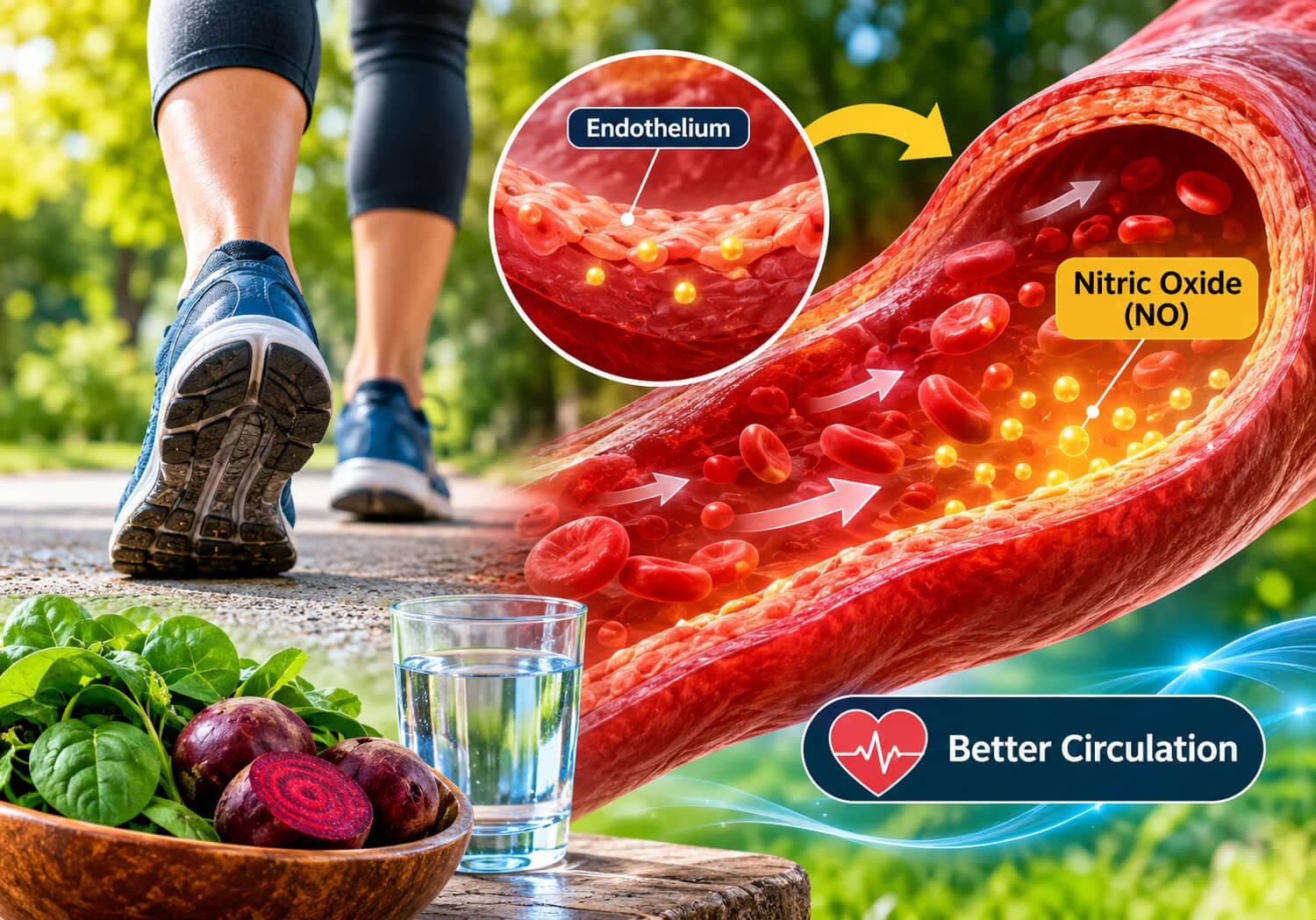
When you start moving your body, your working muscles immediately demand more oxygen and fuel. To meet that demand, your heart pumps faster and pushes blood through your arteries at a higher speed. That physical rush of blood against your artery walls is the exact trigger that answers how does regular exercise increase nitric oxide in blood vessels.
Many people think of nitric oxide purely as a pre-workout supplement ingredient for getting a better gym pump. In reality, your body is a powerful nitric oxide factory, and consistent physical training is the primary switch that keeps production running smoothly.
Understanding this biological process helps you train smarter, protect your heart, and improve your daily stamina. Let us break down what happens inside your arteries every time you lace up your shoes or pick up a pair of weights, and how you can structure your weekly workouts to maximize vascular health.
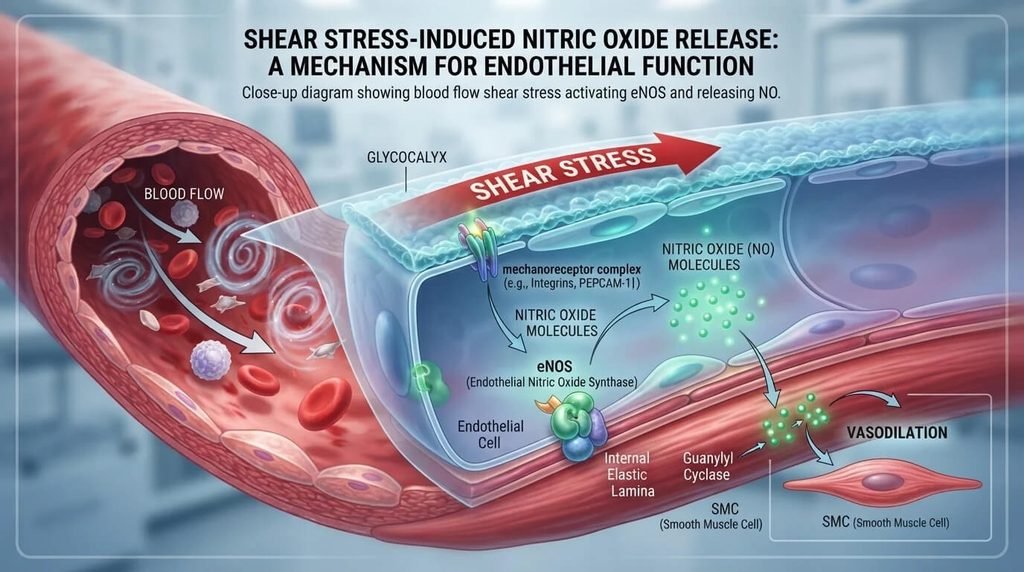
Quick Answer: Regular exercise increases nitric oxide in blood vessels by speeding up blood flow, which creates physical friction called shear stress against the inner artery lining (the endothelium). This friction activates an enzyme called endothelial nitric oxide synthase (eNOS), signaling your blood vessels to produce nitric oxide, relax, and widen for better circulation.
Detailed Explanation: How Does Regular Exercise Increase Nitric Oxide in Blood Vessels?
To understand how movement changes your blood vessels, you have to look at the microscopic lining inside every artery in your body. This single-cell layer is called the endothelium. Far from being a passive tube, the endothelium acts like a smart sensor that constantly monitors blood flow and pressure.
1. Blood Flow Speed and Hemodynamic Shear Stress
At rest, your heart pumps roughly 5 liters of blood per minute. During moderate-to-vigorous exercise, cardiac output can climb to 20 liters per minute or more, according to research on exercise physiology from the National Center for Biotechnology Information (NCBI).
As this surge of blood travels through your arteries, it drags along the surface of the endothelial cells. Scientists call this mechanical dragging force hemodynamic shear stress. Think of it like water rushing faster through a garden hose—the faster the flow, the more friction occurs along the inner walls.
2. Mechanotransduction and eNOS Activation
Endothelial cells are lined with tiny hair-like sensors and ion channels that detect this increase in shear stress. Through a process called mechanotransduction, the cells convert that physical friction into a chemical signal inside the cell.
This signal triggers an influx of calcium and activates an enzyme known as endothelial nitric oxide synthase (eNOS). Once switched on, eNOS takes an amino acid circulating in your blood called L-arginine, combines it with oxygen, and converts it into nitric oxide (NO) gas.
3. Smooth Muscle Relaxation and Vasodilation
Because nitric oxide is a gas, it diffuses quickly out of the endothelium and into the layer of smooth muscle wrapping around the outside of the blood vessel. Inside those muscle cells, nitric oxide activates another enzyme (guanylyl cyclase) to produce a messenger molecule called cyclic GMP (cGMP).
This molecule tells the vascular smooth muscle to let go of its tension. As the muscle relaxes, the artery widens—a process called vasodilation. Wider arteries mean lower resistance, healthier blood pressure, and rapid delivery of oxygen-rich blood to your working muscles.
4. Long-Term Structural Adaptations from Regular Training
A single workout gives you a temporary spike in nitric oxide that lasts for several hours. However, when you exercise regularly over weeks and months, your body makes permanent upgrades to this system:
- Increased eNOS Expression: Research published in PubMed Central (PMC) shows that consistent endurance training actually increases the total amount of eNOS enzyme stored inside your blood vessel walls.
- Reduced Oxidative Stress: Free radicals (reactive oxygen species) normally destroy nitric oxide before it can do its job. Regular exercise boosts your body’s natural antioxidant defenses, such as superoxide dismutase, which protects nitric oxide and extends its lifespan in your bloodstream.
- Improved Arterial Elasticity: Over time, repeated vasodilation keeps blood vessels flexible and prevents the arterial stiffening commonly seen with aging and sedentary habits.
Coach’s Tip: You do not need to crush yourself with grueling, breathless workouts to trigger shear stress. Simply elevating your heart rate into a steady, brisk pace where you can still hold a short conversation—often called Zone 2 cardio—creates plenty of laminar (smooth, directional) blood flow to stimulate eNOS production safely.
Comparing Exercise Types for Nitric Oxide Production
Different styles of training stress your cardiovascular system in unique ways. While aerobic exercise is the undisputed king of sustained shear stress, resistance training and interval work also play valuable supporting roles.
| Training Style | Primary Vascular Mechanism | Nitric Oxide Impact | Ideal Weekly Frequency | Best Examples |
| Moderate Aerobic (Zone 2) | Sustained, smooth laminar shear stress across large blood vessels | High (steady eNOS activation and long-term enzyme upregulation) | 3–5 sessions (30–45 mins each) | Brisk walking, cycling, jogging, swimming, rowing |
| High-Intensity Interval Training (HIIT) | Rapid spikes in cardiac output followed by recovery reperfusion | High (strong acute shear stress and arterial elasticity gains) | 1–2 sessions (15–25 mins each) | 30-second bike sprints, hill repeats, rowing intervals |
| Resistance Training | Rhythmic muscle contractions compressing and releasing blood vessels | Moderate (local microvascular dilation and reactive hyperemia) | 2–3 sessions (30–45 mins each) | Squats, push-ups, dumbbell rows, resistance band circuits |
| Mobility & Light Movement | Gentle blood flow elevation and reduction of vascular tension | Low to Moderate (maintains baseline circulation, prevents stagnation) | Daily (10–20 mins) | Easy walking, dynamic stretching, yoga flows |
According to the American Heart Association (AHA), combining at least 150 minutes of moderate aerobic activity with two days of muscle-strengthening work per week provides the strongest overall protection for your blood vessels.
How to Apply It: A Practical Weekly Routine to Maximize Nitric Oxide
Knowing the science behind how does regular exercise increase nitric oxide in blood vessels only helps if you put it into practice. Below is a balanced, practical weekly workout plan designed to stimulate both steady laminar shear stress and muscular blood flow without burning you out.
Weekly Schedule Overview
- Monday: 35-Minute Brisk Walk or Steady Cycling (Aerobic Shear Stress)
- Tuesday: Full-Body Strength & Blood Flow Circuit (30 Minutes)
- Wednesday: Active Recovery (20-Minute Easy Walk + Mobility)
- Thursday: 25-Minute Interval Cardio Session (HIIT Reperfusion)
- Friday: Full-Body Strength & Blood Flow Circuit (30 Minutes)
- Saturday: 45-Minute Moderate Endurance Session (Swim, Hike, or Bike)
- Sunday: Complete Rest or Light Stretching

Workout 1: The Steady Aerobic Session (Monday & Saturday)
This session focuses on keeping blood moving smoothly through your major lower-body arteries (femoral and iliac arteries) for an extended period.
- Warm-Up (5 minutes): Start at an easy pace. Let your heart rate climb gradually and focus on breathing deeply through your nose.
- Main Work (25–35 minutes): Increase your pace to a brisk walk at 3.5 to 4.0 mph (5.6 to 6.4 km/h), a steady bike ride, or an easy jog. You should be able to speak in short sentences, though singing would feel tough.
- Cool-Down (5 minutes): Slow your pace down gradually so blood does not pool in your lower legs.
Workout 2: Full-Body Resistance & Pump Circuit (Tuesday & Friday)
When large muscles contract and relax rhythmically, they act like secondary pumps that squeeze veins and push blood back toward the heart. Perform these four exercises as a circuit, moving from one to the next with minimal rest, then resting 90 seconds at the end of the round. Complete 3 to 4 rounds.
1. Goblet Squat
- Target Muscles: Quadriceps, glutes, hamstrings, core.
- Sets & Reps: 3–4 sets of 12–15 reps.
- Weight Guidance: Start with a 15–25 lb (7–11 kg) dumbbell or kettlebell.
- Tempo & Rest: Lower for 3 seconds, pause 1 second at the bottom, drive up in 1 second. Move straight to the next exercise.
- Form Cues: Hold the weight tight against your chest with elbows tucked down. Keep your feet shoulder-width apart, push your hips back, and sit between your knees while keeping your chest proud. You should feel steady tension across your thighs and glutes without your heels lifting off the floor.
- Regression (Easier): Bodyweight box squat to a 16-inch (41 cm) chair or bench.
- Progression (Harder): Barbell front squat or add a 3-second pause at the bottom of every rep.

2. Incline or Floor Push-Up
- Target Muscles: Pectorals, front deltoids, triceps, core.
- Sets & Reps: 3–4 sets of 10–15 reps.
- Tempo & Rest: Lower for 2 seconds, push up smoothly in 1 second. Move straight to the next exercise.
- Form Cues: Place your hands slightly wider than shoulder-width apart. Brace your abs and squeeze your glutes so your body forms a straight line from head to heels. Lower your chest until your upper arms are parallel to the floor, keeping your elbows angled back at about 45 degrees rather than flared out wide.
- Regression (Easier): Place your hands on a sturdy bench or countertop at a 24-to-30-inch (61-to-76 cm) height.
- Progression (Harder): Elevate your feet on a 12-inch (30 cm) step or wear a weighted vest.
3. Bent-Over Dumbbell Row
- Target Muscles: Latissimus dorsi, rhomboids, rear deltoids, biceps.
- Sets & Reps: 3–4 sets of 12 reps per arm.
- Weight Guidance: Start with 15–30 lb (7–14 kg) dumbbells.
- Tempo & Rest: Pull for 1 second, squeeze at the top for 1 second, lower for 2 seconds. Move straight to the next exercise.
- Form Cues: Hinge forward at your hips until your torso is at a 45-degree angle, keeping your spine flat. Pull the dumbbells toward your hip pockets rather than your armpits, driving your elbows behind your back. You should feel a strong squeeze between your shoulder blades.
- Regression (Easier): Single-arm dumbbell row supported with one hand and knee on a flat bench.
- Progression (Harder): Chest-supported double dumbbell row with a 2-second hold at the peak contraction.
4. Reverse Lunge to Knee Drive
- Target Muscles: Glutes, quadriceps, hamstrings, calves.
- Sets & Reps: 3–4 sets of 10 reps per leg.
- Weight Guidance: Bodyweight or hold a pair of 10–20 lb (4.5–9 kg) dumbbells at your sides.
- Tempo & Rest: Step back for 2 seconds, drive up in 1 second. Rest 90 seconds after completing both legs before starting the next round.
- Form Cues: Step one foot straight back about 24 to 30 inches (61 to 76 cm) and lower your back knee until it hovers 1 to 2 inches (2.5 to 5 cm) above the floor. Push hard through your front heel to stand back up and bring your back knee forward to hip height.
- Regression (Easier): Stationary split squat holding onto a rack or wall for balance.
- Progression (Harder): Walking lunges across a 40-foot (12-meter) turf lane holding dumbbells.

Workout 3: Low-Impact HIIT Protocol (Thursday)
High-intensity intervals create rapid surges in blood velocity followed by brief periods of recovery, delivering a potent stimulus to your endothelium without requiring hours of training.
- Warm-Up (5 minutes): Easy pedaling on a stationary bike or brisk walking, gradually increasing speed in the final minute.
- Intervals (12 minutes): Perform 8 rounds of 30 seconds fast effort (8 out of 10 exertion) followed by 60 seconds easy recovery (3 out of 10 exertion).
- Cool-Down (5 minutes): Easy spinning or walking until your breathing returns to normal.
Common Mistake: Holding your breath during heavy strength exercises—known as the Valsalva maneuver—causes a sudden, massive spike in blood pressure that temporarily compresses blood vessels and disrupts smooth laminar flow. Always exhale smoothly as you push or pull the weight, and inhale as you lower it.
Nutrition and Lifestyle Habits That Support Exercise-Induced Nitric Oxide
Exercise acts as the spark plug for nitric oxide production, while your daily nutrition supplies the raw fuel. Pairing smart training with supportive lifestyle habits ensures your endothelium has everything it needs to respond to shear stress.
Eat Nitrate-Rich Whole Vegetables
Your body actually has a backup pathway to make nitric oxide that does not rely on the eNOS enzyme. When you eat vegetables high in natural dietary nitrates, beneficial bacteria on your tongue convert those nitrates into nitrites, which your stomach and blood vessels then turn into nitric oxide.
Research from the National Institutes of Health (NIH) highlights that dietary nitrates work alongside exercise to lower the oxygen cost of physical activity and improve blood flow efficiency. Top whole-food sources include:
- Arugula and spinach
- Beetroot and beet juice
- Swiss chard and kale
- Celery and radishes
Protect Your Oral Microbiome
Because friendly bacteria in your mouth are essential for converting dietary nitrates into usable nitric oxide, using harsh antibacterial mouthwash right before or after workouts can blunt the blood-pressure-lowering benefits of exercise. Stick to standard brushing and flossing, and save strong antiseptic rinses unless prescribed by your dentist.
Prioritize Quality Sleep and Daily Movement
Poor sleep increases cortisol and systemic inflammation, both of which generate free radicals that break down nitric oxide prematurely. If you struggle with restless nights, understanding how sleep affects metabolism and hormonal recovery can help you build a better evening routine.
Additionally, sitting uninterrupted for eight hours a day causes blood flow in your legs to stagnate, temporarily reducing endothelial function. Standing up to walk for just two to three minutes every hour keeps baseline shear stress active throughout the workday.
Stay Hydrated and Support Overall Metabolic Health
Blood volume depends directly on your hydration status. When you are dehydrated, your blood becomes thicker and harder for your heart to pump smoothly, reducing the quality of shear stress along artery walls. Drink water consistently before, during, and after training.
Supporting your body’s broader cellular energy systems also helps maintain healthy blood vessels. Learning which nutrients support normal energy metabolism and focusing on boosting metabolic flexibility naturally creates an internal environment where oxidative stress stays low and vascular function thrives. For individuals exploring targeted nutrition, understanding how L-arginine supports blood flow alongside whole-food dietary choices can provide helpful context.

Safety Notes and Who Should Be Careful
While regular exercise is one of the safest and most effective ways to improve blood vessel health, sudden spikes in blood flow and heart rate require smart progression—especially if you are returning to fitness after a long break.
- Start Gradually: If you have been sedentary, begin with 15 to 20 minutes of easy walking three to four days a week before adding intervals or heavier weights.
- Watch for Warning Signs: Stop exercising immediately and seek medical attention if you experience chest tightness, unusual shortness of breath, dizziness, lightheadedness, or radiating pain in your arm, neck, or jaw.
- Check Medications: If you take blood pressure medications (such as ACE inhibitors, beta-blockers, or calcium channel blockers) or prescription nitrates for heart conditions, regular exercise can naturally lower your blood pressure further. Monitor how you feel when standing up quickly and talk with your prescribing physician about adjusting dosages safely over time.
Please consult with a doctor or physical therapist before starting a new exercise program, particularly if you have high blood pressure, cardiovascular disease, diabetes, or joint pain.
Related Tips to Get More Out of Every Workout
- Breathe Through Your Nose During Easy Cardio: Nasal breathing slows your respiratory rate, improves oxygen uptake, and naturally mixes small amounts of nitric oxide produced in your nasal sinuses into the air traveling to your lungs.
- Do Not Skip the Warm-Up: Giving your arteries five minutes of gradually increasing movement allows eNOS activation and vasodilation to ramp up smoothly before you hit peak effort.
- Focus on Consistency Over Intensity: Four 30-minute brisk walks every week will do far more for your endothelial health than one exhausting 90-minute workout followed by six days on the couch. If you are looking for sustainable ways to increase daily energy and stamina, steady aerobic consistency is always the foundation.
- Pair Cardio with Strength Training: Combining endurance work with resistance training addresses both large-vessel shear stress and local muscular capillary growth, giving you complete cardiovascular coverage. You can also explore practical strategies to support metabolism naturally as your fitness base grows.
Frequently Asked Questions
How does aerobic exercise stimulate nitric oxide release?
Aerobic exercise speeds up your heart rate and increases the volume of blood flowing through your arteries. This faster blood flow creates gentle mechanical friction called shear stress against the endothelium, which switches on the eNOS enzyme to convert L-arginine into nitric oxide gas, relaxing and widening your blood vessels.
Does strength training increase nitric oxide levels?
Yes, strength training increases nitric oxide, though through a slightly different mechanism than cardio. Rhythmic muscle contractions temporarily compress local blood vessels, and when the muscle relaxes between reps, blood rushes back into the tissue—creating a burst of shear stress that stimulates local nitric oxide release and improves microvascular circulation.
How long does it take for regular exercise to boost nitric oxide?
A single workout boosts nitric oxide production immediately, keeping blood vessels more relaxed for several hours afterward. However, long-term structural improvements—such as higher baseline levels of the eNOS enzyme and stronger natural antioxidant defenses—typically develop after 4 to 8 weeks of consistent weekly exercise.
What type of exercise increases nitric oxide the most?
Moderate-intensity aerobic exercise, such as brisk walking, cycling, swimming, or jogging for 30 to 45 minutes, increases nitric oxide the most reliably. This steady pace creates continuous, smooth laminar shear stress along artery walls without causing excessive oxidative stress, making it ideal for daily endothelial health.
Can walking increase nitric oxide in blood vessels?
Yes, brisk walking is an effective way to increase nitric oxide in blood vessels. Walking fast enough to elevate your heart rate and deepen your breathing increases blood velocity through your lower-body arteries, triggering enough shear stress to stimulate eNOS activity and improve vascular elasticity over time.
Why does nitric oxide decrease with age and how does exercise help?
As we age, natural eNOS enzyme activity declines and oxidative stress rises, breaking down nitric oxide faster and causing arteries to stiffen. Regular physical activity counteracts this decline by repeatedly stimulating shear stress, preserving eNOS enzyme levels, and boosting internal antioxidants that protect nitric oxide in the bloodstream.
Conclusion
Understanding how does regular exercise increase nitric oxide in blood vessels takes the mystery out of cardiovascular fitness. Every time you go for a brisk walk, ride a bike, or move through a controlled strength circuit, the faster flow of blood gently stimulates your endothelium to produce its own natural vasodilator.
You do not need expensive supplements or extreme routines to unlock these benefits. Focus on accumulating 150 minutes of moderate aerobic movement each week, add two days of full-body resistance training, eat plenty of nitrate-rich leafy greens, and stay consistent. Over time, your blood vessels will stay cleaner, more flexible, and better equipped to fuel every workout and daily task.