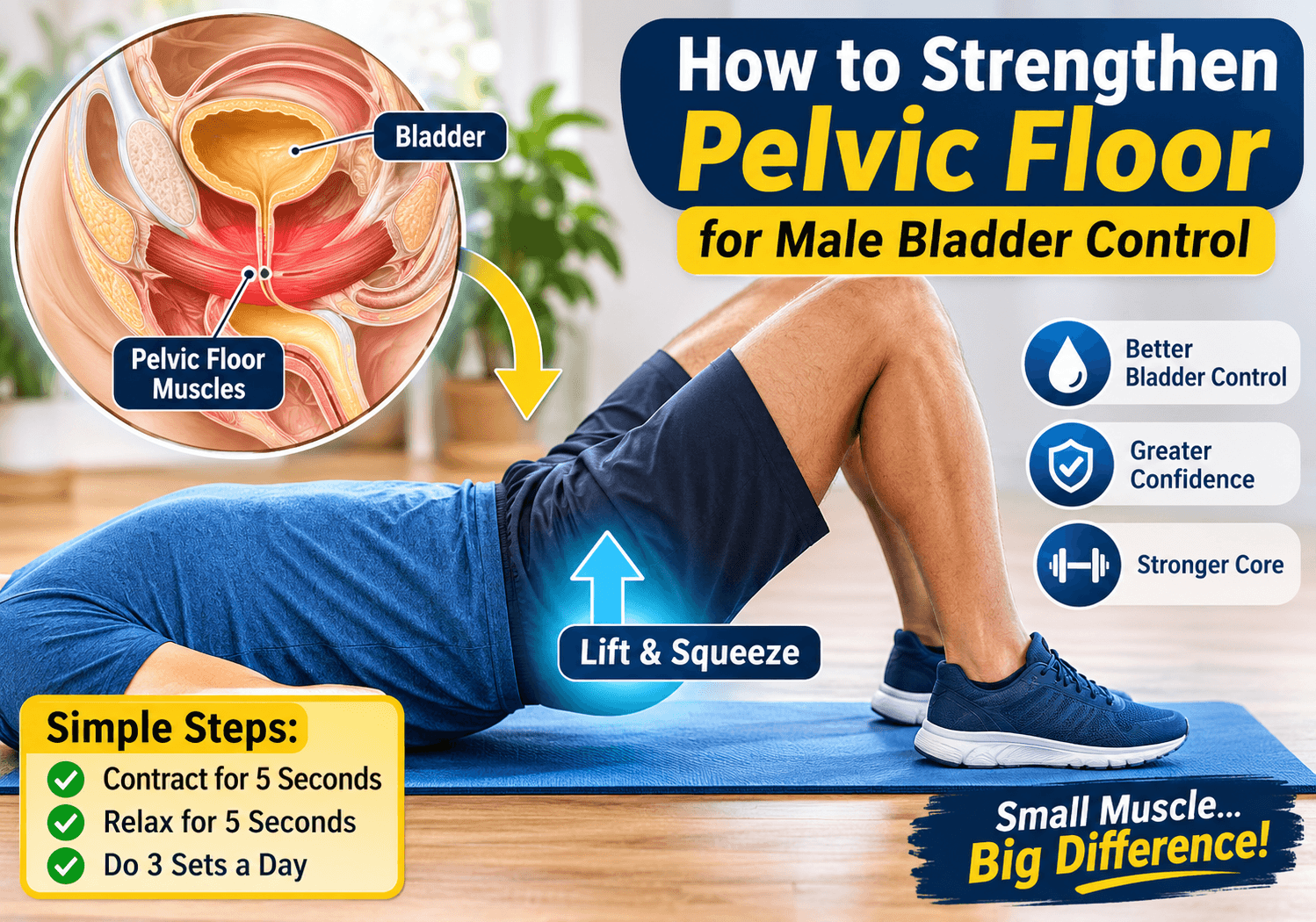
Losing a little control of your bladder doesn’t have to be something you just “live with.” Whether it’s a small leak when you cough, a sudden rush to find a restroom, or recovery after prostate surgery, the good news is that the muscles involved are trainable. Learning how to strengthen pelvic floor for male bladder control is one of the most practical, low-cost things a man can do for his daily comfort and confidence.
As a strength and conditioning coach, I’ve walked guys through pelvic floor work in the gym and at home. The exercises are simple, but the details matter a lot. Do them wrong, and you’ll waste weeks. Do them right, and most men notice a real difference in bladder control within four to eight weeks. This guide breaks down exactly what to do, how often, and how to progress safely.
Quick Answer: To strengthen your pelvic floor for better bladder control, perform Kegel exercises (concentric contractions of the pubococcygeus muscle) in sets of 10 reps, holding each squeeze for 5 seconds, 3 times per day. Add slow “reverse Kegels” for relaxation and a few core-stability moves. Most men see improvement in 4–8 weeks of consistent practice.
Muscles Worked: Primary and Secondary
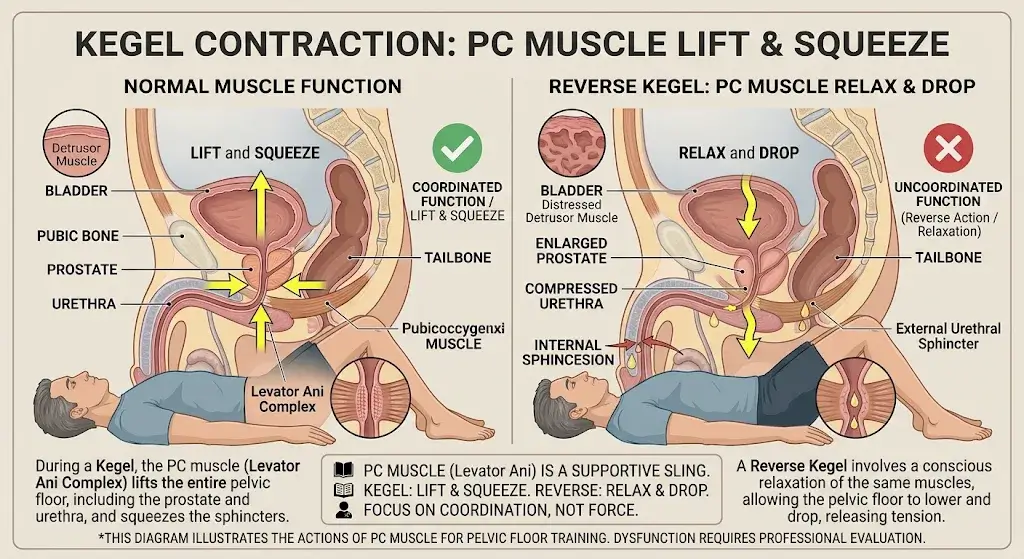
The pelvic floor isn’t one muscle. It’s a hammock of tissue that stretches from your pubic bone to your tailbone. For bladder control, a few specific structures do most of the work.
Primary muscles:
- Pubococcygeus (PC) muscle – the central band of the levator ani that wraps around the urethra and bladder neck. This is the muscle you squeeze in a standard Kegel.
- External urethral sphincter – a ring of muscle at the base of the bladder that you can voluntarily tighten to “hold it in.”
- Internal urethral sphincter – works involuntarily but benefits from the surrounding tissue being strong and well-supported.
Secondary / supporting muscles:
- Transverse abdominis – the deep “corset” muscle that works with the pelvic floor to manage intra-abdominal pressure.
- Diaphragm – proper breathing coordination (inhale = pelvic floor relaxes, exhale = pelvic floor engages) is critical.
- Gluteus maximus and hip adductors – strong glutes and inner thighs help stabilize the pelvis and reduce strain on the bladder.
Why Pelvic Floor Strength Matters for Bladder Control
A weak pelvic floor means less urethral closure pressure. When you cough, sneeze, lift a heavy box, or run, the pressure in your abdomen spikes. If the pelvic floor and sphincter can’t counter that pressure, a small amount of urine leaks. This is called stress incontinence, and it’s far more common in men than most realize—especially after 40 or following prostate procedures.
Research from the National Institute of Diabetes and Digestive and Kidney Diseases (NIDDK) confirms that pelvic floor muscle training is a first-line, non-surgical treatment for male urinary incontinence NIDDK – Urinary Incontinence in Men. A systematic review in the Cochrane Database of Systematic Reviews found that structured pelvic floor exercises reduced incontinence episodes in men after prostatectomy compared with no treatment Cochrane Review – Pelvic Floor Muscle Training for Male Incontinence.
Beyond incontinence, a well-trained pelvic floor supports:
- Better bladder capacity (you can wait longer between bathroom trips)
- Improved urine stream strength
- Reduced urgency and “rush” sensations
- Core stability that helps with lifting, running, and general posture
- Sexual function, including erectile support and ejaculatory control (which ties into broader men’s stamina and wellness habits)
The key word is consistent. One session won’t change anything. Think of it like building any other muscle: progressive overload, regular frequency, and patience.

Step-by-Step: How to Do Male Pelvic Floor Exercises (Kegels)
Before you start, you need to identify the right muscle. The simplest test: try to stop your urine mid-stream (do this only once as a test, not as a regular exercise). The muscle you use to do that is your PC muscle. You should also feel a slight lift and tightening low in the pelvis, not a squeeze in your belly, thighs, or buttocks.
Step 1 – Find a comfortable starting position.
Lie on your back with knees bent and feet flat on the floor, hip-width apart. This removes gravity and makes it easier to isolate the pelvic floor. Once the movement feels natural, progress to sitting, then standing.
Step 2 – Inhale and relax.
Take a slow breath in through your nose. As you inhale, let your pelvic floor drop and relax (this is a “reverse Kegel” or “give”). You should feel a gentle release, like the start of a bowel movement, without actually pushing.
Step 3 – Exhale and contract.
As you breathe out, squeeze and lift the PC muscle. Imagine you’re trying to stop urine and lift a marble up inside your pelvis. Hold the squeeze for 5 seconds while continuing to breathe gently.
Step 4 – Release fully.
Let go completely for 5 seconds. The relaxation phase is just as important as the squeeze. A pelvic floor that’s always tight is a dysfunctional pelvic floor.
Step 5 – Repeat.
Do 10 reps in a row. That’s one set. Rest 30 seconds, then do 2 more sets.
Step 6 – Add the “quick flick” variation.
After your 5-second holds, do 5 rapid squeezes (1 second on, 1 second off). These train the fast-twitch fibers that react to sudden pressure changes like a sneeze.
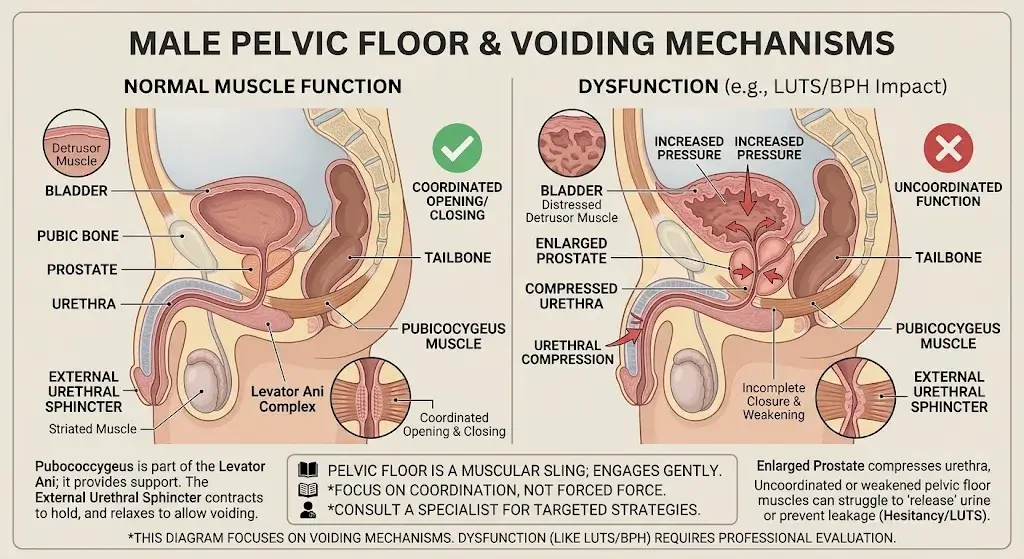
Coach’s Tip: Pair every Kegel with your exhale. If you’re holding your breath while squeezing, you’re spiking intra-abdominal pressure and actually working against yourself. Think “breathe out, squeeze up.” This diaphragm-pelvic-floor coordination is the single biggest upgrade you can make to your form.
Sets, Reps, and Progression by Goal
There’s no “weight” to load here, but you can progress by increasing hold time, adding resistance, and changing positions. Use this table as your training plan:
| Goal | Holds (sec) | Quick flicks (sec) | Sets | Frequency | Progression cue |
| Beginner / rehab (post-surgery, first 2–3 weeks) | 3 | 1 | 3 × 8 | 3×/day (morning, midday, evening) | Add 1 rep per week |
| Bladder control maintenance (4–8 weeks) | 5 | 1 | 3 × 10 | 3×/day | Add 1 sec to hold every 2 weeks |
| Advanced / sport-specific (8+ weeks, athletes, heavy lifters) | 8–10 | 1 | 4 × 10 | 3×/day + 1×/week “max squeeze” (10-sec hold) | Add external resistance (see Variations) |
| Reverse Kegel / relaxation (do alongside every session) | 5 (relax) | — | 2 × 10 | 3×/day | Focus on full release, not force |
Rest between sets: 30 seconds.
Rest between sessions: At least 4 hours (spread 3 sessions across the day).
Tempo: 2 seconds to contract, hold, 2 seconds to release. No jerking.
After 8 weeks, if you’re an athlete or someone who does heavy compound lifts (squats, deadlifts, overhead press), add a bracing cue: before you lift, take a small breath, engage your transverse abdominis, and maintain a gentle pelvic floor contraction through the rep. This protects the urethral sphincter under load.
Common Mistakes and Fixes
Even a simple exercise gets butchered. Here are the four mistakes I see most often:
| Mistake | What it feels like | Fix |
| Squeezing glutes or thighs | You feel your butt or inner thighs tighten | Lie down, place a hand on each glute. If your hand moves, you’re cheating. Focus on the “stop urine” sensation only. |
| Holding your breath | Your shoulders rise, your belly pushes out | Exhale slowly through pursed lips during the squeeze. If you can’t breathe, you’re going too hard. |
| Pushing down (bearing down) | You feel pressure in your perineum, like straining | This is the opposite of a Kegel. Practice the reverse Kegel first: inhale, let the pelvic floor drop. Then switch to the lift. |
| Doing it only once a day | You feel “fine” after a week but no real change | Three sessions per day is the minimum. Set phone alarms if you have to. Consistency beats intensity here. |
Common Mistake: Many men do 50 Kegels in a row at their desk and call it a day. The problem? They’re only training one fiber type and skipping the relaxation phase. A pelvic floor that’s chronically over-tightened can actually worsen urgency and frequency. Always include the reverse Kegel and the full 5-second release.
Variations: Easier to Harder
Regression (Easier) – “The 3-Second Lie-Down”
If you’re new to this or recovering from surgery, start here:
- Lie on your back, knees bent.
- Inhale and let the pelvic floor relax for 3 seconds.
- Exhale and gently squeeze for 3 seconds (think “lift a coin”).
- Release for 3 seconds.
- Do 5 reps, 2 sets, once a day.
- Progress to 3×/day after one week.
This removes gravity and makes it easy to feel the correct muscle.
Standard – “The 5-Second Sit”
- Sit in a chair with feet flat, back straight.
- Perform the full 5-sec hold / 5-sec release described in the Step-by-Step section.
- 3 × 10, three times per day.
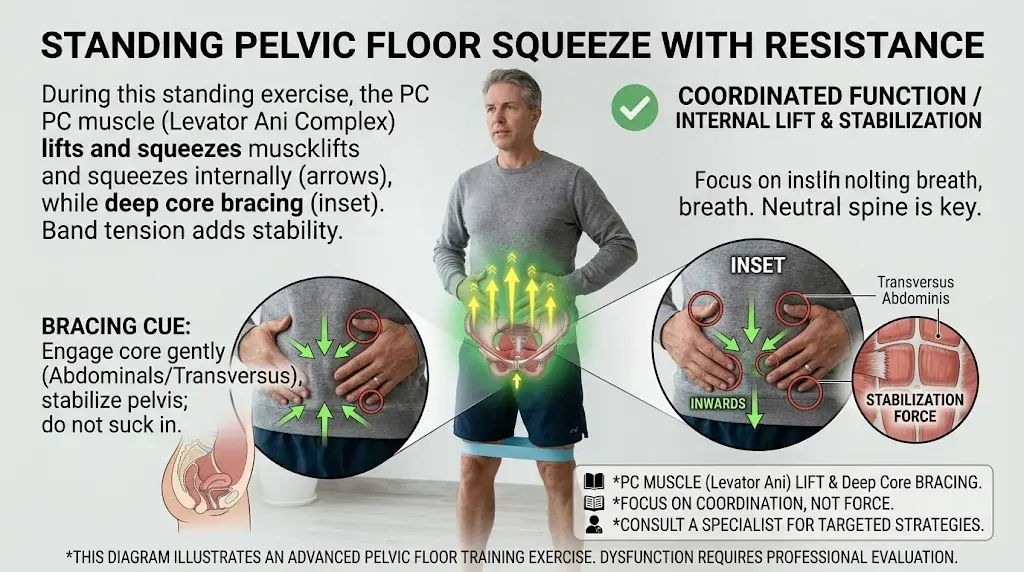
Progression (Harder) – “The Standing Squeeze + Load”
- Stand with feet hip-width, knees soft (not locked).
- Squeeze and lift the pelvic floor for 8–10 seconds while maintaining a neutral spine.
- Add a light resistance band (10–15 lb / 4.5–7 kg tension) around your thighs at knee height. As you squeeze the pelvic floor, gently press your knees outward against the band. This forces the adductors and pelvic floor to co-contract.
- Do 4 × 8, 3×/day.
Advanced – “The Max-Brace Hold”
- Stand holding a light dumbbell (5–10 lb / 2.3–4.5 kg) in each hand at your sides.
- Take a breath, brace your core (transverse abdominis + pelvic floor), and hold the full contraction for 10 seconds.
- Release. Rest 10 seconds.
- Do 5 reps. Perform this 1–2×/week as a “strength” day, separate from your daily Kegel sessions.
Alternatives and Complementary Exercises
Kegels are the core of the program, but they work best as part of a small routine that addresses the whole pelvic girdle. Here are four complementary moves you can do at home with no equipment:
1. Dead Bug (core stability)
- Lie on your back, arms reaching to ceiling, knees at 90°.
- Extend opposite arm and leg toward the floor while keeping your lower back pressed into the mat.
- 3 × 10 per side. This trains the transverse abdominis to work with the pelvic floor under load.
2. Glute Bridge
- Lie on your back, knees bent, feet flat.
- Drive through your heels and lift your hips to hip height. Squeeze glutes at the top.
- 3 × 12. Strong glutes reduce the load on the pelvic floor during daily movement.
3. Adductor Squeeze (with a ball or pillow)
- Sit or lie with a soft ball (or rolled towel) between your knees.
- Squeeze the ball for 5 seconds, release.
- 3 × 15. This activates the hip adductors that support the pelvic ring.
4. Diaphragmatic Breathing (reverse Kegel emphasis)
- Lie on your back, one hand on chest, one on lower belly.
- Inhale through the nose for 4 counts; let the belly and pelvic floor expand downward.
- Exhale through pursed lips for 6 counts; gently draw the pelvic floor up.
- 2 × 10 breaths. This is the “relaxation” counterpart to the Kegel and is critical for men with overactive bladder or urgency.
If you want a broader look at building natural stamina and energy that supports overall pelvic health, check out this guide on natural energy and stamina strategies.
Who Should Be Careful (and When to See a Doctor)
Pelvic floor exercises are low-risk, but they’re not a substitute for medical evaluation. See a urologist or pelvic floor physical therapist before starting this routine if:
- You’ve had prostate, bladder, or pelvic surgery in the last 6 weeks.
- You experience pain during urination, blood in your urine, or a weak/absent stream.
- You have a known neurological condition (spinal cord injury, multiple sclerosis, Parkinson’s).
- You’ve been told you have a pelvic organ prolapse or significant pelvic floor hypertonicity (a “too-tight” pelvic floor).
- Your incontinence is sudden, worsening, or accompanied by fever or back pain.
A pelvic floor physical therapist can use biofeedback (surface EMG or perineal probes) to confirm you’re contracting the right muscle and to assess whether your issue is under-active (needs strengthening) or over-active (needs relaxation work). This distinction matters because a hypertonic pelvic floor will worsen with aggressive Kegels.
For men navigating the broader health shifts that come after 40—including changes in bladder function, energy, and hormonal balance—this evidence-based overview of men’s health changes after 40 is a useful starting point for understanding what’s normal and what warrants a check-up.
Sample Weekly Pelvic Floor Workout for Bladder Control
Here’s a practical 7-day plan you can slot into your existing routine. Total time: 10–15 minutes per session.
| Day | Session | What to Do | Duration |
| Mon | AM | 3 × 10 Kegels (5-sec hold) + 2 × 10 reverse Kegels | ~5 min |
| Mon | PM | 3 × 10 Kegels + 3 × 10 quick flicks | ~5 min |
| Tue | AM | 3 × 10 Kegels + Dead Bug (3 × 10/side) | ~7 min |
| Tue | PM | 3 × 10 Kegels + Glute Bridge (3 × 12) | ~7 min |
| Wed | AM | 3 × 10 Kegels + Adductor Squeeze (3 × 15) | ~6 min |
| Wed | PM | 3 × 10 Kegels + Diaphragmatic Breathing (2 × 10) | ~5 min |
| Thu | AM | 3 × 10 Kegels + Standing Squeeze w/ band (3 × 8) | ~7 min |
| Thu | PM | 3 × 10 Kegels + reverse Kegels (2 × 10) | ~5 min |
| Fri | AM | 3 × 10 Kegels + Dead Bug (3 × 10/side) | ~7 min |
| Fri | PM | 3 × 10 Kegels + Glute Bridge (3 × 12) | ~7 min |
| Sat | AM | 4 × 10 Kegels (8-sec hold) + Max-Brace Hold (5 reps) | ~8 min |
| Sat | PM | Rest or gentle walk | — |
| Sun | AM | 3 × 10 Kegels + Diaphragmatic Breathing (2 × 10) | ~5 min |
| Sun | PM | Rest | — |
Progression rule: Every 2 weeks, add 1 second to your hold time (up to a max of 10 seconds). After 8 weeks, you can add a 4th daily session if you’re an athlete or do heavy lifting.
Coach’s Tip: Do your AM session right after you wake up, before you get out of bed. Lying down makes it easier to isolate the muscle, and you’re less likely to “forget” it. Set a phone alarm for your midday and evening sessions. Most men who stick to the 3×/day schedule report noticing fewer “near-miss” leaks within 3–4 weeks.
FAQ
How long do Kegel exercises take to work for men?
Most men notice a measurable improvement in bladder control within 4 to 8 weeks of doing 3 sessions per day. Full adaptation of the urethral sphincter and pelvic floor can take up to 12 weeks. Consistency matters more than intensity; missing sessions resets the clock.
How many Kegel reps should men do for bladder control?
Aim for 3 sets of 10 reps (5-second holds) plus 5 quick flicks, performed 3 times per day. That’s roughly 90 contractions per day. More isn’t better—overtraining the pelvic floor can lead to hypertonicity and worsened urgency.
Can Kegel exercises help after prostate surgery?
Yes. Pelvic floor muscle training is recommended by urologists as part of post-prostatectomy rehabilitation, typically starting 1–2 weeks after surgery once the catheter is removed. A pelvic floor physical therapist can tailor the program to your specific surgical approach (radical, laparoscopic, or robotic).
What if I can’t feel the right muscle to squeeze?
Try the “stop urine” test once (not repeatedly) to identify the PC muscle. If you still can’t isolate it, a pelvic floor physical therapist can use surface EMG biofeedback to show you exactly which muscles are firing. This is the fastest way to get the form right.
Do Kegel exercises work for men with overactive bladder (urge incontinence)?
They can help, but the approach is different. For urge incontinence, the emphasis shifts toward reverse Kegels, diaphragmatic breathing, and bladder retraining (gradually increasing the time between bathroom visits). A urologist or pelvic floor therapist can determine whether your incontinence is stress-type, urge-type, or mixed.
Should I do Kegels while lifting weights or running?
You don’t need to consciously squeeze during every rep, but a gentle “bracing” engagement (about 30% effort) before and during heavy lifts or high-impact running helps protect the urethral sphincter. Avoid bearing down or Valsalmaning (holding your breath and pushing) under heavy load.
Conclusion: Small Muscle, Big Difference
Learning how to strengthen pelvic floor for male bladder control doesn’t require a gym membership, special equipment, or a lot of time. It requires 10 minutes a day, three times a day, and the patience to let the tissue adapt. The pubococcygeus muscle and external urethral sphincter respond to progressive overload just like any other muscle in your body. Start with the 3-second lie-down version, build to 5-second holds in a seated position, and eventually progress to standing squeezes with a resistance band.
Pair your Kegels with core stability work (dead bugs, glute bridges), diaphragmatic breathing for relaxation, and the adductor squeezes outlined above. Track your progress in a simple journal: note the number of “near-miss” leaks per week, your urgency rating (1–10), and how long you can comfortably wait between bathroom trips.
If you’re dealing with persistent incontinence, post-surgical recovery, or pain, don’t skip the step of seeing a urologist or pelvic floor physical therapist. They can rule out structural issues and confirm that your pelvic floor needs strengthening rather than relaxation.
You don’t have to accept leaks, urgency, or lost confidence as “just part of getting older.” The muscle is there. The training is straightforward. Start today, three times a day, and give it eight weeks.