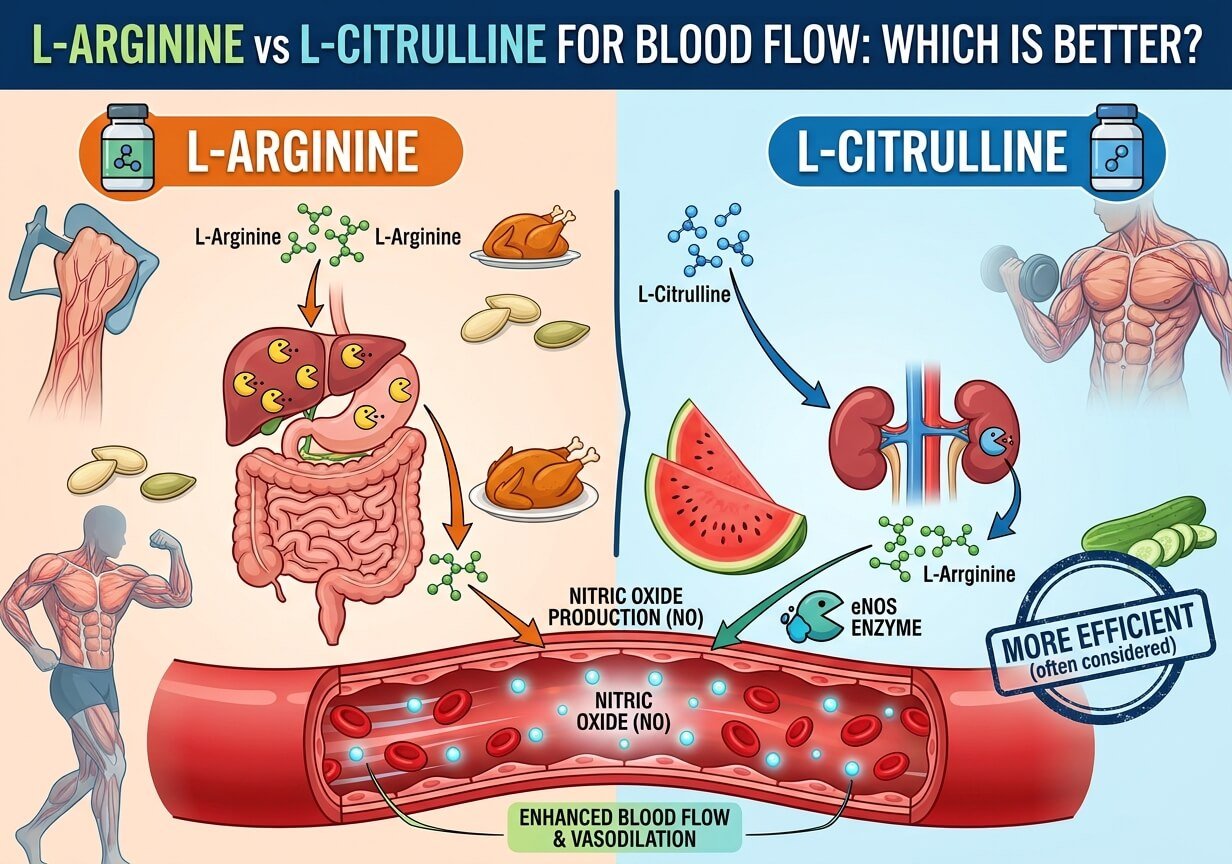
When it comes to supporting blood flow, vascular function, and exercise performance, L-arginine and L-citrulline are two of the most popular amino acid supplements on the market. Both play central roles in the body’s synthesis of nitric oxide (NO)—a gaseous signaling molecule that instructs blood vessels to dilate and relax.
To answer the central question directly: L-citrulline is often considered more efficient than L-arginine for elevating circulating arginine levels and promoting nitric oxide production. This is primarily due to differences in absorption and metabolism; oral L-citrulline bypasses much of the intestinal and liver first-pass metabolism that limits the bioavailability of orally consumed L-arginine.
However, greater bioavailability does not automatically guarantee superior clinical outcomes for every individual or health condition. While L-citrulline may raise blood arginine levels more effectively, research comparing actual clinical outcomes—such as blood pressure reduction, exercise endurance, or vascular reactivity—presents a more nuanced picture.
This comprehensive guide compares L-arginine and L-citrulline across their metabolic pathways, bioavailability, clinical evidence, sports performance benefits, dosages, safety profiles, and food sources to help you understand which option aligns best with your health goals.
1. What Is L-Arginine?
How Does L-Arginine Work in the Body?
L-arginine is a semi-essential (or conditionally essential) amino acid. Under normal physiological conditions, the human body can synthesize adequate amounts of L-arginine internally. However, during periods of rapid growth, physical stress, illness, or trauma, metabolic demand may exceed the body’s synthesis capacity, making dietary intake essential.
How L-Arginine Supports Nitric Oxide Production
L-arginine serves as the direct physiological substrate for a family of enzymes known as nitric oxide synthases (NOS). In the vascular system, endothelial nitric oxide synthase (eNOS) oxidizes L-arginine to yield nitric oxide gas and L-citrulline as a byproduct. Because L-arginine is the immediate precursor to NO, it plays a fundamental role in vascular tone regulation.
Natural Food Sources of L-Arginine
L-arginine is widely distributed across protein-rich dietary sources, including:
- Meat and Poultry: Turkey, chicken, beef, and pork.
- Seafood: Salmon, tuna, shrimp, and crab.
- Nuts and Seeds: Pumpkin seeds, sesame seeds, peanuts, walnuts, and almonds.
- Legumes: Soybeans, chickpeas, and lentils.
- Dairy: Milk, yogurt, and cheese.
What Are L-Arginine Supplements Used For?
Dietary supplements containing L-arginine are commonly used to support cardiovascular health, encourage healthy blood pressure, enhance athletic performance, and support endothelial function.
2. What Is L-Citrulline?
How Does L-Citrulline Work in the Body?
L-citrulline is a non-essential amino acid that functions primarily as a metabolic intermediate in the urea cycle—the liver process responsible for converting toxic ammonia into urea for excretion. Unlike L-arginine, L-citrulline is not incorporated into structural proteins during protein synthesis.
How L-Citrulline Converts Into L-Arginine
When L-citrulline is ingested or produced in the intestines, it enters systemic circulation and travels to the kidneys. Within renal tissue, two enzymes—argininosuccinate synthetase (ASS) and argininosuccinate lyase (ASL)—convert L-citrulline directly into L-arginine.
[ L-Citrulline ] ──(Kidneys: ASS & ASL)──> [ L-Arginine ] ──(eNOS)──> [ Nitric Oxide (NO) ]
Why L-Citrulline May Increase Arginine Availability
When L-arginine is taken orally, a significant percentage is broken down in the digestive tract and liver by enzymes called arginases (a process known as first-pass clearance). L-citrulline, conversely, is not a substrate for intestinal or hepatic arginases. It passes through the gastrointestinal system and liver relatively unimpeded, allowing a larger proportion of the ingested dose to reach the kidneys for conversion into L-arginine.
Natural Food Sources of L-Citrulline
The most abundant natural source of L-citrulline is watermelon (Citrullus lanatus), particularly its rind. Other natural sources include:
- Cucumbers
- Cantaloupe and honeydew melon
- Pumpkins and squashes
- Bitter melon
3. How Do L-Arginine and L-Citrulline Increase Nitric Oxide?
What Is Nitric Oxide and Why Does It Matter for Blood Flow?
Nitric oxide (NO) is an endogenously produced gas that acts as a vital signaling molecule throughout the cardiovascular system. Its primary vascular function is to maintain basal arterial tone, prevent excessive blood pressure, inhibit abnormal blood clotting, and reduce arterial wall inflammation.
How L-Arginine Directly Supports Nitric Oxide Synthesis
Within endothelial cells (the cell layer lining blood vessels), the enzyme eNOS converts L-arginine into nitric oxide and L-citrulline in the presence of oxygen and crucial cofactors (such as tetrahydrobiopterin, or BH4).
How L-Citrulline Helps Increase L-Arginine Availability
L-citrulline acts as an upstream reservoir. By providing a steady supply of substrate for renal L-arginine synthesis, L-citrulline indirectly elevates intracellular L-arginine levels in endothelial cells, maintaining a steady pool of raw material for eNOS.
How Nitric Oxide Relaxes Blood Vessels
Once synthesized by eNOS, nitric oxide diffuses into adjacent vascular smooth muscle cells. It activates an enzyme called soluble guanylyl cyclase (sGC), which increases intracellular cyclic guanosine monophosphate (cGMP). Elevated cGMP levels trigger a reduction in intracellular calcium, causing the smooth muscle surrounding blood vessels to relax. This process—vasodilation—widens the blood vessel lumen and enhances blood flow.
What Is the Role of Endothelial Nitric Oxide Synthase (eNOS)?
eNOS is the key enzyme responsible for producing nitric oxide in healthy blood vessels. When eNOS activity is impaired (a state known as endothelial dysfunction), nitric oxide bioavailability drops, contributing to vascular stiffness and restricted circulation.
4. L-Arginine vs L-Citrulline: Key Differences
To compare these two amino acids at a glance, consider the summary table below:
| Comparison Factor | L-Arginine | L-Citrulline |
| Role in Nitric Oxide Production | Direct substrate for eNOS enzyme | Upstream precursor converted into L-arginine in the kidneys |
| Gastrointestinal & Liver Metabolism | Subject to substantial first-pass breakdown by intestinal and liver arginases | Bypasses first-pass hepatic metabolism; highly bioavailable |
| Impact on Systemic Blood Arginine | Causes a rapid spike, but undergoes quick degradation | Produces a higher, more sustained increase in plasma L-arginine |
| Primary Research Focus | Endothelial function, blood pressure, cardiovascular risk factors | Exercise performance, muscle pump, endurance, circulation |
| Common Natural Food Sources | Meat, poultry, seafood, nuts, seeds, legumes, dairy | Watermelon (rind and flesh), cucumbers, melons, squash |
| Gastrointestinal Tolerability | Higher risk of diarrhea and cramps at doses ≥ 9–12 grams | Generally well-tolerated at comparable doses (up to 10–15g) |
5. L-Arginine vs L-Citrulline for Blood Flow: Which Works Better?
Which Supplement Increases Nitric Oxide More Effectively?
Biochemically, L-citrulline is often more effective at raising plasma L-arginine concentrations than taking oral L-arginine itself. Clinical pharmacokinetic studies demonstrate that oral L-citrulline administration results in higher peak concentrations and greater overall area-under-the-curve (AUC) for plasma arginine over time.
Which Amino Acid Is Better for Circulation?
While L-citrulline reliably elevates blood arginine levels, human clinical trials assessing microvascular blood flow, arterial stiffness, and regional circulation produce varied findings. Both supplements can support vascular relaxation, but individual response varies based on baseline endothelial health, age, and dietary status.
Which May Better Support Vascular Function?
In individuals with compromised eNOS activity or elevated arginase activity, L-citrulline may provide a more consistent delivery of substrate to endothelial cells. However, for individuals with intact metabolic pathways, both amino acids can support general endothelial health.
Is L-Citrulline More Bioavailable Than L-Arginine?
Yes. Pharmacokinetic studies clearly confirm that oral L-citrulline exhibits higher oral bioavailability than oral L-arginine due to its resistance to first-pass metabolism in the gut and liver.
Does Better Bioavailability Mean Better Results?
Not necessarily. While higher bioavailability translates to higher systemic arginine levels, clinical trial outcomes do not always correlate linearly with blood concentration. A 2024 systematic review analyzing clinical trial designs for L-arginine and L-citrulline emphasized that substantial heterogeneity across study methodologies, dosing regimens, and subject health statuses makes it impossible to declare one universally superior for all clinical vascular outcomes.
6. Potential Benefits of L-Arginine and L-Citrulline
Supporting Healthy Blood Circulation
Both amino acids support the physiological mechanisms underlying healthy blood circulation by maintaining adequate endothelial nitric oxide generation.
Nitric Oxide and Blood Vessel Function
By promoting regular vasodilation, optimal nitric oxide levels help keep blood vessel walls elastic, helping to maintain normal arterial compliance and blood flow dynamics.
L-Arginine, L-Citrulline, and Blood Pressure Research
Scientific studies examining the effect of L-arginine and L-citrulline on blood pressure show modest, variable reductions in systolic and diastolic measurements, particularly in individuals with pre-existing hypertension or endothelial dysfunction. However, meta-analyses note that neither supplement should replace prescribed antihypertensive medications.
Potential Benefits for Exercise Performance
By supporting vasodilation during physical exertion, both supplements aim to enhance delivery of oxygen and nutrients to active skeletal muscle tissue while facilitating the clearance of metabolic waste products like lactate and ammonia.
Muscle Pumps, Endurance, and Exercise Recovery
L-citrulline—frequently formulated as citrulline malate—has accumulated considerable evidence in sports nutrition for reducing subjective post-workout muscle soreness (DOMS) and slightly increasing total repetition volume during resistance training.
L-Arginine vs L-Citrulline for Erectile Function
Erectile tissue relies on nitric oxide-mediated cyclic GMP production to enable penile smooth muscle relaxation and cavernous blood influx. Small clinical trials indicate that both L-arginine and L-citrulline supplementation may offer mild benefits for individuals with light-to-moderate erectile dysfunction, particularly when combined with other supportive therapies.
What Benefits Are Supported by Human Studies?
- L-Arginine: Supported by research in cardiovascular health, endothelial dysfunction management, and preeclampsia research under medical oversight.
- L-Citrulline: Supported by studies evaluating aerobic performance, high-intensity resistance exercise recovery, and sustained plasma arginine elevation.
7. What Does Scientific Research Say About L-Arginine vs L-Citrulline?
Human Studies Comparing Arginine and Citrulline
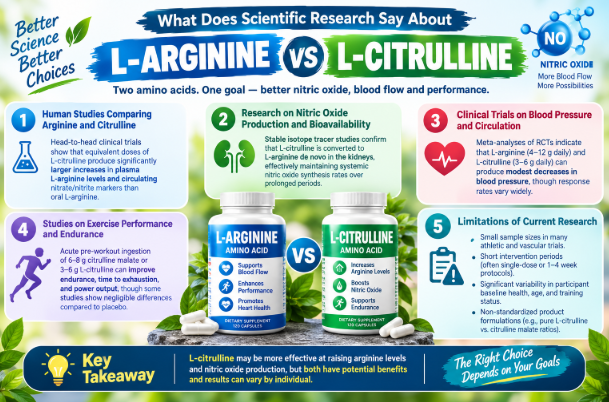
Head-to-head clinical trials measuring plasma amino acid levels after oral loading show that equivalent doses of L-citrulline produce significantly larger increases in systemic L-arginine levels and circulating nitrate/nitrite markers than oral L-arginine.
Research on Nitric Oxide Production and Bioavailability
Studies using stable isotope tracers confirm that L-citrulline is converted to L-arginine de novo in the kidneys, effectively maintaining systemic nitric oxide synthesis rates over prolonged periods.
Clinical Trials on Blood Pressure and Circulation
Meta-analyses of randomized controlled trials (RCTs) indicate that L-arginine supplementation (typically 4–12 grams daily) and L-citrulline supplementation (typically 3–6 grams daily) can produce modest decreases in blood pressure, though response rates vary widely.
Studies on Exercise Performance and Endurance
A range of sports science trials report that acute pre-workout ingestion of 6–8 grams of citrulline malate or 3–6 grams of pure L-citrulline can improve athletic endurance, time to exhaustion, and power output, though some studies show negligible differences compared to placebo.
Limitations of Current Research
- Small sample sizes in many athletic and vascular clinical trials.
- Short intervention periods (often single-dose or 1–4 week protocols).
- Significant variability in participant baseline health, age, and training status.
- Non-standardized product formulations (e.g., pure L-citrulline vs. citrulline malate ratios).
8. L-Arginine vs L-Citrulline for Exercise and Muscle Pumps
How Nitric Oxide Supports Blood Flow During Exercise
During intense exercise, working skeletal muscles require rapid, increased delivery of oxygenated blood. Nitric oxide-induced vasodilation lowers vascular resistance, allowing greater blood volume (“hyperemia”) to enter working muscles, contributing to the physiological phenomenon known as a “muscle pump.”
L-Arginine vs L-Citrulline for Pre-Workout Supplements
L-citrulline is widely favored over L-arginine in modern pre-workout formulations. Because oral L-arginine is rapidly degraded and often triggers gastrointestinal upset at effective pre-workout doses, L-citrulline provides a more reliable and comfortable option for athletes seeking enhanced hyperemic responses.
Which Supplement Has Better Evidence for Endurance?
L-citrulline (and citrulline malate) possesses stronger overall empirical support in exercise science literature for enhancing endurance and high-intensity repetition performance compared to pure L-arginine.
Citrulline Malate vs L-Arginine for Workout Performance
Citrulline malate pairs L-citrulline with malic acid—a Krebs cycle intermediate involved in aerobic ATP energy production. This dual action is hypothesized to support both nitric oxide-mediated blood flow and cellular energy metabolism during demanding physical activity.
9. L-Arginine vs L-Citrulline Dosage and Supplement Timing
What L-Arginine Dosages Have Been Studied?
- General Circulation & Vascular Support: 2,000 mg to 6,000 mg daily, divided into 2–3 smaller doses to reduce stomach upset.
- Clinical Research Studies: Up to 9,000–12,000 mg daily under medical supervision.
What L-Citrulline Dosages Have Been Studied?
- Pure L-Citrulline (Vascular & General Health): 3,000 mg to 6,000 mg daily taken as a single dose or divided.
- Citrulline Malate (Pre-Workout Performance): 6,000 mg to 8,000 mg (yielding roughly 4,000 to 5,300 mg of active L-citrulline at a 2:1 ratio) taken 30–60 minutes prior to exercise.
When Do People Take L-Arginine or L-Citrulline?
- For Exercise: 30 to 60 minutes prior to training.
- For General Vascular Health: Taken consistently every day, either with meals or on an empty stomach based on personal gastrointestinal tolerance.
How Long Might Supplementation Take to Affect Outcomes?
- Acute Plasma Levels: Plasma arginine concentrations begin rising within 30 to 90 minutes post-ingestion.
- Vascular & Health Outcomes: Clinical benefits related to endothelial health or blood pressure typically require consistent daily supplementation over 2 to 8 weeks.
10. Can You Take L-Arginine and L-Citrulline Together?
How the Two Amino Acids May Work Together
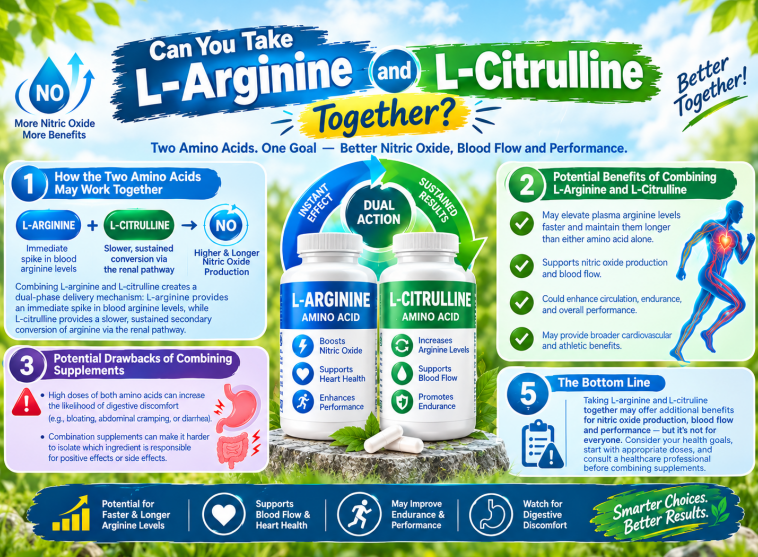
Combining L-arginine and L-citrulline creates a dual-phase delivery mechanism: L-arginine provides an immediate spike in blood arginine levels, while L-citrulline provides a slower, sustained secondary conversion of arginine via the renal pathway.
Potential Benefits of Combining L-Arginine and L-Citrulline
Some preliminary animal and small human trials suggest that co-ingestion of L-arginine and L-citrulline may elevate plasma arginine levels faster and maintain them longer than equivalent doses of either amino acid taken individually.
Potential Drawbacks of Combining Supplements
Taking high doses of both amino acids simultaneously can increase the likelihood of digestive discomfort, such as bloating, abdominal cramping, or diarrhea. Furthermore, combination supplements can make it more difficult to isolate which ingredient is responsible for positive effects or potential side effects.
11. L-Arginine vs L-Citrulline Side Effects and Safety
Common L-Arginine Side Effects
- Abdominal pain, bloating, and gas
- Nausea and loose stools/diarrhea (especially at doses exceeding 9 grams)
- Low blood pressure (hypotension) if taken in excess
Possible L-Citrulline Side Effects
L-citrulline is generally exceptionally well-tolerated. High doses (over 10–15 grams) may occasionally cause mild stomach upset, but gastrointestinal distress is reported far less frequently than with L-arginine.
Can These Supplements Affect Blood Pressure?
Yes. Because both compounds enhance vasodilation, they can lower blood pressure. Individuals who naturally have low blood pressure or those taking prescription antihypertensive medications should exercise caution.
Potential Medication Interactions
Consult a qualified healthcare provider before using either supplement if you take:
- Antihypertensive Drugs: Combining with blood pressure medications can cause blood pressure to drop too low.
- Nitrates (e.g., Nitroglycerin): Co-administration can trigger significant, unsafe drops in blood pressure.
- PDE-5 Inhibitors (e.g., Sildenafil, Tadalafil): Combined vasodilation can cause sudden hypotension.
How to Choose a Quality Dietary Supplement
- Select products tested by independent third-party certification organizations (such as NSF International, USP, or Informed Choice).
- Check the supplement facts panel to verify whether the product contains pure L-citrulline or citrulline malate (and note the ratio).
- Choose manufacturers that adhere to current Good Manufacturing Practices (cGMP).
12. Natural Ways to Support Nitric Oxide and Healthy Blood Flow
Foods Rich in L-Arginine
Including protein-rich foods like pumpkin seeds, turkey breast, peanuts, soybeans, and lentils in your diet provides natural sources of L-arginine alongside essential cofactors.
Watermelon and Other Sources of L-Citrulline
Consuming fresh watermelon, watermelon juice, or cucumber helps increase dietary L-citrulline naturally while supporting daily hydration.
Nitrate-Rich Foods and the Nitric Oxide Pathway
Dietary nitrates offer a powerful, alternative mechanism for boosting nitric oxide independently of L-arginine and eNOS (via the enterosalivary nitrate-nitrite-NO pathway). Excellent dietary sources include:
- Beetroot and beet juice
- Arugula, spinach, and Swiss chard
- Celery and lettuce
Exercise and Healthy Endothelial Function
Regular aerobic exercise (such as cycling, running, or swimming) and resistance training exert mechanical shear stress on blood vessel walls. This shear stress upregulates eNOS enzyme gene expression, promoting long-term, natural nitric oxide production.
Nitric Boost: Supporting Circulation, Vascular Wellness & Daily Vitality.
13. Frequently Asked Questions About L-Arginine vs L-Citrulline
1. Is L-arginine or L-citrulline better for blood flow?
L-citrulline is generally considered more bioavailable and efficient at raising systemic L-arginine levels because it avoids extensive liver breakdown. However, both support nitric oxide synthesis, and individual results vary depending on health status and personal goals.
2. Which supplement increases nitric oxide more effectively?
L-citrulline usually increases blood arginine levels and nitric oxide biomarkers more effectively over a sustained period than an equivalent oral dose of pure L-arginine.
3. Why is L-citrulline often considered more bioavailable than L-arginine?
Oral L-arginine undergoes extensive clearance by arginase enzymes in the intestines and liver. L-citrulline bypasses this intestinal and hepatic first-pass metabolism and is converted directly to L-arginine in the kidneys.
4. Can L-citrulline increase L-arginine levels?
Yes. In fact, clinical studies demonstrate that supplementing with oral L-citrulline raises circulating L-arginine levels in the blood more effectively than supplementing with L-arginine itself.
5. Is L-arginine good for blood circulation?
Yes, L-arginine serves as the direct raw material used by blood vessel lining cells to create nitric oxide, which helps relax blood vessels and support normal circulation.
6. Does L-citrulline actually improve blood flow?
Research indicates that L-citrulline supports vascular relaxation and arterial compliance, helping to maintain healthy blood circulation in both resting states and during exercise.
7. Can I take L-arginine and L-citrulline together?
Yes, some people combine them to achieve both a rapid spike in blood arginine (from L-arginine) and sustained arginine levels (from L-citrulline). However, high combined doses can increase the risk of stomach upset.
8. Which is better for exercise performance, L-arginine or L-citrulline?
L-citrulline (especially citrulline malate) has stronger scientific support in sports nutrition for supporting exercise performance, muscle endurance, and post-workout recovery.
9. Which supplement has better evidence for lowering blood pressure?
Both supplements have demonstrated modest blood pressure-lowering effects in clinical studies, but neither is considered a primary treatment for clinical hypertension.
10. Can L-arginine or L-citrulline help erectile function?
Because erection requires nitric oxide-mediated blood vessel relaxation, both supplements have been studied for mild erectile support, though results are modest compared to medical treatments.
11. How much L-arginine should you take for blood flow?
Typically studied doses of L-arginine range from 2,000 mg to 6,000 mg per day, often divided into two or three smaller doses throughout the day to prevent GI discomfort.
12. How much L-citrulline should you take daily?
Common daily dosages for pure L-citrulline range from 3,000 mg to 6,000 mg daily, while citrulline malate is often taken at doses of 6,000 mg to 8,000 mg pre-workout.
13. What foods contain L-arginine and L-citrulline?
L-arginine is abundant in protein-rich foods like poultry, meat, nuts, seeds, and legumes. L-citrulline is found primarily in watermelon, cantaloupe, cucumbers, and squashes.
14. Are L-arginine and L-citrulline safe for daily use?
Both amino acids are generally considered safe for healthy adults when used at studied dosages. However, individuals taking blood pressure or heart medications should consult a doctor first.
15. How long does it take for L-arginine or L-citrulline to work?
Blood levels of arginine typically peak within 30 to 90 minutes after ingestion, but long-term vascular or blood pressure benefits usually require several weeks of consistent use.
16. Is citrulline malate the same as L-citrulline?
No. Pure L-citrulline consists solely of the amino acid, whereas citrulline malate combines L-citrulline with malic acid, a compound involved in cellular energy production.
14. Conclusion: Which Is Better for Blood Flow?
Both L-arginine and L-citrulline play integral roles in supporting the body’s nitric oxide production pathway and encouraging healthy vascular tone.
To summarize:
- L-Arginine acts as the direct substrate for nitric oxide synthesis, but oral supplements suffer from low bioavailability due to significant breakdown in the digestive tract and liver.
- L-Citrulline bypasses first-pass metabolism, traveling to the kidneys where it is converted into L-arginine—making it an exceptionally efficient method for raising systemic blood arginine levels.
- Clinical application matters: L-citrulline generally carries stronger research support for pre-workout performance and gastrointestinal tolerance, whereas both amino acids offer supportive roles for overall cardiovascular health.
Before starting any new supplement regimen—particularly if you take prescription medications for blood pressure, erectile dysfunction, or heart health—always consult a qualified healthcare professional to determine the safest and most effective approach for your individual needs.