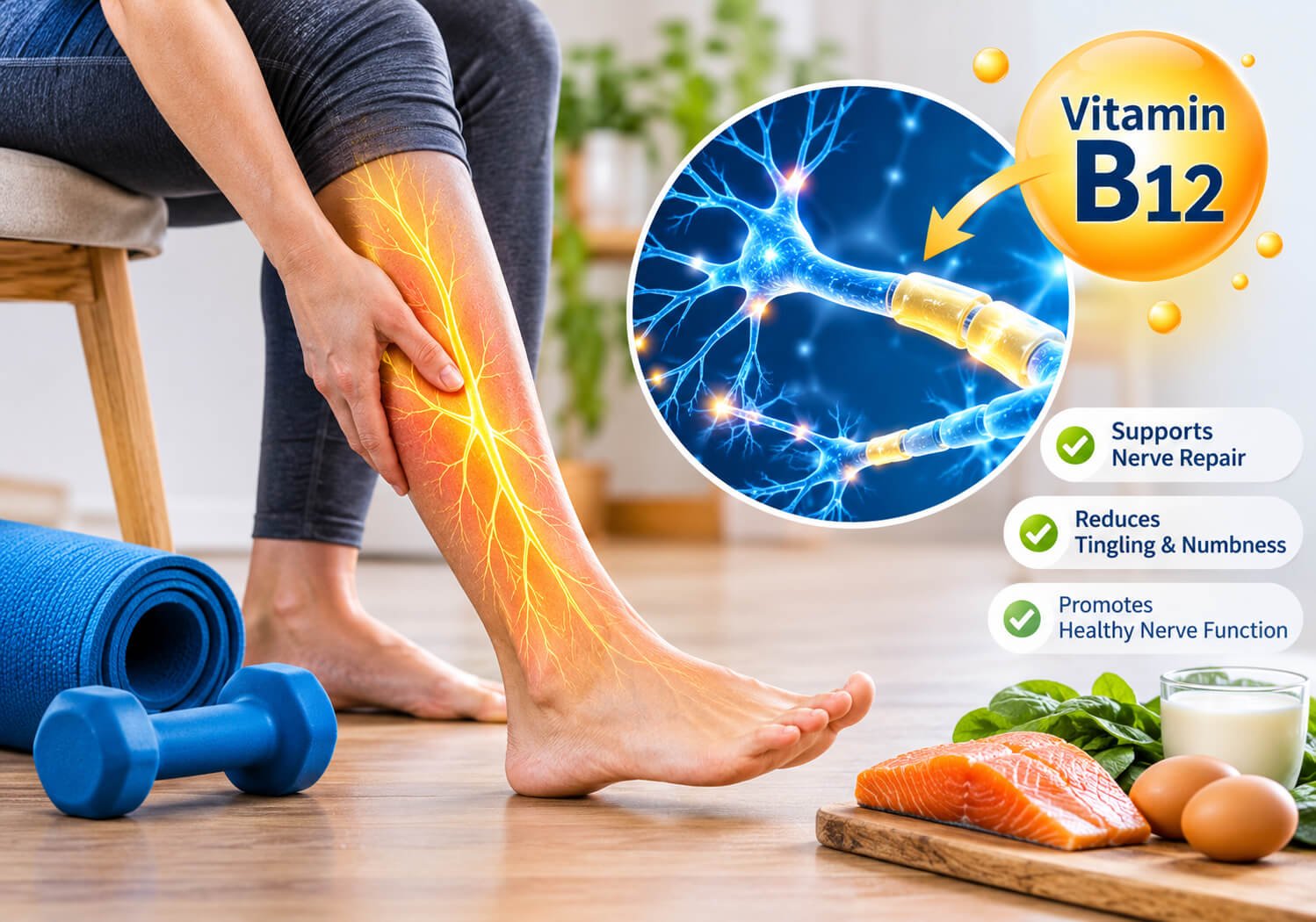
If you are dealing with tingling, numbness, or weakness in your limbs, understanding the role of vitamin B12 for nerve damage recovery is a critical first step. Nerve health is foundational to how you move, feel, and perform daily activities. As a strength and conditioning coach, I often work with clients who are rebuilding their physical capacity after neurological setbacks. Proper nutrition, specifically adequate cobalamin levels, works hand-in-hand with targeted rehabilitation to restore function. This guide breaks down the science, practical applications, and safety considerations of using this essential nutrient to support your nervous system.
Quick Answer
Vitamin B12 is essential for rebuilding the myelin sheath and supporting nerve regeneration. For nerve damage recovery, methylcobalamin is the most effective and bioavailable form. Combined with targeted physical rehabilitation, adequate B12 levels can help reduce neuropathic symptoms and improve functional mobility. Always consult a healthcare provider for proper diagnosis and dosing.
How Vitamin B12 for Nerve Damage Recovery Actually Works
To understand how vitamin B12 for nerve damage recovery supports healing, we must look at the nervous system’s structure. Your nerves are like electrical wires. The inner core is the axon, which carries the signal. The outer protective layer is the myelin sheath. This sheath acts as insulation, ensuring signals travel quickly and efficiently from your brain to your muscles.
When you suffer from a vitamin B12 deficiency, this myelin sheath begins to degrade. This process is called demyelination. Without proper insulation, nerve signals become slow, distorted, or blocked entirely. This manifests as the classic symptoms of peripheral neuropathy: tingling, numbness, burning pain, and muscle weakness.
Research from the National Institutes of Health (NIH) confirms that cobalamin is strictly required for the synthesis of myelin. Furthermore, vitamin B12 helps regulate homocysteine levels in the blood. Elevated homocysteine is toxic to nerve cells and is strongly linked to neurological decline. By keeping homocysteine in check, B12 creates a safer environment for axonal regeneration.
It is important to note that nerve healing is a slow process. Nerves regenerate at a rate of approximately 1 inch (2.54 cm) per month under optimal conditions. Therefore, patience and consistency with both supplementation and physical therapy are absolutely vital for meaningful progress.
Understanding the Different Forms of Vitamin B12
Not all supplements are created equal. When researching vitamin B12 for nerve damage recovery, you will encounter several different forms of cobalamin. Choosing the right one matters for absorption and neurological efficacy.
| Form of Vitamin B12 | Description | Best For Nerve Recovery? |
| Methylcobalamin | The active, naturally occurring form of B12 found in the body and some foods. | Yes. Highly bioavailable and directly supports myelin synthesis and nerve regeneration. |
| Adenosylcobalamin | Another active form, primarily stored in the mitochondria of cells. | Yes. Supports cellular energy production in nerve tissues, aiding overall nerve function. |
| Cyanocobalamin | A synthetic, stable form commonly used in inexpensive supplements and fortified foods. | No. The body must convert it to methylcobalamin, which is inefficient, especially in older adults or those with genetic mutations (like MTHFR). |
| Hydroxocobalamin | A natural form often used in clinical B12 injections. | Yes. Highly effective for severe deficiencies, typically administered by a healthcare professional. |
For most individuals seeking neurological support, methylcobalamin is the gold standard. It bypasses the need for complex conversion processes in the liver, delivering active B12 directly to the nervous system.
Signs You Might Need B12 for Nerve Health
Recognizing the early warning signs of a deficiency can prevent permanent neurological damage. The symptoms often develop gradually and can be mistaken for normal aging or other conditions.
Watch for these common neurological symptoms:
- Paresthesia: A persistent “pins and needles” sensation, usually starting in the toes or fingers.
- Numbness: A reduced ability to feel touch, temperature, or pain in the extremities.
- Balance Issues: Unsteadiness when walking, especially in the dark, due to impaired proprioception (your body’s sense of position).
- Muscle Weakness: Difficulty gripping objects or a feeling of heaviness in the legs.
- Cognitive Changes: Brain fog, memory lapses, or difficulty concentrating, as the brain is also part of the central nervous system.
If you experience these symptoms, request a comprehensive blood panel from your doctor. This should include serum B12, methylmalonic acid (MMA), and homocysteine levels. MMA and homocysteine are more sensitive markers of cellular B12 deficiency than serum B12 alone.
Practical Steps: Integrating Vitamin B12 for Nerve Damage Recovery into Your Routine
As a coach, I know that taking a supplement is only half the battle. To maximize vitamin B12 for nerve damage recovery, you must pair it with targeted physical rehabilitation. Movement stimulates blood flow, which delivers the B12 and other vital nutrients directly to the damaged nerve tissues.
Below is a practical, evidence-based movement protocol designed to support nerve gliding, improve circulation, and rebuild strength safely.

1. Seated Sciatic Nerve Glide
Nerve gliding (or flossing) exercises gently mobilize the nerve through its surrounding tissue, preventing adhesions and improving nutrient delivery.
- How to do it: Sit tall on a chair. Slowly straighten your affected leg until you feel a mild tension (not pain) in the back of the thigh. Simultaneously, point your toes away from you. Then, bend the knee back to the starting position while flexing your foot (toes toward your shin).
- Sets/Reps: 2 to 3 sets of 10 to 12 repetitions per leg.
- Tempo: 2 seconds to extend, 1-second hold, 2 seconds to return.
- Regression: Keep the knee slightly bent throughout the movement to reduce tension.
- Progression: Add a gentle neck tilt (looking away from the extending leg) to increase the neural stretch.
2. Ankle Alphabet Mobilization
This exercise improves joint mobility and stimulates the peripheral nerves in the lower leg and foot.
- How to do it: Sit or lie down with your leg elevated. Imagine your big toe is a pen. Slowly and deliberately trace the letters of the alphabet (A through Z) in the air.
- Sets/Reps: 2 sets of 1 full alphabet per foot.
- Tempo: Slow and controlled, taking about 30 seconds per alphabet.
- Regression: Use your hands to gently guide the foot through the movements if active mobility is limited.
- Progression: Perform the exercise while standing on one leg (near a wall for support) to challenge balance and proprioception.

3. Supported Calf Raises
Strengthening the lower leg muscles provides better structural support for the nerves and improves overall gait mechanics.
- How to do it: Stand facing a wall, placing your hands on it for support. Slowly rise onto the balls of your feet, lifting your heels as high as comfortable. Pause at the top, then slowly lower back down.
- Sets/Reps: 3 sets of 8 to 10 repetitions.
- Weight Guidance: Start with bodyweight. Progress by holding light dumbbells, such as 5 lb (2.2 kg) in each hand.
- Tempo: 2 seconds up, 1-second pause, 3 seconds down (eccentric focus).
- Regression: Perform the exercise seated, pressing the balls of your feet into the floor.
- Progression: Perform single-leg calf raises, holding 10 lb (4.5 kg) dumbbells.
COACH’S TIP: Never push through sharp, shooting nerve pain during exercise. A mild stretch or pulling sensation is acceptable, but sharp pain means you are irritating the nerve. Scale back the range of motion immediately.
COMMON MISTAKE: Holding your breath during nerve glides or strength exercises. This increases intra-abdominal pressure and can temporarily restrict blood flow to the nerves. Breathe in during the preparation phase, and exhale steadily during the exertion phase.
Building Cardiovascular Endurance Safely
Cardiovascular exercise is crucial for systemic circulation. However, high-impact activities can aggravate sensitive nerves.
- Start with low-impact walking. Begin with short distances, such as 0.25 miles (0.4 km), on flat, even surfaces.
- Gradually increase your distance by 10% each week, aiming for a target of 1.5 miles (2.4 km) per session, 3 to 4 times a week.
- If walking is painful, substitute with stationary cycling or swimming, which remove gravitational stress from the lower extremities while maintaining excellent blood flow.
Dietary Sources and Supplementation Guidelines
While supplementation is often necessary for therapeutic nerve repair, dietary intake remains the foundation of long-term nerve health. Vitamin B12 is found almost exclusively in animal products.
Excellent dietary sources include:
- Clams: 3 oz (85 g) provides over 80 mcg (more than 3,000% of the Daily Value).
- Beef liver: 3 oz (85 g) provides roughly 70 mcg.
- Salmon: 3 oz (85 g) provides about 4.8 mcg.
- Fortified nutritional yeast: 2 tablespoons can provide 4 to 8 mcg (ideal for plant-based diets).
For therapeutic nerve damage recovery, dietary sources are rarely enough, especially if malabsorption is the root cause. Conditions like pernicious anemia, atrophic gastritis, or long-term use of acid-reducing medications (like omeprazole) destroy the “intrinsic factor” protein needed to absorb B12 from food.
In these cases, supplementation is required. Sublingual (under the tongue) methylcobalamin drops or lozenges bypass the digestive system, allowing for direct absorption into the bloodstream. Typical therapeutic doses for neurological symptoms range from 1,000 mcg to 2,000 mcg daily, but this must be determined by a healthcare provider based on your blood work. For severe cases, intramuscular B12 injections administered by a doctor are the most effective method to rapidly restore tissue levels.
Safety Notes and Who Should Be Careful
Vitamin B12 is a water-soluble vitamin, meaning your body excretes excess amounts through urine. Because of this, it has a very high safety profile, and no Tolerable Upper Intake Level (UL) has been established by the Food and Nutrition Board. However, there are still important safety considerations to keep in mind.
First, high doses of B12 can mask a vitamin B9 (folate) deficiency. Both deficiencies cause a specific type of anemia (megaloblastic anemia). If you take high doses of B12, it may correct the anemia, but the underlying folate deficiency will continue to cause irreversible neurological damage. This is why comprehensive blood testing is non-negotiable before starting high-dose therapy.
Second, certain medications interact with B12 absorption. Metformin, a common diabetes medication, is known to decrease B12 absorption in the gut. If you are managing diabetic neuropathy, you must be especially vigilant about monitoring your B12 levels.
Additionally, individuals with Leber’s disease (a hereditary eye disease) should avoid cyanocobalamin, as it can cause severe and rapid optic nerve atrophy. Always disclose all supplements to your prescribing physician to avoid adverse interactions.
Related Tips for Holistic Nerve Recovery
Nerve healing does not happen in a vacuum. To truly optimize vitamin B12 for nerve damage recovery, you must support your body’s overall metabolic and physiological environment.
Prioritize Sleep Quality Nerve repair and myelin synthesis predominantly occur during deep, slow-wave sleep. Poor sleep elevates cortisol and systemic inflammation, which actively hinders neurological healing. Aim for 7 to 9 hours of quality sleep per night. Learn more about how sleep affects metabolism and weight management to understand the broader hormonal impact of rest on tissue repair.
Support Metabolic Flexibility Your nerves require a massive amount of energy to repair. Ensuring your cells can efficiently switch between fuel sources (metabolic flexibility) provides a steady energy supply for healing. Strategies to boost metabolic flexibility without crash dieting can help maintain stable blood sugar, which is critical since glucose spikes are highly toxic to peripheral nerves.
Address Broader Nutritional Deficiencies B12 rarely works alone. Magnesium supports nerve transmission and muscle relaxation. Alpha-lipoic acid (ALA) is a potent antioxidant shown to reduce symptoms of diabetic neuropathy. Understanding which vitamins support metabolism when you have a deficiency can help you build a comprehensive nutritional strategy alongside your B12 protocol.
Maintain Energy During Rehab Physical therapy can be exhausting, especially when your nervous system is already compromised. Ensuring you are getting the best vitamins for energy will help you stay consistent with your rehabilitation exercises without burning out.
Consider Holistic Supplement Support When building your recovery stack, it is wise to evaluate how different compounds interact. Reviewing guidance on which supplements may support weight management safely can also be beneficial, as maintaining a healthy body weight reduces mechanical stress on compressed nerves, such as in sciatica or carpal tunnel syndrome.
FAQ
Can vitamin B12 reverse nerve damage? Vitamin B12 can halt the progression of nerve damage and support the regeneration of the myelin sheath, potentially reversing early or mild symptoms. However, if the axon (the inner nerve core) has completely degenerated, the damage may be permanent. Early intervention is critical for the best outcomes.
How long does it take for B12 to repair nerves? Nerve regeneration is a slow process. Nerves typically heal at a rate of about 1 inch (2.54 cm) per month. While some symptomatic relief from reduced inflammation may occur within a few weeks, meaningful structural repair and functional recovery often take 6 to 12 months of consistent, adequate supplementation.
What is the best form of B12 for nerve damage? Methylcobalamin is widely considered the best form for nerve damage recovery. It is the active, naturally occurring form of B12 that readily crosses the blood-brain barrier and directly participates in the synthesis and maintenance of the protective myelin sheath.
Does B12 help with diabetic neuropathy? Yes, research suggests B12 can be highly beneficial for diabetic neuropathy. Diabetes damages nerves through high blood sugar and oxidative stress. Furthermore, the common diabetes drug metformin depletes B12 levels. Supplementing can help restore nerve function and reduce neuropathic pain in these patients.
Can you get too much vitamin B12 for nerve repair? Because B12 is water-soluble, it is generally very safe, and excess is excreted in urine. There is no established upper toxic limit. However, extremely high doses should only be taken under medical supervision to ensure they do not mask a concurrent folate deficiency or interact with other medications.
How much B12 should I take for neuropathy? Therapeutic doses for neurological symptoms typically range from 1,000 mcg to 2,000 mcg of methylcobalamin daily, either orally or sublingually. For severe deficiencies, doctors may prescribe intramuscular injections. Always follow the specific dosage recommended by your healthcare provider based on your blood test results.
Conclusion
Navigating neurological setbacks is challenging, but you have more control over your healing environment than you might think. Utilizing vitamin B12 for nerve damage recovery is a scientifically supported, foundational step in rebuilding the myelin sheath and restoring proper nerve conduction. By choosing the right form, such as methylcobalamin, and pairing it with gentle, progressive nerve gliding and strengthening exercises, you create the optimal conditions for your body to heal.
Remember that consistency is your greatest asset. Nerve repair is measured in months, not days. Work closely with your healthcare team to monitor your blood levels, adjust your supplementation, and tailor your physical rehabilitation. With patience, proper nutrition, and guided movement, you can reclaim your mobility and reduce neuropathic discomfort.f