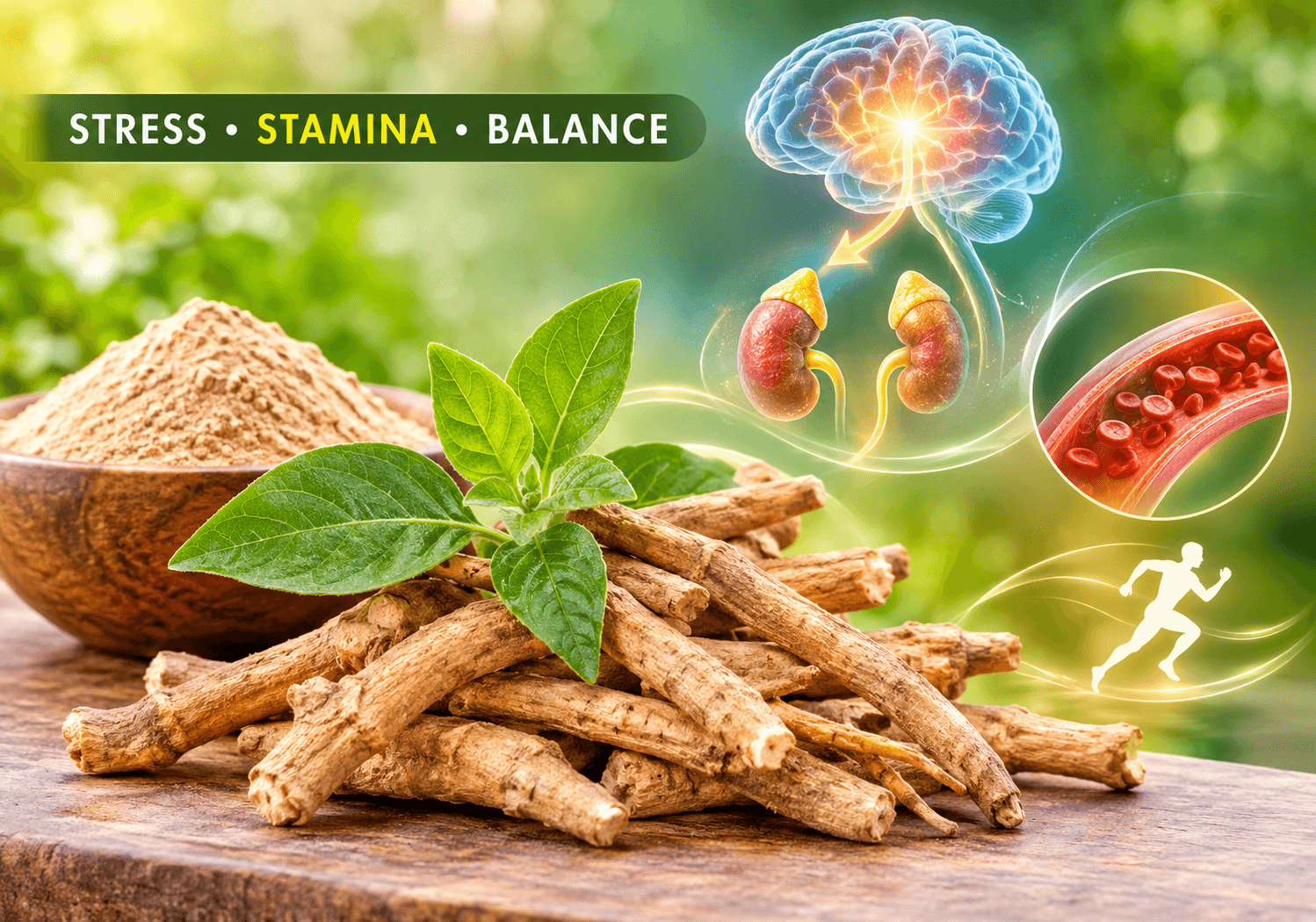
Chronic physical and mental stress acts like a handbrake on male performance, both in the gym and in the bedroom. Understanding the mechanism of ashwagandha on male sexual stamina and stress starts with looking at how your nervous system and endocrine system share resources. When your body stays stuck in a high-alert survival state, blood flow, hormone production, and physical endurance all take a back seat.
As a strength and conditioning coach, I see many active men who train hard, eat well, and still hit a wall with energy, recovery, and sexual stamina. They often assume they need a harsh stimulant or a quick-fix booster. In reality, managing the stress response is usually the missing link.
Before you add any new herb or supplement to your routine, check with your doctor or a qualified healthcare provider, especially if you take prescription medications or have an underlying health condition.
Quick Answer: The mechanism of ashwagandha on male sexual stamina and stress centers on the hypothalamic-pituitary-adrenal (HPA) axis. By blunting excessive cortisol release, Withania somnifera shifts the body out of “fight-or-flight” mode. Lower cortisol allows healthier luteinizing hormone and testosterone signaling, improves nitric oxide-mediated blood flow, and supports overall physical endurance.
How Stress Sabotages Male Stamina and Performance
To appreciate how an adaptogen works, you first need to see what chronic stress does to the male body. Stress is not just a mental feeling; it is a full-body chemical cascade designed to help you outrun immediate danger.
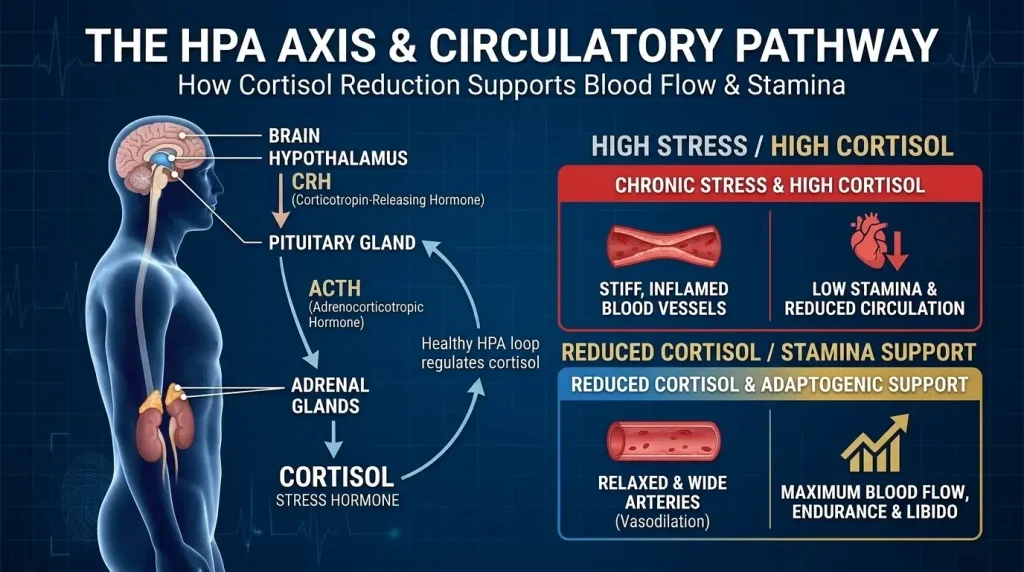
When your brain perceives a threat—whether from heavy work deadlines, poor sleep, or overtraining—your hypothalamus signals your pituitary gland, which then tells your adrenal glands to pump out cortisol and adrenaline. This communication network is called the hypothalamic-pituitary-adrenal (HPA) axis.
In short bursts, cortisol is useful. It mobilizes stored glucose and sharpens focus during a heavy squat session. However, when cortisol remains elevated around the clock, several systems break down:
- Hormonal Suppression: Cortisol and testosterone share precursor building blocks, and high cortisol actively inhibits the gonadotropin-releasing hormone (GnRH) pathway. Over time, elevated stress hormones suppress luteinizing hormone (LH) and reduce natural testosterone output.
- Blood Vessel Constriction: Adrenaline and sympathetic nervous system activation constrict peripheral blood vessels to route blood toward large skeletal muscles and vital organs. Smooth muscle relaxation in pelvic tissues becomes much harder to achieve and sustain.
- Energy Depletion: Chronic stress disrupts deep sleep architecture and drains cellular energy reserves, leaving you fatigued long before physical exertion should stop you.
- Performance Anxiety Loop: Once fatigue or poor blood flow happens once, the brain links intimacy with stress, triggering even more adrenaline the next time.
Research consistently shows that can stress and poor sleep lower male libido by disrupting this exact hormonal and nervous system balance. Breaking that cycle requires calming the HPA axis at its source rather than masking fatigue with caffeine.
The Core Mechanism of Ashwagandha on Male Sexual Stamina and Stress
Ashwagandha (Withania somnifera) is an evergreen shrub native to India, the Middle East, and parts of Africa. In sports nutrition and clinical research, it is classified as an adaptogen—a natural compound that helps the body resist physical, chemical, and biological stressors.
Its active compounds are primarily withanolides, a group of naturally occurring steroidal lactones found mainly in the plant’s roots and leaves. Rather than acting like a central nervous system stimulant, ashwagandha works through four interconnected biological pathways.
1. HPA Axis Regulation and Cortisol Blunting
The primary mechanism of ashwagandha on male sexual stamina and stress begins in the brain and adrenal glands. Clinical trials indicate that standardized ashwagandha root extract downregulates overactive signaling along the HPA axis.
In a double-blind, randomized, placebo-controlled trial published in the Indian Journal of Psychological Medicine, adults with chronic stress who took 300 mg of high-concentration ashwagandha root extract twice daily for 60 days experienced a 27.9% reduction in serum cortisol levels compared to the placebo group.
When serum cortisol drops back into a healthy range:
- Your sympathetic (“fight-or-flight”) nervous system dials down.
- Your parasympathetic (“rest-and-digest”) nervous system takes over, which is required for arousal and sustained vascular blood flow.
- Heart rate variability (HRV) improves, signaling better autonomic nervous system recovery.
2. GABAergic Signaling and Mental Calm
Sexual stamina is heavily tied to pacing and nervous system arousal. If your sympathetic nervous system fires too fast, physical arousal spikes too quickly, shortening stamina and triggering performance anxiety.
Ashwagandha exhibits GABA-mimetic activity, meaning its compounds interact with gamma-aminobutyric acid (GABA) receptors in the central nervous system. GABA is the brain’s primary inhibitory neurotransmitter; it acts like a dimmer switch on racing thoughts and overactive nerve firing.
By supporting GABAergic signaling without causing heavy sedation, ashwagandha helps men maintain a calmer baseline state. In practical coaching terms, this translates to better focus, less mental chatter, and smoother autonomic pacing during physical exertion.
3. Endocrine Support: Luteinizing Hormone, Testosterone, and DHEA-S
Once cortisol is no longer suppressing the hypothalamic-pituitary-gonadal (HPG) axis, reproductive hormone signaling can normalize. Several peer-reviewed studies have examined how ashwagandha influences male endocrine markers.
A 2019 randomized, double-blind, placebo-controlled crossover study in the American Journal of Men’s Health found that overweight, mildly fatigued men aged 40 to 70 who took a standardized ashwagandha extract for 8 weeks showed an 18% greater increase in DHEA-S and a 14.7% greater increase in testosterone compared to those taking a placebo.
It is important to keep expectations grounded here. Ashwagandha does not act like synthetic hormone therapy, nor will it push testosterone far above your natural genetic ceiling. Instead, it removes the stress-induced brakes so your testes can respond normally to luteinizing hormone signals. Exploring does ashwagandha increase testosterone and libido in men in detail reveals that the largest hormonal rebounds occur in men who start out stressed, sleep-deprived, or under-recovered.
4. Nitric Oxide Pathways, Blood Flow, and Cardiorespiratory Endurance
Stamina—whether running a 5K, pushing through a high-rep squat set, or sustaining physical intimacy—depends on oxygen delivery and vascular health. Chronic psychological stress generates reactive oxygen species (free radicals) that damage the delicate inner lining of blood vessels, known as the endothelium.
Endothelial damage reduces the availability of nitric oxide (NO), the signaling molecule that tells blood vessel smooth muscle to relax and widen (vasodilation).
Ashwagandha supports vascular stamina in two ways:
- Antioxidant Protection: Withanolides boost endogenous antioxidant enzymes like superoxide dismutase (SOD) and glutathione peroxidase, protecting nitric oxide from being destroyed by oxidative stress.
- Cardiorespiratory Efficiency: A controlled trial in the Journal of Ayurveda and Integrative Medicine demonstrated that healthy athletic adults taking 300 mg of ashwagandha twice daily for 8 weeks significantly improved their VO2 max (maximum oxygen consumption) compared to a placebo group.
Better oxygen uptake and healthier blood vessel dilation mean muscles—and vascular tissues—resist fatigue longer under sustained effort.
Summary of Biological Mechanisms and Practical Effects
| Biological Pathway | Primary Mechanism of Action | Key Biomarkers Affected | Practical Impact on Stamina & Stress |
| HPA Axis Modulation | Dampens excessive adrenal stress signaling | Serum cortisol (decreases), DHEA-S (stabilizes) | Reduces chronic fatigue and physical burnout |
| Neurotransmitter Balance | Enhances GABA-receptor signaling in the brain | GABA activity, sympathetic nerve tone | Calms racing thoughts and performance anxiety |
| HPG Endocrine Axis | Removes cortisol inhibition on pituitary signaling | Luteinizing hormone (LH), free & total testosterone | Restores healthy drive, mood, and recovery capacity |
| Vascular & Oxidative Defense | Neutralizes free radicals to preserve endothelial function | Superoxide dismutase (SOD), nitric oxide availability | Supports smoother blood flow and sustained vascular tone |
| Cardiorespiratory Capacity | Improves cellular oxygen utilization and mitochondrial efficiency | VO2 max, hemoglobin levels, muscular endurance | Delays physical exhaustion during sustained effort |
What Clinical Research Says About Ashwagandha and Male Sexual Function
While early research focused mostly on general anxiety and athletic endurance, newer clinical trials have directly measured male sexual function parameters using validated scoring tools like the International Index of Erectile Function (IIEF) and the Derogatis Interview for Sexual Functioning (DISF-M).
In a 2022 double-blind, randomized, placebo-controlled trial published in Health Science Reports, 50 adult males with lower sexual desire were given either 300 mg of ashwagandha root extract twice daily or a placebo for 8 weeks. The ashwagandha group showed statistically significant improvements in total DISF-M scores—including sexual desire, arousal, and overall satisfaction—alongside a marked increase in serum testosterone compared to the placebo group.
Similarly, a broader review of adaptogenic herbs indexed by the National Center for Complementary and Integrative Health (NCCIH) notes that clinical evidence supports ashwagandha’s role in reducing perceived stress and improving sleep quality, though researchers emphasize the need for longer-term safety studies beyond 3 to 6 months.
Coach’s Tip: Do not treat ashwagandha like a pre-workout stimulant that you take 30 minutes before activity. Adaptogens build cumulative benefits by gradually recalibrating your stress response over 4 to 8 weeks of consistent daily use.
Comparing Ashwagandha Extracts and Formulations
Walking down a supplement aisle—or browsing online—can be confusing because not all ashwagandha powders deliver the same concentration of active withanolides. The part of the plant used (root only vs. root and leaf) and the extraction method change the chemical profile.
| Extract Type / Form | Plant Part Used | Typical Withanolide Standardization | Common Clinical Daily Dose | Best Application |
| KSM-66 | Root only | 5% withanolides (via HPLC) | 300 mg – 600 mg | Daytime stress, athletic stamina, testosterone & libido support |
| Sensoril | Root and leaf | 10% withanolides | 125 mg – 250 mg | Evening relaxation, high anxiety, sleep quality |
| Shoden | Root and leaf | 35% withanolide glycosides | 60 mg – 120 mg | High-potency stress reduction and restorative sleep |
| Raw Root Powder (Churna) | Whole dried root | ~1% – 2% (unstandardized) | 2,000 mg – 5,000 mg | Traditional culinary/tonic use; harder to dose precisely |
When evaluating do libido supplements for men actually work, extract standardization is the first quality check I teach clients to verify. Root-only extracts like KSM-66 are most frequently used in male performance and sports endurance trials because they keep leaf-derived compounds like withaferin A at negligible levels while delivering consistent root withanolides.
How to Apply This: A Coach’s 4-Pillar Stamina Protocol
Even the best-studied adaptogen cannot outwork a lifestyle that constantly triggers your fight-or-flight response. When I work with men looking to improve physical endurance, stress resilience, and sexual stamina, we pair targeted supplementation with three foundational training and recovery habits.
1. Evidence-Based Dosing and Timing
- Standard Dose: Most clinical trials showing cortisol reduction and stamina benefits use 300 mg to 600 mg per day of a standardized root extract (5% withanolides).
- Split Dosing: Take 300 mg with breakfast to blunt daytime work stress, and 300 mg with dinner or 60 minutes before bed to support parasympathetic recovery.
- Cycling Strategy: Because long-term human data past 12 weeks is still limited, many coaches and sports nutritionists recommend cycling ashwagandha—for example, 8 to 12 weeks on, followed by 2 to 4 weeks off—to assess how your body maintains its baseline stress resilience.
2. Zone 2 Aerobic Conditioning for Vascular Stamina
Sexual stamina is fundamentally cardiovascular endurance paired with nervous system control. If your resting heart rate is high and your aerobic base is weak, any sustained physical effort spikes adrenaline and cuts stamina short.
- The Prescription: Perform 3 sessions per week of Zone 2 cardio for 30 to 45 minutes per session.
- Intensity Cue: Keep your heart rate at roughly 60% to 70% of your maximum heart rate. You should be able to speak in full sentences without gasping for air—this is called the “talk test.”
- Equipment Options: Brisk incline treadmill walking (set at 3.0 to 3.5 mph [4.8 to 5.6 km/h] at a 6% to 10% incline), stationary cycling, or rowing.
3. Heavy Compound Strength Training and Pelvic Floor Control
Strength training stimulates natural anabolic hormone signaling and improves insulin sensitivity, which directly supports endothelial nitric oxide production.
- Lower-Body Focus: Include compound movements like goblet squats, Romanian deadlifts, and hip thrusts twice a week. Use moderate loads—for example, starting with a 35 lb (16 kg) to 50 lb (23 kg) dumbbell for 3 sets of 8 to 12 reps, resting 90 seconds between sets.
- Pelvic Floor Integration: During the upward (concentric) phase of squats and glute bridges, exhale slowly and gently engage your pelvic floor muscles—the same muscles used to stop the flow of urine mid-stream. Relax them completely at the bottom of the movement. A tight, chronically clenched pelvic floor fatigues quickly; true stamina requires both strength and the ability to relax under tension.
4. Down-Regulating the Nervous System Before Sleep
Sleep is when the male body produces the vast majority of its daily testosterone and clears metabolic stress waste from the brain.
- Physiological Sighs: Before bed—or anytime you feel performance anxiety rising—practice 3 to 5 cycles of the physiological sigh: take two quick inhales through your nose (one deep breath, followed immediately by a second sharp top-off inhale), then one long, slow exhale through your mouth lasting 6 to 8 seconds. This mechanically stimulates the vagus nerve and slows your heart rate within seconds.

Common Mistake: Stacking ashwagandha with high doses of caffeine, yohimbe, or aggressive “male enhancement” stimulants. Stimulants force adrenaline up while ashwagandha tries to calm the HPA axis down, canceling out the parasympathetic relaxation required for sustained stamina.
Who Should Be Careful With Ashwagandha?
Although ashwagandha is widely used and generally well-tolerated in short-term clinical trials, it is a biologically active herb that affects hormones, the immune system, and liver metabolism. Certain groups should avoid it or use it only under strict medical supervision:
- Thyroid Conditions: Ashwagandha may increase thyroid hormone levels (T3 and T4). Men with hyperthyroidism or those taking thyroid hormone replacement medication risk pushing levels too high.
- Autoimmune Diseases: Because Withania somnifera can stimulate immune cell activity, individuals with rheumatoid arthritis, lupus, multiple sclerosis, or Hashimoto’s thyroiditis should consult a specialist before using it.
- Liver Health: Rare cases of herb-induced liver injury linked to ashwagandha products have been documented in medical literature, including case summaries cataloged by the NIH LiverTox database. Anyone with pre-existing liver disease should avoid it, and anyone noticing yellowing skin, dark urine, or unusual upper abdominal pain should stop immediately and see a doctor.
- Upcoming Surgery: Because ashwagandha slows central nervous system activity, stop taking it at least two weeks before any scheduled surgery to avoid interactions with anesthesia.
- Medication Interactions: Use caution if you take sedatives, blood pressure medications, immunosuppressants, or blood sugar-lowering drugs, as ashwagandha can amplify their effects.
Frequently Asked Questions (FAQ)
How does ashwagandha improve male sexual stamina?
Ashwagandha improves male sexual stamina primarily by lowering elevated cortisol levels along the HPA axis. Reduced stress shifts your nervous system out of fight-or-flight mode, calms performance anxiety, supports healthy luteinizing hormone and testosterone signaling, and protects nitric oxide pathways needed for sustained vascular blood flow.
How long does ashwagandha take to reduce cortisol and boost stamina?
Most clinical trials measure significant reductions in serum cortisol, perceived stress, and sexual function scores after 4 to 8 weeks of consistent daily supplementation. While some men notice calmer sleep within the first 10 to 14 days, hormonal and vascular endurance adaptations require steady daily use.
Can ashwagandha help with performance anxiety in men?
Yes, research suggests ashwagandha supports GABAergic signaling in the brain, which helps quiet overactive nerve firing and racing thoughts. By lowering baseline sympathetic nervous system tension, it can reduce the adrenaline spikes that cause premature fatigue and performance anxiety during intimacy.
What is the best daily dosage of ashwagandha for stress and stamina?
Clinical studies on stress and male vitality typically use 300 mg to 600 mg per day of a standardized root extract containing at least 5% withanolides. Splitting the dose into 300 mg in the morning and 300 mg in the evening helps maintain steady HPA axis support throughout the day.
Does ashwagandha increase nitric oxide for blood flow?
Ashwagandha does not directly supply nitric oxide like L-citrulline or beetroot, but it protects existing nitric oxide from oxidative breakdown. Its antioxidant withanolides reduce free radical damage to blood vessel linings, allowing smoother endothelial dilation and better blood flow during physical exertion.
Is it safe to take ashwagandha every day long-term?
Short-term clinical trials lasting up to 3 months show that standardized ashwagandha root extract is safe for most healthy adults. However, because long-term human safety data beyond 6 months is limited, many practitioners recommend cycling it—such as 8 to 12 weeks on followed by 2 to 4 weeks off—under medical guidance.
Conclusion
Understanding the mechanism of ashwagandha on male sexual stamina and stress reveals why this adaptogen works differently from quick-fix stimulants. By regulating the HPA axis, lowering chronic cortisol, supporting GABA-mediated calm, and protecting vascular nitric oxide pathways, Withania somnifera helps remove the physiological roadblocks that hold male endurance back.
When paired with consistent Zone 2 cardio, compound strength training, and solid sleep habits, a standardized ashwagandha root extract can be a practical, evidence-supported tool for rebuilding both physical and sexual stamina. Always choose third-party tested extracts and discuss new supplements with your healthcare provider to ensure they fit safely into your overall health plan.