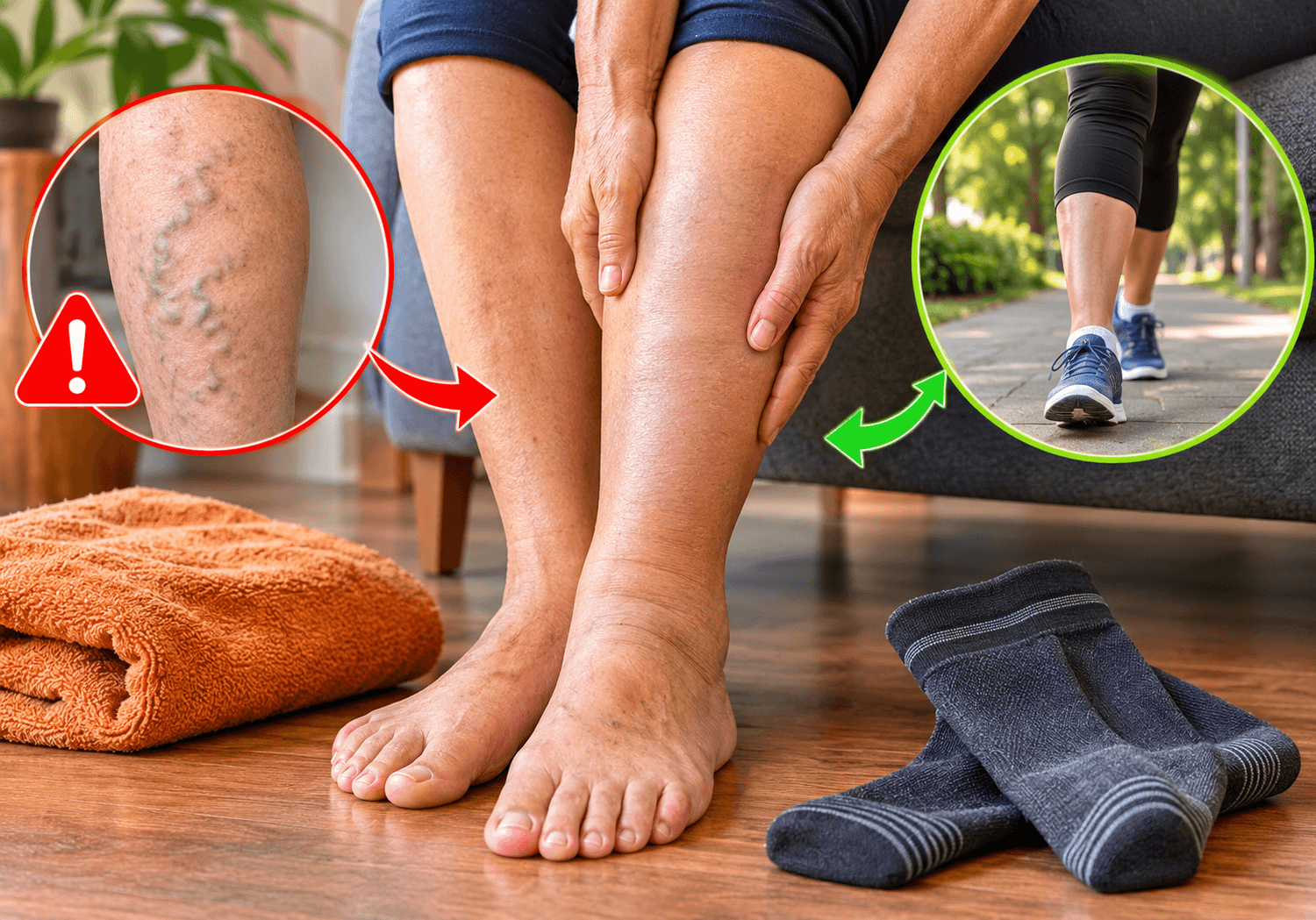
Your legs are supposed to feel warm, strong, and responsive after a good workout. Instead, you notice your toes turning pale, your calves cramping by mid-afternoon, or a small cut on your ankle that just will not heal. If you’ve been Googling signs of poor circulation in legs and what to do about them, you are not alone. Reduced blood flow to the lower extremities affects millions of adults, and the early warning signs are easy to dismiss until they become harder to ignore.
As a strength and conditioning coach, I work with clients every week who sit at a desk for eight hours, stand on their feet for a shift, or simply age into a body that no longer pumps blood as efficiently as it used to. The good news: in many cases, targeted movement, smart daily habits, and a few equipment tweaks can meaningfully improve leg blood flow. The bad news: some signs point to a condition that needs a doctor’s eyes before you start any exercise program. This guide walks you through both sides—what to look for and what to actually do about it.
Quick Answer: The most common signs of poor circulation in legs include cold or numb feet, swelling (edema), skin color changes (pale, blue, or mottled), slow-healing sores, unexplained calf cramps, and visible varicose veins. What to do: start a daily walking routine, add ankle pumps and calf raises to your warm-up, elevate your legs when resting, wear compression socks if recommended, and see a doctor if you notice open sores, sudden one-sided swelling, or chest pain with leg symptoms.
What Poor Circulation in Your Legs Actually Looks Like
” Poor circulation” is an umbrella term. It can mean your arteries are narrowing (peripheral arterial disease), your veins are struggling to push blood back up against gravity (venous insufficiency), or your tiny capillaries are not delivering oxygen efficiently (microcirculation problems). Each one shows up differently, and knowing the difference helps you pick the right fix.
According to the Mayo Clinic, peripheral artery disease (PAD) affects the arteries and often first shows up as pain or cramping in the calves, thighs, or hips during walking that eases with rest. Venous insufficiency, by contrast, tends to make legs feel heavy, swollen, and achy by the end of the day.
Here is a practical checklist. If you recognize two or more of these in your own legs, it is worth paying attention.
Swelling and Heaviness
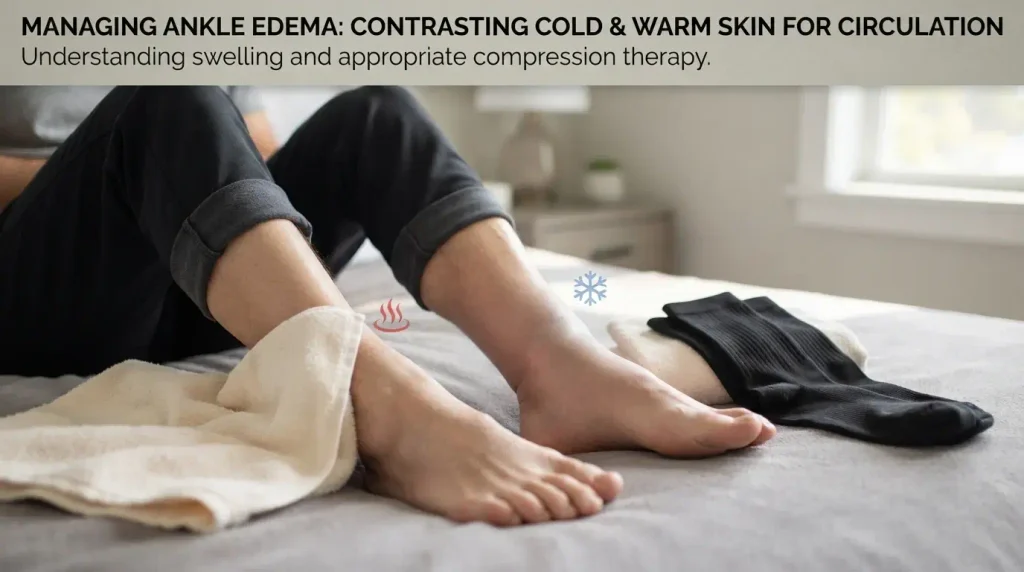
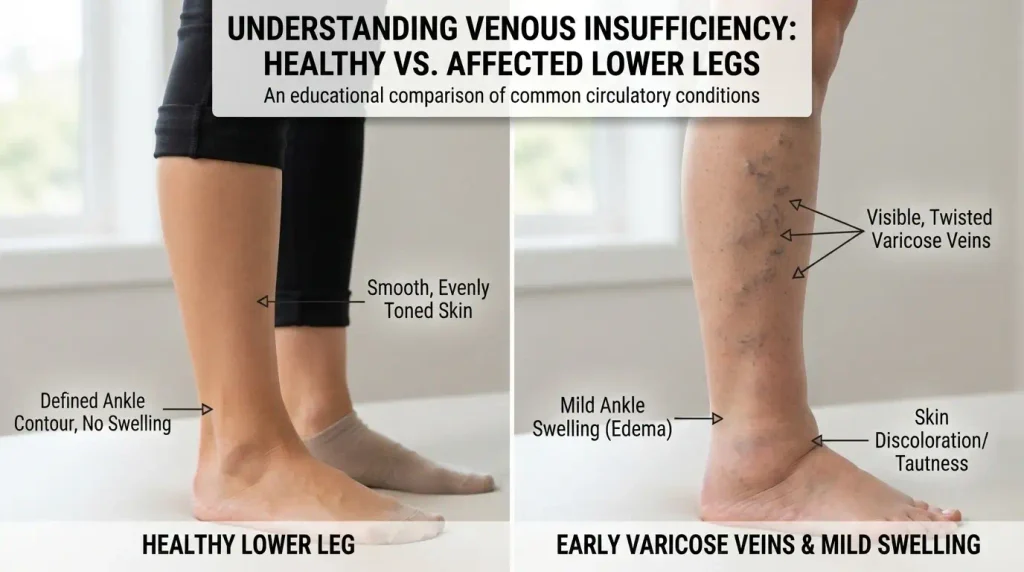
Fluid pools in the ankles, feet, or lower calves, especially after sitting or standing for a long stretch. You might notice your shoes feel tighter by 4 p.m. than they did in the morning, or a ring leaves a deep indent on your shin. The National Institutes of Health MedlinePlus entry on edema notes that mild, bilateral (both-legs) swelling is common with inactivity, but persistent or one-sided swelling deserves medical evaluation.
Cold Feet and Legs
Your toes or the tops of your feet feel noticeably colder than the rest of your body, even in a heated room. In arterial issues, the skin may look pale or waxy because less oxygenated blood is reaching the tissue. If one foot is cold and the other is warm, that asymmetry is a red flag worth mentioning to a doctor.
Numbness and Tingling
A “pins and needles” sensation in the soles of your feet or along the outside of your calves can signal that nerves are not getting enough blood supply. This is different from the temporary tingle when you sit cross-legged. If the numbness is constant, spreading, or paired with weakness, it may point to peripheral neuropathy or a compressed nerve rather than pure circulation.
Skin Color and Texture Changes
Healthy leg skin is warm and matches the tone of the rest of your body. With chronic poor circulation, you may notice:
- Pale or bluish toes (especially when legs are elevated)
- Reddish-purple discoloration on the lower shins and ankles
- Shiny, thin, or hairless skin on the shins
- Thickened, waxy patches (lipodermatosclerosis) in venous cases
Slow-Healing Sores and Wounds
A small scrape on your shin that should heal in a week is still scabbing over three weeks later. Open sores (ulcers) around the ankle or on the toes that do not close are a classic sign that blood flow is too low to support tissue repair. The Cleveland Clinic flags non-healing wounds as a reason to seek prompt medical care.
Muscle Cramps and Pain
Calf or foot cramps that wake you at night, or a burning, aching tightness in the calves that shows up after a short walk and goes away when you stop, can both be circulation-related. Intermittent claudication—the classic PAD symptom—feels like a muscle cramp that limits how far you can walk before you have to pause.
Varicose Veins and Spider Veins
Bulging, rope-like veins on the calves or inner thighs, or a web of tiny red/blue lines on the lower legs, are visible signs that venous valves are not closing properly. They are often cosmetic in mild cases, but they can progress to skin changes and ulcers if left unmanaged.
Why Circulation in Your Legs Gets Worse
Understanding the “why” helps you target the right fix. The most common contributors include:
- Prolonged sitting or standing. Your calf muscles act as a “second heart,” squeezing veins to push blood upward. When you sit still for hours, that pump stops, and blood pools in the lower legs.
- Aging. Arteries lose elasticity over time, and the tiny capillary networks in the feet can thin out, reducing oxygen delivery.
- Smoking and secondhand smoke. Nicotine constricts blood vessels and damages the endothelial lining of arteries, accelerating atherosclerosis.
- Diabetes and high cholesterol. Both accelerate arterial narrowing and damage small-vessel circulation.
- Obesity. Extra body mass increases pressure on veins in the pelvis and legs, making it harder for blood to flow back up.
- Dehydration and low iron. Both reduce blood volume or oxygen-carrying capacity, making the system work harder.
- Sedentary lifestyle. Without regular movement, the vascular system simply does not get the stimulus it needs to stay efficient.
The CDC’s Physical Activity Guidelines for Americans recommend at least 150 minutes of moderate aerobic activity and two days of muscle-strengthening work per week for adults. Meeting even a portion of that guideline is one of the most evidence-backed ways to support vascular health.
What to Do About Poor Circulation in Legs: Exercises That Help
This is where I put my coaching hat on. The goal is not to “blow off” bad circulation with a single heroic workout. The goal is to build a consistent, low-impact movement habit that gets the calf muscle pump working, opens up capillary beds, and strengthens the muscles that support your legs.
Important: If you have been diagnosed with PAD, deep vein thrombosis (DVT), or an active ulcer, get clearance from your doctor or physical therapist before starting any new exercise routine. The exercises below are for general circulation support, not treatment of a specific diagnosis.
1. Ankle Pumps (Seated or Standing)
This is the single highest-return movement for leg circulation. It flexes and extends the ankle, squeezing the soleus and gastrocnemius muscles and pumping venous blood upward.
How to do it:
- Sit in a chair with both feet flat on the floor, or stand holding a counter for balance.
- Slowly point your toes away from your body (plantar flexion) for a 2-second hold.
- Slowly pull your toes up toward your shins (dorsiflexion) for a 2-second hold.
- That is one rep. Keep the movement smooth, not jerky.
Prescription: 2 sets of 20 reps, 3 times per day (morning, mid-afternoon, evening). Rest 30 seconds between sets.
Easier version: Do it while seated in bed or on the couch with legs elevated on a pillow.
Harder version: Add a light resistance band (5–10 lb / 2–4.5 kg) looped around the ball of your foot and anchored to a sturdy post. Pull against the band during dorsiflexion.
Coach’s Tip: If you sit at a desk all day, set a phone alarm every 45 minutes to do 15 ankle pumps while you’re still in your chair. It takes 30 seconds and keeps the calf pump active. You will not believe how much it reduces that “heavy leg” feeling by 3 p.m.
2. Calf Raises (Standing)
The gastrocnemius and soleus are your primary venous-return muscles. Strengthening them directly improves the “pump” that moves blood out of your lower legs.
How to do it:
- Stand behind a sturdy table or chair, holding the edge for balance.
- Rise up onto the balls of your feet as high as you comfortably can.
- Hold the top position for 2 seconds, squeezing the calves.
- Lower your heels slowly (3 seconds) until they are just below floor level.
- That is one rep.
Prescription: 3 sets of 12–15 reps, 2–3 days per week. Rest 60 seconds between sets. Use a 2-1-3 tempo (2 seconds up, 1 second hold, 3 seconds down).
Easier version: Perform seated calf raises. Sit on a bench, place a light dumbbell (5–10 lb / 2–4.5 kg) or a water jug on your knees, and raise your heels while keeping your toes on the floor. This isolates the soleus, which is the deeper calf muscle that works at a 90-degree knee angle.
Harder version: Step onto a low box (6–8 in / 15–20 cm) and perform single-leg calf raises. Hold 2–5 lb (1–2.3 kg) in the opposite hand for balance. Aim for 3 sets of 10 per leg.
3. Seated Leg Extensions (Quad Focus)
Strong quadriceps and hamstrings support the hip and knee joints, reducing the compensatory strain on your lower-leg vessels. They also help you walk farther, which is the best long-term circulation exercise.
How to do it:
- Sit in a sturdy chair with feet flat on the floor.
- Slowly extend one leg forward until it is parallel to the floor.
- Hold for 2 seconds, squeezing the top of your thigh.
- Lower the leg back down over 3 seconds.
- Alternate legs.
Prescription: 2 sets of 12 per leg, 3 days per week. No added weight needed for most people.
Progression: Loop a light resistance band (10–15 lb / 4.5–7 kg) around the ball of your foot and anchor it under a heavy piece of furniture.
4. Walking Protocol
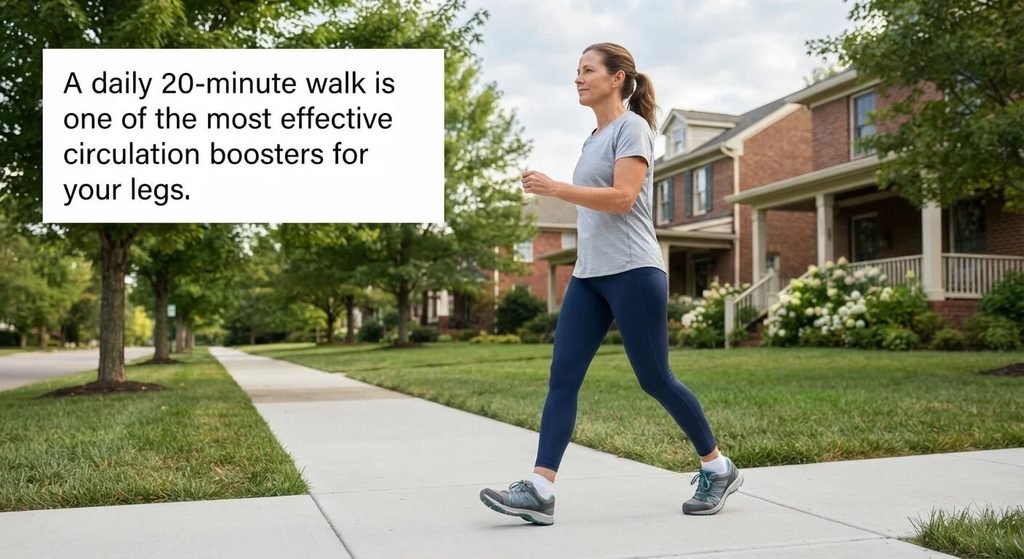
Walking is the gold-standard aerobic exercise for peripheral circulation. It is low-impact, free, and scalable. Research published in the Journal of the American Heart Association has linked regular walking to improved ankle-brachial index (a measure of arterial blood flow) in adults with mild PAD.
How to structure it:
- Weeks 1–2: Walk at a comfortable pace for 10–15 minutes, 5 days per week. Total distance: about 1–1.5 miles (1.6–2.4 km) per session.
- Weeks 3–4: Increase to 20–25 minutes per walk. Add 5 minutes of slow walking as a cool-down.
- Weeks 5–8: Aim for 30 minutes per walk, 5 days per week. If you feel calf tightness, stop, rest until it eases, then resume. Do not push through sharp pain.
- Ongoing: 30 minutes most days, with one or two longer walks (45–60 minutes) on the weekend.
Easier version: Walk in place at your kitchen counter for 5-minute intervals, 4–5 times a day.
Harder version: Add gentle hills or a 0.5–1 mph (0.8–1.6 km/h) treadmill incline. Alternatively, pick up the pace to a “brisk walk” where you can talk but not sing.
5. Leg Swings (Dynamic Warm-Up)
These open up the hip joint and get blood flowing through the hamstrings, glutes, and adductors before a longer walk or workout.
How to do it:
- Stand next to a wall or chair, holding it with one hand.
- Swing one leg forward and back in a controlled arc, keeping it straight but not locked.
- Let the momentum carry it; do not force the range.
- Do 10–12 swings, then switch legs.
- Repeat the movement side-to-side (lateral swings) for another 10 per leg.
Prescription: 2 rounds before any walking session or workout. No rest needed between directions.
Common Mistake: Swinging the leg hard and fast, using momentum from the torso instead of the hip. This can strain the lower back and does not improve circulation any more than a controlled swing does. Keep the arc small (about 30–45 degrees) and the tempo slow (about 2 seconds per swing).
Putting It Together: A 15-Minute Daily Circulation Routine
If you are just starting out, this is a simple, no-equipment routine you can do in a small apartment or at your desk:
| Order | Exercise | Sets × Reps | Rest |
| 1 | Ankle pumps (seated) | 2 × 20 | 30 sec |
| 2 | Seated leg extensions | 2 × 12 per leg | 30 sec |
| 3 | Standing calf raises | 3 × 12 | 45 sec |
| 4 | Leg swings (front-back + side-to-side) | 2 × 10 per leg | 20 sec |
| 5 | Walk in place or short walk | 5 min | — |
Total time: roughly 12–15 minutes. Do this once in the morning and once in the late afternoon for best results.
Daily Habits That Support Leg Blood Flow
Exercise is the engine, but these habits keep the system running smoothly between workouts:
- Elevate your legs. When you sit or lie down, prop your calves on a pillow so your feet are slightly above heart level for 15–20 minutes. This uses gravity to help venous return.
- Wear compression socks. Graduated compression stockings (15–20 mmHg for mild use) apply gentle pressure to the lower leg, supporting vein valves. Ask a pharmacist or doctor whether they are appropriate for you, especially if you have arterial disease.
- Stay hydrated. Aim for roughly 64–80 oz (1.9–2.4 L) of water daily, more if you are active or in a hot environment. Dehydrated blood is thicker and moves more slowly through small vessels.
- Move every 30–45 minutes. If your job requires long stretches of sitting or standing, set a timer. Stand up, do 10 ankle pumps, walk to the water cooler, or do a quick set of calf raises.
- Keep your feet warm. Cold causes vasoconstriction (narrowing of blood vessels). In winter, wear warm socks and avoid tight shoes that compress the toes.
- Manage weight. Even a modest reduction in excess body weight (5–10% of starting weight) can reduce pressure on the veins in your pelvis and legs, easing the workload on your circulatory system.
- Prioritize sleep. Poor sleep is linked to higher blood pressure and increased inflammation, both of which stress blood vessels. The Harvard T.H. Chan School of Public Health notes that consistent 7–9 hours of sleep supports overall cardiovascular and metabolic health. If you struggle with sleep quality, exploring how sleep affects metabolism and weight management can give you a broader picture of how rest ties into circulation.
When to See a Doctor: Red Flags You Should Not Ignore
Most mild, bilateral leg swelling and coldness can be managed with the habits and exercises above. But certain signs mean “stop self-treating and call a doctor”:
- Sudden swelling in one leg only, especially if it is red, warm, and tender. This can indicate a deep vein thrombosis (DVT), a blood clot that requires urgent treatment. The Cleveland Clinic’s DVT resource recommends seeking same-day medical care if you notice these symptoms.
- An open sore or ulcer on the foot or ankle that shows no sign of healing after 1–2 weeks.
- Rest pain in the toes or feet, especially at night, where elevating the leg makes the pain worse. This can indicate advanced arterial disease.
- Chest pain, shortness of breath, or jaw/arm pain accompanying leg symptoms. These can be signs of a cardiac event and require emergency care.
- Numbness, weakness, or loss of bladder/bowel control in the legs. This is a neurological emergency (cauda equina syndrome) and needs immediate attention.
If you have diabetes, a history of smoking, high cholesterol, or a family history of vascular disease, schedule a routine check-up and ask your doctor about an ankle-brachial index (ABI) test, a simple, non-invasive screening for PAD.
What NOT to Do
A few common “fixes” can actually make things worse:
- Do not massage a swollen or painful calf aggressively if you suspect a DVT. Massaging a clot can dislodge it.
- Do not use hot water bottles or heating pads directly on numb skin. Reduced sensation means you can burn yourself without realizing it.
- Do not sit cross-legged for long periods. It compresses the popliteal vein behind the knee and restricts flow to the lower leg.
- Do not wear tight shoes, garters, or compression garments that are the wrong size. They can act like a tourniquet.
- Do not start a high-intensity interval training (HIIT) program if you have unexplained leg pain or a new diagnosis of PAD. Get medical clearance first, then build up gradually.
What are the first signs of poor circulation in legs?
The earliest signs are usually cold or numb toes, mild ankle swelling by late afternoon, and a feeling of heaviness or tightness in the calves after sitting or standing. Skin on the shins may start to look shiny or lose hair. If you notice two or more of these consistently, it is worth monitoring and discussing with a doctor.
Can poor circulation in legs be reversed?
In many cases, yes—especially when the cause is inactivity, mild venous insufficiency, or early arterial narrowing. Consistent walking, calf-strengthening exercises, quitting smoking, managing blood sugar and cholesterol, and wearing compression socks can significantly improve blood flow. Advanced PAD or a DVT, however, requires medical treatment and cannot be “exercised away.”
How long does it take to improve leg circulation with exercise?
Most people notice reduced swelling and less “heaviness” within 2–3 weeks of a consistent daily walking and calf-raise routine. More meaningful improvements in arterial blood flow (measured by ABI) typically take 6–12 weeks of regular aerobic activity, according to exercise-rehabilitation protocols referenced by the American College of Sports Medicine.
Does walking really help poor circulation in legs?
Yes. Walking is the most studied and most accessible exercise for peripheral circulation. It activates the calf muscle pump, improves endothelial function (the lining of your blood vessels), and increases capillary density over time. Even 20–30 minutes of brisk walking most days is associated with measurable improvements in leg blood flow.
What shoes are best for poor circulation in legs?
Choose shoes with a wide toe box, low heel (less than 1 in / 2.5 cm), and good arch support. Avoid tight laces, pointed toes, or high heels that compress the forefoot. If you have swelling, go up a half-size or buy shoes in the late afternoon when your feet are at their largest.
Should I wear compression socks to bed?
Generally, no. Compression socks are designed for daytime use when you are upright. Lying down with compression on can restrict arterial inflow. Remove them before bed unless your doctor specifically tells you otherwise. If you have PAD, ask your doctor before using any compression garment, as external pressure can worsen arterial flow.
Conclusion: Your Legs Are Telling You Something—Listen and Move
Recognizing the signs of poor circulation in legs and what to do about them starts with paying attention to how your lower body feels on a regular basis. Cold toes, afternoon swelling, slow-healing scrapes, and calf cramps are not just “part of getting older.” They are signals that your vascular system needs support.
The practical path forward is straightforward: walk most days, add ankle pumps and calf raises to your routine, elevate your legs when you rest, stay hydrated, move every 45 minutes, and see a doctor if you notice red flags like one-sided swelling, open sores, or rest pain. You do not need a gym membership, expensive equipment, or a six-hour training block. You need consistency, a pair of comfortable walking shoes, and about 15 minutes a day.
If you are over 40 and looking for a broader framework that ties movement, metabolism, and daily habits together, my guide on how to increase metabolism naturally after 40 covers the same “move consistently, eat well, sleep enough” philosophy from a slightly different angle. And if you want to understand how the foods and nutrients you choose influence blood vessel health, the role of omega-3 fatty acids in reducing inflammation is worth a read.
Your legs carry you through every walk, every step up the stairs, every long day on your feet. Give them the movement and care they need, and they will keep up for years to come.