Picture yourself halfway through a heavy set of barbell back squats or pushing a weighted sled across gym turf. Your heart is pumping harder, your breathing is quick, and your working muscles need fresh oxygen and nutrients fast. That is where blood flow—and nitric oxide—enters the picture.
If you have seen citrulline malate on pre-workout labels, you probably hear big promises about muscle pumps and stamina. Understanding how does citrulline malate increase nitric oxide production helps you separate real physiology from gym hype. As a coach, I want you to know what happens inside your body so you can decide if it fits your training routine.
Before starting any new supplement, check with a doctor or physical therapist first, especially if you take blood pressure or heart medications or manage a health condition.
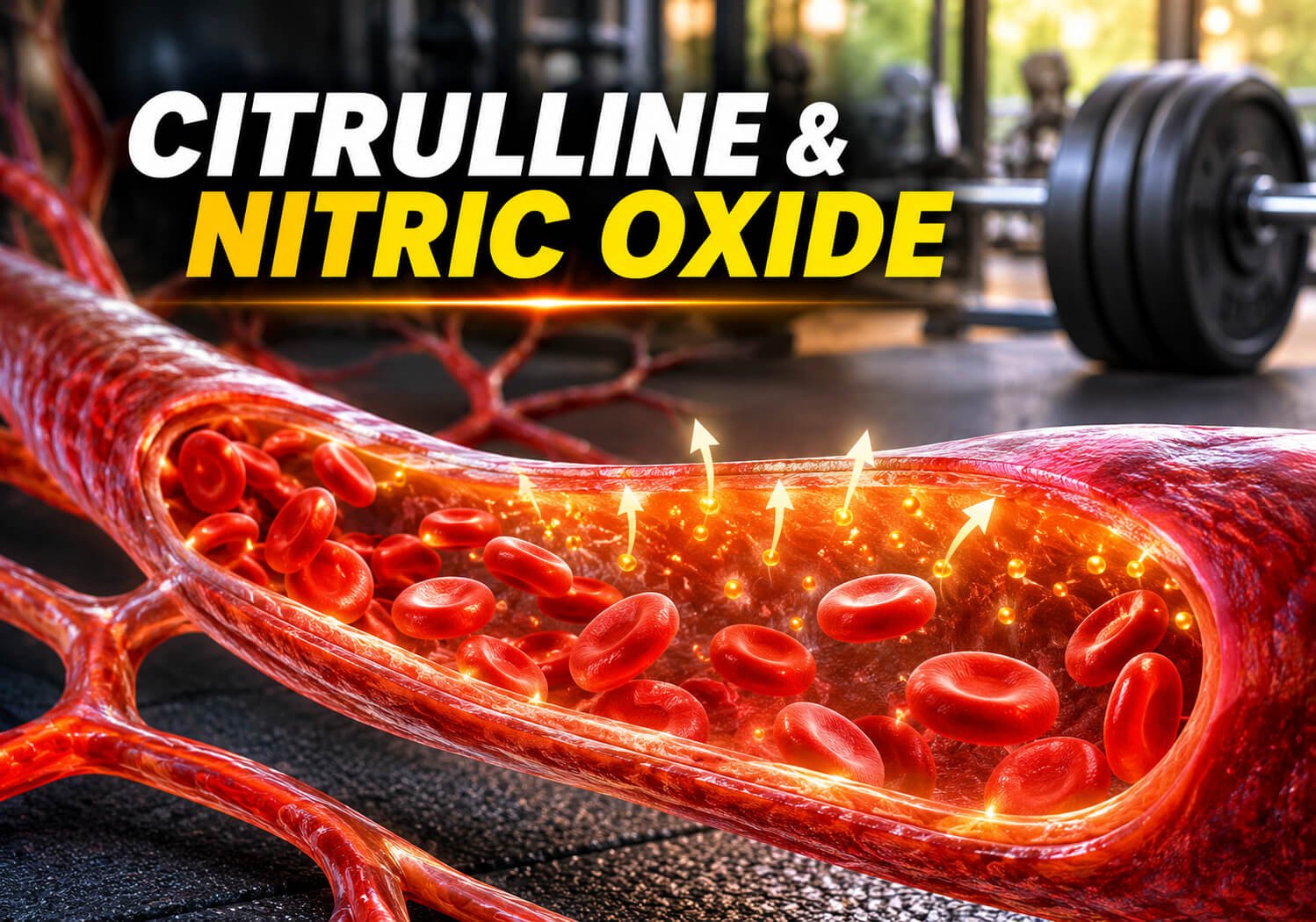
Quick Answer: Citrulline malate boosts nitric oxide production by delivering L-citrulline, which your kidneys convert into L-arginine. Higher L-arginine levels fuel nitric oxide synthase enzymes inside blood vessel linings, helping vessels relax and widen. The added malate component supports energy metabolism during exercise, while blood flow improvements may support training volume and recovery.
What Research Says About Citrulline Malate and Nitric Oxide
To see how does citrulline malate increase nitric oxide production, it helps to trace the biochemical pathway step by step. Nitric oxide is a short-lived signaling gas made inside the inner lining of your blood vessels, called the endothelium. When released, it signals smooth muscle in vessel walls to relax, a process known as vasodilation.
Research indexed on PubMed and the National Library of Medicine [VERIFY] shows that oral L-citrulline raises plasma L-arginine levels more reliably than taking L-arginine directly. Why? Much of supplemental L-arginine gets broken down in the gut wall and liver before ever reaching your bloodstream or working muscles.
The Citrulline-to-Arginine-to-Nitric-Oxide Pathway
Once you swallow citrulline malate, the L-citrulline travels to your small intestine and enters circulation. Rather than getting heavily degraded on the first pass through the liver, it reaches the kidneys and other tissues where enzymes convert L-citrulline back into L-arginine.
That newly formed L-arginine serves as the raw building block for nitric oxide synthase (NOS) enzymes. Inside endothelial cells, NOS converts L-arginine and oxygen into nitric oxide and L-citrulline. Guidance from National Institutes of Health dietary supplement resources [VERIFY] notes that nitric oxide helps regulate vascular tone and blood flow throughout the body.
Why Malate Is Paired With Citrulline
Citrulline malate combines L-citrulline with malic acid, often in a 2:1 or 1:1 ratio. Malate is an intermediate in the tricarboxylic acid (TCA) cycle, which helps cells generate usable energy (ATP) during aerobic and anaerobic work.
Studies published in peer-reviewed journals like Sports Medicine and the Journal of Strength and Conditioning Research [VERIFY] examine whether malate helps clear metabolic byproducts, such as lactate and ammonia, during repeated hard sets. While nitric oxide drives blood vessel relaxation, malate is aimed more at cellular energy support and fatigue resistance.
What Blood Flow Changes Actually Mean for Training
Widening blood vessels does not magically add ten pounds to your bench press in one afternoon. Instead, better blood flow can help deliver oxygen and nutrients to working muscles and clear waste products between sets.
In practical gym terms, that may help you squeeze out one or two extra reps on later sets of dumbbell bench presses or Romanian deadlifts. Over weeks and months of progressive overload, slightly higher quality training volume adds up—provided your sleep, protein, and program are solid.
Coach’s Tip: Treat citrulline malate as a small supporting player, not your main training engine. A solid warm-up, steady hydration, enough carbs around tough sessions, and progressive overload do far more for your lifts and conditioning than any scoop of powder.
Comparing Citrulline Malate, L-Citrulline, and L-Arginine
Lifters often compare citrulline malate with plain L-citrulline or L-arginine when building a pre-workout stack. Each form has a slightly different role, dose profile, and practical trade-off in the gym.
| Feature | Citrulline Malate | Pure L-Citrulline | L-Arginine |
| Main Ingredients | L-citrulline bound to malic acid | Free-form L-citrulline | Free-form L-arginine |
| Nitric Oxide Pathway | Converts to L-arginine, then fuels NOS | Converts to L-arginine, then fuels NOS | Direct substrate, but higher first-pass breakdown |
| Typical Pre-Workout Dose | Often 6–8 g (providing ~3–5 g L-citrulline) [VERIFY] | Often 3–6 g before training [VERIFY] | Often 3–6 g, with less consistent plasma rise [VERIFY] |
| Extra Energy Component | Includes malate for TCA cycle support | None (pure amino acid) | None (pure amino acid) |
| Best Fit for Lifters | High-rep lifting, circuits, and mixed conditioning | Straightforward nitric oxide support without acid | Basic amino acid option if tolerated well |
Keep in mind that an 8 g scoop of 2:1 citrulline malate contains roughly 5.3 g of citrulline and 2.7 g of malate. Reading the supplement facts panel saves you from under-dosing or accidentally taking more than you intend.
You can see how broader metabolic and energy support fits into your routine in our guide on which nutrients support normal energy metabolism.
How to Apply Citrulline Malate in Real Workouts
Knowing how does citrulline malate increase nitric oxide production is only half the job; using it smartly in a real session is the other half. Most lifters and endurance athletes take citrulline malate about 30 to 60 minutes before training with 8 to 12 fl oz (about 240 to 350 mL) of water.
If you are trying it for the first time, start on the lower end of the label’s range to see how your stomach handles it. Malic acid has a tart taste and can occasionally feel heavy on an empty stomach if you mix it too concentrated.

Sample Lower-Body and Conditioning Session
Here is how a practical 45-minute strength and conditioning workout looks where blood flow and muscular endurance matter. Adjust load selection so you leave 1 to 2 clean reps in reserve on strength sets.
- Barbell Back Squat: 4 sets of 6–8 reps, resting 2–3 minutes between sets. Focus on bracing your core, lowering under control, and driving evenly through mid-foot as your quadriceps, glutes, and hamstrings work.
- Romanian Deadlift: 3 sets of 8–10 reps, resting 90–120 seconds. Push your hips back smoothly while keeping a slight knee bend until you feel a clear hamstring stretch, then stand tall.
- Dumbbell Bench Press: 3 sets of 10–12 reps, resting 90 seconds. Lower dumbbells with elbows roughly 45 degrees from your torso to challenge your pectorals, deltoids, and triceps.
- Lat Pulldown or Chest-Supported Row: 3 sets of 10–12 reps, resting 60–90 seconds. Pull with your elbows to engage your latissimus dorsi and mid-back without swinging your chest.
- Sled Push or Rowing Machine Intervals: 6 rounds of 30–40 seconds hard effort (or about 0.1 to 0.2 miles / 0.16 to 0.32 km on a rower), resting 60–90 seconds between rounds. Keep your spine tall and drive smoothly through your legs and calves.
Scaling Easier (Regression) and Harder (Progression)
Every workout should match your current fitness level and joint comfort. If the circuit above feels too intense, scale down without losing the training habit.
- Easier Version (Regression): Swap barbell back squats for goblet squats holding a 15–30 lb (6.8–13.6 kg) dumbbell at your chest. Cut sled pushes or rowing intervals to 4 rounds of 20 seconds with a full 90-second rest, or walk briskly for 0.5 miles (0.8 km) on a treadmill.
- Harder Version (Progression): Add 5–10 lb (2.3–4.5 kg) to your squat or Romanian deadlift when you hit the top of your rep range with clean form. Shorten rest on accessory lifts to 60 seconds, or push a 90–135 lb (40.8–61.2 kg) loaded sled across a 50-foot (15.2 m) lane for extra rounds.
Common Mistake: Chasing a massive “pump” by dropping weights too light and rushing sloppy reps. Blood flow helps support hard work, but real strength and muscle growth come from controlled tension, full range of motion, and steady progression over time.

Safety Notes, Side Effects, and Smart Habits
Evidence-based sports nutrition guidelines from organizations like the American College of Sports Medicine [VERIFY] emphasize starting with whole foods, hydration, and structured training before adding performance supplements. Even when an ingredient has solid mechanistic support, individual tolerance varies.
Potential Side Effects and Who Should Use Caution
Most healthy adults tolerate citrulline malate well at standard pre-workout doses, though mild digestive upset, stomach cramping, or nausea can happen. Taking it with a small carbohydrate snack rather than on a completely empty stomach often solves mild stomach discomfort.
Because nitric oxide promotes vasodilation, anyone with low blood pressure, cardiovascular disease, kidney issues, or a prescription for nitrates, blood pressure drugs, or erectile dysfunction medications should speak with a healthcare provider first. Exercise recommendations from the Centers for Disease Control and Prevention [VERIFY] also remind adults to pair aerobic activity with at least two days of muscle-strengthening work per week for broad health benefits.
Related Habits That Support Blood Flow Naturally
You do not need a supplement tub to support healthy circulation and stamina. Simple daily habits do heavy lifting behind the scenes:
- Drink water consistently: Even mild dehydration reduces blood volume and makes moderate workouts feel much harder.
- Eat nitrate-rich whole foods: Vegetables like beets, arugula, and spinach provide dietary nitrates that follow a complementary nitric oxide pathway.
- Prioritize sleep and aerobic base work: Regular cardio and 7–9 hours of sleep support healthy vascular function and workout recovery.
If you are sorting through other workout or metabolic ingredients, see our breakdown on which supplements support metabolism without stimulants and how to evaluate ingredients in weight management supplements. You can also check practical guidance on how to improve daily energy without caffeine and how to increase energy and stamina naturally.
For broader training and physique context on xbodyshape.org, pair smart conditioning with consistent resistance training and recovery rather than relying on quick fixes.

Frequently Asked Questions
How does citrulline malate increase nitric oxide production in the body?
Citrulline malate supplies L-citrulline, which bypasses heavy breakdown in the gut and liver and converts into L-arginine. Higher L-arginine availability supports nitric oxide synthase enzymes in blood vessel linings, increasing nitric oxide production so blood vessels can relax and widen during physical activity.
Does citrulline malate increase blood flow during lifting?
Research suggests citrulline malate may support blood flow and vascular relaxation during exercise by raising L-arginine and nitric oxide availability. While this can enhance the muscle pump and nutrient delivery during resistance training, individual responses vary depending on dose, training intensity, and baseline health.
How much citrulline malate should I take before a workout?
Many sports nutrition studies use roughly 6 to 8 grams of citrulline malate taken 30 to 60 minutes before exercise [VERIFY]. Always check your specific product label, follow a healthcare provider’s advice if you take medications, and test tolerance gradually on training days.
Is citrulline malate better than L-arginine for nitric oxide?
Studies often favor citrulline over L-arginine for raising blood L-arginine levels because more L-citrulline survives initial digestion and converts steadily in the body. Adding malate also pairs nitric oxide support with a compound involved in cellular energy metabolism.
How long does citrulline malate take to work?
Taken 30 to 60 minutes before a workout, citrulline begins raising L-arginine levels within about an hour [VERIFY]. Most people judge its practical training value over one to two weeks of consistent workouts rather than from a single session.
Should I take citrulline malate on rest days?
You do not strictly need citrulline malate on rest days if your primary goal is supporting blood flow and performance during workouts. Some people still take it on non-training days for consistency, though whole foods, hydration, and recovery remain the top priorities.

Conclusion
Understanding how does citrulline malate increase nitric oxide production makes it easier to view the supplement realistically: it feeds the L-arginine to nitric oxide pathway while malate helps support cellular energy during hard work. It can be a useful extra tool for lifters and conditioning athletes, especially during high-volume sessions.
Still, no powder replaces progressive strength training, smart pacing, adequate protein, hydration, and quality sleep. Build those habits first, use citrulline malate intentionally if it fits your goals and medical clearance, and keep showing up consistently.