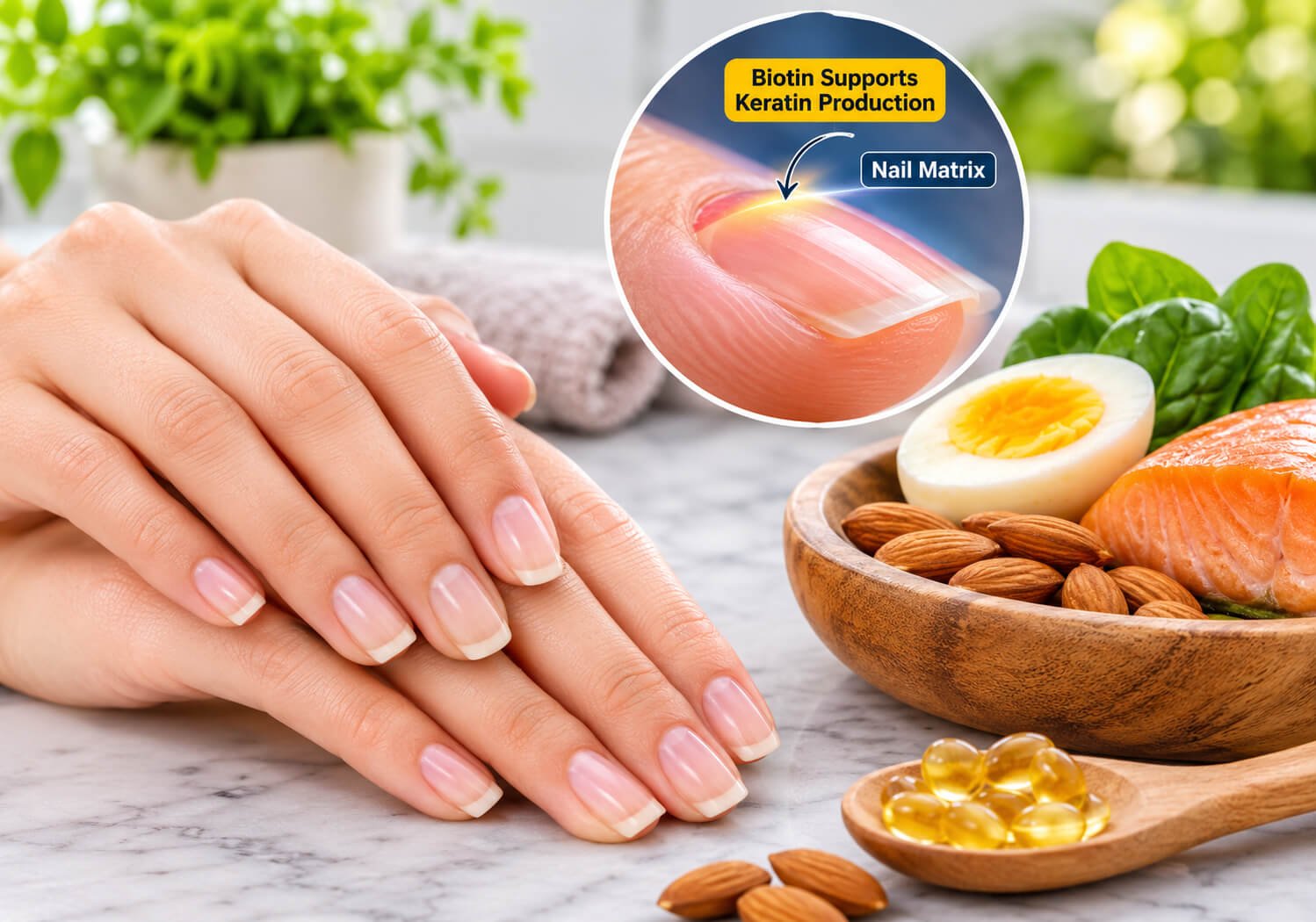
Your nails crack, peel, or split down the middle every time you try to open a jar. You’ve tried strengthening polishes, cuticle oil, and even a new diet, but the brittleness keeps coming back. You start Googling “does biotin help strengthen brittle nails” and land on a dozen contradictory articles. Some swear it’s a miracle. Others say it’s a total waste of money.
Here’s the honest, evidence-based answer. Biotin (vitamin B7) plays a real role in keratin production, the protein that makes up your nail plate. A small but well-designed clinical trial found that daily biotin supplementation improved nail growth rate and reduced splitting in people with brittle nail syndrome. That said, the evidence base is still thin, and biotin will not fix every cause of weak nails.
This guide breaks down what the research shows, how much to take, how long to wait before you see a change, and what else actually matters for nail strength. By the end, you’ll know whether a biotin supplement belongs in your routine or whether your brittle nails need a different fix.
Quick Answer:
Research suggests biotin (vitamin B7) may help strengthen brittle nails. A 2017 double-blind, placebo-controlled trial found that 2.5 mg of biotin daily improved nail growth rate and reduced splitting in participants with brittle nail syndrome. Results typically appear after 6–12 weeks. However, biotin works best when a mild deficiency exists or as one part of a broader nail-care strategy. Check with a doctor before starting any supplement.
What Biotin Actually Does in Your Body
Biotin is a water-soluble B vitamin that your body cannot store in large amounts. It acts as a coenzyme for four carboxylase enzymes involved in fatty acid synthesis, amino acid breakdown, and glucose production, according to the NIH Office of Dietary Supplements.
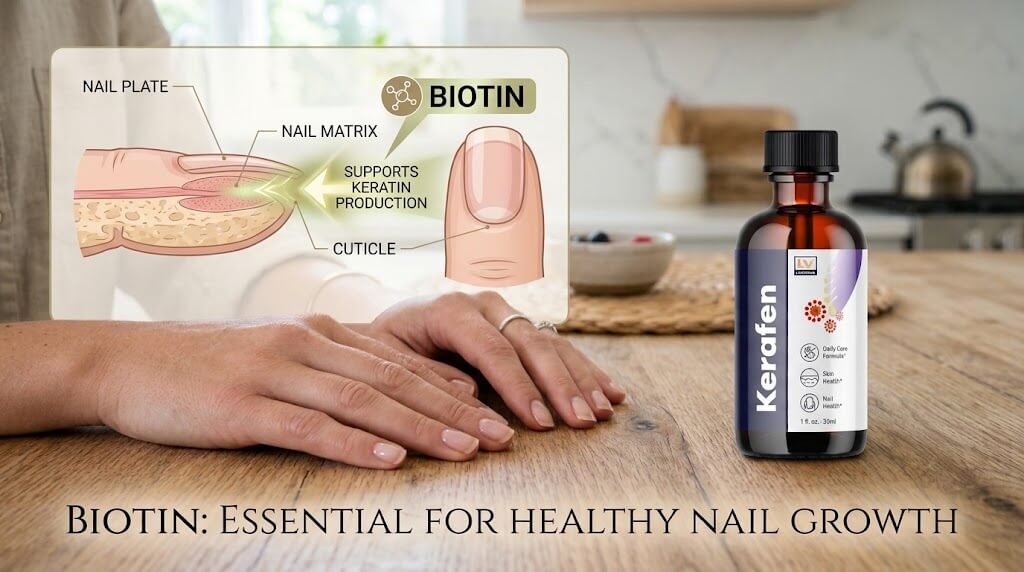
For your nails specifically, biotin supports the keratinocytes in the nail matrix—the tiny area under your cuticle where new nail cells are manufactured. Keratin is a tough, fibrous protein built from sulfur-containing amino acids like cysteine and methionine. Biotin-dependent enzymes help process the fatty acids and amino acids that feed those keratin-building cells.
Think of it this way: your nail matrix is a factory. Biotin is one of the tools on the assembly line. If the tool is missing or underused, the product (your nail plate) comes out weaker and more prone to splitting.
The recommended daily allowance (RDA) for biotin in adults is 30 micrograms (mcg), set by the NIH. Most people who eat a varied diet get well above that number from food alone.
What the Research Says About Biotin and Brittle Nails
Let’s separate the hype from the data.
The key clinical trial. A 2017 randomized, double-blind, placebo-controlled study published in the International Journal of Dermatology enrolled 41 women with brittle nail syndrome. Participants took either 2.5 mg (2,500 mcg) of biotin daily or a placebo for 6 to 9 months. The biotin group showed a statistically significant increase in nail growth rate and a measurable reduction in nail fragility compared to placebo, as reported in PubMed / PMC.
What the study did NOT show. The trial was small (41 participants), lasted only 6–9 months, and included only women with a pre-existing brittle nail diagnosis. It was not a long-term study, and it did not test biotin in people with normal nails or in men.
Broader context. The Mayo Clinic notes that biotin deficiency is rare in people who eat a balanced diet. True deficiency is most often seen in people with biotinidase deficiency (a genetic condition), long-term antibiotic use, uncontrolled diabetes, or severe malnutrition. If you do not have a deficiency, adding extra biotin may offer little beyond what your diet already provides.
Where the evidence is still thin. No large-scale, multi-year trial has confirmed biotin as a standalone treatment for onychoschizia (the medical term for brittle, splitting nails). Dermatology guidelines from the American Academy of Dermatology do not currently list biotin as a first-line treatment, though they acknowledge it as a reasonable adjunct.
Bottom line: Biotin is not a miracle cure, but the available evidence supports a modest benefit for people with brittle nails, especially those with a mild subclinical deficiency. It works best as one piece of a larger strategy.
How Much Biotin Do You Need? Dosage and Timing
The table below summarizes what the research and clinical guidance suggest.
| Goal | Typical Dose | Duration to See Change | Notes |
| Maintain adequate intake (no deficiency) | 30 mcg (RDA) | N/A | Usually met through diet alone |
| Support brittle nails (per 2017 trial) | 2,500 mcg (2.5 mg) | 6–12 weeks | Take with a meal for consistency |
| Upper range seen in supplements | 5,000–30,000 mcg | 3–6 months | No established upper limit; higher doses not proven superior |
| Biotinidase deficiency (medical condition) | 5–20 mg (prescribed) | Ongoing | Requires medical supervision |
A few practical notes:
- Start at 2,500 mcg. This is the dose used in the clinical trial. There is no strong evidence that 10,000 or 30,000 mcg works better.
- Give it at least 8 weeks. Nails grow about 3.5 mm (about 1/8 inch) per month. You need several growth cycles before a supplement can show up in the visible nail plate.
- Take it consistently. Biotin is water-soluble, so your body does not store it. Daily intake matters more than an occasional large dose.
- Stop before blood work. Biotin at doses above 5,000 mcg can interfere with certain lab tests, including thyroid panels and troponin (heart) assays, according to the NIH ODS. Talk to your doctor if you have upcoming lab work.
Coach’s Tip:
I always tell clients to track one variable at a time. If you start biotin, keep your nail-care routine, diet, and hydration the same for at least 8 weeks. That way, if your nails look better, you actually know what helped. Take a photo of your nails on day 1, day 30, and day 60 so you have a visual reference.

How to Apply It: A Practical 12-Week Plan for Brittle Nails
Biotin alone rarely fixes a nail problem. Here is a step-by-step plan that layers biotin into a broader routine.
Week 1–2: Assess and Baseline
- See a doctor or dermatologist if your nails are severely cracked, discolored, painful, or changing shape. Rule out fungal infection, psoriasis, thyroid issues, or iron/zinc deficiency first.
- Take a baseline photo of both hands in natural light.
- Review your diet. Are you getting enough protein (aim for about 0.8 g per kg of body weight daily), iron, zinc, and omega-3 fatty acids?
- Start a biotin supplement at 2,500 mcg daily, taken with your largest meal.
Week 3–6: Build the Foundation
- Hydrate. Aim for about 2 liters (roughly 68 oz) of water daily. Dehydrated nail plates are more prone to peeling.
- Wear gloves for dishes, cleaning, and anything with harsh chemicals.
- Moisturize the cuticle daily with a simple oil (jojoba, almond, or a dedicated cuticle oil).
- Avoid nail-biting, picking, and using nails as tools.
- Eat biotin-rich foods (see table below) at least 4–5 times per week.
Week 7–12: Evaluate and Adjust
- Compare your nail photos. Look for less splitting, smoother edges, and faster growth.
- If improvement is minimal, go back to your doctor. Your brittleness may be driven by something biotin cannot fix (e.g., hypothyroidism, anemia, eczema).
- If you see progress, continue the routine. You can taper the supplement after 3–4 months and see if diet alone maintains the benefit.
Common Mistake:
Buying a 30,000 mcg biotin gummy and expecting your nails to look different in two weeks. Nails grow slowly. The keratin produced in week one will not reach the free edge of your nail for 6 to 10 weeks. Patience is not optional here. Also, gummies often contain added sugar and fillers; a plain capsule or tablet at 2,500 mcg is cleaner and cheaper.
Foods Rich in Biotin and Other Nail-Supporting Nutrients
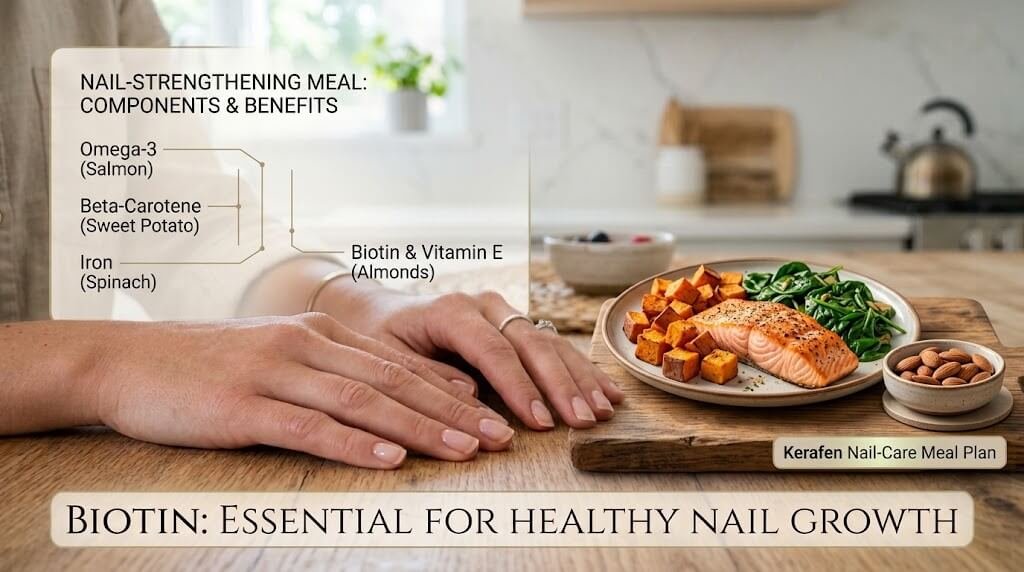
You do not have to rely on a pill. A well-rounded diet can cover your biotin needs and supply the other building blocks your nails require.
| Food (1 serving) | Biotin (mcg) | Other Nail-Relevant Nutrients |
| 3 large egg yolks | ~30–36 | Protein, choline, vitamin D |
| 1 oz (28 g) roasted almonds | ~10–15 | Vitamin E, magnesium, protein |
| 1 oz (28 g) walnuts | ~5–7 | Omega-3 (ALA), vitamin E |
| 1 cup (150 g) cooked sweet potato | ~5–8 | Vitamin A, fiber |
| 3 oz (85 g) cooked salmon | ~5–7 | Omega-3 (EPA/DHA), protein, vitamin D |
| 1 cup (170 g) cooked spinach | ~5–10 | Iron, folate, vitamin K |
| 1 cup (190 g) cooked mushrooms (portobello) | ~10–15 | Selenium, protein |
| 1 cup (158 g) cooked chickpeas | ~7–10 | Protein, iron, zinc, folate |
Values are approximate ranges based on USDA FoodData Central. Individual values vary by variety, cooking method, and soil.
Protein matters as much as biotin. Keratin is a protein. If you are not eating enough protein—especially sulfur-containing amino acids like cysteine and methionine—no amount of biotin will build strong nails. Aim for a palm-sized portion of protein (chicken, fish, eggs, tofu, legumes) at each main meal. You can learn more about how protein supports overall tissue health in our guide to protein intake and metabolism.
Iron and zinc are often overlooked. Low iron (ferritin below 30 ng/mL) and low zinc are both linked to brittle, spoon-shaped, or ridged nails. If your diet is low in red meat, shellfish, or legumes, a doctor may recommend a targeted supplement.
Safety Notes: Who Should Be Cautious
Biotin is generally safe at doses up to 30,000 mcg, and the NIH has not set an upper tolerable limit because excess biotin is excreted in urine. That said, a few groups need extra care:
- People with upcoming lab tests. As noted, high-dose biotin can skew thyroid (TSH, free T4) and cardiac (troponin) results. The FDA issued a safety communication about this interference. Stop biotin at least 72 hours before blood work, or inform your lab.
- People with biotinidase deficiency. This rare genetic condition prevents the body from recycling biotin. It requires medical management with prescribed biotin (5–20 mg) and monitoring by a metabolic specialist. Do not self-treat.
- Pregnant or breastfeeding women. Biotin is safe at the RDA (30 mcg) and is included in most prenatal vitamins. Higher supplemental doses (2,500+ mcg) are not harmful in most cases, but check with your OB-GYN first.
- People taking certain medications. Long-term valproic acid (an anti-seizure drug) and some antibiotics can deplete biotin. Talk to your prescribing doctor before adding a supplement.
- People with kidney disease. Biotin is cleared by the kidneys. If you have reduced kidney function, your doctor should guide dosing.
If your brittle nails are accompanied by hair loss, fatigue, skin rashes, or changes in nail color/shape, see a doctor before starting any supplement. Brittle nails can be a sign of thyroid disorder, anemia, psoriasis, or a fungal infection—conditions that need specific treatment, not a vitamin.
This article is for general information and is not a substitute for advice from a doctor or physical therapist.
Related Tips for Stronger Nails Beyond Biotin
Biotin is one lever. Here are the others that move the needle:
- Protect your nails from water and chemicals. Chronic wetness softens the nail plate and invites peeling. Wear rubber gloves for dishes, laundry, and cleaning.
- Trim and file in one direction. Filing back-and-forth creates micro-cracks. Use a fine-grit (180+) file and stroke from the side toward the center.
- Use a base coat with actual structural benefit. Look for formulas with keratin, calcium, or vitamin E. Avoid “drying” top coats with formaldehyde or toluene.
- Stay hydrated and eat enough calories. Severe caloric restriction or chronic dehydration makes nails (and skin) more fragile. If you are in a calorie deficit for weight management, make sure you are still hitting your protein and micronutrient targets. You can read more about supporting metabolism naturally while protecting your overall nutritional status.
- Manage eczema and psoriasis. Skin conditions around the nail fold (the matrix area) directly affect nail quality. A dermatologist can prescribe topical treatments that protect the matrix.
- Get enough sleep. Your body repairs tissue during deep sleep. Chronic sleep deprivation is linked to higher inflammation and slower tissue turnover. Our guide on how sleep affects metabolism and weight management covers the hormonal side, but the tissue-repair angle is just as important for nails.
- Limit alcohol and smoking. Both reduce blood flow to the nail matrix and deplete B vitamins over time.
Can Too Much Biotin Hurt Your Nails?
There is no well-documented case of biotin causing brittle nails at any dose. The main risks of very high doses (10,000–30,000 mcg) are:
- Interference with lab tests (thyroid, troponin, some hormone panels).
- Rare skin reactions (acne-like rash), though this is uncommon.
- Wasted money. Doses far above 2,500 mcg have not shown additional nail benefit in the available literature.
If you take biotin and notice new breakouts or unusual lab results, stop the supplement and talk to your doctor.
FAQ
How much biotin should I take for brittle nails?
The dose used in the 2017 clinical trial was 2,500 mcg (2.5 mg) per day. Start there with a meal. Doses up to 30,000 mcg are generally considered safe, but higher amounts have not shown additional nail benefit. Check with your doctor before exceeding 5,000 mcg, especially if you have upcoming blood work.
How long does biotin take to work for nails?
Expect 6 to 12 weeks before you notice a visible difference. Nails grow roughly 3.5 mm (about 1/8 inch) per month, so the keratin produced in the first few weeks will not reach the free edge until later. Consistency matters more than the dose.
Do I need a biotin deficiency to benefit from supplementation?
Not necessarily. The 2017 trial included participants with brittle nail syndrome, not confirmed biotin deficiency. However, the effect was modest. If your diet already provides 30+ mcg daily, the added benefit of a supplement may be small. Biotin works best as part of a broader nail-care strategy.
Does biotin help with hair loss too?
Biotin is included in many hair-loss supplements, but the evidence for hair specifically is weaker than for nails. A 2017 review in Dermato-Endocrinology noted limited data. Biotin may help hair thinning caused by a true deficiency, but it is not a proven treatment for androgenetic alopecia or other common hair-loss types.
Can I get enough biotin from food alone?
For most people, yes. The RDA is 30 mcg, and a diet that includes eggs, nuts, sweet potatoes, salmon, and mushrooms typically covers that. Supplementation makes more sense if your diet is very limited, you have a medical condition that impairs absorption, or a doctor recommends it for brittle nails.
Is biotin safe to take every day long-term?
Biotin is water-soluble, and the body excretes excess in urine. No upper limit has been established by the NIH. That said, if you take high doses (5,000+ mcg) regularly, inform your doctor and lab before any blood test. For most people, 2,500 mcg daily for 3–4 months, then reassessing, is a sensible approach.
Conclusion: Does Biotin Help Strengthen Brittle Nails?
The short answer is yes, with caveats. The best available evidence—a small but well-controlled 2017 trial—shows that 2,500 mcg of biotin daily can improve nail growth rate and reduce splitting in people with brittle nail syndrome. The effect is real but modest, and it takes 6 to 12 weeks to show up.
Biotin is not a standalone fix. It works as one component of a strategy that includes adequate protein, iron, zinc, hydration, protection from chemicals, and treatment of any underlying medical condition. If your nails are severely brittle, changing color, or painful, see a doctor or dermatologist before reaching for a supplement bottle.
Start with 2,500 mcg daily, eat a balanced diet rich in eggs, nuts, fish, and vegetables, protect your hands, and give it at least two months. Track your progress with photos. If you see improvement, great. If not, your doctor can help identify the real cause.
Your nails are a window into your overall nutrition and health. Biotin is a reasonable tool in that toolbox—just not the only one.