Fatigue mid-set. That 2 p.m. brain fog. Running out of gas on the last mile of a bike ride. If any of that sounds familiar, you are not alone. As a strength and conditioning coach, I see it constantly: people showing up to the gym or the trail running on four hours of sleep, a skipped lunch, and a glass of coffee, then wondering why their performance flatlines.
Supplements can fill small gaps, but they are not magic. The best supplements for energy and stamina work by supporting the body’s existing energy pathways—helping your mitochondria make ATP, keeping your blood oxygen-rich, or smoothing out the cortisol spikes that drain you by afternoon. They work best when your sleep, nutrition, and training load are already on track.
Below, I break down ten supplements with the strongest evidence base for supporting daily energy and workout stamina. For each one, you will get the mechanism, a practical dose, timing, and who should (and should not) take it.
Quick Answer: The best supplements for energy and stamina include a B-vitamin complex, creatine monohydrate, caffeine (200–400 mg), beta-alanine, L-citrulline, CoQ10, magnesium, iron (if deficient), electrolytes, and an adaptogen like rhodiola rosea. No single pill replaces sleep and food, but these ten have the most research behind them for supporting ATP production, oxygen delivery, and fatigue resistance.
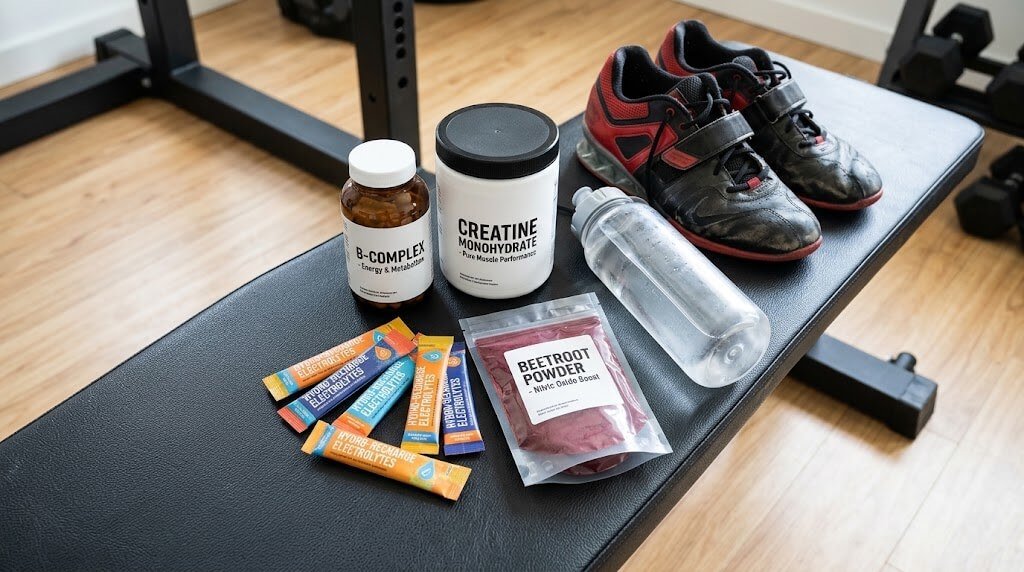
1. B-Vitamin Complex (B6, B12, Folate)
Why it works: Your cells convert the food you eat into usable energy (ATP) through a series of chemical reactions. B vitamins act as coenzymes in those reactions. Without adequate B6, B12, and folate, the process slows, and you feel sluggish even if you ate enough calories. The National Institutes of Health (NIH) Office of Dietary Supplements notes that B12 is essential for red blood cell formation and neurological function, both of which tie directly to how “wired” you feel.
Who benefits most: People on low-carb or plant-based diets, adults over 50 (absorption of B12 declines with age), and anyone who has been told their B12 or folate levels are borderline.
Practical dose and timing:
- A standard B-complex providing 100% of the Daily Value for B1, B2, B3, B6, B12, and folate.
- Take with your first meal of the day (breakfast or a pre-workout snack) so the vitamins are available when your training load peaks.
- B12 specifically: 2.4–6 mcg per day for most adults. If you are vegan or have a diagnosed deficiency, your doctor may recommend 50–100 mcg sublingual or injectable B12.
What to look for on the label: Methylcobalamin (the active form of B12) rather than cyanocobalamin if you want the most bioavailable option. Methylfolate instead of folic acid if you carry an MTHFR gene variant.
Coach’s Tip: If you already take a multivitamin that covers B vitamins, you do not need a separate B-complex. Check the label. Duplicating B12 at very high doses (over 1,000 mcg daily long-term) is not harmful for most people, but it can mask a deficiency that a doctor should actually diagnose.
2. Creatine Monohydrate
Why it works: Creatine is stored in your skeletal muscle as phosphocreatine. During short, high-intensity efforts—sprinting, heavy lifting, the last five reps of a set—your muscles burn through ATP in seconds. Phosphocreatine donates a phosphate group to ADP to rapidly regenerate ATP. More creatine in the muscle = more “fuel in the tank” for those explosive bursts. A large body of research reviewed in the Journal of the International Society of Sports Nutrition supports creatine as one of the most effective legal ergogenic aids for strength and power output.
Who benefits most: Anyone doing resistance training, HIIT, or sports with repeated sprints (soccer, basketball, tennis). It also shows emerging support for cognitive stamina under sleep restriction.
Practical dose and timing:
- Loading (optional): 20 g/day split into four 5-g doses for 5–7 days.
- Maintenance: 3–5 g (about one level teaspoon) per day, any time. Consistency matters more than timing.
- Mix with water or a post-workout shake. No need to cycle.
What to look for: Creatine monohydrate powder (Creapure or equivalent third-party tested). You do not need “creatine HCL” or “creatine ethyl ester”—the plain monohydrate form is the most studied and the most cost-effective.
Safety note: Creatine is safe for healthy adults at 3–5 g/day. People with pre-existing kidney disease should talk to a doctor before starting.
3. Caffeine (in Supplement Form)
Why it works: Caffeine blocks adenosine receptors in the brain. Adenosine is the neurotransmitter that builds up during the day and makes you feel drowsy. By blocking it, caffeine reduces perceived exertion, sharpens focus, and can improve both aerobic and anaerobic performance. The American College of Sports Medicine (ACSM) position stand on nutrition and the competitive athlete recognizes caffeine as a well-supported ergogenic aid at doses of 3–6 mg per kg of body weight.
Who benefits most: Anyone who wants a pre-workout edge or needs to push through a long cardio session. Also useful for the mid-afternoon slump if you cannot nap.
Practical dose and timing:
- 3–6 mg/kg body weight, taken 30–60 minutes before exercise. For a 165-lb (75-kg) person, that is roughly 225–450 mg.
- For all-day energy without a workout, 100–200 mg (about one small cup of coffee) in the morning and, if needed, 100 mg early afternoon.
- Avoid caffeine after 2 p.m. if you are sensitive, because it can disrupt sleep architecture and make the next day’s fatigue worse.
What to look for: Caffeine anhydrous powder or capsules (100 mg or 200 mg per capsule). Pre-workout formulas often contain 150–300 mg per serving—read the label.
Common Mistake: Taking 400 mg of caffeine at 6 a.m., another 200 mg at noon, and a pre-workout with 300 mg at 5 p.m. That is 900 mg in one day. Tolerance builds fast, the “edge” fades, and you end up needing more just to feel normal. If you are already running on 600+ mg daily, your adenosine receptors are upregulated, and supplements will feel weaker. Consider a 3–7 day caffeine taper to reset sensitivity. You can read more about this in my guide on why caffeine pills cause energy crashes and how to prevent it.
4. Beta-Alanine
Why it works: Beta-alanine is a precursor to carnosine, a dipeptide stored in fast-twitch muscle fibers. Carnosine acts as a pH buffer, slowing the acid buildup that makes your muscles burn during efforts lasting 1–4 minutes (think: a 400-m track repeat, a 12-rep backset, or the second round of a CrossFit WOD). Research published in the Journal of the International Society of Sports Nutrition shows that 4–6 g/day of beta-alanine increases carnosine stores and can improve repeated-bout performance.
Who benefits most: Athletes and lifters doing high-rep sets (8–20 reps), circuit training, rowing, swimming, or any sport with sustained moderate-to-high intensity.
Practical dose and timing:
- 3–6 g per day, split into 800 mg–1.6 g doses taken 2–3 times a day (stomach comfort).
- Take with meals. No pre-workout timing needed—carnosine builds up over weeks.
- Expect a mild tingling (paresthesia) on the face and hands. It is harmless.
What to look for: Beta-alanine powder or 800 mg capsules. Avoid “beta-alanine + citrulline” blends if you want to track doses independently.
5. L-Citrulline / Beetroot Extract
Why it works: L-citrulline is converted to L-arginine in the kidneys, which then boosts nitric oxide (NO) production. More NO means wider blood vessels, better blood flow to working muscles, and more oxygen and nutrient delivery. Beetroot extract works through a similar NO pathway via dietary nitrates. A meta-analysis in Sports Medicine found that beetroot juice or extract (6–8 mmol nitrate, roughly 500–700 mg of a 5% nitrate-concentrate) can improve time-trial performance in endurance events by 1–3%.
Who benefits most: Runners, cyclists, swimmers, and anyone doing steady-state cardio over 20 minutes. Also helpful for people who feel “pumped out” during long sets.
Practical dose and timing:
- L-Citrulline: 3–6 g, 60 minutes before exercise.
- Beetroot extract (standardized to 5% nitrates): 500–700 mg, 2–3 hours before exercise.
- Both can be taken daily for general circulation support.
What to look for: L-citrulline malate (2:1 ratio) or pure L-citrulline powder. For beetroot, look for a nitrate percentage on the label (5–8% is typical).
6. Coenzyme Q10 (CoQ10)
Why it works: CoQ10 sits inside the mitochondrial electron transport chain, where it shuttles electrons to produce ATP. Think of it as the spark plug in your cellular engine. Levels decline with age and can be lowered by statin medications. The NIH National Center for Complementary and Integrative Health (NCCIH) notes that CoQ10 supplementation is generally safe and may support cardiovascular and cellular energy, though more large-scale trials are needed for specific performance claims.
Who benefits most: Adults over 40–50, people on statins, and anyone who feels a general “low battery” that is not explained by a single nutrient deficiency.
Practical dose and timing:
- 100–300 mg per day, taken with a meal that contains some fat (fat-soluble absorption).
- Ubiquinol form (the reduced, active form) is better absorbed than ubiquinone, especially for those over 40.
- Give it 4–8 weeks before judging whether you feel a difference.
What to look for: Ubiquinol 100–200 mg softgels. Third-party tested (NSF, Informed Sport, or USP verified).
7. Magnesium
Why it works: Magnesium is a cofactor in over 300 enzymatic reactions, including ATP synthesis, muscle contraction, and nerve signaling. Low magnesium is linked to muscle cramps, poor sleep quality, and increased fatigue. The National Institutes of Health Office of Dietary Supplements lists the adequate intake at 400–420 mg/day for adult men and 310–320 mg/day for adult women.
Who benefits most: People who sweat heavily, eat a lot of processed food, or do not consume many leafy greens, nuts, or legumes. Also relevant if you get nighttime leg cramps or feel “wired but tired” in the evening.
Practical dose and timing:
- 200–400 mg of elemental magnesium per day, taken in the evening with dinner or before bed.
- Forms: magnesium glycinate (gentle on the stomach, good for sleep), magnesium citrate (also helps digestion), magnesium threonate (crosses the blood-brain barrier, may support cognitive stamina).
- Avoid magnesium oxide if you want good absorption—it has the lowest bioavailability.
What to look for: “Elemental magnesium” on the label, not just “magnesium glycinate 1,000 mg” (which may only contain 140 mg elemental Mg).
8. Iron (Only If Deficient)
Why it works: Iron is a core component of hemoglobin, the protein that carries oxygen from your lungs to your working muscles. Low iron (or iron-deficiency anemia) directly reduces your oxygen-carrying capacity, making even moderate exercise feel exhausting. The CDC identifies iron deficiency as one of the most common nutritional deficiencies worldwide, particularly in women of reproductive age.
Who benefits most: Women who menstruate heavily, endurance athletes with “sport anemia,” vegans/vegetarians on low-iron diets, and anyone whose blood work shows low ferritin (below 30 ng/mL) or low hemoglobin.
Practical dose and timing:
- Do NOT self-supplement iron without a blood test. Excess iron (hemochromatosis) is toxic to the liver and heart.
- If a doctor confirms deficiency: typically 65 mg elemental iron (ferrous sulfate) once daily with vitamin C for absorption, taken on an empty stomach or with a small meal.
- Recheck ferritin in 6–8 weeks.
What to look for: Ferrous bisglycinate (chelated iron) is gentler on the stomach than ferrous sulfate. Pair with 50–100 mg vitamin C.
Coach’s Tip: Before reaching for an iron supplement, get a simple blood panel: CBC, ferritin, and serum iron. I have had clients who felt “anemic” for months, only to find out their actual issue was low B12 or a thyroid nudge. Iron is cheap, but taking it when you do not need it is not harmless.
9. Electrolytes (Sodium, Potassium, Magnesium)
Why it works: Every muscle contraction and nerve impulse depends on the movement of sodium, potassium, and calcium across cell membranes. When you sweat for more than 60 minutes—especially in heat—you lose these minerals. Dehydration and electrolyte imbalance cause fatigue, cramping, and a drop in performance that no amount of plain water fixes. The ACSM position stand on exercise and fluid replacement recommends electrolyte replacement for sessions lasting longer than 60 minutes in warm conditions.
Who benefits most: Anyone training in hot or humid conditions, doing sessions over an hour, or following a low-sodium diet. Also useful for the “post-gym fog” that hits 30 minutes after a heavy sweat session.
Practical dose and timing:
- During exercise: 300–600 mg sodium + 100–200 mg potassium per hour of sweating.
- Post-workout: a recovery drink or a pinch of salt on a banana and a small portion of rice/potato.
- For all-day energy (not just workouts): ensure you are not chronically under-salted. Most Americans get enough sodium, but those on low-sodium or keto diets may need 1,500–3,000 mg sodium daily.
What to look for: An electrolyte mix with sodium (500–1,000 mg per serving), potassium (100–200 mg), and a small amount of magnesium. Avoid sugary sports drinks if you are watching calories; a low-sugar or sugar-free option works.
10. Rhodiola Rosea (Adaptogen)
Why it works: Rhodiola rosea is an adaptogenic herb that may help your body manage the stress response. It appears to modulate cortisol and support mitochondrial efficiency in fatigued muscle. A systematic review in Phytotherapy Research found that 200–600 mg of standardized rhodiola extract (3% rosavins, 1% salidroside) per day may reduce perceived fatigue and improve mental performance during stress.
Who benefits most: People whose “low energy” is more mental than physical—brain fog, afternoon crashes, feeling drained after a stressful workday. Also useful during periods of high training volume or travel.
Practical dose and timing:
- 200–400 mg of a standardized extract (3% rosavins / 1% salidroside), taken in the morning or early afternoon.
- Avoid taking it within 4–6 hours of bedtime, as it can be mildly stimulating.
- Cycle: 5 days on, 2 days off, or 4 weeks on, 1 week off, to avoid tolerance.
What to look for: Standardized extract (not just “rhodiola root powder”). Look for the rosavin and salidroside percentages on the label.

How to Build Your Daily Energy Stack
You do not need all ten. In fact, stacking too many at once makes it impossible to tell what is helping. Here is a practical framework I use with clients:
Step 1 – Fix the basics first. Sleep 7–9 hours. Eat enough protein (0.7–1 g per lb of body weight) and carbohydrates around training. Hydrate. If your energy is terrible, the problem is almost always sleep, food, or stress—not a missing pill. For more on the foundational side, see my guide on which nutrients support normal energy metabolism.
Step 2 – Get blood work. A basic panel (CBC, ferritin, B12, folate, vitamin D, magnesium, TSH) tells you if you have a true deficiency. Supplement what is low. If your iron is 15 ng/mL, iron is your #1 priority, not creatine.
Step 3 – Add one performance supplement at a time. Start with the one that matches your training:
- Lifting / HIIT: Creatine (3–5 g daily) + caffeine (200 mg pre-workout).
- Endurance (running, cycling, swimming): Beetroot extract or L-citrulline + electrolytes.
- General daily energy / brain fog: B-complex + magnesium (evening) + rhodiola (morning).
Step 4 – Reassess after 3–4 weeks. Did you feel a difference? If yes, keep it. If no, drop it and try the next one. Keep a simple training journal noting energy level (1–10) each morning.
Step 5 – Do not skip the non-supplement levers. The CDC physical activity guidelines recommend at least 150 minutes of moderate aerobic activity and two days of muscle-strengthening per week. No supplement compensates for a sedentary lifestyle. Pair your stack with consistent movement, and the energy gains compound.
If you are also managing a calorie deficit for weight loss, energy management becomes even more important. You can explore how L-tyrosine supports energy during a calorie deficit as an additional option for mental focus when food intake is lower.
Safety Tips and Who Should Talk to a Doctor First
- Pregnant or breastfeeding: Avoid high-dose caffeine (>200 mg/day), rhodiola, and any supplement not cleared by your OB. Stick to prenatal vitamins with B12 and iron if prescribed.
- Kidney or liver disease: Do not take creatine, high-dose B-vitamins, or iron without medical clearance.
- On medications: Statin users should ask their doctor about CoQ10. Blood-thinner users should be cautious with high-dose omega-3s (not on this list but often stacked). Caffeine can interact with certain anxiety medications.
- Athletes in tested sports (Olympic, NCAA, pro): Check the WADA prohibited list. All ten supplements on this list are currently allowed, but always verify with your sport’s governing body.
- Start low, go slow. Introduce one new supplement at a time so you can identify any GI upset or sensitivity.
If you have a diagnosed medical condition, are on multiple medications, or are unsure whether a supplement is safe for you, check with your doctor or a registered dietitian before starting. This article is for general information and is not a substitute for advice from a doctor or physical therapist.
FAQ
What is the fastest-acting supplement for energy?
Caffeine is the fastest, with peak effects at 30–60 minutes after ingestion. L-citrulline and beetroot extract take 60 minutes to 3 hours to show a performance effect. B-vitamins, creatine, and CoQ10 build up over days to weeks and are not “quick fixes.”
Can I take all these supplements together?
You can, but you do not need to. Stacking five or six new products at once makes it hard to know what is working and increases the chance of GI discomfort. Add one at a time, 2–3 weeks apart, and track how you feel.
Do energy supplements work if I am sleeping 5–6 hours?
They can help a little, but they cannot replace sleep. The National Sleep Foundation recommends 7–9 hours for adults. Chronic short sleep elevates cortisol, blunts insulin sensitivity, and reduces motivation. No supplement fully offsets that.
Are pre-workout formulas better than individual supplements?
Pre-workouts are convenient, but they often contain 10–15 ingredients at sub-therapeutic doses and can be expensive. Buying creatine, caffeine, and beta-alanine separately is usually cheaper and lets you control the dose. If you prefer a pre-workout, check the label for the exact milligrams of each ingredient.
How long before I notice a difference with creatine or CoQ10?
Creatine: you may feel a small edge within 3–5 days, but full muscle saturation takes 3–4 weeks. CoQ10: give it 4–8 weeks. Beta-alanine: carnosine levels rise over 4–6 weeks. These are not instant-effect supplements.
Is it safe to take caffeine and L-citrulline together?
Yes. They work through different pathways (adenosine blockade vs. nitric oxide vasodilation). Many pre-workouts combine them. Just keep total caffeine under 400 mg/day and stay hydrated.
Conclusion
The best supplements for energy and stamina are not one magic capsule. They are a small, targeted toolkit: B vitamins to keep your metabolic engine running, creatine to top off your phosphocreatine tank, caffeine to sharpen focus, beta-alanine to buffer the burn, L-citrulline or beetroot to open up blood flow, CoQ10 to support mitochondrial output, magnesium to calm the nervous system, iron to carry oxygen (if you are low), electrolytes to keep muscles firing, and an adaptogen like rhodiola to smooth out stress-driven fatigue.
Pick the two or three that match your training and your bloodwork. Give each one a fair 3–4-week trial. Keep your sleep and nutrition solid. And if your energy stays flat despite all of that, see your doctor and rule out thyroid, anemia, or other underlying causes.
You do not need a 12-bottle supplement shelf. You need the right two or three, taken consistently, alongside a training plan that actually moves you. That is where the real stamina is built.