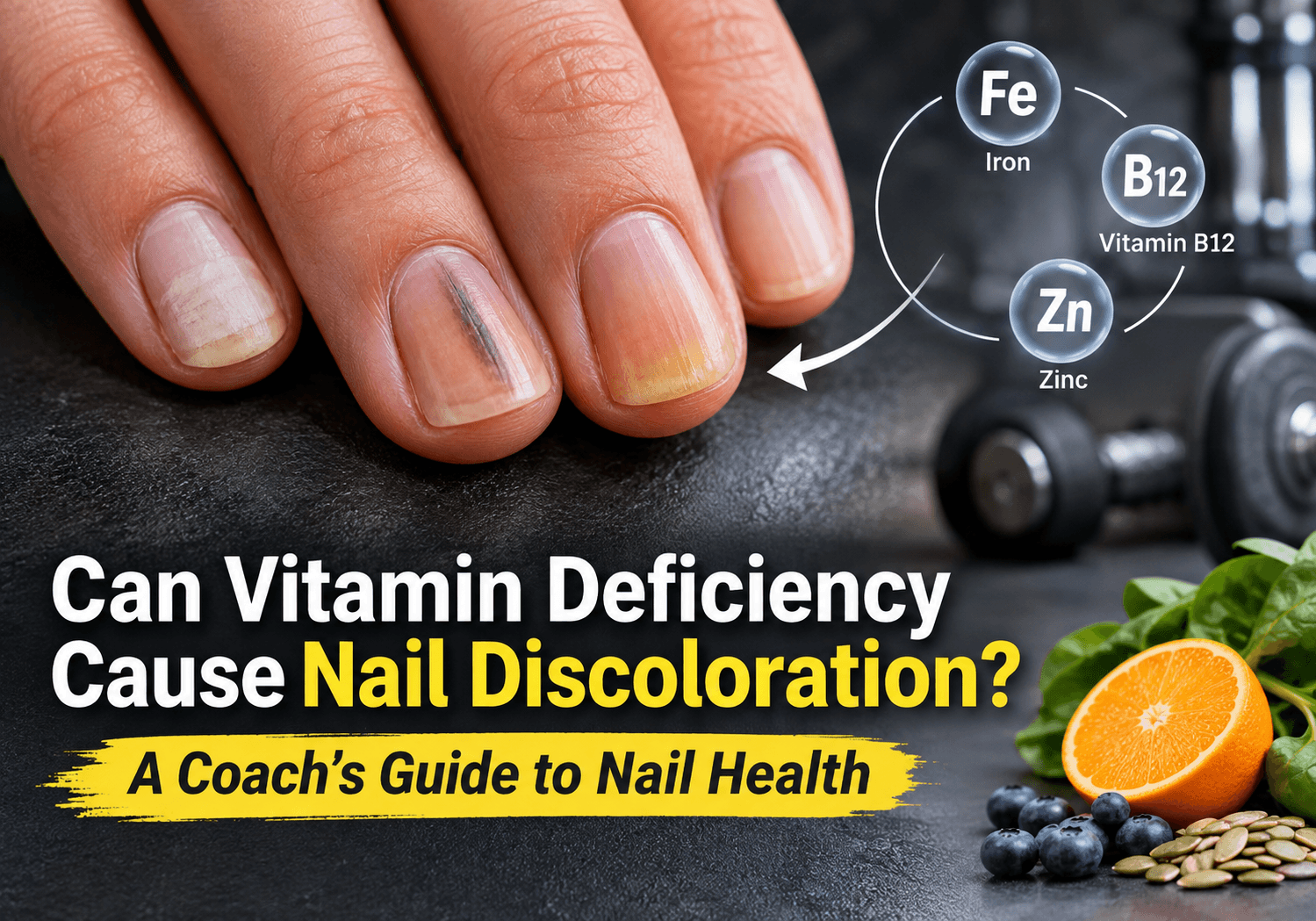
You train hard, eat clean, and track your macros. But lately, you have noticed something strange when you grip the barbell or hold your morning coffee. Your nails look pale, spotted, or even slightly yellow. You might be asking yourself: can vitamin deficiency cause nail discoloration? The short answer is a resounding yes. Your nails are essentially the dashboard indicators for your internal metabolic engine.
When your body lacks essential micronutrients, it prioritizes vital organs over peripheral tissues like your hair and nails. As a coach, I see this constantly in athletes and active adults who push their bodies to the limit while eating in a caloric deficit. Understanding the link between your diet, your training, and your nail health is crucial for long-term performance and recovery. Let us break down exactly what your nails are trying to tell you about your internal health.
Quick Answer
Yes, vitamin and mineral deficiencies can directly cause nail discoloration. Lack of iron, B12, zinc, and vitamin C alters the nail matrix and capillary beds, leading to pale, yellow, white, or darkened nails. Fixing your diet and training routine can restore healthy nail growth over several months.
The Science: Can Vitamin Deficiency Cause Nail Discoloration?
To understand how nutrition affects your hands, you need to understand the anatomy of the nail. Your nails are made of a tough, protective protein called keratin. They grow from the nail matrix, which is a pocket of rapidly dividing cells located just under your cuticle. Because these cells divide so quickly, they require a constant, heavy supply of oxygen, vitamins, and minerals.
When you experience a nutrient gap, the nail matrix is one of the first tissues to suffer. The body shunts blood and nutrients away from your extremities to protect your heart, brain, and lungs. This lack of localized perfusion and cellular building blocks directly changes the color, texture, and shape of the new nail growing out. Let us look at the specific vitamins and minerals that dictate nail pigmentation and structure.
Iron and Oxygen Transport
Iron is absolutely critical for nail health. It is a core component of hemoglobin, the protein in your red blood cells that carries oxygen from your lungs to the rest of your body. According to the National Institutes of Health, iron deficiency is one of the most common nutritional gaps in the world, especially among active women and endurance athletes.
When your iron stores drop, your nail matrix does not get enough oxygen to support normal cell division. This can cause the nail bed to lose its healthy pinkish-red hue, turning pale or stark white. In severe cases of iron deficiency anemia, the nail can actually thin out and curve upward at the edges, creating a spoon-like depression known clinically as koilonychia.
Vitamin B12 and Cellular Pigmentation
Vitamin B12 is essential for DNA synthesis, nerve function, and the formation of red blood cells. It also plays a fascinating role in regulating melanin, the pigment that gives color to your skin, hair, and nails. The National Institutes of Health notes that B12 deficiency is particularly common in vegans, vegetarians, and older adults who lack the stomach acid required to absorb it from food.
When B12 levels crash, it can trigger localized changes in melanocyte activity within the nail matrix. This often presents as brownish, bluish-black, or grayish longitudinal streaks running down the nail. This condition, known as melanonychia, is usually reversible once B12 levels are restored through diet or targeted supplementation.
Zinc and Keratin Synthesis
Zinc is a trace mineral that acts as a co-factor for over 300 enzymes in the body, many of which are involved in protein synthesis and cell division. The National Institutes of Health highlights that zinc is heavily concentrated in the skin and nail tissues. Active individuals lose zinc through sweat, making them highly susceptible to subclinical deficiencies.
Without adequate zinc, the keratinocytes in your nail matrix cannot multiply properly. This disruption in the growth cycle often manifests as leukonychia, which are random white spots or cloudy patches on the nail plate. Severe zinc deficiency can also cause Beau’s lines, which are deep horizontal ridges that indicate a temporary halt in nail growth due to physical stress or severe nutritional deprivation.
Vitamin C and Capillary Integrity
Vitamin C is famous for immune support, but its role in structural tissue is just as important. It is required for the synthesis of collagen, the structural protein that gives strength to your blood vessels, skin, and nail beds. The National Institutes of Health warns that marginal vitamin C intake can lead to capillary fragility.
When the tiny blood vessels (capillaries) under your nail bed become fragile, they can micro-bleed during everyday activities or heavy lifting. This results in splinter hemorrhages, which look like tiny, vertical red, brown, or black lines running in the direction of nail growth. While often harmless, frequent splinter hemorrhages in an active person can point to a lack of dietary vitamin C and poor vascular recovery.
Active Individuals and Nutrient Gaps: Why Diets Trigger Nail Changes
You might wonder why gym-goers and athletes seem to struggle with nail discoloration more than the general population. The answer lies in the high metabolic demand of training combined with restrictive dietary practices. When you are trying to manipulate your body composition, you are walking a tightrope between fueling performance and creating a caloric deficit.
First, consider the physical loss of micronutrients during exercise. When you sweat heavily during a long run or a grueling HIIT session, you are not just losing water. You are excreting trace minerals like zinc, magnesium, and iron. If you are constantly training in a hot environment or wearing heavy sweat gear, your mineral depletion accelerates. This directly impacts the raw materials available for nail matrix regeneration.
Second, endurance athletes face a unique phenomenon called foot-strike hemolysis. Every time your foot strikes the pavement during a long run, the physical impact literally crushes red blood cells in the capillaries of your feet. Over time, this destroys your iron stores, leading to exercise-induced anemia. This is a primary reason why marathon runners and triathletes frequently present with pale, brittle, or spoon-shaped nails.
Finally, we must address the impact of popular diets. If you are eating in a steep deficit, you might wonder what affects metabolism and body weight in the long term. Restrictive diets often eliminate entire food groups. A strict carnivore or keto diet might lack the vitamin C found in citrus and bell peppers. A vegan diet might lack the bioavailable B12 and heme-iron found in animal products. Even if you are taking vitamins for energy while dieting, poor absorption or improper timing can leave your nail matrix starved for nutrients. Understanding vitamins that support metabolism is only half the battle; you must also ensure you are absorbing them.
Decoding the Colors: What Your Nails Are Telling You
To help you troubleshoot your own nail health, I have put together a clinical translation chart. This table connects the visual symptom you see in the mirror with the underlying physiological mechanism and the likely nutritional culprit.
| Visual Symptom | Clinical Term | Likely Nutrient Deficiency | Physiological Mechanism |
| Pale, white, or concave nails | Koilonychia | Iron, Protein | Lack of hemoglobin oxygenation; thinning of the nail matrix tissue. |
| Random white spots or clouds | Leukonychia | Zinc, Calcium | Disruption in keratinocyte division and cellular maturation. |
| Brown, gray, or black vertical streaks | Melanonychia | Vitamin B12, Folate | Altered melanin production and DNA methylation in the nail bed. |
| Tiny vertical red/brown lines | Splinter Hemorrhages | Vitamin C, Vitamin K | Capillary fragility and micro-tears in the vascular bed under the nail. |
| Deep horizontal ridges or grooves | Beau’s Lines | Zinc, Protein, Calories | Temporary cessation of cell division due to severe metabolic stress. |
| Yellow, thickened, or crumbling nails | Onycholysis / Xanthonychia | Biotin, Vitamin E, Protein | Poor keratin cross-linking and oxidative damage to the nail plate. |
Deep Dive: Koilonychia and Iron
Spoon nails are a hallmark sign of chronic tissue hypoxia. The nail matrix literally lacks the structural integrity to grow flat, so the edges curl up. If you are a female athlete with heavy menstrual cycles, or if you drink excessive amounts of coffee and tea (which contain tannins that block iron absorption), you are at high risk for this condition. Pairing iron-rich foods with nutrients for energy metabolism like Vitamin C can drastically improve absorption.
Deep Dive: Leukonychia and Zinc
Many people mistakenly believe white spots on the nails are caused by bumping them against equipment. While trauma can cause localized white spots, widespread leukonychia across multiple fingers is almost always a sign of impaired protein synthesis. Zinc is the master mineral for keratin transcription. If you are eating a diet high in phytates (found in raw grains and legumes), these compounds can bind to zinc in your gut and prevent absorption, leading to white, cloudy nails.
Deep Dive: Splinter Hemorrhages and Vitamin C
If you are lifting heavy weights, your blood pressure spikes temporarily. If your capillary walls lack the collagen support provided by Vitamin C, the micro-vessels under the nail bed can rupture under the pressure. This leaves tiny pools of trapped blood that look like wood splinters. This is a clear sign that your connective tissue recovery is lagging behind your muscular output.
How to Apply It: A Nutrient-Absorption and Recovery Routine
Understanding if a vitamin deficiency can cause nail discoloration is only step one. Step two is fixing the delivery system. You can eat all the vitamins for metabolic health in the world, but if your peripheral blood flow is poor and your insulin sensitivity is low, those nutrients will never reach the nail matrix in your fingers and toes.
As a coach, I use targeted resistance training to improve nutrient partitioning and peripheral vasodilation. By increasing muscle mass and demanding localized blood flow, we force the cardiovascular system to build better capillary networks in the extremities. Below is a “Capillary Perfusion & Metabolic Health” circuit designed to drive nutrient-rich blood into the hands, grip, and lower body.

The Workout: Capillary Perfusion Circuit
Perform this circuit 2 times per week, ideally on your active recovery days or at the end of a standard lifting session. The goal is not maximal fatigue, but sustained time-under-tension to promote vascular engorgement and metabolic waste clearance.
- Goblet Squats: 3 sets of 12-15 reps
- Farmer’s Carries: 3 sets of 60 seconds
- Kettlebell Halos: 3 sets of 10 reps per direction
- Push-ups (or Incline Push-ups): 3 sets to technical failure
Rest: 60 seconds between sets. Keep the tempo controlled (3 seconds down, 1 second pause, 1 second up).
Exercise 1: Goblet Squats
Hold a kettlebell or dumbbell close to your chest. Stand with your feet roughly 12 inches (30 cm) wider than shoulder-width. Lower your hips until your thighs are parallel to the floor, then drive back up.
- Weight Guidance: Use a 35 lb (16 kg) to 50 lb (24 kg) weight.
- Why it works: Large compound leg movements demand massive cardiac output, which subsequently improves systemic circulation and endothelial health (the lining of your blood vessels).
Exercise 2: Farmer’s Carries
Grab two heavy kettlebells or dumbbells. Stand tall, pull your shoulders down and back, and walk for 50 feet (15 meters) or 60 seconds.
- Weight Guidance: Use 40 lb (18 kg) to 70 lb (32 kg) per hand.
- Why it works: This is the ultimate nail-bed perfusion exercise. The intense grip demand forces massive amounts of blood into the forearms, hands, and nail beds, stretching the capillary networks and improving localized nutrient delivery.
Exercise 3: Kettlebell Halos
Hold a light kettlebell by the horns upside down. Slowly circle it around your head, keeping your neck still and your core tight.
- Weight Guidance: Use a 15 lb (7 kg) to 25 lb (11 kg) kettlebell.
- Why it works: This improves shoulder mobility and upper-body lymphatic drainage, reducing systemic inflammation that can impede cellular repair in the nail matrix.
Exercise 4: Push-ups
Keep your body in a straight line from head to heels. Lower your chest to the floor, then press back up.
- Why it works: Upper body pressing drives blood flow into the chest, shoulders, and triceps, supporting the vascular highways that eventually feed the hands.
Regression (Easier Version)
If you are a beginner or dealing with joint pain, modify the circuit. Swap Goblet Squats for Bodyweight Box Squats to a 16-inch (40 cm) box. Swap Farmer’s Carries for Wrist Curls with 10 lb (4.5 kg) dumbbells to safely build forearm vascularity without taxing your central nervous system. Perform Push-ups from an elevated surface or on your knees.
Progression (Harder Version)
For advanced athletes looking to increase metabolism naturally and maximize blood flow, increase the density. Turn the circuit into an AMRAP (As Many Rounds As Possible) format. Set a timer for 20 minutes and cycle through the exercises with minimal rest. Use 70 lb (32 kg) kettlebells for the carries and add a 5-second isometric hold at the bottom of every squat.
Coach’s Tip: Hydration is non-negotiable for nail health. Blood volume is primarily water. If you are dehydrated, your blood becomes viscous (thick), and your body will restrict flow to the extremities to protect your core. Drink at least 16 oz (500 ml) of water with a pinch of sea salt 30 minutes before this workout to maximize capillary perfusion.
Common Mistake: Rushing the Farmer’s Carry. Many athletes use momentum and swing the weights, relying on straps. This defeats the purpose. You must grip the weight barehanded and squeeze the handle as hard as possible. The intense muscular contraction in the forearms is what acts as a “pump” to drive nutrient-rich blood into the nail beds.
Safety Notes and When to See a Doctor
While vitamin deficiencies are a primary cause of nail discoloration in active populations, they are not the only cause. It is vital to practice safe self-assessment and know when to hand the reins over to a medical professional.
First, nail discoloration can be a sign of localized fungal or bacterial infections. Onychomycosis (nail fungus) often presents as thickened, yellow, or crumbling nails. This is incredibly common in athletes who use communal showers or wear tight, sweaty training shoes for hours. A vitamin supplement will not cure a fungal infection; you need topical or oral antifungal medications prescribed by a doctor.
Second, dark, vertical streaks on the nail (melanonychia) can sometimes be a sign of subungual melanoma, a serious form of skin cancer. If a dark streak appears suddenly on only one nail, is wider than 3 millimeters, or begins to spread to the surrounding skin (Hutchinson’s sign), you must see a dermatologist immediately. Do not assume it is just a B12 deficiency.
Finally, horizontal ridges (Beau’s lines) can indicate a systemic illness, a high fever, or uncontrolled diabetes, rather than just a simple zinc gap. If your nail changes are accompanied by chronic fatigue, hair loss, unexplained weight changes, or neurological symptoms like tingling in your hands, seek medical bloodwork. Always consult with a healthcare provider before starting high-dose supplementation, especially if you are trying to figure out how to support metabolism naturally while managing an underlying condition.
Related Tips for Stronger Nails and Better Health
Fixing nail discoloration requires a multi-pronged approach that combines dietary tweaks, lifestyle habits, and intelligent training. Here are my top coaching strategies for optimizing your micronutrient status and protecting your nail matrix.
1. Optimize Iron Absorption with Food Pairing
If you suspect low iron is causing pale or spoon-shaped nails, do not just take a pill. Focus on food synergy. Heme iron (found in red meat and poultry) is easily absorbed. Non-heme iron (found in spinach, lentils, and pumpkin seeds) is poorly absorbed on its own. However, consuming non-heme iron with Vitamin C increases absorption by up to 300%. Squeeze lemon juice over your spinach salad, or eat strawberries alongside your morning oats. Avoid drinking coffee or black tea with your meals, as the polyphenols aggressively block iron uptake in the gut.
2. Protect Your Gut Lining
You are not just what you eat; you are what you absorb. Chronic stress, excessive NSAID (ibuprofen) use for workout soreness, and highly processed diets can inflame the gut lining. This leads to malabsorption of critical protein supplements for recovery and trace minerals like zinc. Incorporate fermented foods like kefir, sauerkraut, or a high-quality probiotic to maintain the microvilli in your small intestine where nutrient absorption takes place.
3. Manage Cortisol and Sleep
Your nail matrix does the majority of its cellular repair and division while you are in deep, slow-wave sleep. If you are training hard but only sleeping 5 hours a night, your cortisol levels will remain chronically elevated. High cortisol causes vasoconstriction (narrowing of the blood vessels), which literally starves your extremities of the blood flow required to deliver vitamins to the nail bed. Prioritize 7 to 9 hours of quality sleep in a cool, dark room to allow your parasympathetic nervous system to drive recovery.
4. Limit Harsh Chemical Exposure
Sometimes the discoloration is external. If you frequently use acetone-based nail polish removers, wear your hands in harsh cleaning chemicals, or use chalk excessively during weightlifting without washing your hands properly, you can strip the lipid barrier of the nail plate. This leads to yellowing and brittleness that mimics a vitamin deficiency. Wear gloves when cleaning, use a hydrating cuticle oil containing jojoba and vitamin E, and wash the gym chalk off your hands immediately after your session.
5. Track Your Progress
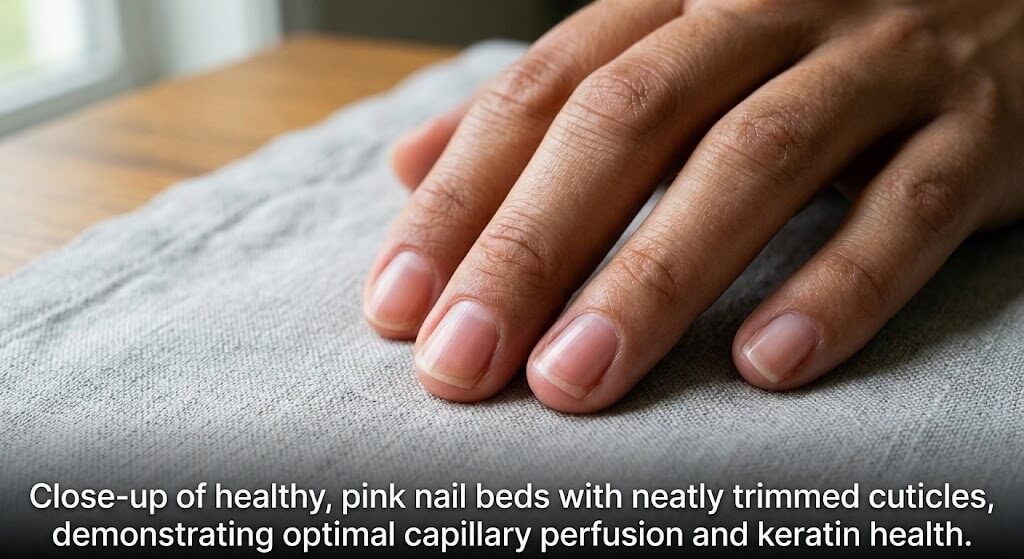
Nails grow incredibly slowly. Fingernails take about 6 months to fully replace themselves, while toenails can take 12 to 18 months. If you correct a B12 or iron deficiency today, you will not see the new, healthy nail color at the tip of your finger for half a year. Take a close-up photo of your nails today in natural lighting. Check back in 60 days to monitor the “half-moon” (lunula) at the base of your cuticle. The new growth emerging from the cuticle is the true indicator of your current internal health.
Frequently Asked Questions
What vitamin deficiency causes white spots on nails? White spots, clinically known as leukonychia, are most commonly linked to a zinc deficiency. Zinc is vital for the rapid cell division required in the nail matrix. Minor trauma to the nail can also cause white spots, but widespread spotting across multiple fingers usually indicates a gap in dietary zinc or impaired protein synthesis.
Can low iron cause nail discoloration? Yes, severe iron deficiency anemia is a primary cause of nail discoloration. Lack of iron reduces hemoglobin, limiting oxygen delivery to the nail bed. This causes the nails to appear pale, washed out, or stark white. In advanced cases, the nails may become thin and concave, forming a spoon shape called koilonychia.
Does B12 deficiency change nail color? Vitamin B12 deficiency can cause hyperpigmentation in the nail bed. This typically presents as brownish, bluish-black, or grayish longitudinal streaks running vertically down the nail plate. This condition is highly reversible once B12 levels are restored through dietary changes, sublingual tablets, or intramuscular injections.
Why are my nails turning yellow from diet? Yellow nails can result from a deficiency in fat-soluble vitamins like Vitamin E, or a lack of biotin and protein required for healthy keratin cross-linking. However, yellowing is also frequently caused by external factors, such as frequent use of dark nail polishes without a base coat, fungal infections, or heavy smoking.
How to fix nail discoloration from vitamin deficiency? To fix nutritionally induced nail discoloration, you must identify the gap via bloodwork and correct it through a nutrient-dense diet or targeted supplementation. Because fingernails take roughly six months to fully grow out, you must maintain consistent nutritional habits and optimize blood flow through exercise to see the new, healthy nail emerge from the cuticle.
Can lack of protein affect nail color and shape? Absolutely. Nails are composed almost entirely of a structural protein called keratin. A chronic lack of dietary protein forces the body to halt non-essential tissue growth. This can lead to nails that are thin, brittle, prone to peeling, and lacking their healthy pinkish hue due to a compromised underlying nail bed structure.
Conclusion
So, can vitamin deficiency cause nail discoloration? Without a doubt. Your nails are a direct reflection of your metabolic health, your dietary habits, and your body’s ability to absorb and utilize essential micronutrients. Whether it is pale nails signaling an iron gap, white spots pointing to low zinc, or dark streaks indicating a B12 issue, your body is constantly communicating with you. By eating a nutrient-dense diet, managing your training stress, and utilizing targeted workouts to drive blood flow to your extremities, you can rebuild your nail matrix from the inside out. Listen to your body, fuel it properly, and your results will show in every detail.