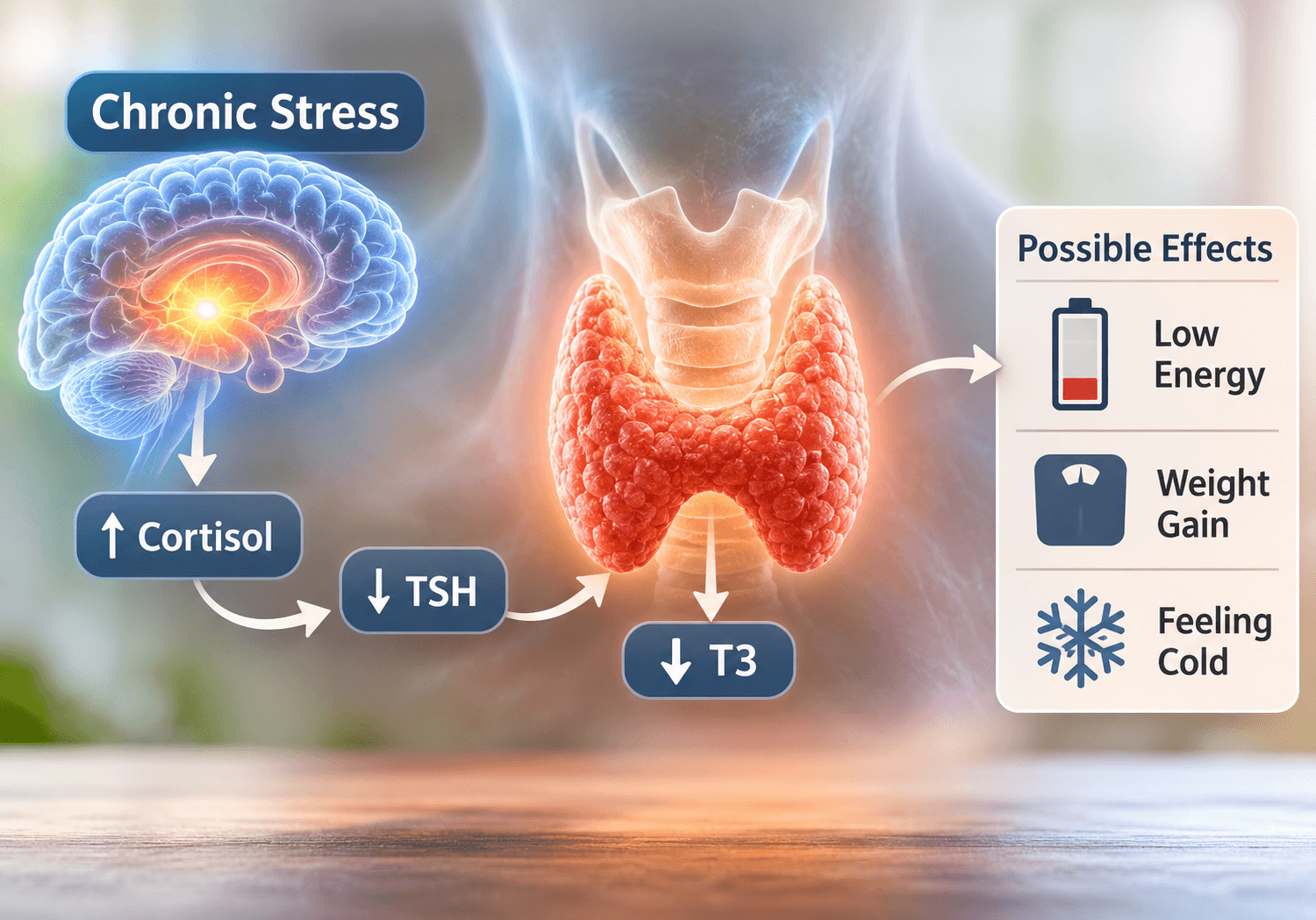
You’ve been feeling sluggish, gaining weight around your midsection, and your energy crashes by 2 p.m. every day. You’ve been under nonstop work pressure for months, and nothing you eat or how much you sleep seems to help. You might wonder whether your thyroid is involved. The short answer is yes—can chronic stress affect thyroid function? is a question with a clear, research-backed answer: prolonged stress disrupts the hormonal signals that tell your thyroid what to produce and how much.
As a strength and conditioning coach, I see this pattern in clients all the time. Someone walks in exhausted, their resting heart rate is elevated, and their strength numbers are dropping week after week. We talk about their schedule, their sleep, their daily load. The thyroid rarely “breaks” from a single stressful week. But months or years of unresolved stress can shift the entire endocrine conversation in a way that slows your metabolism, wrecks your sleep, and makes every workout feel harder.
This article breaks down exactly how the stress response talks to your thyroid, what the research says, and—most importantly—what you can actually do about it.
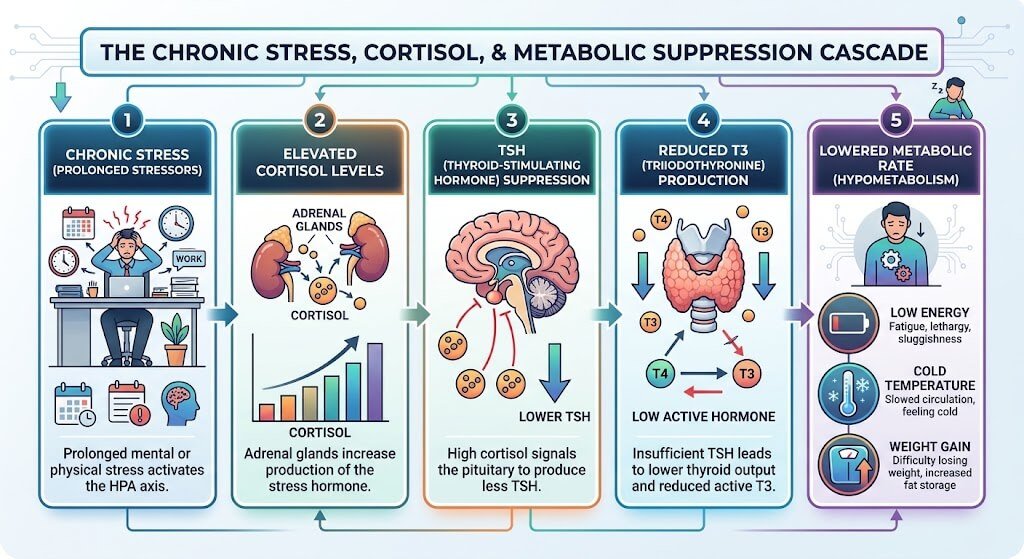
Quick Answer: Yes, chronic stress can affect thyroid function. Prolonged elevation of cortisol suppresses TSH (thyroid-stimulating hormone) from the pituitary gland and increases the conversion of T4 into inactive reverse T3, reducing the active thyroid hormone available to your cells. This does not typically cause permanent thyroid damage on its own, but it can mimic hypothyroid symptoms and, in some cases, worsen existing autoimmune thyroid conditions like Hashimoto’s.
The HPA Axis and the Thyroid: How They’re Connected
To understand the stress-thyroid link, you need to know about two “control centers” in your brain.
The HPA axis (hypothalamic-pituitary-adrenal axis). When you perceive a threat—deadline, argument, car accident—your hypothalamus releases CRH (corticotropin-releasing hormone). That signals the pituitary to release ACTH, which tells your adrenal glands to pump out cortisol. This is your “fight-or-flight” chemical. In short bursts, it’s useful. You grab the kid off the road. You nail the presentation.
The HPT axis (hypothalamic-pituitary-thyroid axis). Your hypothalamus releases TRH (thyrotropin-releasing hormone), which signals the pituitary to release TSH. TSH travels to your thyroid gland and tells it to produce T4 (thyroxine) and a small amount of T3 (triiodothyronine). T3 is the active form that drives your metabolic rate, body temperature, and energy production in every cell.
Here’s the critical part: these two axes don’t operate in isolation. They share the same hypothalamic and pituitary “office space.” When the HPA axis is in overdrive for weeks or months, it starts crowding out and suppressing the HPT axis. Research published in peer-reviewed endocrinology journals confirms that sustained cortisol elevation directly inhibits TSH secretion from the pituitary gland (1).
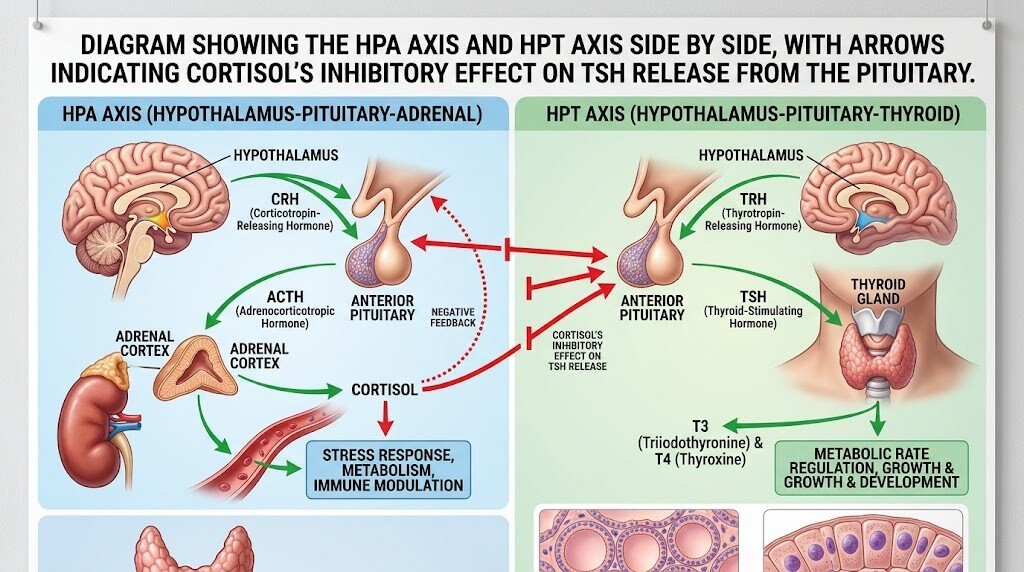
Think of it this way. Your hypothalamus and pituitary are like a two-person control room. When one channel (stress) is screaming at full volume 24/7, the other channel (metabolism) gets turned down. That’s not a thyroid “disease.” It’s a prioritization problem. Your body is saying, “We’re in survival mode. Save energy. Slow the furnace.”
What Chronic Stress Does to Thyroid Hormones
The effects aren’t just “less TSH.” There are several specific mechanisms at work:
1. Cortisol Suppresses TSH
Elevated cortisol acts directly on the pituitary to reduce TSH output. Lower TSH means less stimulation of the thyroid gland, which means less T4 and T3 production. Studies in humans and animal models show that sustained high cortisol levels correlate with lower free T4 and free T3 concentrations (2).
2. T4 Gets Converted to Reverse T3 Instead of Active T3
This is the mechanism most people miss. T4 is a “pro-hormone.” Your cells convert it into T3 (active) or reverse T3 (inactive) depending on the situation. Cortisol upregulates the enzyme 15-deiodinase, which shunts T4 toward reverse T3 instead of T3 (3). So even if your thyroid is making a normal amount of T4, your cells are getting less of the active hormone they need.
3. Dopamine and TSH Regulation
Chronic stress also disrupts dopamine signaling in the hypothalamus. Dopamine normally inhibits TSH in a controlled way, but when stress dysregulates the dopamine system, the fine-tuning of TSH pulses gets thrown off. The result is less consistent thyroid stimulation throughout the day (4).
4. Inflammation and Thyroid Tissue
Prolonged stress increases systemic inflammatory markers (IL-6, CRP). In people with a genetic predisposition to autoimmune thyroiditis, that inflammatory environment can accelerate the immune attack on thyroid tissue, worsening conditions like Hashimoto’s thyroiditis (5).
Hormone Effect at a Glance
| Factor | Normal Role | Effect of Chronic Stress | Net Result |
| Cortisol | Short-term energy mobilization | Sustained elevation | Suppresses TSH; increases rT3 |
| TSH | Stimulates T4/T3 production | Reduced secretion | Less thyroid output |
| T4 → T3 conversion | Drives cellular metabolism | Shifted toward reverse T3 | Less active hormone at the cell |
| Dopamine | Fine-tunes TSH pulses | Dysregulated | Inconsistent thyroid stimulation |
| Inflammatory cytokines | Tissue repair (acute) | Chronic low-grade elevation | Worsens autoimmune thyroiditis |
Can Stress Trigger or Worsen Thyroid Conditions?
This is where the question gets more nuanced, and where I want to be clear: stress alone does not typically create a structural thyroid problem out of nothing. You don’t get a thyroid nodule or a goiter purely from a stressful year at work.
However, the research points to two important scenarios:
Worsening existing autoimmune thyroid disease. If you already have Hashimoto’s thyroiditis (the most common cause of hypothyroidism in the U.S.), chronic stress can increase thyroid antibody titers and accelerate the loss of functional thyroid tissue. A 2019 review in the Journal of Clinical Endocrinology & Metabolism noted that psychological stress is a recognized trigger for flares in autoimmune thyroid conditions (5). If you have Graves’ disease, stress can similarly exacerbate the autoimmune response.
Mimicking hypothyroidism without structural damage. Many people with “stress-induced” thyroid changes will show a mildly elevated TSH (say, 5.5–7 mIU/L) and low-normal free T3. This is sometimes called “euthyroid sick syndrome” or “central hypothyroidism secondary to HPA axis activation.” The thyroid gland itself is structurally fine. The problem is upstream. When the stress resolves, the axis often normalizes (2).
Subclinical hypothyroidism. A TSH between 4.5 and 10 mIU/L with normal T4 is called subclinical hypothyroidism. Chronic stress is one of the contributing factors that can push a borderline TSH into this range, especially in women over 40 whose thyroid function is already declining slightly with age (6).
Coach’s Tip: If you’ve been feeling “off” for more than six weeks—fatigue, unexplained weight gain, cold hands and feet, brain fog, constipation—get a full thyroid panel (TSH, free T4, free T3, reverse T3, TPO antibodies) done by your doctor. Don’t just get a TSH. A normal TSH with low free T3 and elevated reverse T3 can still explain your symptoms, and that pattern is a hallmark of stress-related HPT axis suppression.
How to Apply This: Practical Steps to Support Thyroid Health Under Stress
You can’t always eliminate stress. But you can change how your body handles it. Here’s what I recommend to clients, broken into a practical weekly framework.
1. Move Your Body (But Don’t Overdo It)
Regular physical activity is one of the most effective ways to “burn off” excess cortisol and restore HPA axis balance. The HHS Physical Activity Guidelines for Americans recommend at least 150 minutes of moderate aerobic activity plus two days of muscle-strengthening work per week (7).
What I prescribe for a stressed client:
- Aerobic work: 3 sessions/week, 30–40 minutes at a conversational pace (Zone 2, roughly 60–70% of max heart rate). Brisk walking, cycling, swimming, or an elliptor. The key is consistency, not intensity. Going all-out on a HIIT class five days a week will add cortisol, not remove it.
- Strength training: 2 sessions/week, full-body, 3 sets of 8–12 reps per exercise. Focus on compound lifts—squats, deadlifts, rows, presses. Progressive overload matters, but leave 1–2 reps in the tank on the last set. You’re building resilience, not chasing a PR.
- Mobility / yoga: 1–2 sessions/week, 20–30 minutes. Focus on hip openers, thoracic spine rotation, and diaphragmatic breathing. This directly activates the parasympathetic nervous system and lowers cortisol.
Easier version (regression): If you’re brand new to exercise or coming off a long period of inactivity, start with 20-minute brisk walks, 3 days/week, plus a 10-minute bodyweight routine (squats, push-ups against a wall, glute bridges). Build from there.
Harder version (progression): Once the 30-minute Zone 2 sessions feel easy (usually 4–6 weeks in), add 1–2 intervals: 5 × 2 minutes at 85% max HR with 3 minutes easy recovery. Keep the total session under 45 minutes.

2. Protect Your Sleep
Sleep is when your HPA axis resets. Poor sleep (less than 7 hours) independently elevates cortisol by 10–15% and disrupts the TSH pulse rhythm (8). The connection between sleep and metabolism is well-documented, and thyroid function is part of that hormonal web.
Non-negotiables I tell every client:
- Same bedtime and wake time, ±30 minutes, even on weekends.
- No screens (phone, laptop, TV) in the 60 minutes before bed.
- Room temperature around 65–68 °F (18–20 °C).
- No caffeine after 2 p.m.
- If you can’t fall asleep in 20 minutes, get up, do something boring in dim light, and try again. Don’t stare at the clock.
3. Fuel the Thyroid with Key Nutrients
Your thyroid literally needs raw materials to make hormone. A few stand out:
- Iodine: Found in iodized salt, seaweed, dairy, and eggs. Most people in the U.S. get enough from iodized salt, but if you’ve switched to sea salt or are on a very restrictive diet, you may be low.
- Selenium: Found in Brazil nuts (2–3 per day), tuna, eggs, and sunflower seeds. Selenium is a cofactor for the enzymes that convert T4 to T3.
- Zinc: Found in beef, pumpkin seeds, lentils, and chickpeas. Zinc supports T4-to-T3 conversion and overall immune regulation.
- Vitamin D: Many people are deficient, especially in northern climates. Low vitamin D is linked to higher rates of autoimmune thyroiditis.
For a broader look at what your body needs to keep energy metabolism running, check out which nutrients support normal energy metabolism.
4. Manage the Stress Itself
Exercise helps, but you also need to address the source. This isn’t “just meditate” platitudes. Here’s a practical stack:
- Box breathing: 4 seconds in, 4 seconds hold, 4 seconds out, 4 seconds hold. Do 4–6 rounds when you feel the stress spike. This is what I have clients do between sets on heavy days.
- Time-boxed worry: Set a 10-minute window (say, 5:30–5:40 p.m.) to write down every worry. Outside that window, you acknowledge the thought and park it. It sounds silly, but it works to reduce the “background hum” of chronic stress.
- Social connection: One genuine conversation per day—not scrolling, not a work Slack message. A real conversation with a friend, partner, or family member lowers cortisol measurably.
- Limit alcohol: More than 1–2 drinks on a regular basis disrupts sleep architecture and raises next-morning cortisol.
If stress is tied to eating patterns or emotional cravings, the research on adaptogens for stress eating and cortisol management is worth a read, though I’d always prioritize sleep, movement, and nutrition first.
Sample Weekly Routine for a Stressed Client
| Day | Activity | Duration | Notes |
| Monday | Zone 2 walk or cycle + 10-min mobility | 40 min | Conversational pace; no music if it helps you “zone out” |
| Tuesday | Full-body strength (squats, rows, press, deadlifts) | 45 min | 3 × 10, RPE 7/10, 90-sec rest |
| Wednesday | Rest or 20-min yoga (hip openers, cat-cow, child’s pose) | 20 min | Focus on exhale length |
| Thursday | Zone 2 swim or elliptor | 35 min | Keep HR under 140 bpm |
| Friday | Full-body strength (same pattern, different exercises) | 45 min | 3 × 10, RPE 7/10 |
| Saturday | Outdoor activity (hike, bike ride, sport) | 45–60 min | Fun > intensity |
| Sunday | Full rest or 15-min walk + stretching | 15 min | No structured exercise |
Common Mistake: Clients who are already stressed often think they need to “do more” exercise to compensate. They sign up for a 60-minute HIIT class four times a week, skip sleep, and wonder why they feel worse. Excessive training volume in a high-cortisol state is counterproductive. It adds to the allostatic load instead of reducing it. Start with the 3+2+1 framework above (3 aerobic, 2 strength, 1 mobility) and build only when recovery feels good.
Safety Notes and When to See a Doctor
I want to be direct: this article is for general information and is not a substitute for advice from a doctor or physical therapist.
See a primary-care physician or endocrinologist if you experience:
- Symptoms of hypothyroidism (persistent fatigue, unexplained weight gain of more than 5 lb / 2.3 kg over 2–3 months, cold intolerance, constipation, dry skin, hair thinning) lasting more than 6 weeks
- Symptoms of hyperthyroidism (unexplained weight loss, rapid or irregular heartbeat, heat intolerance, tremor, anxiety)
- A visible or palpable lump in the front of your neck
- You are already on thyroid medication (levothyroxine or methimazole) and your symptoms are changing
- You are pregnant or planning pregnancy (thyroid function is critical for fetal development)
- You have a known autoimmune condition and notice new symptoms
A full thyroid panel (TSH, free T4, free T3, reverse T3, TPO antibodies, Tg antibodies) is a simple blood draw. If your TSH is in the 4.5–10 range with normal T4, your doctor may monitor it every 6–12 months rather than start medication immediately, especially if a clear stressor is present (6).
If you are already managing a thyroid condition, do not change your medication dose based on what you read online. Work with your endocrinologist.
Related Tips for Metabolic Health Under Stress
Thyroid function is one thread in a larger metabolic tapestry. When stress is chronically elevated, it also affects insulin sensitivity, leptin signaling, and your body’s ability to switch between burning carbs and burning fat. If you want to understand the bigger picture of what affects metabolism and body weight, the thyroid is a major player but not the only one.
A few additional practices that support the whole system:
- Prioritize protein at every meal. Aim for 0.7–1 g per pound of body weight (1.5–2.2 g/kg) daily. Protein supports muscle mass, which is your metabolic engine, and it stabilizes blood sugar so you’re not riding a cortisol spike from a 3 p.m. snack. For a deeper dive, see how to increase energy and stamina naturally.
- Don’t crash-diet under stress. Severe caloric restriction (below 1,200 kcal for women or 1,500 kcal for men) on top of high cortisol will further suppress T3 and slow your metabolic rate. If you need to lose weight, a moderate deficit of 300–500 kcal/day is more sustainable and less hormonally disruptive. Learn more about boosting metabolic flexibility without crash dieting.
- Get outside. 15–20 minutes of daylight in the morning helps regulate your circadian rhythm, which in turn supports healthy cortisol and melatonin cycles. This is free, and it works.
- Track your symptoms, not just the scale. Keep a simple journal: energy level (1–10), sleep quality (1–10), mood, and any thyroid-specific symptoms. Patterns will emerge that a single blood test won’t show.
If you’re working on a broader metabolic health plan, increasing metabolism naturally starts with the same pillars: sleep, movement, nutrition, and stress management.
FAQ
Can stress cause hypothyroidism?
Chronic stress does not typically cause permanent, structural hypothyroidism on its own. However, sustained cortisol elevation can suppress TSH and shift T4 conversion toward inactive reverse T3, producing hypothyroid symptoms (fatigue, weight gain, cold intolerance) even when the thyroid gland is structurally intact. In people with pre-existing autoimmune thyroiditis, stress can accelerate disease progression.
Does cortisol block thyroid hormone?
Cortisol doesn’t “block” thyroid hormone in the way a medication might. Instead, it suppresses TSH release from the pituitary (reducing new T4/T3 production) and upregulates the enzyme that converts T4 into inactive reverse T3. The net effect is less active T3 available at the cellular level, which slows metabolism and energy production.
How does chronic stress affect TSH levels?
Prolonged HPA axis activation leads to sustained high cortisol, which inhibits TSH secretion from the anterior pituitary. In many cases, TSH will be mildly elevated (4.5–7 mIU/L) or, paradoxically, low-normal if the suppression is significant. The pattern depends on how long the stress has been present and the individual’s baseline thyroid function.
Can reducing stress improve thyroid function?
Research suggests that when the primary stressor is removed or managed, the HPT axis often normalizes within weeks to a few months. Exercise, consistent sleep, and stress-management techniques (breathing, social connection, time in nature) all help downregulate the HPA axis. However, if structural thyroid damage has already occurred (e.g., advanced Hashimoto’s), stress reduction will help symptoms but won’t reverse the damage.
What is the connection between stress and thyroid?
The connection is neuroendocrine. The hypothalamus and pituitary regulate both the stress response (HPA axis) and thyroid output (HPT axis). When one is chronically overactive, it disrupts the other. Cortisol suppresses TSH, shifts T4 to reverse T3, and promotes a low-grade inflammatory state that can worsen autoimmune thyroid conditions.
How long does it take for stress to affect thyroid?
Acute stress (a few days to a couple of weeks) typically does not produce measurable thyroid changes. Most research and clinical observation suggest that the HPT axis begins to show measurable disruption after 4–8 weeks of sustained, unresolved stress. The longer the stressor persists, the more pronounced the hormonal shifts become.
Conclusion: You Can Influence the Conversation
So, can chronic stress affect thyroid function? Yes. The evidence is clear: months of unresolved stress shift your cortisol, suppress TSH, redirect T4 into inactive reverse T3, and—in vulnerable individuals—worsen autoimmune thyroid disease. The good news is that this is largely a regulatory problem, not a structural one. Your thyroid gland is probably fine. The “signal” it’s receiving is off.
You don’t need to eliminate stress from your life. You need to build a system that helps your HPA axis recover each day. That system looks like this: move your body in a moderate, consistent way; protect 7–8 hours of quality sleep; eat enough protein and key micronutrients; take 5 minutes a day to breathe slowly and unclench your jaw; and get outside in the morning light.
If your symptoms persist beyond six to eight weeks of consistent lifestyle changes, or if they’re worsening, see your doctor for a full thyroid panel. Bring your symptom journal. Ask for TSH, free T4, free T3, reverse T3, and thyroid antibodies—not just a TSH.