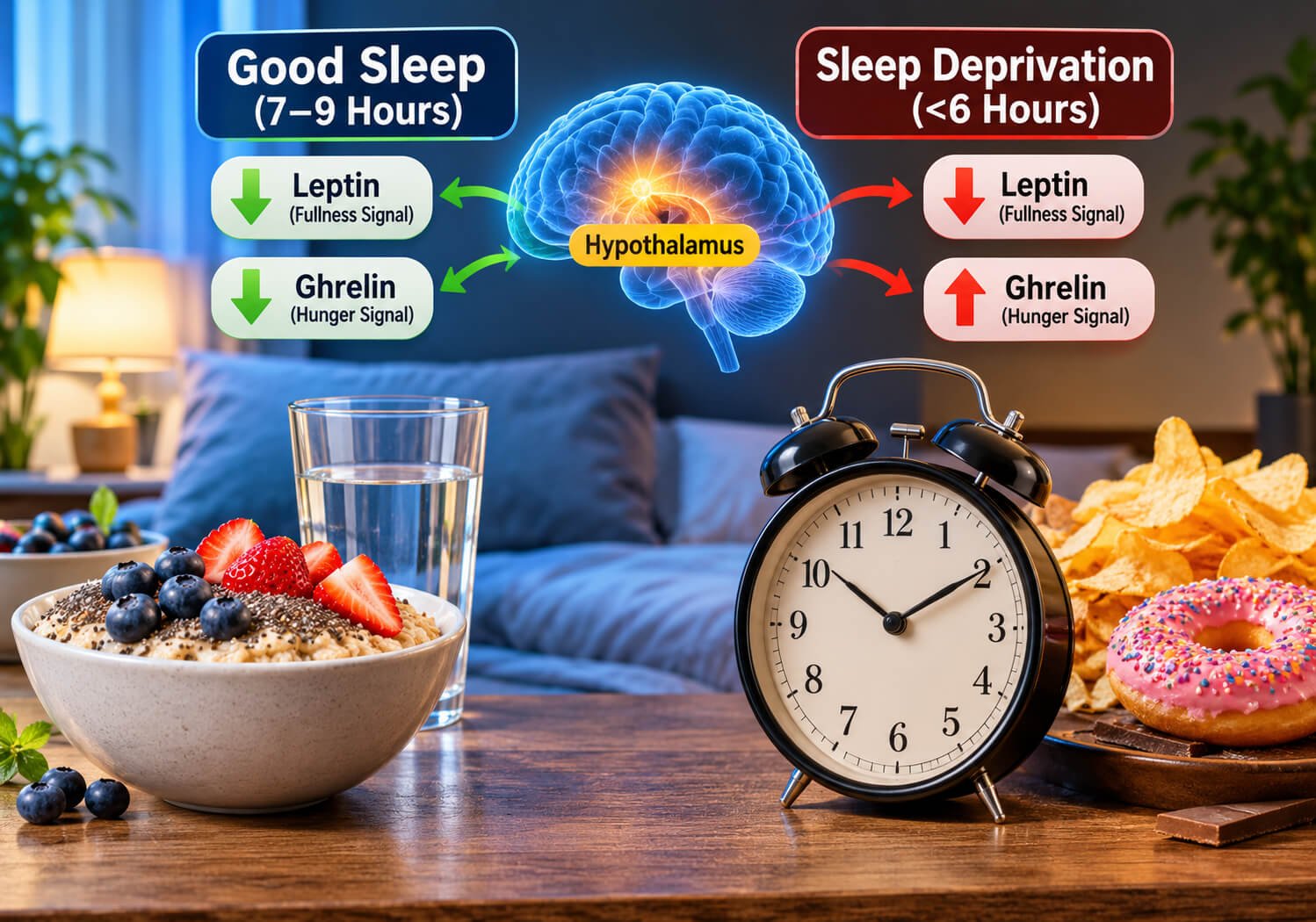
You can nail every single workout, hit your daily protein target, and track your calories down to the gram, yet still feel like your appetite is completely out of control. When clients tell me they feel ravenous at night or cannot stop thinking about high-sugar snacks despite eating enough food, my first question is rarely about their diet—it is about how many hours they slept last night. Understanding how does sleep deprivation affect leptin and ghrelin balance reveals why willpower often fails when you are running on fumes.
Short sleep does not just leave you dragging through your warm-up; it triggers a measurable shift in the two primary chemical messengers that govern hunger and fullness. When you cut sleep short, your brain receives louder signals to eat and quieter signals to stop, making fat loss and performance recovery significantly harder.
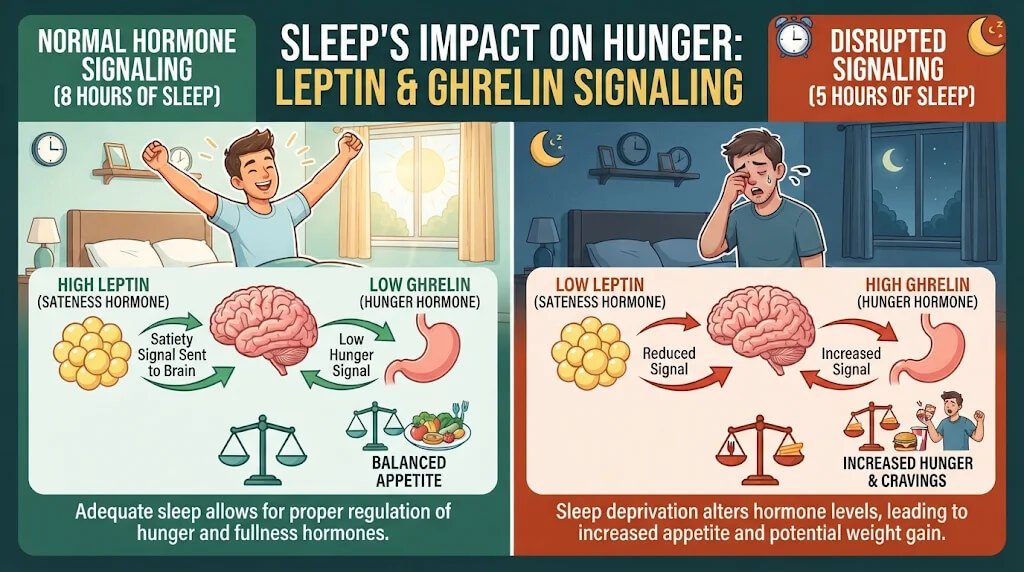
Quick Answer: Sleep deprivation disrupts your appetite control by lowering leptin (the hormone that signals fullness) and raising ghrelin (the hormone that triggers hunger). Even two consecutive nights of restricted sleep can shift this hormonal balance, increasing daily calorie cravings—especially for high-carbohydrate, high-fat foods—while reducing your brain’s ability to recognize when you are satisfied.
What Are Leptin and Ghrelin?
Before looking at what happens when you lose sleep, it helps to understand how these two hormones work together under normal conditions. Think of leptin and ghrelin as the gas pedal and brake pedal for your daily food intake, communicating constantly between your body and a control center in your brain called the hypothalamus.
- Leptin (The Brake Pedal): Produced primarily by your fat cells (adipose tissue), leptin travels through your bloodstream to your brain to signal energy sufficiency. When leptin levels are healthy and your brain responds properly, you feel satisfied after a meal and your body maintains a normal metabolic rate.
- Ghrelin (The Gas Pedal): Secreted mainly by the lining of your stomach (specifically the fundus), ghrelin rises when your stomach is empty and drops shortly after you eat. It tells your brain that it is time to seek out food and prepares your digestive system for incoming calories.
Under ideal conditions, these two hormones operate on a predictable circadian rhythm. During a full night of restorative rest, leptin levels rise while you sleep so you do not wake up starving at 3:00 AM, and ghrelin stays suppressed until morning approaches.
How Does Sleep Deprivation Affect Leptin and Ghrelin Balance?
When you consistently get less than the seven to nine hours of sleep recommended by the Centers for Disease Control and Prevention, that smooth hormonal handoff breaks down. Research consistently demonstrates that sleep restriction pushes both hormones in the exact wrong direction for anyone trying to manage their body weight or fuel athletic performance.
In a landmark clinical study published in the Annals of Internal Medicine, researchers restricted healthy young men to just four hours of sleep per night for two consecutive nights. Compared to when those same men slept ten hours, their leptin levels dropped by 18% and their ghrelin levels surged by 28%. Alongside those hormonal shifts, participants reported a 24% increase in hunger and a 23% jump in appetite, with cravings spiking specifically for calorie-dense, high-carbohydrate foods like sweets, salty snacks, and starchy meals.
Additional data from the Wisconsin Sleep Cohort Study reinforced these findings outside of a lab setting. Adults who habitually slept only five hours per night showed 15.5% lower leptin and 14.9% higher ghrelin than those sleeping eight hours, independent of their baseline body mass index (BMI).
Normal Sleep (7–9 Hours):
[Balanced Leptin ↑] + [Controlled Ghrelin ↓] ──> Normal Satiety & Steady Energy
Sleep Deprivation (<6 Hours):
[Suppressed Leptin ↓] + [Elevated Ghrelin ↑] ──> Heightened Hunger & Cravings
Why Your Brain Craves Junk Food When You Are Tired
Understanding how does sleep deprivation affect leptin and ghrelin balance explains why you feel hungry, but secondary brain chemistry explains what you crave. Sleep loss does not make you crave steamed broccoli and grilled chicken breast; it drives you toward hyperpalatable foods loaded with sugar and fat.
Neuroimaging research from UC Berkeley shows that a single night of total sleep deprivation blunts activity in the prefrontal cortex—the brain region responsible for rational decision-making and impulse control—while overactivating the amygdala, your brain’s primitive reward center. Simultaneously, sleep restriction elevates endocannabinoids, chemical compounds that amplify the pleasure response you get from eating sweet and fatty foods, as documented in research supported by the National Institutes of Health.
Sleep Architecture, Cortisol, and Secondary Hunger Signals
Leptin and ghrelin do not operate in a vacuum. When you cut sleep short, you disrupt specific stages of sleep architecture—particularly slow-wave sleep (deep sleep) and rapid eye movement (REM) sleep—which sets off a domino effect across several other metabolic hormones.
| Hormone or System | Normal Sleep Response (7–9 Hours) | Sleep-Deprived Response (<6 Hours) | Practical Effect on Your Body |
| Leptin | Rises overnight to suppress appetite | Drops by ~15–18% | Brain fails to register fullness after eating normal portions |
| Ghrelin | Suppressed overnight; rises before meals | Increases by ~15–28% | Persistent stomach hunger and earlier onset of cravings |
| Cortisol | Peaks in early morning; stays low at night | Remains elevated in the evening | Promotes abdominal fat storage and stress-driven eating |
| Insulin | Efficiently clears blood glucose | Sensitivity drops significantly | Higher blood sugar spikes and stronger post-meal energy crashes |
| GLP-1 & PYY | Released after meals to slow digestion | Blunted post-meal response | Food feels less filling, leading to larger portion sizes |
The Role of Deep Sleep and Insulin Sensitivity
Most of your physical recovery and growth hormone release occurs during slow-wave sleep in the first half of the night. When you go to bed late or wake up frequently, you lose valuable minutes in this restorative stage. According to research cited by the National Heart, Lung, and Blood Institute, chronic sleep deficiency impairs glucose metabolism and reduces insulin sensitivity, meaning your muscle cells absorb carbohydrates less efficiently.
When your muscles cannot take up fuel effectively, your body compensates by signaling for quick energy—usually in the form of refined sugar and caffeine. Over time, pairing elevated ghrelin with poor insulin sensitivity creates a frustrating cycle where you eat more calories, feel less energized during workouts, and store a higher percentage of excess energy as body fat. If you want a deeper look at how rest governs your daily calorie burn, explore our guide on how sleep affects metabolism and weight management.
Coach’s Tip: Track Your “Next-Day Hunger Score”
When coaching clients through a fat-loss phase, I have them rate their hunger from 1 to 10 every afternoon alongside their hours of sleep from the previous night. Within two weeks, almost everyone sees the exact same pattern: any night under 6.5 hours pushes their afternoon hunger score up by 2 to 3 points, even when their breakfast and lunch macros stay identical. Tracking this connection takes the guilt out of cravings and proves it is biology, not weak willpower.

How Sleep Loss Impacts Training Performance and Body Composition
For lifters, runners, and recreational athletes, disrupted hunger hormones carry a direct cost in the gym. If you are training in a modest calorie deficit to lose body fat while preserving lean muscle mass, sleep deprivation actively works against your body composition goals.
In a controlled study published in the Annals of Internal Medicine, dieters following the exact same calorie-restricted meal plan were split into two groups: one slept 8.5 hours per night, and the other slept 5.5 hours per night. Both groups lost the same total amount of weight, but the sleep-deprived group lost 55% less body fat and 60% more lean muscle mass, while experiencing significantly higher ghrelin levels and stronger hunger throughout the day.
When you step under a barbell for heavy compound lifts—such as a barbell back squat loaded at 185 lb (84 kg) or a dumbbell bench press using 50 lb (22.7 kg) dumbbells—sleep loss reduces neuromuscular drive and increases your rate of perceived exertion (RPE). That means a weight that normally feels like a manageable 7 out of 10 effort suddenly feels like a 9 out of 10 grind.
- Reduced Training Volume: Fatigue cuts your total reps short, reducing the mechanical tension needed to maintain or build muscle.
- Slower Muscle Repair: Lower slow-wave sleep blunts overnight protein synthesis, leaving you sore longer between sessions.
- Compensatory Eating: After a sluggish workout, elevated ghrelin pushes you to overeat post-training, easily erasing the 300 to 400 calories you burned during the session.

Practical Strategies to Rebalance Leptin and Ghrelin
You cannot out-supplement chronic sleep debt, and no fat burner will override a 28% spike in ghrelin. Fixing your hunger hormones starts with protecting your sleep window and adjusting your daily habits when an unavoidable short night happens.
1. Anchor Your Wake Time and Sleep Window
Your hypothalamus relies on consistent light and dark cues to time leptin and ghrelin secretion. Aim for 7 to 9 hours of sleep per night, keeping your wake-up time within a 30-minute window every day—including weekends. Sleeping until 10:00 AM on Sunday after waking at 6:00 AM all week creates “social jet lag,” which delays Sunday night melatonin release and keeps Monday morning ghrelin elevated.
2. Front-Load Protein and Viscous Fiber
When you do get stuck with a short night of sleep, adjust your nutrition proactively rather than waiting for afternoon cravings to hit. Prioritizing 30 to 40 grams of lean protein at breakfast helps blunt elevated morning ghrelin and stimulates satiety hormones like peptide YY (PYY). Learning how protein intake affects hunger and fullness hormones gives you a reliable nutritional buffer on tired days, especially when paired with soluble fiber from oats, berries, or chia seeds.
3. Time Your Caffeine Cutoff Strictly
Caffeine blocks adenosine receptors in your brain, masking fatigue without actually clearing sleep pressure. Because caffeine has a half-life of roughly 5 to 6 hours, a 200 mg pre-workout drink taken at 4:00 PM still leaves 100 mg circulating in your system at 10:00 PM. Even if you fall asleep, late caffeine reduces deep slow-wave sleep—the exact stage required for healthy leptin regulation. Set a strict caffeine cutoff 8 to 10 hours before bedtime.
4. Auto-Regulate Your Workouts After Poor Sleep
When you sleep fewer than six hours, forcing a brutal high-intensity interval training (HIIT) session or testing a one-rep max drives cortisol even higher and worsens evening hunger. Instead, use a simple coaching adjustment:
- Keep the habit, lower the intensity: Show up to the gym, complete your warm-up, and reduce your working weights by 10–15% (for example, dropping a 135 lb [61 kg] Romanian deadlift to 115 lb [52 kg]) while resting an extra 60 seconds between sets.
- Choose steady movement over maximal stress: Swap exhausting metabolic finishers for a brisk 20-to-30-minute walk outdoors at 3.0–3.5 mph (4.8–5.6 km/h). Morning sunlight helps reset your circadian clock without spiking stress hormones.
Common Mistake: Trying to “Starve Out” Sleep-Deprived Cravings
One of the biggest mistakes I see clients make after a rough night of sleep is skipping breakfast or cutting lunch calories in half to “save room” for dinner. Because ghrelin is already elevated from sleep loss, fasting all morning sends hunger signals into overdrive by late afternoon, almost always resulting in an evening binge on ultra-processed snacks. Eat regular, protein-rich meals on schedule so you stay ahead of the hormonal wave.
5. Optimize Your Bedroom Environment
Small environmental tweaks measurably improve sleep efficiency so you spend more time in restorative sleep stages:
- Cool the room: Keep your thermostat between 60°F and 67°F (15.5°C to 19.4°C) to support your body’s natural overnight drop in core temperature.
- Block blue light: Dim overhead lights and step away from phones or laptops 45 to 60 minutes before bed, as evening blue light suppresses melatonin and delays sleep onset.
- Keep a consistent wind-down routine: Spend 10 minutes doing light mobility work, nasal breathing, or reading a physical book to transition your nervous system out of daytime fight-or-flight mode.
If you frequently struggle with late-night eating despite solid habits, reading up on how to manage cravings during a calorie deficit and exploring ways to manage food cravings without supplements can provide extra structure while your sleep routine stabilizes.
Daily Hormone-Reset Checklist for Better Sleep and Appetite Control
Use this simple daily framework to align your training, nutrition, and recovery habits with your natural circadian rhythm.
| Time of Day | Action Step | Hormonal Benefit |
| Within 30 Mins of Waking | Get 10–15 minutes of outdoor sunlight without sunglasses | Anchors circadian clock; sets timing for evening melatonin and leptin |
| Breakfast (Meal 1) | Eat 30–40 g protein + high-fiber carbohydrates | Suppresses morning ghrelin spike and stabilizes blood glucose |
| 8–10 Hours Before Bed | Final cutoff for coffee, energy drinks, and caffeinated pre-workouts | Protects slow-wave sleep architecture overnight |
| Training Window | Strength train 3–4x/week; auto-regulate volume if sleep was <6 hours | Improves insulin sensitivity without excessive cortisol spikes |
| 3 Hours Before Bed | Finish your last large meal; avoid heavy, high-fat, or spicy foods | Prevents nighttime reflux and elevated core temperature during sleep |
| 60 Minutes Before Bed | Dim screens, cool room to 60–67°F (15.5–19.4°C), do 5–10 mins mobility | Signals parasympathetic recovery and uninterrupted sleep cycles |

Safety Notes and When to Seek Medical Guidance
While improving sleep hygiene resolves mild, lifestyle-driven appetite fluctuations for most active adults, persistent sleep issues can point to underlying medical conditions. Obstructive sleep apnea, restless legs syndrome, thyroid imbalances, and chronic insomnia fragment your sleep architecture even if you spend eight hours in bed.
If you consistently wake up gasping, snore loudly, experience overwhelming daytime fatigue, or notice sudden shifts in weight and appetite that do not respond to consistent sleep and nutrition habits, schedule an evaluation with a physician or sleep specialist. Additionally, if you take prescription medications that affect blood sugar, appetite, or sleep, consult your doctor before making major changes to your diet, exercise intensity, or bedtime routine.
Related Tips for Long-Term Metabolic Resilience
- Pair Strength Training with Daily Step Goals: Resistance training increases muscle mass and improves baseline insulin sensitivity, while accumulating 7,000 to 10,000 daily steps boosts non-exercise activity thermogenesis (NEAT) without triggering the compensatory hunger spikes sometimes caused by excessive endurance cardio. For more strategies on building sustainable energy habits, see our guide on how to support metabolism naturally for weight management and learn how to improve daily energy without caffeine.
- Keep Evening Snacks High-Protein and Low-Sugar: If genuine hunger keeps you awake before bed, a small snack like 3/4 cup (170 g) of plain Greek yogurt or a scoop of casein protein mixed in water provides slow-digesting amino acids without spiking insulin right before sleep.
Frequently Asked Questions (FAQ)
How many hours of sleep do you need to regulate leptin and ghrelin?
Most adults need 7 to 9 hours of quality sleep per night to maintain healthy leptin and ghrelin signaling. Clinical studies show that sleeping fewer than 6 hours—even for just two consecutive nights— measurably lowers leptin and elevates ghrelin, increasing daily hunger and cravings for calorie-dense foods.
Does one night of poor sleep raise ghrelin levels?
Yes, a single night of acute sleep restriction can elevate morning ghrelin levels and alter brain reward pathways. While one bad night will not ruin your progress, it temporarily lowers prefrontal cortex impulse control and makes sugary, high-fat foods appear much more appealing the following day.
Why does lack of sleep make you crave sugar and carbs?
Sleep deprivation simultaneously lowers leptin, raises ghrelin, and increases endocannabinoid levels in the bloodstream. This chemical combination activates reward centers in your brain while reducing impulse control, driving specific cravings for fast-digesting carbohydrates and high-fat snacks that provide quick energy.
Can catching up on sleep on weekends fix leptin and ghrelin balance?
Sleeping in on weekends helps relieve subjective tiredness, but studies show it does not completely restore metabolic hormone balance or insulin sensitivity after a week of short sleep. Maintaining a consistent bedtime and wake time within 30 minutes every day is far more effective for appetite control.
How does sleep deprivation affect fat loss and muscle recovery?
When dieting on a calorie deficit, sleeping 5.5 hours instead of 8.5 hours can shift weight loss away from body fat and toward lean muscle tissue. Poor sleep elevates cortisol and ghrelin while reducing slow-wave sleep, which slows muscle protein synthesis and makes hunger harder to manage.
What should I eat after a bad night of sleep to control hunger?
Start your morning with 30 to 40 grams of lean protein paired with soluble fiber, such as eggs with oatmeal and berries, or Greek yogurt with chia seeds. Protein and viscous fiber help blunt elevated morning ghrelin, stabilize blood sugar, and prevent afternoon energy crashes and cravings.
Conclusion
Understanding how does sleep deprivation affect leptin and ghrelin balance shifts how you approach fat loss, muscle building, and daily nutrition. When you consistently get less than seven hours of rest, your body lowers leptin, raises ghrelin, and amplifies brain reward signals for high-calorie foods—turning everyday dietary discipline into an uphill biological battle.
Treat your sleep schedule with the same commitment you bring to your training program. Lock in a consistent 7-to-9-hour sleep window, cut off caffeine early, and anchor your meals with lean protein and fiber so your hormones work with your goals instead of against them.