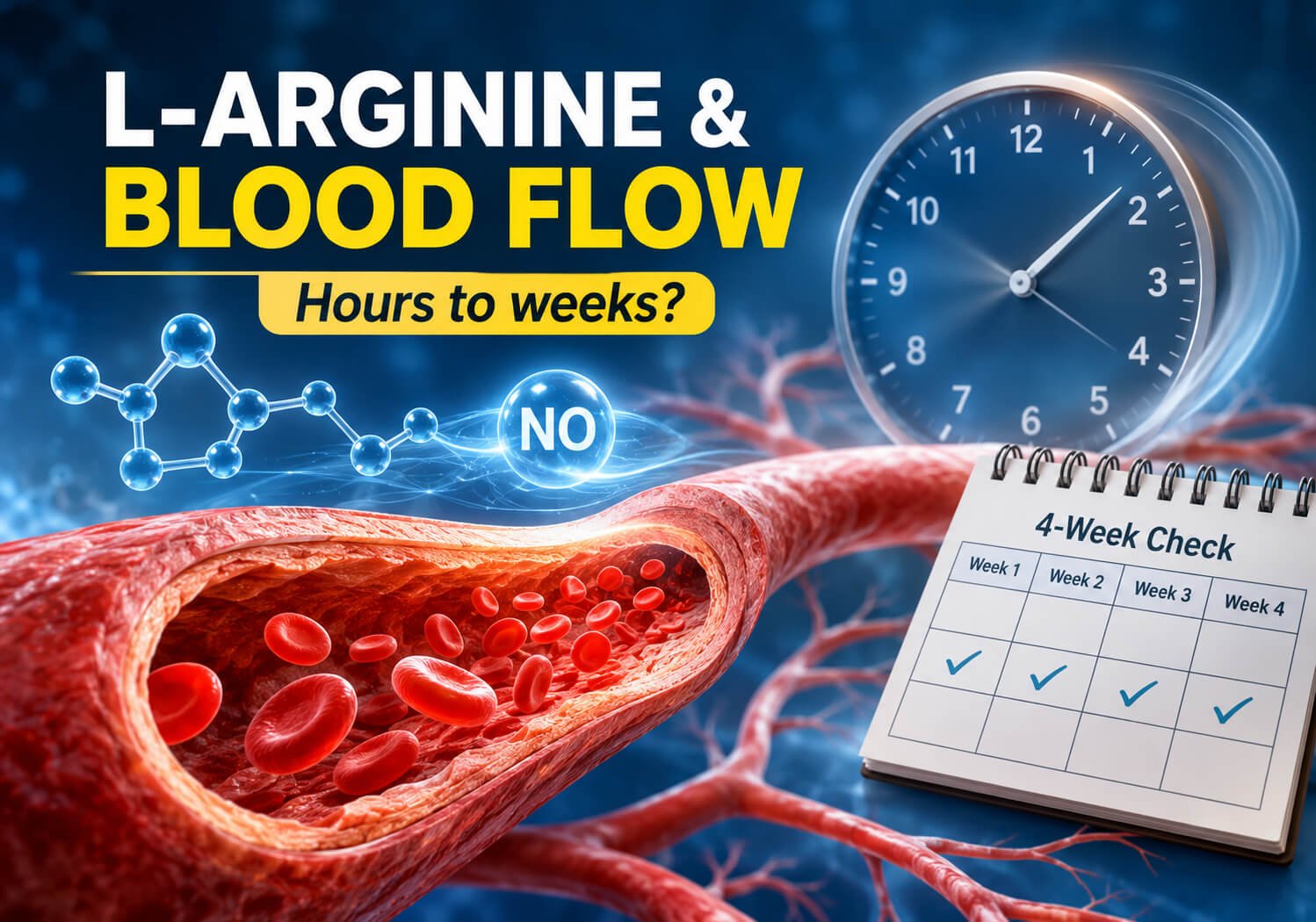
You bought the tub, and now you want a date on the calendar. The honest answer to how long does L-arginine take to improve blood flow is “it depends,” and the details matter. Blood levels of the amino acid rise within hours of a dose. Changes in how your blood vessels behave took days to weeks in the studies that found them, and some studies found no change at all.
This guide covers what the research shows, a realistic timeline, and how to run a fair four-week check on yourself. It also covers safety, because L-arginine can interact with common heart and blood pressure medicines. Think of it as a coach’s plan for testing a supplement without guessing.
Quick Answer
Plasma levels rise within hours, but real vessel changes are slower and less certain. Trials that found benefits ran from days to three months, mostly in people with impaired circulation. Healthy adults often see little change. Don’t expect an instant pump from one dose. Check with your doctor first.
What “Improving Blood Flow” Actually Means
Your body converts L-arginine into nitric oxide (NO), a signal that tells blood vessel walls to relax and widen. A review in the NCBI database describes how L-arginine is oxidized to NO and citrulline, which ultimately helps regulate regional blood flow. The lining of your vessels, called the endothelium, does this work.
Researchers usually measure the result with flow-mediated dilation (FMD). A cuff briefly blocks blood flow in the arm, then a technician measures how much the brachial artery widens when the cuff is released. A bigger widening suggests healthier endothelial function.
This matters for your expectations. “Blood flow” in a study is a measured change in vessel behavior. It is not the same as feeling warmer, pumped, or more energetic. You may never “feel” a change even when a lab test would detect one.
How Long Does L-Arginine Take to Improve Blood Flow? What the Research Says
Studies look at three different time windows. Each answers a different question.
Hours: When Do Blood Levels Rise?
A pharmacokinetic study in healthy men took blood samples from 30 minutes out to 24 hours after a dose. The same study estimated oral bioavailability at about 68%, with a wide range of 51% to 87% between people. Exact peak timing for an oral dose is not in the excerpt I reviewed, so confirm it before publishing [VERIFY].
Here is the part most readers miss. In that study, 6 g taken by mouth produced average plasma levels of roughly 310 µmol/L. A 30 g intravenous infusion produced about 6,223 µmol/L. The researchers found that vascular effects tracked closely with plasma concentration. In atherosclerotic patients, the same paper notes that 30 g by IV causes vasodilation and improves muscle blood flow in the calves.
Many people read “L-arginine widens vessels” and expect that result from a capsule. The IV dose that produced those effects is far larger than anything a pill delivers.
Another reason oral dosing disappoints: a pharmacokinetic comparison describes oral L-arginine as hampered by extensive loss in the gut, due to intestinal arginase activity. In that study, L-citrulline raised plasma L-arginine more effectively than L-arginine itself.
Coach’s Tip: A single dose is a bad test. Plasma levels may rise within hours, but your vessels were not designed to respond to one capsule. Judge the supplement over weeks, using the same routine each day.
Days: The Shortest Effects in Trials
The same NCBI review describes a study in men with coronary artery disease. They took 7 g three times a day (21 g/day) for three days. Plasma L-arginine rose and endothelium-dependent dilation improved.
That is a high dose in a group with known vascular disease. It shows effects can appear within days under those conditions. It does not mean a standard supplement dose will do the same in a healthy lifter.
Weeks: The Most Common Window
A 1996 trial in the Journal of Clinical Investigation tested oral L-arginine in young adults with high cholesterol. The authors concluded that dietary L-arginine significantly improved endothelium-dependent dilation in this group. The review above reports the numbers: with the same 21 g/day split into three doses over four weeks, plasma L-arginine doubled and dilation rose from about 1.7% to 5.6%.
Notice three things: the dose was high, it was split into three servings, and the participants had a vascular risk factor.
For erectile function, which is a blood-flow-dependent outcome, a double-blind trial gave men with organic erectile dysfunction 5 g/day for six weeks. Nine of 29 men on L-arginine and two of 17 on placebo reported meaningful subjective improvement. The objective measures stayed unchanged, and penile blood flow was not affected at that dose. The men who improved had low nitric oxide markers at the start.

Three Months: Longer Trials
A 3-month randomized trial gave 6 g/day to men with vasculogenic erectile dysfunction (51 on L-arginine, 47 on placebo). Scores on the IIEF-6 questionnaire improved significantly. Penile peak systolic velocity improved in mild-to-moderate cases but not in severe ones. If you want the product-level view of this topic, our guide on L-arginine and erectile function goes deeper.
The Reality Check
Not every study is positive. A systematic review and meta-analysis of people with cardiovascular or metabolic disorders found no improvement in flow-mediated dilation with oral L-arginine versus placebo. The authors concluded that oral supplementation was not associated with improvements in the measures they pooled.
The NCBI review also notes that effects seem to depend on baseline endothelial health. It states that L-arginine does not appear able to change flow-mediated dilation in healthy individuals. Taken together, the studies point to uneven results.
Timeline Summary: L-Arginine Blood Flow Studies
| Time window | Dose in study | Who was studied | What was found |
| Hours (single dose) | 6 g oral vs 30 g IV | Healthy men | Plasma levels rose; oral peaks far lower than IV |
| ~3 days | 21 g/day (3 × 7 g) | Men with coronary artery disease | Improved endothelium-dependent dilation (per review) |
| 4 weeks | 21 g/day (3 × 7 g) | Young adults with high cholesterol | Dilation improved (about 1.7% to 5.6%) |
| 6 weeks | 5 g/day | Men with organic ED | 9 of 29 vs 2 of 17 reported improvement; objective measures unchanged |
| 3 months | 6 g/day | Men with vasculogenic ED | IIEF-6 score improved; flow measure improved in mild-moderate cases |
| Pooled analysis | Varied | People with cardiovascular or metabolic disorders | No improvement in flow-mediated dilation |
These doses come from research settings. They are not recommendations, and they are not what a typical product label suggests.
A Realistic Timeline: How Long L-Arginine Takes to Improve Blood Flow
Here is how I would set expectations as a coach, based on the studies above.
- Day 1: Blood levels rise. You are unlikely to feel anything dramatic. A “pump” from one capsule is not supported by this research.
- Days 3-7: Some trials saw vessel changes this early, but at high doses and in people with vascular disease. Treat this as the earliest possible window, not the norm.
- Weeks 2-4: This is where several studies saw measurable changes, again mostly in people with impaired endothelial function.
- Weeks 4-12: The longer trials in men with erectile dysfunction ran here. If nothing has changed by about week 6 to 12, it is reasonable to question whether the supplement is helping you.
- Healthy adults: The pattern may be “nothing measurable.” That is a legitimate result, not a failure of your effort.
Whether the effect shows up also depends on what is limiting your blood flow in the first place. Poor sleep, high stress, and inactivity all play a role. Our pieces on stress and poor sleep and low libido after 40 cover those drivers in more detail.
How to Test L-Arginine Fairly: A 4-Week Plan
Only start this after your doctor says it is safe for you (see the safety section). The goal is a clean comparison, not a guess.
Step 1: Set a Baseline (Week 0)
Write down three things for seven days before you start:
- Your resting blood pressure, if you already monitor it at home.
- Your energy and workout quality, rated 1 to 10 each day.
- Any specific goal measure, such as walking pace or recovery between sets.
Step 2: Change One Thing
Add the supplement and keep everything else the same. Follow the product label unless your doctor tells you otherwise. In the trials above, larger daily amounts were split into several doses, so splitting is a reasonable approach if the label allows it. If you also start a new pre-workout, a new diet, and a new program at once, you will never know what worked.
Step 3: Keep the Foundations Steady
Supplements cannot replace training. The CDC adult activity guidelines recommend at least 150 minutes of moderate-intensity activity a week plus muscle-strengthening on two or more days. Use a simple structure like this:
| Day | Session | Details |
| Mon | Strength A | Goblet squat 3 × 10 with 15-25 lb (7-11 kg); dumbbell row 3 × 10 with 15-20 lb (7-9 kg); push-up 3 × 8; rest 60-90 seconds |
| Tue | Brisk walk | 30 minutes, about 1.5 miles (2.4 km) |
| Wed | Rest or easy walk | 20 minutes |
| Thu | Strength B | Repeat Strength A, adding 5 lb (2 kg) if all reps felt controlled |
| Fri | Brisk walk | 30 minutes |
| Sat | Optional easy activity | Cycling or a longer walk |
| Sun | Rest | Sleep and recovery |
Easier version (regression): Do squats to a box, use a 10 lb (4.5 kg) dumbbell for rows, and do push-ups against a wall or counter. Walk 15 to 20 minutes.
Harder version (progression): Use a 30-40 lb (14-18 kg) dumbbell for squats, slow the lowering phase to 3 seconds, add a fourth set, and extend walks to 45 minutes.

Common Mistake: Judging L-arginine after two or three days, or changing doses every few days. Studies measure effects after steady, repeated use. Constant tinkering makes any change impossible to interpret.
Step 4: Review at Week 4
Compare your notes with the baseline. If nothing has moved, you can continue to week 6 to 8 for a longer look, but it is also fair to stop. If you get dizziness, stomach upset, or lightheadedness, stop and talk to your doctor. If you want help building energy without relying on pills, our guide on how to build energy and stamina is a good starting point.

L-Arginine vs. L-Citrulline: Which One Works Faster?
Because oral L-arginine is partly broken down in the gut, some researchers have looked at L-citrulline as an alternative. In the pharmacokinetic study mentioned earlier, L-citrulline raised plasma L-arginine more effectively than L-arginine did, and it increased signs of NO-dependent signaling in a dose-dependent way.
That does not prove citrulline improves your blood flow or training. It shows it may be a more efficient way to raise blood arginine. Whether it translates into better performance or circulation in healthy lifters is something I could not confirm with an allowed source here [VERIFY], so I would not promise it.
Choosing a Product
Supplements are not tested like medicines. Before buying, check that the label lists the amount of L-arginine per serving, avoid proprietary blends that hide doses, and look for third-party testing. Our guide to how to evaluate supplement ingredients walks through label reading, even though it focuses on weight-management products.
Safety Notes: Who Should Be Careful
Talk to your doctor or pharmacist before starting L-arginine, especially if any of these apply:
- You take blood pressure medicine. MedlinePlus lists ACE inhibitors, ARBs, and other blood pressure drugs as interactions, because L-arginine may lower blood pressure too much.
- You take nitrates or sildenafil. The Mayo Clinic lists nitrate medications and sildenafil as combinations that might cause blood pressure to drop too low.
- You take blood thinners or antiplatelet drugs. Mayo Clinic notes L-arginine might increase bleeding risk with these.
- You take diabetes medicine or other blood-sugar-lowering supplements. MedlinePlus says L-arginine might lower blood sugar.
- You are pregnant or breastfeeding. MedlinePlus describes short-term oral use in pregnancy as possibly safe but advises avoiding long-term use, and advises avoiding use while breastfeeding.
- You have heart disease, low blood pressure, or kidney problems. Get medical clearance first.
Common side effects listed by MedlinePlus include stomach pain, bloating, diarrhea, and low blood pressure. Taking too much too fast is a common reason people feel unwell. Stop if you feel faint, dizzy, or have chest pain, and get medical help if symptoms are severe.
Also remember that unexplained changes in circulation, chest pain, or erectile problems can be signs of an underlying health issue. A supplement should not delay a medical checkup.
Related Tips for Better Circulation Habits
L-arginine is a small piece of the picture. These habits are easier to control:
- Move daily. The CDC guideline above is a baseline for most adults, with your doctor’s guidance if you have health conditions.
- Protect your sleep. Poor sleep and chronic stress can both work against the goals people hope L-arginine will support.
- Review your whole supplement stack. Our overview of libido and energy supplements and our research summary on whether libido supplements work show how to compare products honestly.
- Build total-body habits. Our guide to men’s stamina habits covers training, recovery, and lifestyle together.
FAQ
How long does L-arginine take to work?
Blood levels rise within hours, but measurable vessel changes appeared after days to weeks in trials, mostly in people with impaired circulation. Several studies ran four weeks to three months. Healthy adults may notice nothing. Judge it over a consistent four- to six-week period.
Can you feel L-arginine working?
Not reliably. Studies measured changes with lab tests such as flow-mediated dilation, not with how people felt. Some men in the erectile dysfunction trial reported subjective improvement, but objective measures did not change. A lack of sensation does not prove it is or isn’t working.
How much L-arginine was used in studies?
Doses varied widely: 5 g/day for six weeks, 6 g/day for three months, and 21 g/day split into three servings in short trials. These are research doses, not recommendations. Follow your product label and your doctor’s advice.
Is L-citrulline better than L-arginine?
In one pharmacokinetic study, L-citrulline raised plasma L-arginine more effectively than L-arginine itself. That suggests it may be an efficient alternative, but it does not prove better blood flow or performance. Ask your doctor or pharmacist before switching.
Can I take L-arginine with blood pressure medication?
Only with your doctor’s approval. MedlinePlus and Mayo Clinic both list blood pressure drugs, nitrates, and sildenafil as interactions that might drop blood pressure too low. Do not combine them on your own.
How long can you take L-arginine?
MedlinePlus describes short-term oral use as possibly safe for most people. Long-term safety data are less clear, especially in pregnancy. If you plan to use it beyond a trial period, review it with your doctor.
Conclusion
So, how long does L-arginine take to improve blood flow? Blood levels rise within hours. In the studies that found vessel or erectile-function benefits, changes took days to weeks, and the longer trials ran six weeks to three months. Those benefits appeared mostly in people with impaired circulation. Healthy adults often see little, and a pooled analysis in people with cardiovascular and metabolic disorders found no improvement in flow-mediated dilation.
If you want to try it, get your doctor’s approval, change one thing at a time, and give it four to six weeks with a written baseline. Keep walking, lifting, and sleeping well, because those habits do more for most people than any capsule.