Dark spots can feel stubborn. You treat a pimple, and weeks later a brown mark is still there. You spend a summer outdoors, and a few patches on your cheeks never quite go back to normal.
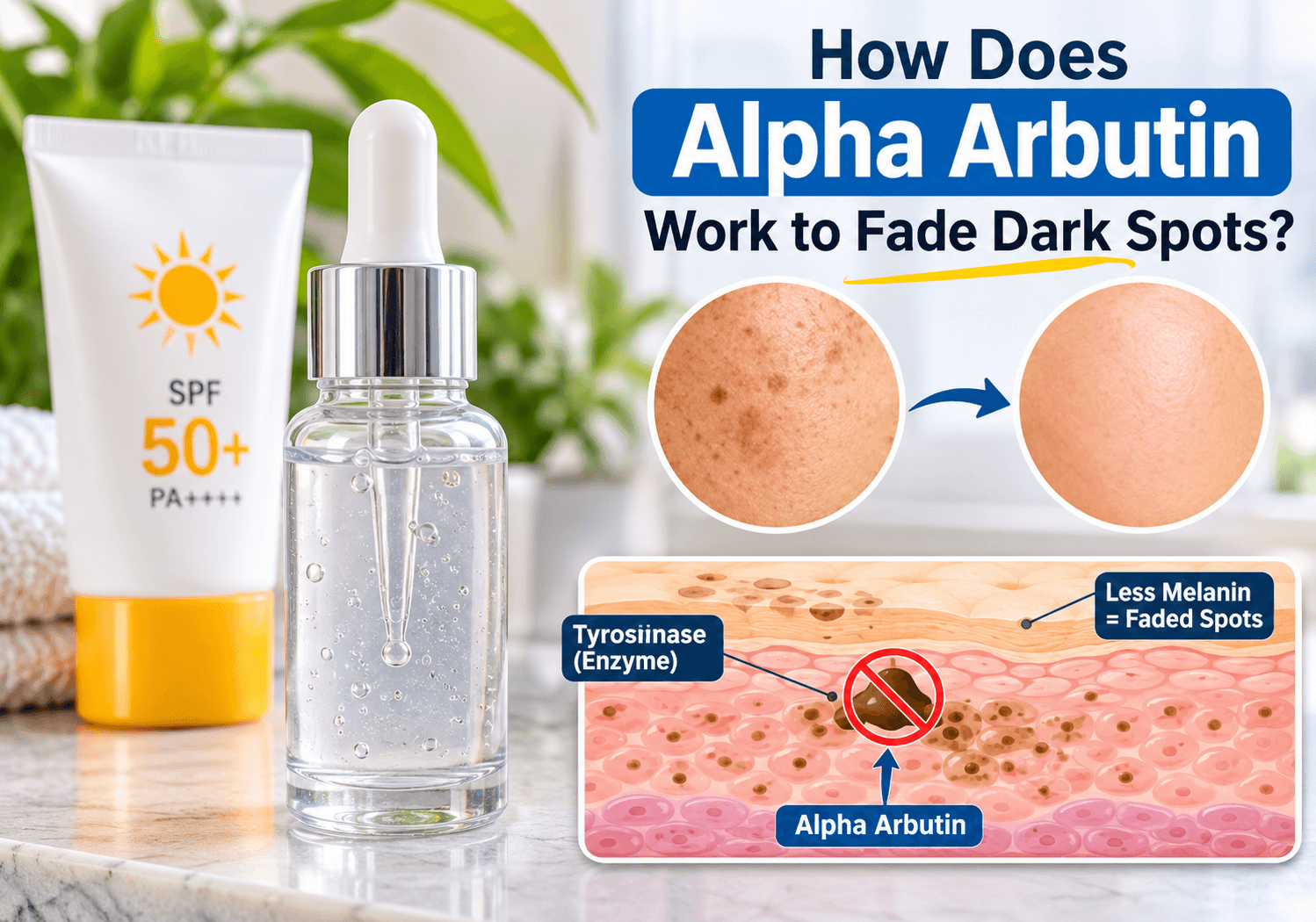
So how does alpha arbutin work to fade dark spots? In simple terms, it slows down the enzyme your skin uses to make pigment. This guide explains how that works, what the research does and doesn’t show, and how to build a routine around it.
Think of it like a training plan. The ingredient is one piece, but daily sun protection and patience do much of the heavy lifting.
Quick Answer: Alpha arbutin fades dark spots by slowing tyrosinase, the enzyme your pigment cells use to make melanin. With less melanin being made, new dark pigment forms more slowly while older pigment gradually sheds with normal skin renewal. It works best with daily sunscreen and patience, and results vary by spot type.

What Dark Spots Are and Why They Form
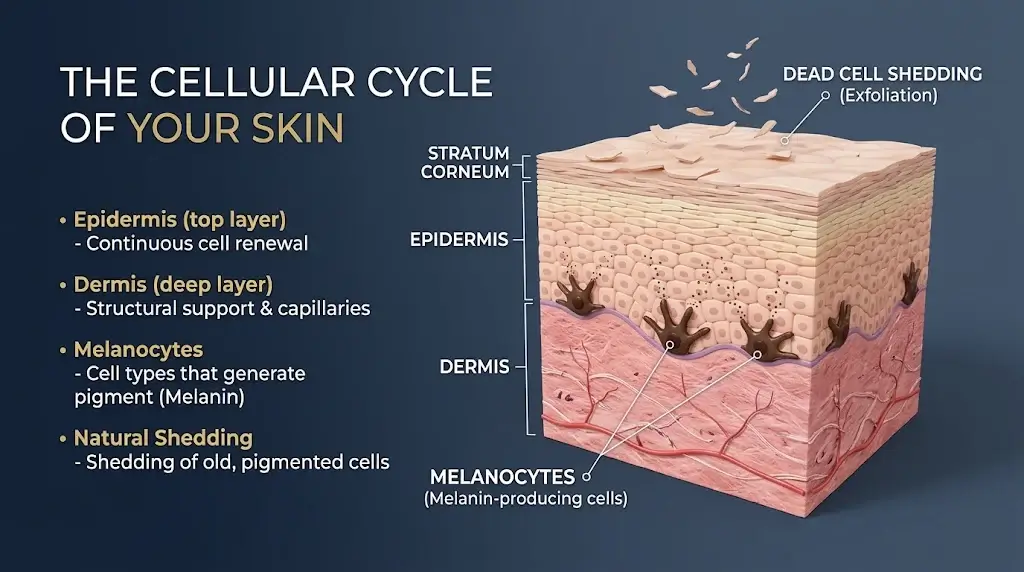
Skin color comes from melanin, a pigment made by cells called melanocytes. Everyone has these cells, and they react to triggers by making more pigment. The result is a patch that looks darker than the skin around it.
Harvard Health explains that the body darkens skin to protect it from ultraviolet radiation, which is why sun protection is the top preventive step. That same article lists common types of dark spots, including age spots (solar lentigines), melasma, and spots that follow skin trauma.
The Main Types of Dark Spots
- Sun spots (solar lentigines): tan to dark brown spots on the face, hands, chest, and forearms from long-term sun exposure.
- Post-inflammatory hyperpigmentation (PIH): marks left after acne, scratches, bug bites, or irritation.
- Melasma: larger, irregular patches, often on the cheeks, forehead, and upper lip. Harvard Health notes that melasma can be driven by both sun exposure and hormonal influences.
Knowing your type matters. A single sun spot and a case of hormone-linked melasma behave very differently, and they respond differently to treatment.
Why Dark Spots Are Harmless but Still Frustrating
Hyperpigmentation is generally not a health risk. Even so, the same Harvard Health piece describes it as one of the most common complaints in dermatology offices and notes it can be emotionally distressing. Wanting even-looking skin is a normal goal.
One caution: a spot that is new, changing, bleeding, or looks different from your others should be checked by a doctor, not treated with a serum.
How Alpha Arbutin Works: The Step-by-Step Mechanism
To understand how alpha arbutin works to fade dark spots, it helps to see how pigment gets made. The short version has three parts: the enzyme, the block, and the shedding.
Step 1: Tyrosinase Is the Pigment Factory’s Key Machine
Melanin is made in melanocytes through a process called melanogenesis. A review of tyrosinase inhibitors explains that tyrosinase is the main enzyme responsible for melanin production in mammals. Without it working, the pigment chain slows down.
Picture a factory line. Tyrosinase is the machine at the first step. Slow that machine and the whole line produces less.
Step 2: Alpha Arbutin Gets in the Way
Alpha arbutin is built from a glucose molecule attached to hydroquinone. A 2021 review in Antioxidants describes how arbutin appeared to act as a competitive inhibitor against L-tyrosine, and it is presumed to compete for the enzyme’s active site because the two molecules look alike.
In plain language, alpha arbutin sits where the enzyme’s normal ingredient would go. The enzyme gets distracted and makes less pigment. Researchers describe this as inhibiting enzyme activity, not destroying pigment cells.
Coach’s Tip: Think “dimmer switch,” not “bleach.” Alpha arbutin turns down pigment production. It does not strip color from healthy skin, and it won’t erase a spot overnight.
Step 3: Old Pigment Fades as Skin Renews
Alpha arbutin does not remove melanin that is already in your skin. Instead, it reduces new production while your skin naturally sheds older, pigmented cells at the surface. This is why fading takes weeks, not days.
How fast skin renews depends on age and skin health, and it slows over time. A timeline of roughly a month or more per renewal cycle is commonly cited , so patience is part of the plan.
What the Research Actually Shows
Here is where honest coaching matters. The science supports the mechanism, but it has limits you should know about.
Evidence From Lab and Skin-Tissue Models
A study in cultured skin tissue found that arbutin inhibited melanin production in cell models and reduced the darkening effect of a pigment-stimulating hormone in guinea pig and human skin tissue. The authors concluded it may be a useful skin-whitening agent. Journal and year for this paper:
That is encouraging, but notice the setting. It was cells and tissue samples, not people applying a serum at home for three months.
Alpha vs. Beta Arbutin: A Mixed Picture
Arbutin comes in two forms, alpha and beta. A review of alpha arbutin reports that α-arbutin showed more potent inhibition of human tyrosinase than natural arbutin, at a much lower concentration. [
However, the 2021 Antioxidants review points out that results have been contradictory on which form is the stronger inhibitor. Different studies used different enzymes and test conditions, including mushroom tyrosinase and mouse tyrosinase. So “alpha is stronger” is a reasonable expectation, not a settled fact.
The Human-Trial Gap
Much of the mechanism evidence comes from enzyme, cell, and tissue experiments. Well-controlled human trials on everyday serums are fewer, and results depend on concentration, formula, and the type of spot . Research suggests alpha arbutin may help, but you should not expect guaranteed results.
Common Mistake: Treating a lab result like a promise. “Inhibits tyrosinase in a dish” does not automatically mean “erases my spot in four weeks.” Set expectations around gradual, modest change.
Alpha Arbutin vs. Other Dark Spot Ingredients
Alpha arbutin is one of several tyrosinase-targeting ingredients. A review of these compounds notes that hydroquinone, arbutin, kojic acid, azelaic acid, L-ascorbic acid, and tranexamic acid have all been used as skin-whitening agents, each with drawbacks. The same review describes arbutin as a prodrug of hydroquinone.
Quick Comparison Table
| Ingredient | How it works (simplified) | Typical access | Key consideration |
| Alpha arbutin | Slows tyrosinase activity | Over the counter | Generally gentle; slow, gradual results |
| Hydroquinone | Strong tyrosinase inhibitor | Often prescription at higher strengths | Reviewed as primary therapy at 2-5% in the literature; use under medical guidance |
| Beta arbutin | Slows tyrosinase activity | Over the counter | Lab data mixed vs. alpha |
| Kojic acid | Tyrosinase inhibitor | Over the counter | Can irritate some skin |
| Azelaic acid | Tyrosinase inhibitor | OTC and prescription | Often used for acne marks |
| Vitamin C (L-ascorbic acid) | Tyrosinase inhibitor, antioxidant | Over the counter | Can be unstable; may sting |
The hydroquinone range comes from the Antioxidants review, which states that hydroquinone at 2 to 5% has been prescribed as primary therapy for hyperpigmentation including melasma.
Is Alpha Arbutin “Hydroquinone in Disguise”?
Not exactly, but the relationship is worth understanding. Arbutin contains a hydroquinone piece. How much free hydroquinone a product releases on skin, and what that means for safety, is something researchers continue to discuss, so this is a good question for a dermatologist if you are concerned. Regulatory limits on concentration differ by region .
Why Sunscreen Beats Every Serum
No dark spot ingredient can outwork unprotected sun exposure. A review on sunscreen in pigment disorders found that melasma and post-inflammatory hyperpigmentation are made worse by UV and visible light, making sunscreen an essential part of treatment.
Skip sunscreen, and you are asking alpha arbutin to push uphill while the sun pushes back.
How to Use Alpha Arbutin for Dark Spots
A simple, consistent routine beats a complicated one. Here is a practical way to start.
Step-by-Step Routine
- Patch test first. Apply a small amount to your inner forearm or behind your ear for a few days. If you see redness, itching, or swelling, stop.
- Cleanse. Use a gentle cleanser on clean, dry skin.
- Apply the serum. Use a few drops to cover the face or targeted spots, and let it absorb.
- Moisturize. A basic moisturizer supports your skin barrier.
- Finish with sunscreen in the morning. Choose a broad-spectrum product.
Easier Version (Regression)
If your skin is sensitive or new to actives:
- Start with every other evening for the first two weeks.
- Use only on the spots, not the whole face.
- Keep everything else in your routine simple.
Harder Version (Progression)
Once your skin tolerates it well:
- Move to twice daily (morning and evening) if the product directions allow.
- Add a second tyrosinase-targeting ingredient, such as vitamin C in the morning, one change at a time.
- Keep sunscreen non-negotiable.
Coach’s Tip: Change one thing at a time. If you start three new products in the same week and your skin reacts, you will not know which one caused it.
What Concentration Should You Look For?
Many over-the-counter serums land around 1-2% alpha arbutin. More is not always better, because very high concentrations can raise the chance of irritation. Check the label and buy from brands that disclose the percentage.
How Long Until You See Changes?
There is no guaranteed timeline. Harvard Health notes that melasma patches typically fade gradually over many months after hormone-related triggers settle and sun is avoided, and in some people the discoloration never entirely disappears. Many brands suggest trying a product for at least several weeks before judging it .
Take a clear photo in the same light every two weeks. That gives you real data instead of guessing in the mirror.
Sun Protection: The Part That Decides Your Results
This is the section many people skip, and it matters most for how alpha arbutin works to fade dark spots in real life.
What to Look For in a Sunscreen
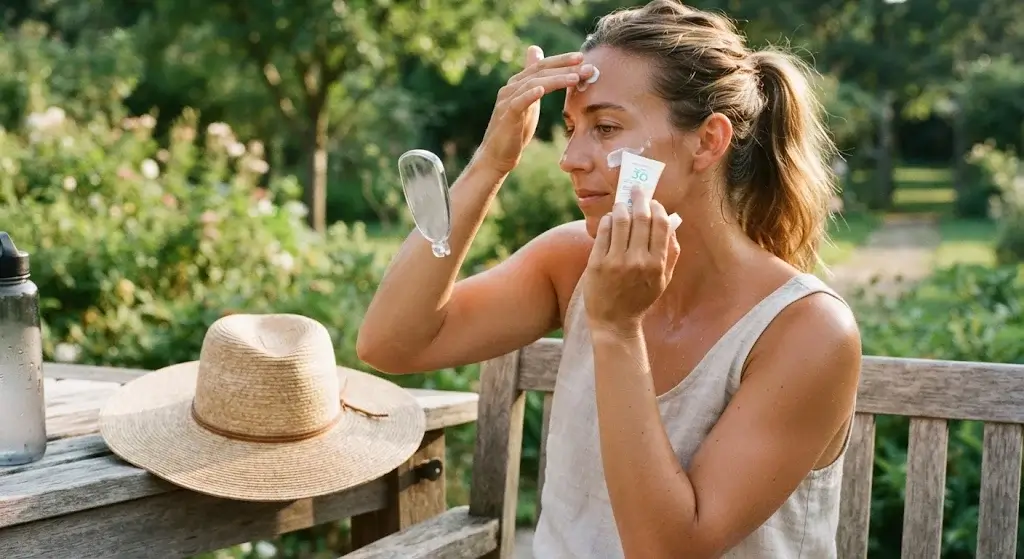
Harvard Health advises using a broad-spectrum sunscreen labeled SPF 30 or higher daily to help prevent melasma flare-ups. Another Harvard Health page on melasma recommends UVA and UVB protection with an SPF of at least 50, plus a brimmed hat. Guidance varies, so ask your dermatologist which fits your skin and spot type.
Harvard Health also notes that, for melasma, a sunscreen that blocks not only the sun’s rays but also visible light and heat is useful. Mineral formulas with iron oxide are often chosen for this reason.
Why Most People Under-Protect
A review of melasma treatment points out that most sunscreens underperform in real life because people use too little product or do not reapply. It also notes that people with darker skin are more affected by melasma yet may be less consistent with sun protection.
Common Mistake: Applying a thin layer once in the morning and calling it done. Use enough product, reapply when outdoors for long periods, and add a hat and shade.
A Simple Sun-Smart Checklist
- Apply sunscreen every morning, even on cloudy days.
- Reapply after sweating, swimming, or several hours outdoors.
- Wear a wide-brimmed hat during peak sun.
- Do not pick at spots or scabs, since that can trigger new post-inflammatory marks.
Safety Notes and Who Should Be Careful
Alpha arbutin is a cosmetic ingredient, not a medical treatment. Most people tolerate it well, but anyone can react to any product.
Possible Side Effects
Watch for redness, stinging, itching, dryness, or peeling. If any of these show up, pause the product and let your skin calm down. If symptoms are strong or do not settle, stop use and ask a doctor.
Who Should Talk to a Doctor First
- Pregnant or breastfeeding: Harvard Health advises that if you are pregnant, you should discuss pregnancy-safe treatment options with your doctor.
- Melasma or widespread patches: These often need a plan tailored by a dermatologist, which may include prescription options.
- Spots that change: New, growing, bleeding, or uneven-colored spots need a professional evaluation.
- Very sensitive or eczema-prone skin: Introduce new products slowly, and consider asking your doctor first.
A Note on “Skin Whitening” Products
Be cautious with products that promise dramatic lightening. Harvard Health warns that many skin-lightening products are at best ineffective and at worst unsafe. Choose reputable brands with ingredient lists you can read, and avoid anything unlabeled or sold with extreme claims.
Related Tips to Support Your Dark Spot Routine
Topical products work on the surface, but the rest of your habits matter too. These are supportive steps, not cures.
Treat Acne and Irritation Early
Because post-inflammatory dark spots follow inflammation, calming breakouts and avoiding harsh scrubbing helps prevent new marks from forming. Gentle care beats aggressive exfoliation.
Think About Nutrition and Hydration
Your skin is built from the inside as well as treated from the outside. If you are curious about nutrition for skin quality, our guide on omega-3 fatty acids for skin hydration explains how fats relate to the skin barrier and inflammation. For antioxidants, see our overview of astaxanthin for skin glow.
Neither of these is a dark spot treatment. They are background support, and you should check with a doctor before starting any supplement.
Be Realistic About Collagen and Vitamin C
Collagen powders are popular for skin, but they target firmness and hydration, not pigment. If you are weighing them, read how long collagen takes to work and the best time to take collagen with vitamin C. Keep expectations separate: collagen for texture, sunscreen and tyrosinase-targeting ingredients for pigment.
Track, Don’t Obsess
Take progress photos every two weeks and judge change over months. Daily mirror-checking makes slow change feel like no change.
Know When a Serum Isn’t Enough
If you have stubborn melasma or deep spots, a dermatologist can discuss options beyond over-the-counter products, which may include prescription creams, peels, or procedures. The melasma treatment review above stresses that rigorous sun protection should accompany any treatment and post-treatment maintenance.
Frequently Asked Questions
How long does alpha arbutin take to fade dark spots?
There is no fixed timeline. Many people judge a product after several weeks of consistent use, but fading can take months, especially for melasma. Results depend on spot type, depth, formula strength, and sun protection. Photos every two weeks help you track change honestly.
Is alpha arbutin better than hydroquinone?
They are different tools. Hydroquinone is a stronger, well-studied option often used under medical guidance, while alpha arbutin is a gentler over-the-counter choice with slower results. Which suits you depends on your spot type and skin. A dermatologist can help you decide.
Can I use alpha arbutin every day?
Many serums are designed for once- or twice-daily use, and the label directions should guide you. Start every other day if your skin is sensitive, then increase slowly. Always follow with sunscreen in the morning, and stop if redness or stinging appears.
Can alpha arbutin and vitamin C be used together?
Both target pigment production, and many routines combine them. Vitamin C is often used in the morning and alpha arbutin in the evening, though layering them together is also common. Introduce one at a time to see how your skin responds.
Does alpha arbutin work on melasma?
It may help some people, but melasma is a complex, often hormone-linked condition that tends to return. Sun protection is essential, and many cases benefit from a dermatologist’s plan. Use alpha arbutin as one supportive step, not a guaranteed fix.
Is alpha arbutin safe during pregnancy?
Pregnancy is a time to be cautious with new active ingredients. Melasma is also common in pregnancy and often fades afterward. Ask your doctor or dermatologist before using alpha arbutin or any lightening product while pregnant or breastfeeding.
Conclusion: What to Remember About How Alpha Arbutin Works to Fade Dark Spots
So, how does alpha arbutin work to fade dark spots? It slows tyrosinase, the enzyme that makes melanin, so new pigment forms more slowly while older pigment sheds as your skin renews. The evidence supports that mechanism, though much of it comes from lab and tissue studies, and results in real life are gradual and vary by person.
Your action plan is simple:
- Patch test, then start slowly.
- Apply consistently, and photograph your progress.
- Use broad-spectrum sunscreen every single morning, and reapply.
- See a dermatologist for melasma, changing spots, or pregnancy questions.
Treat it like a training plan. Consistency and sun protection do the work, and the serum is the support.