You walk into the gym at 5 p.m. and your legs feel like lead. Your afternoon coffee stopped working two weeks ago. You know you need to move more, but the thought of another long cardio session just drains you further.
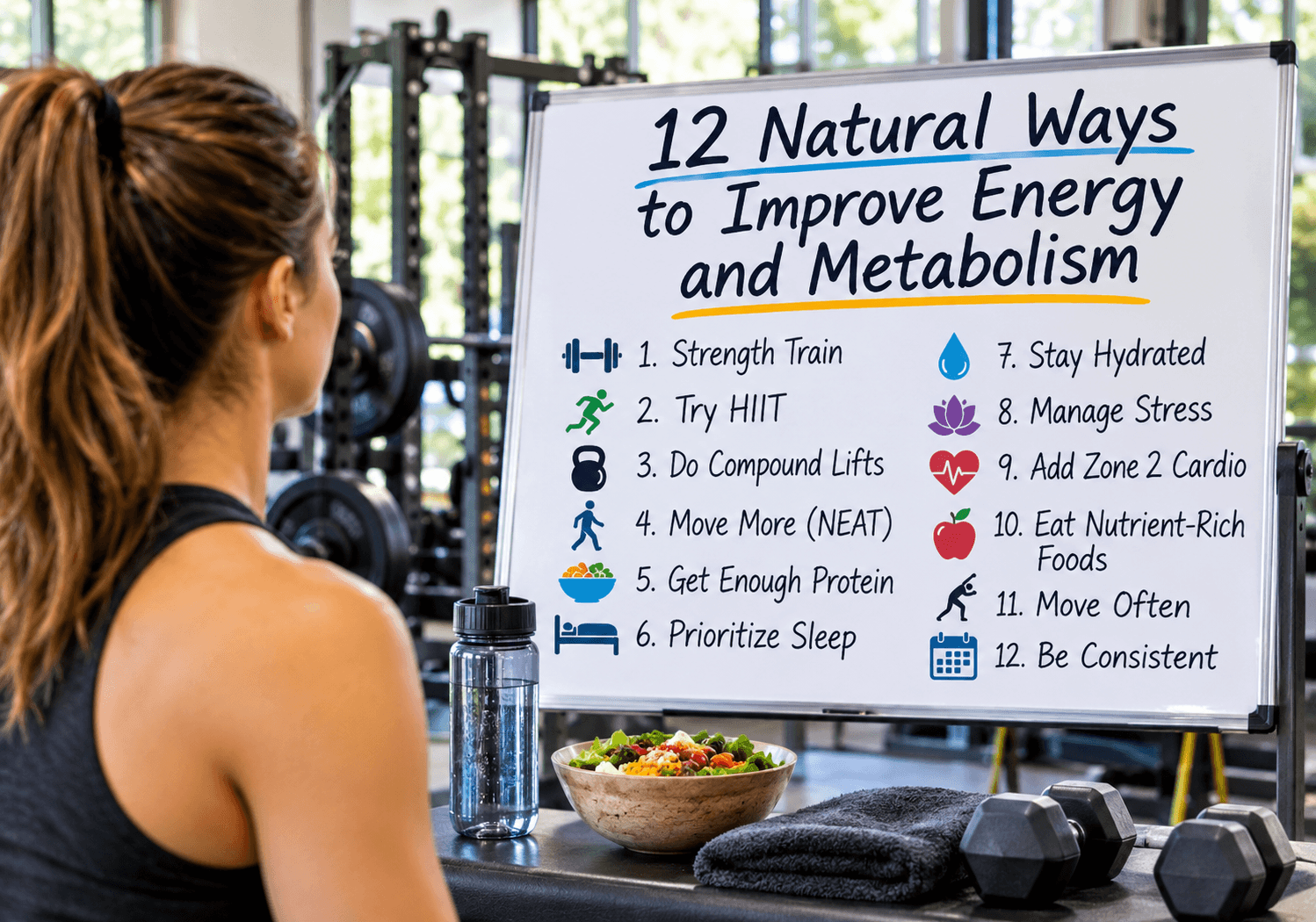
Here’s what I tell every client who walks in with that exact look: you don’t need a magic pill or a 90-minute spin class to fix this. The natural ways to improve energy and metabolism are built into your daily routine—how you lift, how you walk, what you eat, and how you sleep. None of them require a supplement cabinet or a personal trainer’s hourly rate.
Over the years of coaching, I’ve watched people transform their daily energy by stacking small, evidence-backed habits. This guide breaks down twelve of them, with specific sets, reps, food targets, and a weekly schedule you can start this Monday.
Quick Answer
The most effective natural ways to improve energy and metabolism include resistance training 2–3 days per week, daily movement (NEAT), adequate protein intake, 7–9 hours of quality sleep, hydration, stress management, and Zone 2 cardio. Stacking these habits raises your resting metabolic rate, improves mitochondrial function, and stabilizes all-day energy without caffeine or supplements.
Why Your Metabolism Isn’t Just About “Burn Rate”
Before the list, a quick refresher. Your resting metabolic rate (RMR) is the energy your body burns at rest to keep your heart beating, lungs breathing, and cells repairing. It accounts for roughly 60–70% of your total daily caloric expenditure. The rest comes from digestion (the thermic effect of food) and physical activity, which splits into structured exercise and NEAT—non-exercise activity thermogenesis, the calories you burn fidgeting, walking to the car, and standing at a desk.
According to the CDC’s physical activity guidelines, adults should get at least 150 minutes of moderate aerobic activity plus muscle-strengthening work on two or more days per week. That baseline is a floor, not a ceiling. The natural ways to improve energy and metabolism go well beyond hitting that minimum.
The good news: you don’t have to overhaul everything at once. Pick two or three items below, run them for three weeks, then add another. Small, consistent changes outperform a weekend “reset” every single time.

1. Build Muscle with Resistance Training
Skeletal muscle is metabolically active tissue. More muscle means a higher RMR, because your body burns more calories maintaining that tissue even at rest. Research published through the National Institutes of Health consistently links progressive resistance training to increases in resting energy expenditure.
How to do it:
- Beginner: 3 days per week, full-body. 3 sets of 10–12 reps per exercise. Rest 60–90 seconds between sets.
- Intermediate: 4 days per week, upper/lower split. 3–4 sets of 8–10 reps. Rest 90–120 seconds.
- Advanced: 5 days, push/pull/legs. 4–5 sets of 6–8 reps on compounds. Rest 2–3 minutes.
Focus on compound movements: squats, deadlifts, bench press, rows, overhead press, and pull-ups. These recruit multiple muscle groups and drive a larger hormonal and metabolic response than isolation work.
Easier version (regression): Use a 25-lb (11-kg) dumbbell goblet squat instead of a barbell back squat. Start with a 10-lb (4.5-kg) dumbbell row instead of a barbell row.
Harder version (progression): Add a 3-second eccentric (lowering) tempo to your squats. Try a barbell front squat at 85% of your one-rep max for 5 reps.
Coach’s Tip: You don’t need to lift to failure. Stop each set when you have 2–3 reps left in the tank. This keeps joint stress low and lets you train consistently, which matters more for metabolic adaptation than any single brutal session.
2. Add HIIT or Interval Work Once or Twice a Week
High-intensity interval training (HIIT) spikes your EPOC—excess post-exercise oxygen consumption—which means your body keeps burning extra calories for 24–48 hours after the session. A meta-analysis indexed on PubMed found that interval training can elevate post-exercise oxygen uptake more than steady-state cardio of equal duration.
Sample HIIT session (20 minutes total):
- 5-minute brisk walk or easy bike spin (warm-up)
- 8 rounds: 30 seconds hard effort (sprint, row, bike at 90+ RPM) / 60 seconds easy recovery
- 5-minute cool-down walk
Easier version: Swap the 30-second sprints for 20 seconds of moderate effort (brisk walk on an incline, light jump-rope). Keep the 60-second rest.
Harder version: 45 seconds on / 15 seconds off for 10 rounds. Add a 15-lb (7-kg) weighted vest for the sprints.
Aim for one HIIT session per week if you’re new. Two is plenty. More than that starts to tax recovery and can actually blunt metabolic gains if you’re not sleeping and eating well.

3. Prioritize Compound Lifts Over Isolation
A barbell back squat works your quads, glutes, hamstrings, core, and upper back simultaneously. A leg extension works one joint. For metabolic impact, you want to move as much total muscle mass as possible per rep.
Weekly compound lift targets (intermediate):
| Exercise | Sets × Reps | Load Guideline | Rest |
| Barbell back squat | 4 × 8 | 70–80% 1RM | 2 min |
| Conventional deadlift | 3 × 6 | 75–85% 1RM | 2.5 min |
| Barbell bench press | 4 × 8 | 70–80% 1RM | 2 min |
| Barbell row | 3 × 10 | 65–75% 1RM | 90 sec |
| Overhead press | 3 × 10 | 60–70% 1RM | 90 sec |
If you’re new to the gym, start with a 45-lb (20-kg) barbell and add 5-lb (2.3-kg) plates each session until the movement feels controlled. Form before load, always.
Common Mistake: Chasing a new personal record every session. Progressive overload means adding a small amount of weight, a rep, or a set over weeks—not maxing out every visit. Overtraining raises cortisol, which can blunt muscle protein synthesis and make you feel more fatigued, not less.
4. Increase Your NEAT (Daily Non-Exercise Movement)
NEAT is the hidden metabolism lever most people ignore. It’s the calories you burn walking to the mailbox, taking the stairs, pacing while on a phone call, or standing at a kitchen island. Studies reviewed by the American College of Sports Medicine show that NEAT can account for 15–50% of total daily energy expenditure, and it varies wildly between individuals.
Practical NEAT targets:
- Walk 7,000–10,000 steps per day (about 3.5–5 miles / 5.6–8 km)
- Take the stairs instead of the elevator
- Stand for 5 minutes every hour if you sit at a desk
- Park farther from the entrance
- Do a 10-minute walk after lunch and dinner
You don’t need a pedometer, though one helps build the habit. The goal is to make movement ambient, not an event.
5. Hit Your Protein Target
Protein has the highest thermic effect of any macronutrient—your body uses roughly 20–30% of the calories in protein just to digest, absorb, and process it, compared to about 5–10% for carbs and 0–3% for fat. That means eating more protein literally raises your calorie burn around meals.
Additionally, protein supports muscle protein synthesis, which keeps the muscle mass you’re building in item #1 intact, especially during a caloric deficit. The National Institute of Diabetes and Digestive and Kidney Diseases notes that adequate protein intake (roughly 0.7–1 g per pound of body weight, or 1.6–2.2 g/kg for active adults) supports lean mass maintenance.
Daily protein targets:
- Sedentary adult: 0.6–0.8 g/lb (1.2–1.6 g/kg)
- Active / training adult: 0.8–1 g/lb (1.8–2.2 g/kg)
- Example: A 165-lb (75-kg) person training 4 days/week → 132–165 g protein daily
Spread it across 3–4 meals. A 4-oz (113-g) chicken breast gives you about 35 g of protein. Greek yogurt, eggs, legumes, and a scoop of whey or plant protein all fit.
For a deeper look at how protein timing and quantity interact with your metabolic rate, check out our guide on protein intake and metabolism.
6. Protect Your Sleep
This is the one most people underrate. Poor sleep disrupts the hormones that regulate hunger, energy, and glucose handling. A single night of 4 hours of sleep can reduce your resting metabolic rate and increase next-day cravings, according to research summarized by Harvard Health.
Sleep targets:
- 7–9 hours per night for adults
- Consistent bedtime and wake time (±30 minutes), even on weekends
- Cool room (65–68 °F / 18–20 °C)
- No screens 30–60 minutes before bed
- Limit caffeine after 2 p.m.
If you’re training hard, your body needs that extra hour for recovery and hormonal repair. Skipping sleep to “make time” for a workout is a losing trade.
Our article on how sleep affects metabolism and weight management goes deeper into the cortisol and growth hormone pathways.
7. Stay Consistently Hydrated
Mild dehydration (even 1–2% of body weight) can reduce perceived energy, increase perceived effort during exercise, and slightly lower short-term metabolic rate. The Cleveland Clinic recommends drinking water throughout the day rather than chugging it all at once.
Simple targets:
- 0.5 oz (15 ml) of water per pound of body weight as a baseline (a 165-lb person → ~82 oz / 2.4 L)
- Add 12–24 oz (350–700 ml) for every 30 minutes of moderate-to-vigorous exercise
- Start your morning with 12–16 oz (350–470 ml) of water before coffee
You don’t need to hit a rigid number, but if your urine is dark yellow, you’re behind. Aim for pale straw color.
8. Manage Chronic Stress
Elevated cortisol from chronic stress can promote abdominal fat storage, disrupt sleep, and make you feel perpetually “wired but tired.” You can’t eliminate stress, but you can reduce its metabolic toll.
Practical stress-reduction tools:
- 5 minutes of box breathing (inhale 4 sec, hold 4, exhale 4, hold 4) before bed or before a tough workout
- A 10-minute walk outside with no phone
- One “no” per day to a non-essential commitment
- Limit alcohol to 1–2 drinks, 2–3 times per week max (alcohol disrupts sleep architecture and adds empty calories)
You don’t need a meditation app, though one can help build the habit. The key is a daily reset that lowers your sympathetic nervous system baseline.
9. Add Zone 2 Cardio 2–3 Times Per Week
Zone 2 cardio is aerobic work at a conversational pace—about 60–70% of your max heart rate. You should be able to speak in full sentences but not sing. This intensity builds mitochondrial density in your muscle cells, improving how efficiently your body uses oxygen and fat for fuel.
The World Health Organization recommends at least 150 minutes of moderate aerobic activity per week. Zone 2 is the sweet spot for building that aerobic base without the high cortisol spike of repeated HIIT.
Options:
- Brisk walking on a slight incline (3–5% grade)
- Easy cycling (50–65 RPM, moderate resistance)
- Swimming at a steady pace
- Rowing at a controlled 2:1 pull-to-recovery ratio
Duration: 30–45 minutes, 2–3 times per week.
Easier version: 20 minutes of flat-ground walking at a brisk pace.
Harder version: 45 minutes on a treadmill at a 4% incline, 3.5 mph (5.6 km/h), or 40 minutes on an air bike at a steady resistance.
10. Eat Nutrient-Dense Foods That Support Energy Metabolism
Your mitochondria need specific micronutrients to convert food into ATP (cellular energy). Deficiencies in B vitamins, iron, magnesium, and vitamin D can quietly drag your energy and metabolic rate down.
Foods to prioritize daily:
- B vitamins: eggs, lean meats, leafy greens, legumes, whole grains
- Iron: red meat, spinach, lentils, tofu (pair with vitamin C for absorption)
- Magnesium: pumpkin seeds, dark chocolate (70%+), bananas, avocados
- Vitamin D: fatty fish (salmon, mackerel), fortified dairy, or 15 minutes of midday sun
- Fiber: oats, berries, beans, vegetables (supports gut health and steady blood sugar)
You don’t need a supplement if you’re eating a varied diet. But if you’re consistently tired and your bloodwork shows a deficiency, talk to your doctor before adding anything. Our guide on which nutrients support normal energy metabolism covers the specific roles of each micronutrient.
11. Move Throughout the Day (Micro-Movements)
This overlaps with NEAT but deserves its own callout because it’s the easiest habit to start today.
- Stand up and stretch for 2 minutes every 45 minutes at your desk
- Do 10 bodyweight squats between meetings
- Walk for 5 minutes after each meal (this also helps blunt post-meal blood sugar spikes)
- Do a 5-minute mobility routine in the morning: hip circles, cat-cow, thoracic rotations, ankle pumps
These micro-movements keep blood flowing, reduce stiffness, and add up to 200–400 extra calories burned per day without feeling like “exercise.”
12. Be Consistent and Progress Gradually
The single biggest predictor of metabolic improvement isn’t any one exercise or food. It’s showing up 3–5 times per week for 12+ weeks and slowly adding a rep, a pound, or a minute each session.
Progressive overload checklist (weekly):
- Did I add 2.5–5 lb (1–2.3 kg) to a compound lift?
- Did I add 1–2 reps to a set?
- Did I reduce rest by 10 seconds?
- Did I walk 500 more steps than last week?
If you can check at least one box per week, you’re on track. The HHS 2018 Physical Activity Guidelines emphasize that consistency over months matters far more than any single intense session.

How to Stack These Into a Weekly Routine
Here’s a sample week for a beginner-to-intermediate adult. Adjust days and intensity to your schedule.
| Day | Focus | Details |
| Monday | Full-body resistance | Squat, bench, row, OHP – 3×10, 90-sec rest |
| Tuesday | Zone 2 cardio | 30 min brisk walk or easy bike |
| Wednesday | Upper-body resistance | Push-ups, rows, lateral raises – 3×12 |
| Thursday | HIIT + NEAT | 20-min HIIT (8×30/60) + 8,000 steps |
| Friday | Lower-body resistance | Deadlift, lunges, RDL – 4×8 |
| Saturday | Zone 2 cardio + walk | 35 min cycling + 10-min post-dinner walk |
| Sunday | Rest / mobility | 15-min stretch, box breathing, early bedtime |
Sleep and nutrition run every day: 7–9 hours sleep, protein target hit, 8+ cups water, 5+ minutes of stress management.
You can shift days around. The pattern is what matters: 3 resistance sessions, 1–2 HIIT, 2–3 Zone 2, daily NEAT, and consistent sleep/nutrition.
Easier and Harder Versions of the Weekly Plan
If you’re brand new or returning after a long break:
- 2 full-body resistance days (3×12, light weight)
- 2 walks of 20 minutes
- 1 gentle 15-minute HIIT (20 sec on / 40 sec off, 6 rounds)
- Focus on sleep and protein first; add cardio later
If you’re intermediate and want to push further:
- 4 resistance days (upper/lower split, 4×8)
- 2 HIIT sessions (one on bike, one on rowing)
- 2 Zone 2 sessions of 40 minutes
- Add a 5th “active recovery” day: 30-min walk + mobility
Safety Notes and When to Check With a Doctor
Most of the habits above are safe for healthy adults. But a few situations warrant a conversation with your primary-care physician or a sports-medicine specialist before you ramp up:
- You have a diagnosed heart condition, uncontrolled hypertension, or a history of chest pain during exertion
- You’re experiencing persistent fatigue, unexplained weight loss, or hair thinning (possible thyroid or anemia issue)
- You’re over 65 and haven’t exercised regularly in the past year
- You’re pregnant or postpartum
- You take medications that affect heart rate, blood pressure, or blood sugar
If any of those apply, get a quick clearance before starting a new resistance or HIIT program. This article is for general information and is not a substitute for advice from a doctor or physical therapist.
FAQ
How long does it take to see results from natural metabolism-boosting habits?
Most people notice improved energy within 2–3 weeks of consistent sleep, protein, and daily movement. Measurable changes in resting metabolic rate from added muscle mass typically take 8–12 weeks of progressive resistance training, according to guidelines from the ACSM.
Can I improve my metabolism without going to the gym?
Yes. Daily walking, bodyweight exercises (squats, push-ups, lunges), resistance bands, and consistent NEAT can raise your metabolic rate. A 30-minute brisk walk plus 15 minutes of bodyweight work three times a week is a solid starting point.
What is the fastest natural way to increase energy during the day?
A 10-minute walk after lunch, 16 oz (470 ml) of water, and a protein-rich snack (e.g., Greek yogurt with berries) can lift energy within 20–30 minutes. Avoid large carb-heavy meals that trigger a blood sugar spike and crash.
Does building muscle really raise my resting calorie burn?
Yes. Each pound of lean muscle adds roughly 6–10 calories to your daily resting expenditure. It sounds small, but over a year, and combined with the thermic effect of the food needed to build and maintain that muscle, the cumulative effect is meaningful.
Should I do HIIT and Zone 2 cardio on the same day?
You can, but it’s easier to recover from them on separate days. If you must combine them, do Zone 2 first (30 min), then HIIT (15–20 min). Finish with 5 minutes of easy walking and stretching.
Do I need supplements to boost my metabolism naturally?
No. The habits in this guide—resistance training, daily movement, protein, sleep, hydration, and stress management—outperform any supplement stack. If your bloodwork shows a specific deficiency (iron, vitamin D, B12), a targeted supplement under medical guidance may help, but it’s a fix for a gap, not a performance enhancer.
Conclusion
The natural ways to improve energy and metabolism aren’t hidden in a supplement aisle or a 45-minute infomercial workout. They’re in the squat rack, the 30-minute walk, the plate of eggs and vegetables, the 8-hour sleep, and the decision to stand up and stretch at 3 p.m. instead of scrolling your phone.
Pick two or three items from this list. Run them for three weeks. Add one more. By week twelve, your resting metabolic rate will be higher, your all-day energy will be steadier, and the “lead in your legs” feeling will be a memory.
You don’t need to be perfect. You need to be consistent. Now go drink a glass of water, take a five-minute walk, and set your alarm for a slightly earlier bedtime tonight. That’s your first rep.