
If you’ve ever lain in bed at 1 a.m. listening to a high-pitched ring, buzz, or whoosh that seems to get louder the moment the room goes quiet, you know how exhausting tinnitus can be. You’re not alone. The National Institute on Deafness and Other Communication Disorders (NIDCD) estimates that roughly 15% of U.S. adults experience some form of tinnitus, and the quiet of nighttime makes the sensation feel amplified.
The good news: you don’t have to just “live with it.” A handful of natural, low-cost strategies—sound masking, structured relaxation, sleep-hygiene tweaks, and gentle movement—can take the edge off those late-night rings. As a strength and conditioning coach, I spend a lot of time teaching athletes how to manage stress, optimize sleep, and keep their nervous systems in a calm state. The same principles that help a sprinter recover between sessions also help a person with tinnitus get through the night.
Below, I’ve pulled together a practical list of natural ways to manage tinnitus at night, with specific “how-to” steps, what the research suggests, and a simple nightly routine you can start tonight.
⚠️ Important: If your tinnitus is sudden, one-sided, accompanied by hearing loss, dizziness, or a “popping” sensation, see an ENT or audiologist before trying any home strategy. Sudden tinnitus can signal an underlying condition that needs prompt evaluation.
Quick Answer
What are the best natural ways to manage tinnitus at night?
The most effective natural strategies include: (1) playing soft white or pink noise to mask the ringing, (2) following a 30-minute wind-down routine with diaphragmatic breathing, (3) cutting caffeine and alcohol after 2 p.m., (4) keeping your bedroom cool (65–68 °F / 18–20 °C) and dark, and (5) practicing a 10-minute body-scan meditation before bed. Combining three or more of these nightly can reduce perceived tinnitus loudness and improve sleep quality.
Why Tinnitus Feels Louder at Night
Before the strategies, it helps to understand the mechanism. During the day, ambient sounds—traffic, conversation, a running fan—partially mask the tinnitus signal in your auditory cortex. At night, that external noise drops, and your brain’s attention shifts to the internal sound. On top of that, a stressed or fatigued nervous system raises cortisol and adrenaline, which heightens sensory awareness. Research published in the Journal of the American Medical Association (JAMA) has linked poor sleep quality with increased tinnitus distress, creating a frustrating loop: the ringing keeps you awake, and the lack of sleep makes the ringing feel worse.
Understanding this loop is the first step. Every strategy below targets one or more links in that cycle.
12 Natural Ways to Manage Tinnitus at Night
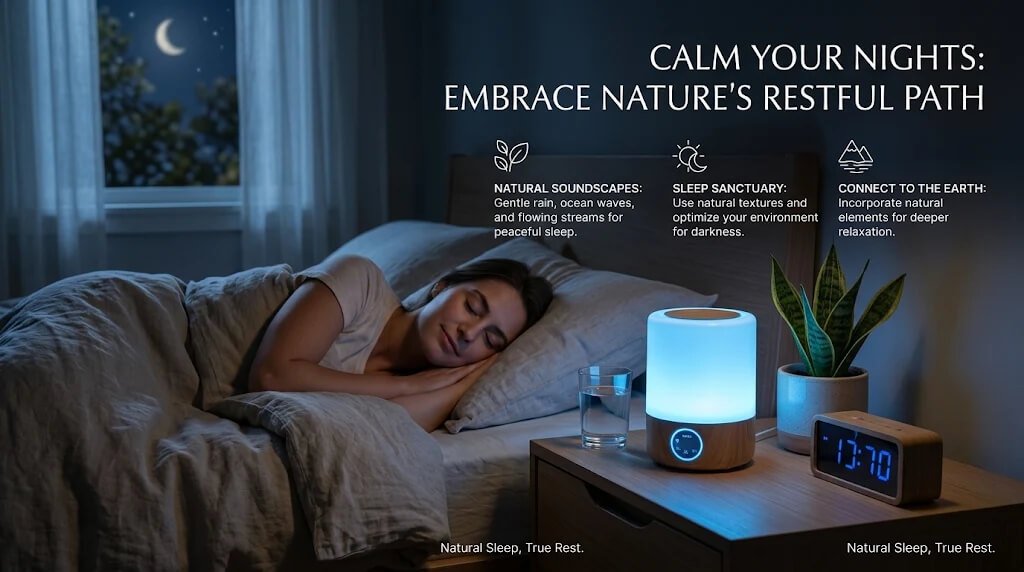
1. Play Soft Background Sound (White, Pink, or Brown Noise)
How to do it: Set a white-noise machine, a fan, or a phone app (search “pink noise” or “brown noise”) to a volume just below the level of your tinnitus. Place the source 3–5 feet (about 1–1.5 m) from your pillow. Aim for a steady, non-melodic sound—rain, ocean waves, or a soft hum work well.
Why it works: Sound enrichment gives your auditory cortex an external signal to process, reducing the brain’s “gain” on the tinnitus signal. A 2020 review in the Journal of the American Academy of Otolaryngology–Head & Neck Surgery found that consistent low-level sound masking was associated with reduced tinnitus loudness ratings over 8–12 weeks.
Tip: Keep the volume low enough that you can still hear a whispered word across the room. You want the sound to blend in, not compete.
2. Build a 30-Minute Wind-Down Routine
How to do it: Pick a consistent “lights-out” time and work backward. For example, if you want to sleep at 10:30 p.m.:
- 10:00 p.m. – 10:10 p.m.: Dim overhead lights. Switch to a warm-toned lamp (2700 K or lower).
- 10:10 p.m. – 10:20 p.m.: Do 10 minutes of diaphragmatic breathing (see #4 below) or a gentle body scan.
- 10:20 p.m. – 10:30 p.m.: Get into bed. Start your sound source. Close your eyes. Let the breathing settle.
Why it works: A predictable routine signals your parasympathetic nervous system to shift from “alert” to “rest” mode. The American Academy of Sleep Medicine recommends consistent pre-sleep rituals as a first-line strategy for improving sleep onset, which in turn reduces the hyperarousal that makes tinnitus more noticeable.
3. Cut Caffeine and Alcohol After 2 p.m.
How to do it: Swap your afternoon coffee for decaf, herbal tea (chamomile, rooibos, or peppermint), or water. Limit alcohol to no more than one small glass (4 oz / 120 ml) of wine or beer, and finish it by 6 p.m.
Why it works: Caffeine is a stimulant that raises heart rate and cortical arousal, both of which can make tinnitus feel louder. Alcohol disrupts REM sleep in the second half of the night, causing micro-awakenings that pull your attention back to the ringing. If you’re already working on reducing caffeine intake for other reasons, this is a natural overlap.
Coach’s Tip: I tell my clients to treat caffeine like a pre-workout. It’s useful in the morning for focus, but taking it too late is like loading a sprinter up on stimulants right before they need to recover. Shift your last cup to before noon and you’ll likely notice less nighttime ringing within a week or two.
4. Practice Diaphragmatic (Belly) Breathing
How to do it:
- Lie on your back with one hand on your chest and the other on your belly.
- Inhale slowly through your nose for a count of 4. Your belly hand should rise; your chest hand should stay relatively still.
- Hold for a count of 2.
- Exhale slowly through pursed lips for a count of 6.
- Repeat for 10 rounds (about 3–4 minutes).
Do this twice: once during your wind-down and once if you wake up at 2 a.m. and can’t settle.
Why it works: Slow, extended-exhale breathing activates the vagus nerve and shifts autonomic balance toward parasympathetic dominance. A study indexed in PubMed found that 10 minutes of diaphragmatic breathing reduced self-reported stress and lowered heart rate in adults, effects that carry into sleep. Lower sympathetic tone means less “volume” on the tinnitus signal.
Easier version: If 10 rounds feel like a lot, start with 5 rounds and build up over two weeks.
Harder version: Add a 4-7-8 pattern (inhale 4, hold 7, exhale 8) once the basic rhythm feels automatic.
5. Keep Your Bedroom Cool, Dark, and Quiet (Except for Your Masking Sound)
How to do it: Set your thermostat to 65–68 °F (18–20 °C). Use blackout curtains or a sleep mask. Remove phone, TV, and laptop from the bedroom, or at minimum keep them on airplane mode.
Why it works: The National Sleep Foundation recommends a bedroom temperature between 60–67 °F (15.5–19.4 °C) for optimal sleep. A cooler room lowers core body temperature, which promotes deeper sleep cycles. Darkness supports melatonin production. Fewer visual and auditory “interruptions” means fewer micro-awakenings that drag your attention back to the tinnitus.
6. Do 5 Minutes of Gentle Neck and Jaw Stretches
How to do it (do each for 30 seconds, 2 reps per side):
- Neck side-lean: Tilt your right ear toward your right shoulder. Gently press with your right hand for a few pounds of pressure (no more than 10 lb / 4.5 kg). Hold. Switch sides.
- Chin tuck: Sit tall. Draw your chin straight back (make a “double chin”) without tilting your head. Hold.
- Jaw release: Open your mouth wide, then slowly close. Repeat 5 times. Then place your tongue on the roof of your mouth and gently press upward for 10 seconds.
Why it works: Tension in the cervical spine and temporomandibular joint (TMJ) can refer sensation to the ear and worsen tinnitus perception. A review in the International Journal of Audiology noted that myofascial tension in the neck and jaw was a common co-factor in tinnitus patients. Even 5 minutes of gentle stretching can reduce that referred tension.
Common Mistake: Jerking your head or forcing the jaw open past a comfortable range. This can irritate the TMJ and make the ringing worse. Move slowly, within a pain-free range, and stop if you feel a sharp click or pain.
7. Limit Screen Time 60 Minutes Before Bed
How to do it: Set a phone or tablet “do not disturb” for 9:30 p.m. (or 60 minutes before your target sleep time). If you must use a screen, enable a blue-light filter and keep brightness below 50%. Better yet, swap the scroll for a physical book, a short audio story, or the breathing exercise in #4.
Why it works: Blue light from screens suppresses melatonin by up to 50% in the hours before sleep, according to research summarized by Harvard Health Publishing. Less melatonin means slower sleep onset, and a longer period of lying awake gives your brain more time to fixate on the tinnitus.
8. Try a Guided Tinnitus Retraining Exercise (Home Version)
How to do it:
- Sit or lie down in a quiet spot.
- Close your eyes and simply listen to the tinnitus for 2 minutes without trying to change it. Notice its pitch, volume, and where you feel it (left ear, right ear, center of head).
- Now shift your attention to your breathing for 2 minutes.
- Alternate: 1 minute on the tinnitus, 1 minute on the breath. Repeat for 10 minutes total.
- Finish by naming three things you can feel (the bed, your feet, the air on your face).
Why it works: This is a simplified version of the attention-shifting component used in Tinnitus Retraining Therapy (TRT) and CBT-based programs. A meta-analysis published in The Cochrane Database of Systematic Reviews found that CBT-based approaches for tinnitus produced moderate reductions in tinnitus distress and improved sleep quality. You don’t need a therapist to practice the attention-shifting component at home, though a professional can tailor the cognitive strategies.
Easier version: Do 5 minutes instead of 10. Focus only on the breathing step.
Harder version: Add a body-scan (see #9) after the 10-minute attention exercise.
9. Practice a 10-Minute Body-Scan Meditation
How to do it: Lie on your back. Starting at your toes, slowly bring attention to each body part—feet, calves, knees, thighs, hips, belly, chest, hands, arms, shoulders, neck, jaw, face, top of head. Spend about 30 seconds on each area. Notice tension without trying to fix it. Breathe into the area and let it soften. If your mind wanders to the tinnitus, gently label it (“that’s the ringing”) and return to the body part you were scanning.
Why it works: Body-scan meditation trains the brain to disengage from a single sensory channel (the tinnitus) and distribute attention across the whole body. A randomized trial indexed in PubMed reported that 8 weeks of mindfulness-based meditation reduced tinnitus-related distress scores in participants. Even a single 10-minute session before bed can lower the “alarm” quality of the sound.
10. Use a Humidifier if Your Air Is Dry
How to do it: Run a cool-mist humidifier in your bedroom, keeping humidity between 40–60%. Clean the tank every 2–3 days to prevent mold. Aim the mist away from your pillow.
Why it works: Dry air can irritate the nasal passages and Eustachian tubes, which connect the middle ear to the throat. Irritation in this area can heighten ear sensitivity and make tinnitus feel more prominent. While this is a small factor, it’s an easy one to address, especially in winter or in air-conditioned rooms.
11. Track Your Triggers with a Simple Journal
How to do it: Keep a small notebook or phone note. Each night, jot down:
- Tinnitus loudness (1–10 scale)
- How you slept (hours, interruptions)
- Caffeine/alcohol consumed that day
- Stress level (1–10)
- Any loud-noise exposure (concerts, power tools, headphones)
- What you did in the last hour before bed
After 2–3 weeks, look for patterns. You might notice the ringing spikes after a stressful workday or after a late espresso.
Why it works: Self-monitoring is a core component of CBT and TRT programs. Identifying your personal triggers lets you adjust the specific variable—less caffeine, a post-workout walk, an earlier bedtime—rather than guessing. The Mayo Clinic recommends keeping a tinnitus diary as a first step in managing the condition.
12. Move Your Body During the Day (Even a 20-Minute Walk)
How to do it: Aim for at least 20–30 minutes of moderate activity most days—brisk walking, cycling, swimming, or a light resistance session. If you’re new to exercise, start with a 15-minute walk after lunch and build to 30 minutes over two weeks. Keep the intensity at a level where you can still hold a conversation (roughly 55–70% of your max heart rate).
Why it works: Regular aerobic activity improves cardiovascular function, including blood flow to the inner ear. A study published in the Journal of the American Medical Association (JAMA) found that adults who met or exceeded aerobic activity guidelines had a lower risk of developing tinnitus compared to sedentary peers. Exercise also reduces circulating cortisol and improves sleep architecture, both of which indirectly lower nighttime tinnitus perception. If you want a structured plan, look into natural energy and stamina support strategies that pair movement with nutrition.
Easier version: Two 10-minute walks (one after lunch, one after dinner) instead of one 20-minute block.
Harder version: Add 2–3 short resistance sessions per week (bodyweight squats, push-ups, rows) to build overall conditioning.

How to Build Your Nightly Tinnitus Routine
You don’t need to do all 12 strategies tonight. Pick three that feel manageable and stack them over a few weeks. Here’s a sample 30-minute wind-down that incorporates the highest-impact items:
| Time (example) | Action | Duration |
| 9:30 p.m. | Last caffeine/alcohol cut-off already passed. Put screens away. | — |
| 10:00 p.m. | Dim lights. Start white/pink noise machine. | 5 min |
| 10:05 p.m. | Gentle neck and jaw stretches (#6). | 5 min |
| 10:10 p.m. | Diaphragmatic breathing (#4), 10 rounds. | 5 min |
| 10:15 p.m. | Body-scan or attention-shifting exercise (#8 or #9). | 10 min |
| 10:25 p.m. | Get into bed. Continue sound. Close eyes. Let breathing settle. | 5 min |
| 10:30 p.m. | Lights out. | — |
Adjust the clock to fit your schedule. The key is consistency: do the same sequence at roughly the same time every night so your nervous system learns the pattern.
Coach’s Tip: Think of this routine the way I program a cool-down after a heavy lifting session. You wouldn’t skip the cool-down because you’re tired. You do it because you’re tired, and it’s what lets you recover. Your nightly tinnitus routine is the same idea: a structured wind-down that tells your brain the stress of the day is over.

What to Avoid at Night (Quick Checklist)
- Loud headphones or earbuds in bed (even at low volume, they can fatigue the cochlea).
- Checking your phone in bed, especially social media or news (raises cortisol, delays melatonin).
- Napping after 3 p.m. (compresses your sleep drive and fragments nighttime sleep).
- Large meals within 2 hours of bed (digestion raises core temperature and disrupts sleep; see how sleep affects metabolism and weight management for the broader sleep-hygiene picture).
- Trying to “fall asleep fast” while fixating on the ringing. The more you monitor it, the louder it feels. Shift attention to the breath or the body scan.
When to See a Doctor
Most tinnitus is benign and manageable with the strategies above. However, schedule an appointment with an ENT or audiologist if you notice any of the following:
- Tinnitus that appeared suddenly (over minutes to a few hours)
- Ringing in only one ear
- Associated hearing loss, muffled hearing, or dizziness
- Pulsatile (whooshing in rhythm with your heartbeat) tinnitus
- Tinnitus that is worsening week over week despite consistent self-care
- Tinnitus that is significantly interfering with sleep, work, or mood for more than 2–3 weeks
An audiologist can run a hearing test, rule out middle-ear or vascular causes, and discuss options like hearing aids with tinnitus masking, sound therapy devices, or referral to a CBT therapist trained in tinnitus.
If you’re also managing stress or hormonal shifts that affect sleep, a conversation with your primary-care provider about how sleep and hormonal changes interact can help you address the root cause rather than just the symptom.
Safety Notes and Cautions
- No “miracle cure.” No supplement, herb, or home remedy has been proven to eliminate tinnitus. Be cautious of products online that promise to “cure” or “silence” tinnitus permanently.
- Supplements: Some people try magnesium, zinc, Ginkgo biloba, or omega-3 fatty acids (see omega-3 fatty acids and their anti-inflammatory role) for tinnitus. The evidence is mixed, and some supplements interact with medications. Talk to your doctor before starting any new supplement, especially if you take blood thinners, antihypertensives, or other daily medications.
- Stress management: If tinnitus is tied to high anxiety or a stress cycle, the strategies above help, but they are not a replacement for professional mental-health support. A therapist trained in CBT or TRT can provide structured cognitive tools. You can also explore adaptogens and cortisol management as a complementary approach, but pair any supplement with a medical conversation.
- Hearing protection: During the day, use earplugs or earmuffs in loud environments (concerts, construction, mowing the lawn). Protecting your cochlea from further noise damage is one of the most practical long-term steps you can take.
F.a.q
1. What is the fastest way to quiet tinnitus at night?
There’s no instant “off switch,” but combining a soft white-noise source with 5–10 minutes of diaphragmatic breathing before bed is the quickest routine most people can start tonight. The masking sound reduces the contrast between the ringing and the silence, while the breathing lowers sympathetic arousal. Consistency over 1–2 weeks is where most people notice a meaningful shift.
2. Does exercise really help tinnitus?
Research suggests a link. A large cohort study in JAMA found that meeting aerobic activity guidelines was associated with a lower risk of tinnitus. Exercise improves circulation, reduces cortisol, and improves sleep—all factors that can lower perceived tinnitus loudness. Aim for 20–30 minutes of moderate activity most days, but avoid very loud gym environments without ear protection.
3. Can stress make tinnitus louder?
Yes. Stress activates the sympathetic nervous system, which increases blood flow and neural firing in the auditory pathway. Many people report that their tinnitus is noticeably louder after a stressful day. Managing cortisol through breathing, movement, and a structured wind-down can reduce that amplification.
4. What foods or drinks make tinnitus worse?
Caffeine, alcohol, and high-sodium meals are the most commonly reported dietary triggers, though sensitivity varies person to person. Keeping a simple food-and-symptom journal for two weeks (see strategy #11) will help you identify your own triggers. There is no single “tinnitus diet” supported by strong evidence.
5. Is tinnitus worse at night, and why?
Most people report nighttime worsening. The main reason is reduced ambient sound: with fewer external noises to mask the ringing, your auditory cortex amplifies the internal signal. Fatigue and a stressed nervous system at the end of the day add to the effect. The strategies in this article target both the masking and the nervous-system components.
6. How long does it take for natural tinnitus management to work?
It varies. Some people notice a small shift in perceived loudness within 5–7 days of consistent sound masking and sleep hygiene. CBT-based attention training and regular exercise tend to show more measurable changes over 6–12 weeks. Be patient with yourself; the goal is to reduce the distress and sleep disruption, not necessarily to eliminate the sound entirely.
Final Thoughts
Managing tinnitus at night doesn’t require a pill, a device, or a procedure. It requires a small set of repeatable habits that lower your nervous system’s “volume” and give your auditory cortex something other than the ringing to process. Start with three strategies from the list above—sound masking, diaphragmatic breathing, and a caffeine cut-off—and layer in the rest over the following weeks.
You don’t have to white-knuckle the quiet. You can teach your brain, night by night, that the ringing is background noise, not an emergency. That shift in perception is where the real relief lives.
If your tinnitus is sudden, one-sided, or paired with hearing changes, please see an ENT or audiologist before relying on home strategies alone. And if you’re working on broader sleep or stress goals alongside tinnitus, the same principles of consistent routine, movement, and reduced stimulation apply across the board.