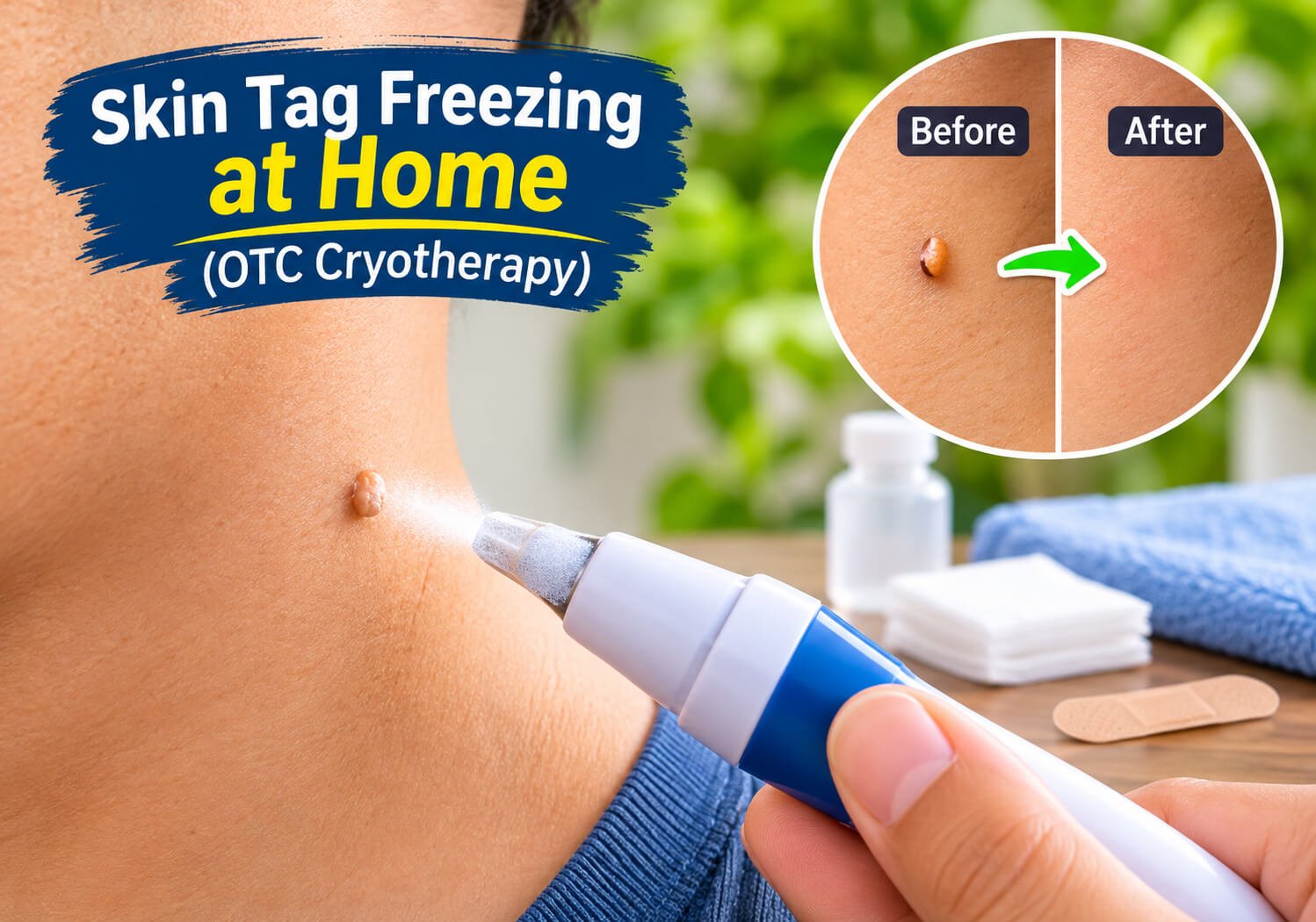
A small, soft bump on your neck or under your arm that rubs against your necklace or bra strap. You’ve probably noticed one, and you’ve probably wondered if you can just zap it away without a doctor’s visit. Skin tag freezing at home using over-the-counter (OTC) cryotherapy products has become one of the most searched-at-home dermatology treatments, and for good reason: it’s low-cost, private, and available at any pharmacy.
But “available” doesn’t always mean “appropriate for your specific spot, size, or skin type.” Before you pop the cap off a cryo pen, it helps to understand exactly what the freezing process does to the tissue, how OTC devices compare to what a dermatologist uses, and which situations call for professional hands instead of a $25 bottle from the drugstore.
This guide walks you through the science, the step-by-step process, the healing timeline, and the safety lines you shouldn’t cross.
QUICK ANSWER
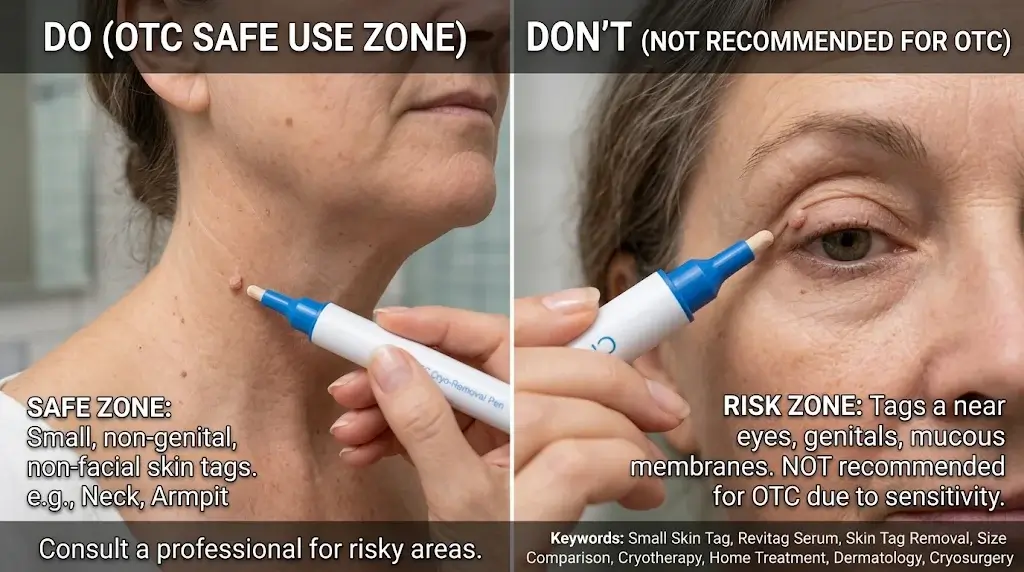
OTC skin tag freezing uses a dimethyl ether (DME) spray or pen to freeze a small benign growth, causing it to slough off in 5–14 days. It works best for tags under 5 mm (0.2 in) on the neck, armpit, or torso. It is not recommended for the face, eyelids, genitals, or any lesion you’re unsure about. Always confirm the growth is a true skin tag with a doctor first.
What Exactly Is a Skin Tag, and Why Do People Freeze Them?
Skin tags—medically called acrochordons—are tiny, soft, flesh-colored or slightly darker growths that hang off the skin on a thin stalk (a peduncle). They’re completely benign, meaning they don’t turn into cancer, and they’re most common on the neck, under the arms, in the groin fold, around the eyelids, and on the chest.
Research published in peer-reviewed dermatology literature links acrochordons to friction, insulin resistance, and a genetic tendency toward loose, thin skin. They’re extremely common: studies suggest roughly 60–70 % of adults over 50 have at least one, according to data summarized by the National Library of Medicine (MedlinePlus) [VERIFY].
Most people don’t freeze a skin tag for medical reasons. They do it because the tag:
- Catches on clothing, jewelry, or a razor
- Gets irritated and bleeds
- Sits in a spot that’s cosmetically noticeable
- Simply bugs them, and they’d rather not wait for a dermatology appointment
That’s a perfectly valid reason. The question is whether an OTC cryo product is the right tool for your tag.
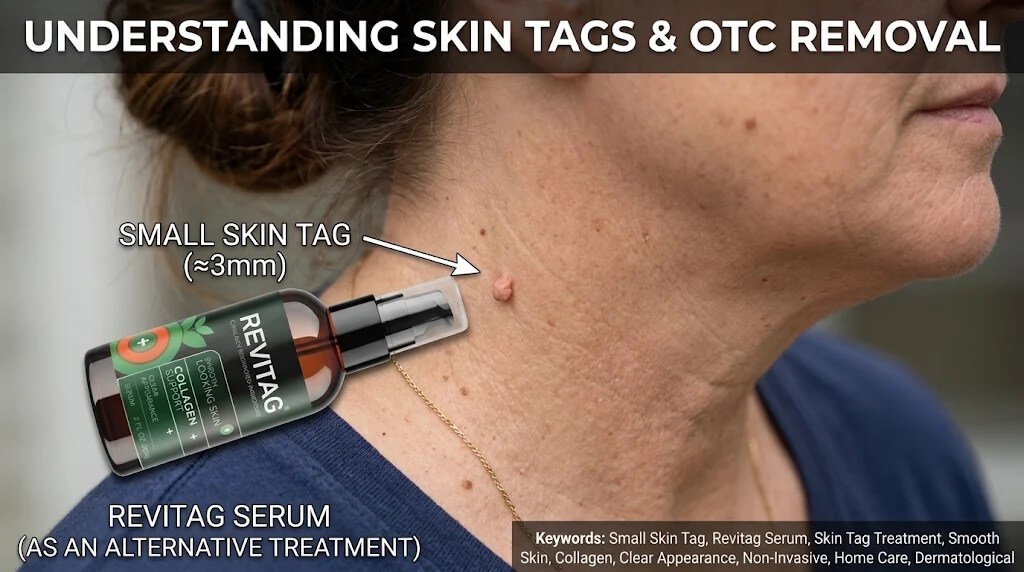
How OTC Cryotherapy Actually Works
Every OTC skin tag freezer you’ll find at a pharmacy—whether it’s a twist-up pen, a spray can, or a small applicator tip—uses the same basic refrigerant: dimethyl ether (DME). When DME is released from a pressurized canister and hits the skin, it expands and absorbs heat rapidly, dropping the tissue temperature to roughly −50 °C to −60 °C (−58 °F to −76 °F) [VERIFY exact range per product label].
Here’s what happens at the cellular level, in plain language:
- Ice crystals form inside and around the cells of the skin tag.
- Cell membranes rupture as the crystals expand, disrupting the tiny blood vessels feeding the tag.
- The tissue dies (necrosis) over the next 24–72 hours. The tag may look darker, more swollen, or develop a small blister.
- Your body’s healing process treats the dead tissue like a scab. Over 5–14 days, the tag dries out, darkens, and eventually detaches on its own.
This is the same fundamental mechanism a dermatologist uses with liquid nitrogen (which hits about −196 °C / −321 °F), but at a much milder temperature. That difference matters, and it’s the single most important thing to understand before you buy a product.
Coach’s Tip: Think of it like a hair dryer vs. a torch. Both use heat (or in this case, cold), but the torch gets the job done in one pass while the hair dryer needs several passes and still risks uneven results. OTC DME is the hair dryer. It can work on small, thin tags, but it won’t match the depth or speed of medical-grade liquid nitrogen.
OTC Cryotherapy vs. Medical Cryotherapy: Side-by-Side
| Factor | OTC Home Cryo (DME pen/spray) | Medical Cryotherapy (liquid N₂) |
| Refrigerant | Dimethyl ether (DME) | Liquid nitrogen |
| Tip temperature | ≈ −50 to −60 °C [VERIFY] | −196 °C |
| Depth of freeze | Superficial; may not reach the base of larger tags | Deeper; can freeze the full peduncle |
| Typical tag size treated | Under 5 mm (0.2 in) | Up to ~10 mm (0.4 in) or larger |
| Number of sessions | Often 1–3 applications, 1–2 weeks apart | Usually 1 session; occasionally a touch-up |
| Pain level | Sharp sting for 10–30 sec; mild soreness after | Brief intense cold; stinging for a few minutes |
| Scarring / pigment risk | Low for small tags; higher if over-applied | Low when done by a trained professional |
| Cost | 15–40 per pen or canister [VERIFY] | 100–300+ per visit (often not covered by insurance for cosmetic reasons) |
| Who performs it | You | Dermatologist, GP, or nurse practitioner |
| Face / eyelid / genital use | Not recommended | Can be done with proper technique |
Step-by-Step: How to Use an OTC Skin Tag Freezer at Home
If you’ve confirmed with your doctor that the growth is a straightforward skin tag, and it’s under about 5 mm (0.2 in) on your neck, armpit, upper chest, or torso, here’s a practical, safe process. Follow the instructions on your specific product, but the general sequence looks like this:
Before You Start
- Wash your hands with soap and water.
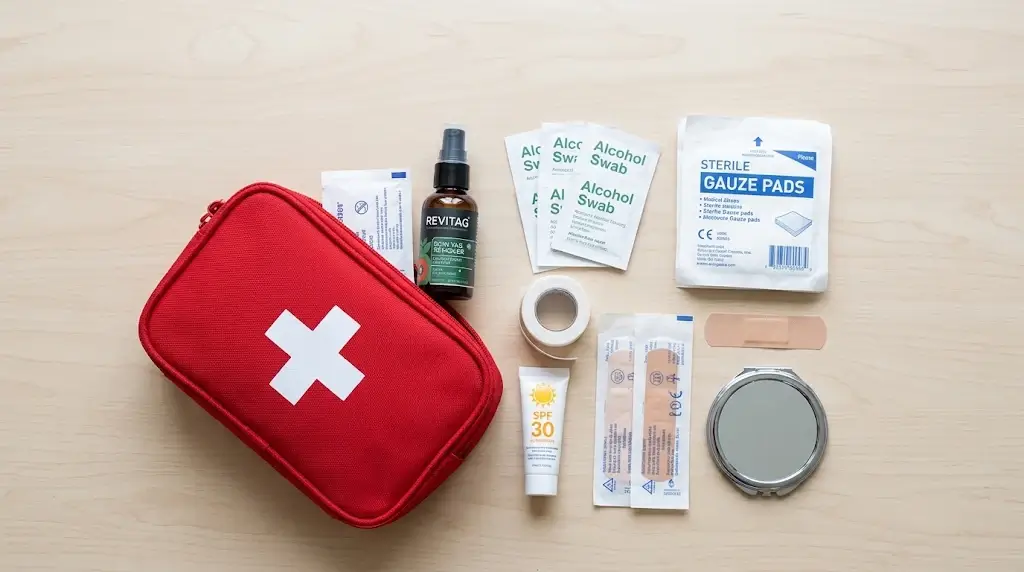
- Clean the skin around the tag with an alcohol swab or mild antiseptic. Let it dry completely.
- Gather supplies: the OTC cryo pen or spray, a small piece of gauze or cotton pad, a clean bandage, and a mirror (or a partner for hard-to-see spots).
- Do it in a well-ventilated room. DME is a flammable gas. Keep away from open flames, heaters, or sparks.
The Freezing Application
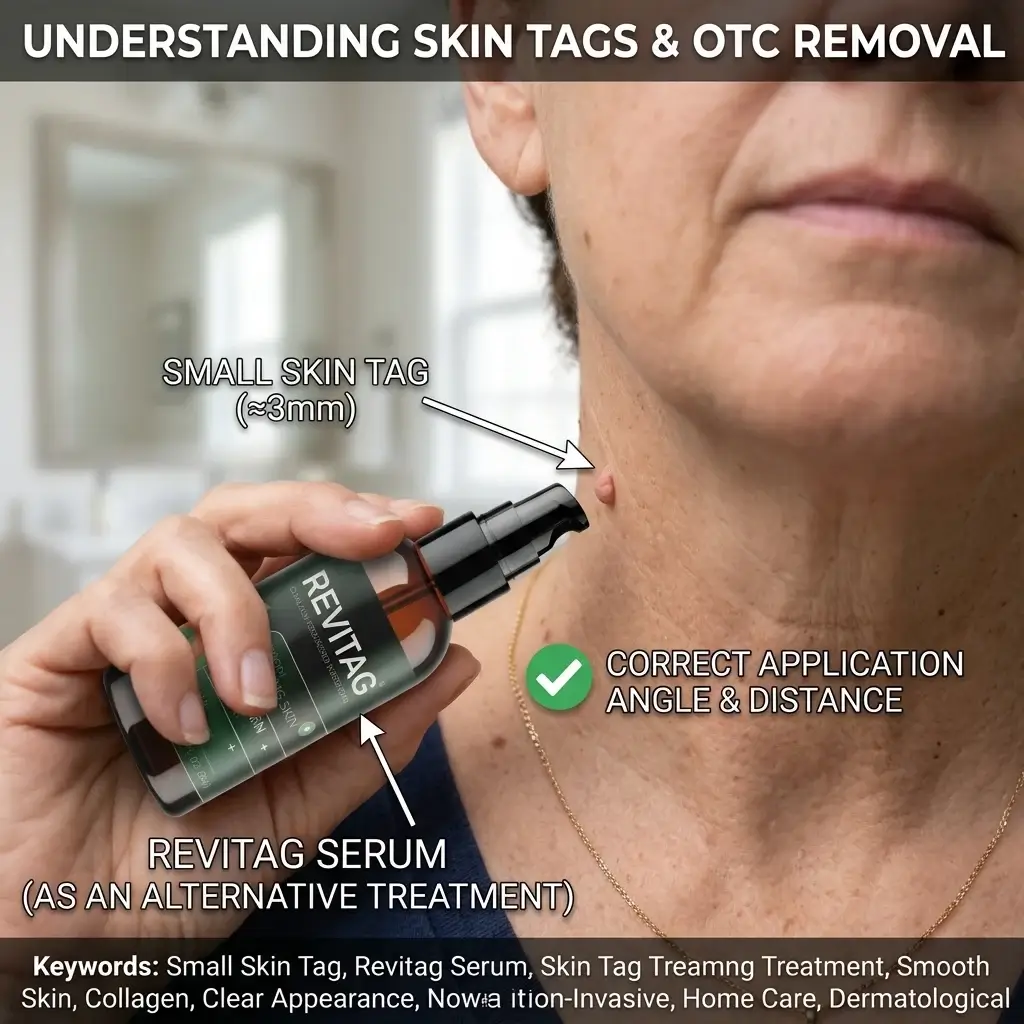
- Position the applicator so the tip (or spray nozzle) is about 1–2 mm (just under 0.1 in) from the skin. Most pens have a twist or push mechanism; sprays have a trigger.
- Apply for the time stated on the label—usually 10 to 30 seconds for a small tag. You’ll feel a sharp, stinging cold. That’s normal.
- Do NOT touch the frozen area with your fingers. The skin will be extremely cold and you can get a secondary frostbite.
- Wait 10–15 seconds, then assess. The tag should look paler or slightly whitened. If it still looks fully pink and unchanged, you may do one additional short application after waiting 30 seconds. Do not exceed the maximum time on the label.
- Remove the applicator and let the area air-dry for a minute or two.
Immediate Aftercare
- Apply a thin layer of petroleum jelly or a fragrance-free moisturizer to the surrounding skin (not directly on the frozen spot if it’s blistered).
- Cover with a small, clean bandage to protect it from rubbing.
- Wash the area gently with mild soap and water once a day. Don’t pick, peel, or scratch.
- Avoid sun exposure on the healing spot for at least 2 weeks. If it’s on your neck, wear a collar or use SPF 30+ sunscreen once the skin has closed.
What to Expect: The Healing Timeline
Knowing what’s “normal” keeps you from panicking (or from peeling the tag off too early).
| Day | What You’ll Likely See |
| Day 0 (treatment day) | Sharp cold sting for 10–30 sec. Tag looks pale or slightly white. Mild redness around the base. |
| Day 1–2 | Tag may darken, swell a little, or form a tiny clear blister. Mild soreness. |
| Day 3–5 | Tag dries out, turns brown or black. The surrounding skin may be slightly pink. |
| Day 5–10 | The tag shrivels and starts to separate at the base. It may fall off on its own while you’re showering. |
| Day 10–14 | A small, flat, pinkish spot where the tag was. This is normal new skin. |
| Week 3–6 | The pink spot gradually fades to match surrounding skin. A faint mark may linger for a few months, especially on darker skin tones. |
If the tag hasn’t fallen off by day 14–21, it likely wasn’t fully frozen at its base. You can do one repeat application after the skin has fully healed, or—better—see a dermatologist for a single liquid-nitrogen pass.
Common Mistake: Picking or snipping the tag off before it’s ready. This can leave an open wound, increase infection risk, and cause a more noticeable scar than the freeze would have. Let it fall off on its own. If it’s still attached after three weeks, make an appointment instead of grabbing scissors.
Safety Considerations: Who Should NOT Try Home Cryotherapy
This is the section I’d read out loud to a client before handing them a cryo pen. Please take it seriously.
Do NOT use an OTC cryo product if the growth is:
- On your face, eyelids, lips, nose, or ears
- In the genital area, inner thighs, or under the breast fold (high moisture, thin skin)
- Larger than 5 mm (0.2 in) or has a thick, fleshy base
- Bleeding, rapidly changing in size, irregularly shaped, or multi-colored (these need a dermatologist to rule out other conditions)
- On broken, infected, or eczematous skin
- On a mole (nevus), wart, or any lesion you haven’t had identified
Also pause and call your doctor if you:
- Have diabetes or impaired wound healing
- Are on blood thinners (warfarin, apixaban, etc.) or have a bleeding disorder
- Have Raynaud’s phenomenon or poor peripheral circulation
- Are pregnant or breastfeeding (get clearance first)
- Have sensitive, very thin, or easily scarred skin (keloid tendency)
- Are under 12 years old (pediatric skin is thinner; a pediatrician should handle it)
The American Academy of Dermatology [VERIFY] consistently advises that any skin lesion you’re not 100 % sure about should be examined in person before any home treatment. A quick visual check by a GP or dermatologist takes five minutes and saves you from freezing the wrong thing.
hoosing an OTC Product: What to Look For
You’ll see a handful of product formats on the shelf or online. Here’s a quick buyer’s checklist:
- Refrigerant: Dimethyl ether (DME) is the standard. Avoid anything that lists “unknown propellant” or a non-dermatological gas.
- Applicator tip: A small, rounded tip (≈ 3–5 mm / 0.1–0.2 in) gives you better control than a wide spray nozzle for tiny tags.
- Application time guidance: The label should state a maximum freeze time (usually 10–30 sec). If it doesn’t, put it back.
- Single-use vs. multi-use: Multi-use pens (10–20 applications per canister) are more economical if you have 2–3 small tags. Single-use wands are fine for one tag.
- Price range: Expect to pay roughly 15–40 per pen or canister [VERIFY current retail pricing].
- Warranty / return policy: Buy from a retailer with a clear return window in case the product is defective.
You don’t need the most expensive brand. You need a product with a clear DME label, a small tip, and explicit time instructions.
Tips for Best Results and Aftercare
- Treat one tag at a time. Give each site 10–14 days to heal before doing another.
- Keep the area clean and dry. A gentle antiseptic wipe once a day is plenty. Avoid hydrogen peroxide or alcohol on the healing spot—they slow re-epithelialization.
- Don’t apply makeup, retinol, or exfoliating acids over the healing area until the skin is fully closed (usually 2 weeks).
- Wear loose clothing over the treated area for the first 48 hours to avoid friction.
- Sun protection matters. New, pink skin is more prone to post-inflammatory hyperpigmentation. Use SPF 30+ or a physical barrier (collar, scarf) for 4–6 weeks.
- If you see increasing redness, pus, a spreading rash, or fever after treatment, stop self-care and see a doctor. Those are signs of infection, not a normal healing response.
- Take a photo of the tag before treatment and one each week after. It helps you track healing and gives your doctor a clear picture if you need a follow-up.
Supporting Overall Skin Health
While you’re focused on the small tag, it’s worth remembering that the surrounding skin’s healing capacity depends on good hydration, nutrition, and circulation. Omega-3 fatty acids, for example, support skin barrier function and may help with normal inflammatory responses, as outlined in our guide to omega-3s and skin hydration. And if you’re already thinking about long-term skin appearance, antioxidants like astaxanthin have been studied for their role in protecting skin from oxidative stress—see our astaxanthin and skin health overview for the research summary.
FAQ
Can you freeze skin tags at home safely?
Yes, for small (under 5 mm / 0.2 in), clearly benign tags on the neck, armpit, or torso. Follow the product’s time limits, keep the area clean, and avoid the face, eyelids, and genitals. If you’re unsure the growth is a true skin tag, get a doctor’s look first.
How long does it take for a frozen skin tag to fall off?
Most small tags detach between 5 and 14 days after a single OTC freeze. Some take up to 21 days. The tag dries, darkens, and shrivels before dropping off. Don’t pull it; let it separate naturally.
Is home cryotherapy the same as what a dermatologist does?
No. A dermatologist uses liquid nitrogen at −196 °C, which penetrates deeper and freezes the tag’s base more completely in one pass. OTC DME products reach roughly −50 to −60 °C, so they work best on small, thin tags and may need a second application.
What are the side effects of OTC skin tag freezing?
Mild stinging during the freeze, temporary redness, a small blister, and a pink or slightly darker spot that fades over 4–8 weeks. Rarely, over-application can cause a small scar or a patch of lost pigment. Infection is uncommon if you keep the area clean.
Can you freeze skin tags on your face at home?
It’s not recommended. Facial skin is thinner, more visible, and closer to the eyes. A small freeze error can leave a noticeable mark or, worse, affect the eyelid. A dermatologist can use a finer, controlled applicator for facial tags.
How much does at-home skin tag freezing cost?
An OTC cryo pen or canister typically runs 15–40 [VERIFY] and treats one to several small tags. A single dermatologist visit for liquid-nitrogen cryotherapy usually costs 100–300+, and insurance often doesn’t cover it when the tag is purely cosmetic.
The Bottom Line
Skin tag freezing at home with an OTC cryotherapy product is a reasonable, low-cost option for small, clearly benign tags in safe body areas. The process is simple, the healing timeline is predictable, and most people handle it in under five minutes.
But “simple” doesn’t mean “universal.” The moment a tag is bigger than a few millimeters, sits near your eye or in a fold, looks unusual, or you simply aren’t sure what it is, the right move is a quick in-person check with a doctor. Five minutes of professional eyes beats a week of worrying about a home freeze that didn’t quite work.
Use the product within its stated limits, keep the area clean, protect the healing skin from the sun, and give it the 10–14 days it needs. And if the tag is still there after three weeks, book the dermatology appointment. You’ll get it done in one pass, with a colder, more precise freeze, and you’ll stop thinking about it.