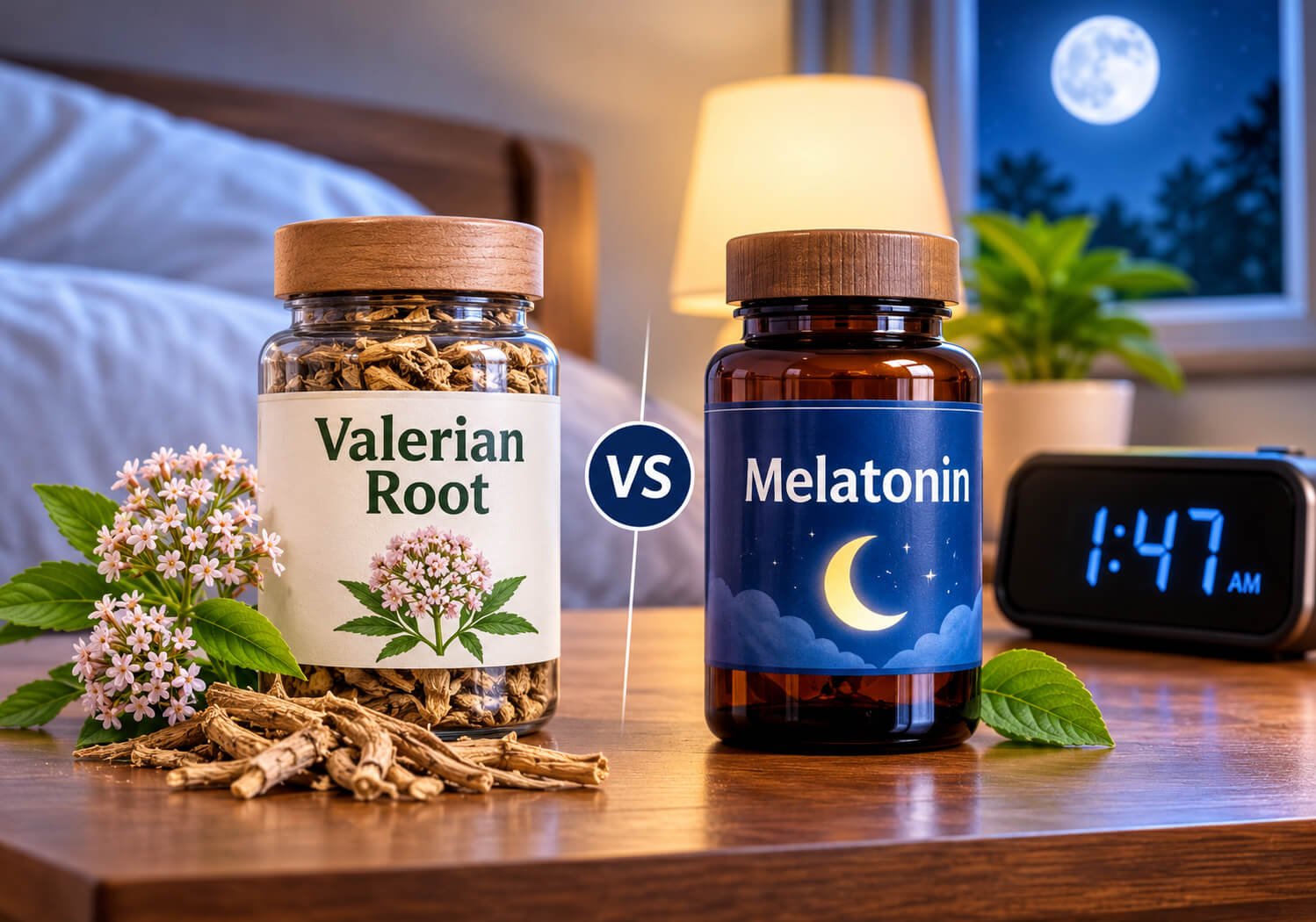
You stare at the ceiling at 1:47 a.m. again. Your brain won’t shut off, and the next day’s workout is already feeling compromised. You’ve heard about valerian root and melatonin as natural ways to fall asleep faster, but which one should you actually try? The short answer: they work through completely different mechanisms, and the right choice depends on why you’re struggling to drift off.
As a strength and conditioning coach, I see sleep issues affect training performance, recovery, and even body composition every single day. Poor sleep throws off your cortisol, blunts muscle protein synthesis, and makes every set of squats feel heavier. So getting your sleep sorted isn’t a luxury—it’s part of your training program.
This valerian root vs melatonin for falling asleep comparison breaks down exactly how each supplement works, what the research says, proper dosing, side effects, and when one clearly beats the other. No fluff, no “try this tea” filler. Just the practical details you need to make a decision tonight.
⚡ Quick Answer
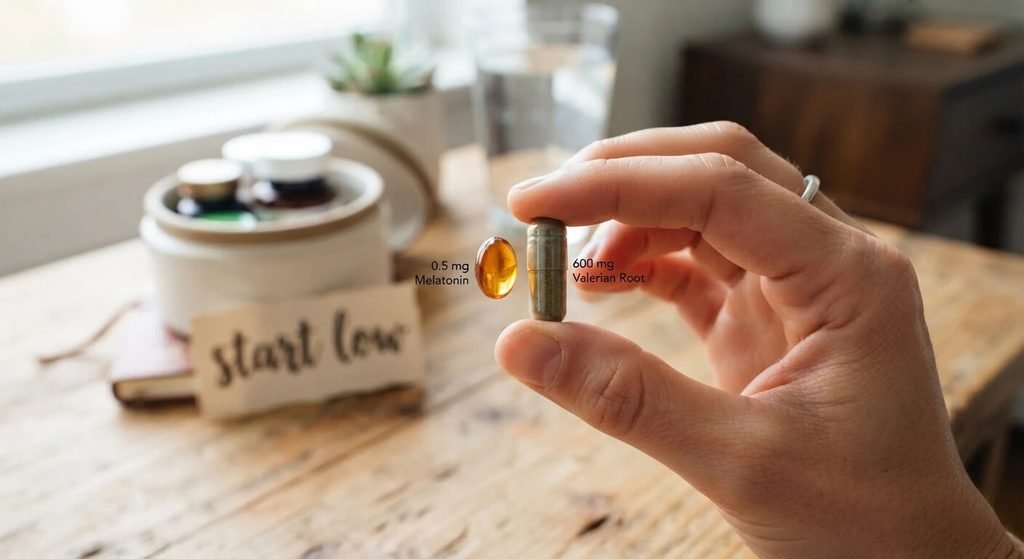
Melatonin is best for timing issues—jet lag, shift work, or a delayed circadian rhythm. Valerian root is better for anxiety-driven sleep onset problems where your mind races. Neither is a sedative in the pharmaceutical sense. Start with 0.5–1 mg melatonin 30–60 min before bed, or 300–600 mg valerian root 60 min before bed, and give it 7–14 nights before judging results.
Side-by-Side Comparison: Valerian Root vs Melatonin
| Factor | Valerian Root | Melatonin |
| What it is | Dried root of Valeriana officinalis (herb) | Hormone produced by the pineal gland |
| Primary mechanism | Binds GABA-A receptors → mild sedation | Binds MT1/MT2 receptors → signals “nighttime” |
| Best for | Racing thoughts, mild anxiety, sleep-onset difficulty | Circadian misalignment, jet lag, delayed sleep phase |
| Typical dose | 300–600 mg (root extract) | 0.5–5 mg (start low) |
| Time to feel effect | 30–60 min (single dose); full benefit may take 2–4 weeks | 20–45 min |
| Sleep architecture effect | May increase deep (slow-wave) sleep, reduce awakenings | Shifts sleep timing; minimal effect on sleep stages |
| Half-life | ~1–2 hours (active compounds) | ~40–60 min |
| Common side effects | Morning grogginess, GI upset (rare) | Daytime drowsiness, vivid dreams, headache |
| Long-term data | Limited (studies up to 28 days) | Decades of use; generally safe ≤6 months |
| Regulatory status (US) | Dietary supplement (not FDA-approved as drug) | Dietary supplement (OTC) |
| Cost (typical) | 15–30 / 60 capsules | 8–20 / 60 capsules |
How Each One Works: The Mechanism Breakdown
Understanding why each supplement helps you fall asleep makes it easier to pick the right one.
Valerian Root: The GABA Pathway
Valerian root contains volatile oils (valerenic acid, isovaleric acid) and iridoid glycosides that interact with GABA-A receptors in the brain. GABA is your brain’s primary inhibitory neurotransmitter—think of it as the “brake pedal” for neural firing.
When valerian compounds bind to GABA-A receptors, they:
- Prolong the opening of chloride channels, making neurons less excitable
- Inhibit the reuptake of GABA, keeping it active longer
- May block the breakdown of GABA by the enzyme GABA-transaminase
The net effect is a mild, broad calming of neural activity. You don’t “black out.” You feel a gentle heaviness, your thoughts slow, and your body relaxes into the mattress.
A 2012 meta-analysis in the Journal of Clinical Sleep Medicine found that valerian reduced sleep-onset latency by roughly 10–15 minutes in people with mild insomnia, though the effect was modest compared to prescription sedatives.

Melatonin: The Circadian Clock Signal
Melatonin is a hormone your pineal gland releases in response to darkness. It doesn’t make you “sleepy” the way a sedative does. Instead, it tells your suprachiasmatic nucleus (your master circadian clock) that it’s nighttime, which in turn:
- Lowers core body temperature by ~0.5–1 °F (0.3–0.6 °C)
- Reduces alertness and wake-promoting signals
- Shifts the timing of your sleep-wake cycle
Exogenous (supplement) melatonin works best when your internal clock is out of sync—think jet lag, rotating shifts, or a chronically delayed sleep phase where your body doesn’t feel sleepy until 2 a.m.
The National Center for Complementary and Integrative Health (NCCIH) notes that melatonin is “generally considered safe for short-term use” but that long-term safety data beyond six months remains limited.
🏋️ Coach’s Tip
If you train in the evening, be mindful of timing. Melatonin taken at 9 p.m. can shift your whole sleep window earlier. If your 6 a.m. alarm is non-negotiable, take it no earlier than 60 minutes before your target bedtime, not just whenever you sit down.
Key Differences That Matter for Your Sleep
1. What’s Actually Keeping You Awake?
This is the single most important question. Before you buy either bottle, ask yourself:
- Do you feel physically tired but your brain won’t quiet down? → Valerian root is more likely to help. The GABA-mediated calming addresses the “racing mind” component.
- Do you feel alert at 10 p.m. and don’t get sleepy until 1–2 a.m.? → Melatonin is more likely to help. You have a timing problem, not an anxiety problem.
- Did you just land from a 7-hour flight or switch from night to day shifts? → Melatonin, full stop. It’s the most evidence-backed tool for circadian re-anchoring.
2. Speed of Effect
| Valerian Root | Melatonin | |
| Single-dose onset | 30–60 min | 20–45 min |
| Full therapeutic benefit | May take 2–4 weeks of nightly use | Often noticeable in 1–3 nights (for timing issues) |
If you need to fall asleep tonight and your issue is a delayed clock, melatonin will likely give you a faster, more noticeable shift. If your issue is chronic low-grade anxiety that makes sleep elusive every night, valerian may need a couple of weeks to build a consistent effect.
3. Sleep Architecture (What Happens Under the Hood)
Polysomnography (sleep lab) studies show different effects:
- Valerian root: Some studies report increased time in slow-wave (deep) sleep and fewer nighttime awakenings. This is the kind of sleep that supports growth hormone release and tissue repair—critical if you’re in a hypertrophy or strength block.
- Melatonin: Primarily shifts when you fall asleep. It has a minimal effect on the proportion of REM vs. NREM sleep. You’re not “deeper” asleep; you’re just earlier asleep.
For an athlete or active person prioritizing recovery, the deep-sleep signal from valerian is a meaningful distinction.
4. Side Effects and Safety Profile
Valerian root common effects:
- Morning grogginess (especially at 600 mg)
- Mild headache
- GI discomfort (nausea, loose stools) in a small percentage of users
- Rare: dizziness, dry mouth
Melatonin common effects:
- Daytime drowsiness (especially at doses >3 mg)
- Vivid or unusual dreams
- Mild headache
- Next-day “hangover” feeling if taken too late or at too high a dose
Both are generally well-tolerated at recommended doses. However, neither is without caution:
- Valerian can interact with benzodiazepines, barbiturates, and other CNS depressants. It may also potentiate the effects of sedating antihistamines.
- Melatonin can interact with blood thinners, immunosuppressants, and diabetes medications. It may lower blood pressure slightly.
If you take any prescription medication, check with your doctor or pharmacist before adding either supplement.
5. Dosing: Start Low, Go Slow
Melatonin dosing (practical protocol):
- Week 1–2: 0.5 mg, 30–60 min before target bedtime
- If no change: increase to 1 mg
- Week 3–4: 1–3 mg if needed
- Do NOT exceed 5 mg routinely. More is not better. The Mayo Clinic notes that doses above 5 mg offer no additional sleep benefit and increase the risk of next-day grogginess.
Valerian root dosing (practical protocol):
- Week 1–2: 300 mg of a standardized extract (valerenic acid ≥0.8%), 60 min before bed
- If no change: increase to 600 mg
- Give it a full 4 weeks before deciding it “doesn’t work”
- Take with a small snack to reduce GI upset
6. Long-Term Use and Tolerance
- Melatonin: No clear evidence of physical dependence or tolerance at standard doses. However, some users report that the “whoosh” of the first week fades. Cycling (5 nights on, 2 off) is a common strategy, though evidence for this is anecdotal.
- Valerian root: No documented physical dependence. Some users report a mild “rebound” of sleep difficulty after stopping after 4+ weeks, but this is not well-studied.
Neither should be used as a permanent crutch. Both work best alongside solid sleep hygiene fundamentals—consistent schedule, cool dark room, no screens 60 min before bed, no caffeine after 2 p.m.
When to Choose Valerian Root
Pick valerian root if:
- Your main issue is a racing mind or mild anxiety at bedtime
- You feel physically tired but can’t “switch off”
- You want a supplement that may support deeper slow-wave sleep for recovery
- You’ve been struggling with sleep onset for weeks to months (not a one-off bad night)
- You prefer a herbal, plant-based approach
- You don’t have a circadian timing problem (you feel sleepy at the right time, just can’t settle)
Who should be cautious with valerian:
- Pregnant or breastfeeding women (insufficient safety data)
- People with liver conditions (valerian is metabolized hepatically)
- Anyone taking sedatives, benzodiazepines, or strong CNS depressants
- People scheduled to drive or operate machinery within 8 hours of dosing
When to Choose Melatonin
Pick melatonin if:
- You’re dealing with jet lag (crossing 3+ time zones)
- You work rotating shifts or nights and need to shift your sleep window
- You have a delayed sleep phase (naturally don’t feel sleepy until very late)
- You’re a teen or young adult whose circadian rhythm has shifted later
- You want a quick, short-term fix (1–2 weeks) rather than a multi-week protocol
- You prefer a hormone-based approach that mimics your body’s own signal
Who should be cautious with melatonin:
- People on blood thinners (warfarin, apixaban) or immunosuppressants
- Those with autoimmune conditions (melatonin may modulate immune function)
- People with epilepsy (theoretical concern; discuss with neurologist)
- Pregnant or breastfeeding women (limited safety data)
⚠️ Common Mistake
Taking 5–10 mg of melatonin “because the bottle says so.” Most over-the-counter bottles default to 3–5 mg, but research consistently shows that 0.5–1 mg is sufficient for most adults. Higher doses don’t make you sleep deeper; they just make you groggier at 7 a.m. and can disrupt your next day’s training session. Start at 0.5 mg. You can always go up.
Can You Take Valerian Root and Melatonin Together?
Short answer: yes, there’s no documented dangerous interaction, but it’s usually unnecessary and can make you overly sedated.
In practice, I’d only consider combining them in one narrow scenario: you have both a circadian timing issue and a racing-mind component, and you’ve tried each alone for 2+ weeks without full resolution. If you do combine:
- Use the lowest effective dose of each (0.5 mg melatonin + 300 mg valerian)
- Take melatonin 30 min before bed, valerian 60 min before bed
- Do not exceed 2–3 weeks of combined use without reassessing
For most people, picking one and giving it a proper 2–4 week trial is the smarter move.
Cost Comparison: What You’ll Actually Pay
| Item | Typical Price Range | Supply | Cost Per Night |
| Valerian root 600 mg (60 caps) | 15–30 | 60 nights | 0.25–0.50 |
| Melatonin 1 mg (60 softgels) | 8–20 | 60 nights | 0.13–0.33 |
| Melatonin 3 mg (60 softgels) | 10–22 | 60 nights | 0.17–0.37 |
Both are inexpensive. Melatonin at 0.5–1 mg is the cheapest option per night. Valerian root costs a bit more but the difference is a few dollars per month. Neither requires a subscription or “premium” pricing to get a quality product. Look for:
- Valerian: Standardized to ≥0.8% valerenic acid; third-party tested (USP, NSF, or ConsumerLab)
- Melatonin: Exact mg per softgel (avoid “melatonin blend” products where the actual dose is hidden); no added stimulants or fillers
How Sleep Quality Affects Your Training and Body Composition
This isn’t just a “feel better” topic. Sleep is a performance variable.
Research published in the Journal of Applied Physiology and summarized by the National Sleep Foundation shows that even one night of <6 hours sleep reduces:
- Max strength output by ~3–5%
- Reaction time by ~10%
- Growth hormone pulse amplitude during deep sleep
- Next-day insulin sensitivity
If you’re in a caloric deficit for body recomposition, poor sleep amplifies hunger hormones (ghrelin up, leptin down) and makes every craving harder to resist. The hormonal cascade from poor sleep also elevates cortisol, which can promote abdominal fat storage over time.
Getting 7–9 hours of quality sleep is as important as your protein intake or your squat form. If a supplement helps you close that gap by 20–30 minutes of sleep onset, it’s a legitimate part of your recovery toolkit. For more on the sleep-metabolism link, see how sleep affects metabolism and weight management.
A Practical 4-Week Sleep Supplement Protocol
Here’s how I’d structure a trial if a client came to me saying, “I can’t fall asleep before 1 a.m. and I’m wrecked for my 6 a.m. sessions.”
- Fixed bedtime and wake time (±30 min), including weekends
- No caffeine after 2 p.m.
- No screens (phone, laptop) 60 min before bed
- Room at 65–68 °F (18–20 °C), blackout curtains
- 10 min of slow diaphragmatic breathing (4 sec in, 6 sec out) in bed
Week 3–4: Add the supplement
- If the issue is timing (you don’t feel sleepy until late): 0.5 mg melatonin, 30 min before target bedtime
- If the issue is a racing mind (you’re tired but can’t settle): 300 mg valerian root, 60 min before bed
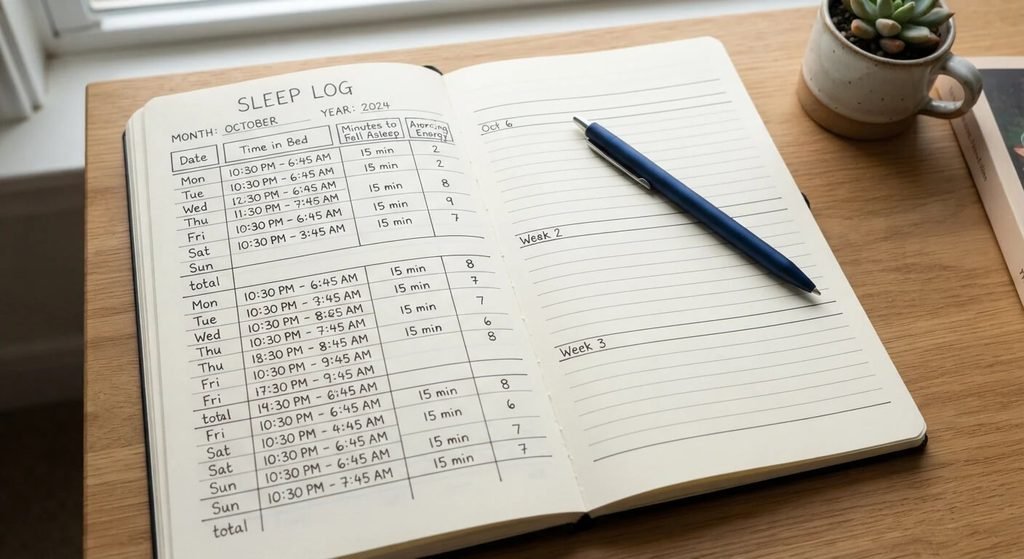
- Track: time to fall asleep, number of awakenings, perceived sleep quality (1–10), next-day energy (1–10)
Week 5+: Reassess
- If sleep onset is <30 min and you feel rested → you’re done. Taper off.
- If partial improvement → adjust dose once (melatonin to 1 mg; valerian to 600 mg)
- If no improvement after 4 weeks → the issue may not be supplement-solvable. See a doctor to rule out sleep apnea, anxiety disorder, or other causes.
Safety Notes and Who Should Talk to a Doctor First
Both valerian root and melatonin are dietary supplements, not FDA-approved medications. That means:
- Manufacturing quality varies. Buy from brands with third-party testing (look for USP, NSF International, or Informed Sport seals).
- “Natural” does not mean “risk-free.” Interactions with prescriptions are real.
- If you have a diagnosed sleep disorder (obstructive sleep apnea, periodic limb movement disorder, narcolepsy), a supplement is not a substitute for medical treatment.
Check with your doctor or pharmacist before starting either if you:
- Take prescription medications (especially sedatives, anticoagulants, immunosuppressants, or antidepressants)
- Are pregnant, planning pregnancy, or breastfeeding
- Have a liver or kidney condition
- Have a history of seizures or bipolar disorder
- Are under 18 (melatonin data in children is limited; valerian data is essentially absent)
This article is for general information and is not a substitute for advice from a doctor or physical therapist.
FAQ
Which is better for falling asleep fast: valerian root or melatonin?
It depends on the cause. If your circadian clock is shifted (jet lag, late chronotype), melatonin at 0.5–1 mg 30 min before bed will likely shift your sleep onset faster. If your mind is racing and you can’t “switch off,” valerian root at 300–600 mg 60 min before bed addresses the anxiety component. Neither is a fast-acting sedative like a prescription drug.
How long does valerian root take to work for sleep?
A single dose may produce mild relaxation within 30–60 minutes, but most users report the full sleep-onset benefit after 2–4 weeks of consistent nightly use. Don’t judge it after two nights. Give it a minimum of 14 nights before deciding it isn’t working for you.
What dose of melatonin should I take for falling asleep?
Start at 0.5 mg, 30–60 minutes before your target bedtime. If there’s no change after 5–7 nights, increase to 1 mg. Doses above 3 mg rarely improve sleep quality and increase the risk of next-day grogginess. The NCCIH recommends the lowest effective dose.
Can I take valerian root and melatonin together?
There’s no documented dangerous interaction, and some people use both for a combined timing + calming effect. If you do, use the lowest dose of each (0.5 mg melatonin + 300 mg valerian) and limit combined use to 2–3 weeks. For most people, one supplement is enough.
Is melatonin safe to take every night long-term?
Short-term use (up to 6 months) is well-studied and generally safe. Long-term data beyond that is limited. Some practitioners recommend cycling (5 nights on, 2 off) to avoid any theoretical receptor desensitization, though evidence for this is anecdotal. If you need a sleep aid nightly for months, it’s worth discussing with your doctor.
Does valerian root cause dependence or withdrawal?
No physical dependence or clinically significant withdrawal has been documented in the research literature. A small number of users report a mild return of sleep difficulty after stopping following 4+ weeks of use, but this is not well-studied. Tapering over 3–5 nights is a reasonable precaution if you’ve been taking it daily for a month or more.
Final Recommendation: Valerian Root vs Melatonin for Falling Asleep
There is no universal “winner.” The right choice is the one that matches your specific sleep problem:
- Choose melatonin if your issue is timing—you don’t feel sleepy until too late, you’re jet-lagged, or your shift work has scrambled your clock. It’s cheap, fast-acting, and well-studied for circadian re-anchoring. Start at 0.5 mg.
- Choose valerian root if your issue is settling—you’re physically tired, the room is dark, but your thoughts won’t stop. It works through a different (GABA) pathway and may support deeper sleep architecture, which matters for recovery. Start at 300 mg and give it 4 weeks.
- Choose neither (and see a doctor) if you snore loudly, gasp for air at night, have chronic insomnia lasting >3 months, or suspect a medical condition.
Whatever you choose, pair it with the non-negotiables: consistent schedule, cool dark room, no screens before bed, and no caffeine after mid-afternoon. A supplement is a 10% fix. Sleep hygiene is the 90%.
And if poor sleep is also hitting your stress levels, appetite, or energy during your training blocks, it’s worth looking at the bigger picture. How stress and poor sleep affect overall well-being is a rabbit hole worth exploring, and adaptogens for stress and cortisol management may complement your sleep strategy.