
You cut back on portions, started walking more, and maybe even swapped out some processed snacks for whole foods. And yet, by 3 p.m. your stomach is growling louder than it ever has. You wonder if something is wrong with you. You’re not broken, and you’re not alone. If you’ve been asking yourself, “why do I feel hungry while losing weight,” the short answer is that your body is running a very old, very effective survival program. When you create a calorie deficit, your brain and gut release a cascade of hunger hormones designed to make you seek more food. Understanding that mechanism is the first step to managing it without abandoning your progress.
Quick Answer
Feeling hungrier while losing weight is a normal physiological response. A calorie deficit triggers the hunger hormone ghrelin to rise and the satiety hormones leptin, PYY, and GLP-1 to fall, which signals your brain to crave more food. This response typically peaks in the first 2–6 weeks of a deficit and eases as your body adjusts. You can blunt the effect by eating enough protein, adding soluble fiber, getting 7–9 hours of sleep, and including regular resistance training.

What’s Actually Happening in Your Body
The Hunger Hormone Response
Your hypothalamus, a small region at the base of your brain, acts as the control center for appetite. It constantly monitors signals from your gut, your bloodstream, and your fat cells. When you eat less than you burn, several things shift at once.
Ghrelin, often called the “hunger hormone,” is produced mainly in the stomach. Levels of ghrelin tend to rise when you are in a caloric deficit, sending a strong “eat now” signal to your hypothalamus. Research published in Nature Medicine by Tschöp and colleagues showed that ghrelin levels increase significantly during fasting and caloric restriction, directly stimulating appetite in both animal models and humans Tschöp et al., 2001.
On the other side of the equation, leptin is produced by fat cells (adipocytes) and tells your brain you have enough energy stored. When you lose weight—even a modest amount—leptin levels drop. A landmark 2011 study in the New England Journal of Medicine by Sumithran and colleagues tracked participants after a 100-day weight-loss program and found that leptin remained roughly 20–30 percent below baseline, while ghrelin stayed elevated, for at least five years after the diet ended Sumithran et al., 2011. In plain terms, your body is still “telling” your brain it’s in a shortage, long after you’ve hit your target weight.
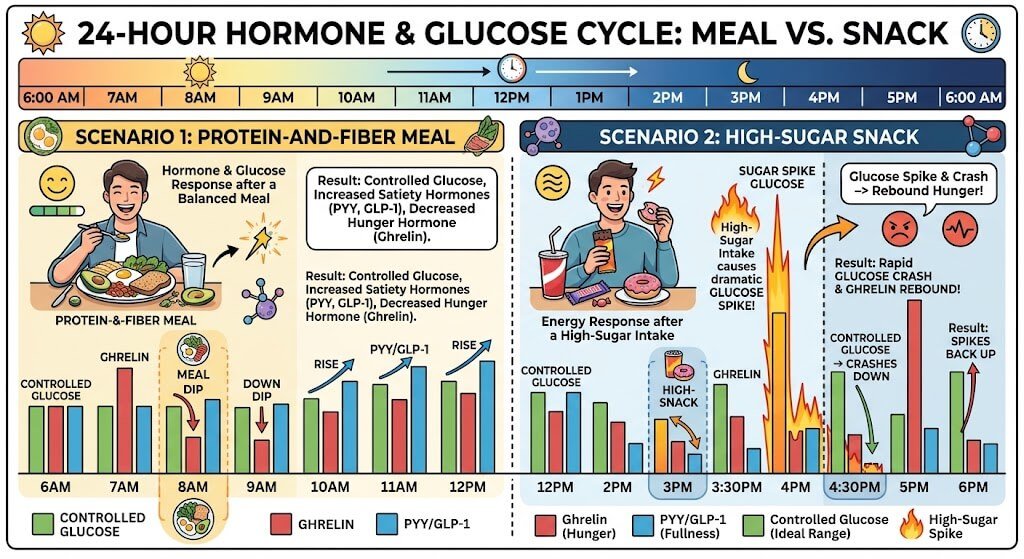
Peptide YY (PYY) and GLP-1 (glucagon-like peptide-1) are satiety hormones released by the intestines after you eat. They slow stomach emptying and signal fullness. During sustained caloric restriction, the post-meal spike in PYY and GLP-1 tends to be smaller, meaning you feel less “done” after a meal than you did before you started cutting calories. You can learn more about how these hormones work together in our guide on GLP-1 and PYY appetite regulation.
Metabolic Adaptation
Beyond hormones, your metabolism itself adjusts. When you reduce calorie intake, your body becomes more energy-efficient. Resting metabolic rate (RMR) drops not only because you have less mass to maintain but also because your body down-regulates non-essential processes to conserve energy. This phenomenon, sometimes called metabolic adaptation or “adaptive thermogenesis,” means you burn slightly fewer calories at rest than a person of the same size who never dieted. The effect is modest—typically 5–15 percent below the expected rate—but it compounds the feeling that your body is “asking” for more fuel.
Blood Sugar and Energy Signals
If your diet during a deficit is high in refined carbohydrates and low in protein and fiber, your blood sugar can swing sharply. A quick spike followed by a crash triggers insulin release, and the subsequent drop in glucose sends another hunger signal to the brain. You end up feeling ravenous an hour or two after eating, even though the meal wasn’t that small. This is one reason the composition of your meals matters as much as the quantity.
The Hormone and Signal Table
The table below summarizes the key players and how a calorie deficit shifts them.
| Signal / Hormone | Normal Role | What Happens in a Calorie Deficit | Practical Effect |
| Ghrelin (stomach) | Triggers hunger between meals | Levels rise, especially in the evening | You feel “emptier” and more driven to eat |
| Leptin (fat cells) | Signals energy stores are sufficient | Levels drop as fat mass decreases | Brain perceives a shortage; appetite increases |
| PYY (intestine) | Promotes fullness after eating | Post-meal release is blunted | You feel less satisfied after a meal |
| GLP-1 (intestine) | Slows gastric emptying; promotes satiety | Reduced post-prandial spike | Meals feel “lighter” and less filling |
| Insulin (pancreas) | Manages blood glucose; high levels suppress hunger | May fluctuate more if diet is high-glycemic | Sugar crashes trigger hunger spikes |
| Cortisol (adrenal glands) | Stress-response hormone | Can rise with sleep loss, overtraining, or chronic diet stress | Increases cravings, especially for high-calorie foods |
| Basal Metabolic Rate | Calories burned at rest | Drops 5–15 % below expected | Body conserves energy; you feel colder, more fatigued |
This table is a simplified overview. In reality, these signals interact continuously, and individual responses vary based on genetics, sex, sleep quality, and how aggressive the deficit is.
How to Manage Hunger While Losing Weight
Knowing why you feel hungry is useful, but the real question is what to do about it. Here are five evidence-based strategies I use with clients who are in a deficit and struggling with persistent hunger.
Strategy 1: Prioritize Protein at Every Meal
Protein is the most satiating macronutrient. It triggers a stronger release of PYY and GLP-1 than carbohydrate or fat, and it has the highest thermic effect of food (your body burns more calories digesting protein—about 20–30 percent of the calories consumed—compared with 5–15 percent for carbs and 0–3 percent for fat). A meta-analysis in the American Journal of Clinical Nutrition found that higher-protein diets led to greater reductions in hunger and spontaneous energy intake compared with lower-protein diets at the same calorie level Leidy et al., 2015.
Practical target: Aim for 0.7–1.0 grams of protein per pound of body weight (1.6–2.2 g/kg) per day, spread across three to four meals. For a 160-lb (73-kg) person, that’s roughly 112–160 g of protein daily. A simple plate template:
- Breakfast: 3 eggs (≈18 g protein) + ½ cup Greek yogurt (≈10 g) + a small handful of walnuts
- Lunch: 6 oz (170 g) grilled chicken or tofu + 1 cup cooked quinoa + large salad
- Dinner: 5 oz (140 g) salmon or lean beef + roasted vegetables + ½ cup black beans
- Snack (if needed): 1 oz (28 g) cottage cheese or a protein shake (≈20 g)
You can read more about how protein specifically blunts hunger signals in our article on how protein helps control hunger during weight loss.
Strategy 2: Add Soluble Fiber
Soluble fiber (found in oats, beans, lentils, apples, flaxseed, and psyllium husk) forms a gel in your gut that slows digestion and prolongs the feeling of fullness. It also feeds beneficial gut bacteria, which produce short-chain fatty acids that influence satiety signaling. Research in The American Journal of Clinical Nutrition has shown that increasing soluble fiber intake by about 10 g per day is associated with a modest but measurable reduction in energy intake and improved satiety Mattes, 2012.
Practical target: 25–35 g of total fiber per day, with at least 10 g coming from soluble sources. Easy swaps:
- Add 2 tablespoons (30 g) of ground flaxseed to your morning oats or smoothie.
- Swap white rice for ½ cup (120 g) cooked lentils or black beans.
- Keep an apple or pear (with skin) as an afternoon snack instead of a granola bar.
- Add 1 tablespoon (10 g) of psyllium husk to a glass of water before a meal if you’re struggling to hit fiber goals.
Our guide on does soluble fiber help control appetite breaks down the research and practical dosing in more detail.
Strategy 3: Move Your Body—Especially Lift Weights
Exercise doesn’t just burn calories; it helps regulate the hormones that drive hunger. Resistance training in particular preserves lean muscle mass during a deficit, which keeps your metabolic rate higher than it would be with dieting alone. The American College of Sports Medicine (ACSM) recommends muscle-strengthening activity at least two days per week for adults, and the HHS 2018 Physical Activity Guidelines echo this, noting that combining aerobic and resistance activity supports long-term weight management.
A simple 3-day-per-week resistance template (≈40 min/session):
| Exercise | Sets | Reps | Rest | Tempo |
| Goblet squat (25–50 lb / 11–23 kg) | 3 | 10–12 | 60 s | 2-1-2-0 |
| Dumbbell row (20–40 lb / 9–18 kg each) | 3 | 10–12 | 60 s | 2-1-2-0 |
| Push-up (full, knee, or incline) | 3 | 8–15 | 60 s | 2-1-2-0 |
| Romanian deadlift (dumbbells, 30–60 lb / 14–27 kg each) | 3 | 10–12 | 60 s | 2-1-2-0 |
| Plank | 3 | 30–45 s | 45 s | Hold |

Easier version (regression): Replace goblet squats with chair sit-to-stands (3 × 12), dumbbell rows with resistance-band rows (3 × 12), push-ups with incline push-ups off a countertop (3 × 10), and Romanian deadlifts with bodyweight glute bridges (3 × 15).
Harder version (progression): Swap goblet squats for barbell back squats (3 × 8, 95–185 lb / 43–84 kg), add a barbell bench press (3 × 8, 95–135 lb / 43–61 kg), and progress the Romanian deadlift to a barbell version (3 × 8, 95–185 lb / 43–84 kg).
Coach’s Tip: You don’t need to turn into a bodybuilder. Even 20 minutes of bodyweight work—squats, push-ups, rows, and planks—done three times a week helps preserve the muscle that keeps your metabolic rate from nosediving. Consistency beats intensity.
Pair the resistance work with 150 minutes per week of moderate aerobic activity (brisk walking, cycling, swimming) spread across the week. A 30-minute brisk walk (about 2 miles / 3.2 km) five times a week is a realistic and effective baseline.
Common Mistake: Many people respond to hunger by adding a long, intense cardio session. While cardio is great, overdoing it in a deficit can spike cortisol, worsen sleep, and actually increase hunger the next day. Keep cardio moderate and enjoyable. Save the hard efforts for days when you’re eating at maintenance.
Strategy 4: Protect Your Sleep
Sleep deprivation is one of the most underappreciated hunger triggers. A single night of 4 hours of sleep can raise ghrelin by roughly 20 percent and lower leptin by about 10 percent, according to research from the University of Chicago published in Annals of Internal Medicine Spiegel et al., 2004. The net effect: you wake up hungrier, crave more high-calorie foods, and feel less satisfied after eating.
Practical steps:
- Aim for 7–9 hours of sleep per night, five to seven nights per week.
- Keep a consistent sleep and wake time, even on weekends.
- Dim screens (phone, laptop, TV) at least 60 minutes before bed.
- Keep your bedroom cool (around 65–68 °F / 18–20 °C) and dark.
- Avoid caffeine after 2 p.m. and large meals within 2–3 hours of bedtime.
Our article on how sleep affects metabolism and weight management goes deeper into the hormonal pathways linking poor sleep to increased appetite.
Strategy 5: Manage Stress and Emotional Triggers
Chronic stress elevates cortisol, which can increase cravings—especially for sweet, salty, and high-fat foods. If you notice that your hunger spikes after a stressful workday or a difficult conversation, the trigger may be emotional rather than purely caloric.
Practical tools:
- A 10-minute walk outside (even 0.5 miles / 0.8 km) can lower acute cortisol levels.
- Box breathing (inhale 4 counts, hold 4, exhale 4, hold 4) for 2–3 minutes before a meal can reduce the “reactive eating” impulse.
- Keep a simple hunger journal: rate your hunger on a 1–10 scale before and after meals for one week. Patterns will emerge.
- If stress eating is a persistent pattern, consider talking with a registered dietitian or a therapist who specializes in eating behavior.
You can explore more strategies in our guide on how to manage cravings during a calorie deficit.

Safety Notes
A few important cautions before you adjust your diet or training:
- Don’t cut calories too aggressively. A deficit larger than 500–750 calories per day (roughly 0.5–1 lb / 0.2–0.5 kg per week of weight loss) increases the likelihood of intense hunger, muscle loss, and metabolic slowdown.
- If you have a history of disordered eating, diabetes, or a hormonal condition (thyroid disorders, PCOS, adrenal issues), talk with your doctor or a registered dietitian before starting a calorie deficit.
- Pregnant or postpartum individuals should not follow a standard calorie-deficit protocol without medical supervision.
- If hunger is accompanied by dizziness, fainting, persistent fatigue, or heart palpitations, stop the deficit and see a healthcare provider.
This article is for general information and is not a substitute for advice from a doctor or physical therapist.
Related Tips for Sustaining a Calorie Deficit
- Eat slowly and mindfully. It takes roughly 20 minutes for satiety signals (PYY, GLP-1) to reach the brain. Putting your fork down between bites and chewing thoroughly can prevent overeating.
- Front-load protein and fiber. Starting your meal with a protein source (eggs, Greek yogurt, a piece of fish) and a fiber-rich side (salad, beans, vegetables) before the starchy component can reduce total intake at that meal.
- Keep healthy snacks visible and prepared. If the easiest option in your kitchen is a bag of chips, you’ll grab it. Pre-portion 1 oz (28 g) of nuts, cut up vegetables with hummus, or keep a boiled egg in the fridge.
- Track for a short period, then trust your palate. Using a food app for 2–4 weeks can calibrate your portion sizes. After that, you can transition to visual cues (a palm-sized protein, a fist-sized carb, a thumb-sized fat per meal).
- Be patient with the adjustment window. Most clients I work with report that the “constant hunger” phase eases noticeably after 3–6 weeks as their body adapts to the new intake level. It won’t feel as dramatic as week one.
For a broader look at what drives hunger and fullness, our article on what helps control hunger during weight loss covers the full landscape of dietary and lifestyle levers.

FAQ
1. Is it normal to feel more hungry when I start losing weight?
Yes. A calorie deficit reliably raises ghrelin and lowers leptin, PYY, and GLP-1, which increases hunger signals. Most people notice the strongest hunger in the first two to six weeks, after which the body partially adapts. It is a physiological response, not a sign of weakness or poor willpower.
2. Does losing weight permanently change my appetite?
Research suggests that some hormonal changes (lower leptin, higher ghrelin) can persist for months or even years after weight loss, according to a long-term follow-up study in the New England Journal of Medicine. However, consistent habits—adequate protein, fiber, sleep, and resistance training—can help normalize appetite signaling over time.
3. Why do I feel especially hungry at night when dieting?
Ghrelin levels naturally peak in the evening, and after a day of caloric restriction, the cumulative drop in satiety hormones makes the evening window feel more intense. Eating a protein- and fiber-rich dinner (for example, 5 oz / 140 g of fish with roasted vegetables and a small portion of whole grains) can blunt the overnight hunger spike.
4. How much of a calorie deficit is “too much”?
A deficit of 300–500 calories per day (about 0.25–0.5 lb / 0.1–0.2 kg per week of loss) is gentle and easier to sustain. A 500–750-calorie deficit is common for moderate weight loss. Going below 1,200 calories per day for women or 1,500 for men without medical supervision is generally not recommended because it increases hunger, muscle loss, and metabolic slowdown.
5. Will exercise make me even hungrier?
Acute exercise can temporarily suppress appetite for 1–3 hours post-workout, but the effect varies by person and intensity. Overtraining or excessive cardio in a deficit can raise cortisol and increase next-day hunger. Moderate resistance training and 150 minutes of weekly aerobic activity are the most balanced approach.
6. What if hunger is making me want to quit my weight-loss plan?
That’s a common and understandable reaction. Consider adjusting the deficit to a smaller number, increasing protein and fiber at each meal, adding a planned refeed day (eating at maintenance for one day per week), and checking in with a registered dietitian. Small, sustainable changes beat a large, unsustainable cut every time.
Conclusion
If you’ve been wondering why do I feel hungry while losing weight, the answer is that your body is doing exactly what it evolved to do: protect you from energy shortage. Ghrelin goes up, leptin goes down, PYY and GLP-1 responses shrink, and your brain cranks up the “find more food” dial. None of this means you’re failing or that your plan is wrong. It means your plan needs to be smarter, not harsher.
Prioritize protein (0.7–1.0 g per lb of body weight), build soluble fiber into every meal, lift weights at least twice a week, protect 7–9 hours of sleep, and give yourself 4–6 weeks for the hormonal noise to quiet down. You don’t need to white-knuckle through hunger. You need to feed your body enough of the right nutrients so the hunger signals lose their volume.
The goal is not to eliminate hunger—it’s to make it manageable so you can stay consistent without feeling like you’re at war with your own physiology. You’ve got this.