
You cut calories, start training, and by Wednesday you feel flat. It’s natural to ask: can magnesium help with energy during weight loss? Magnesium plays a real role in how your cells make energy, so the question is fair. The honest answer is more nuanced than most supplement ads suggest.
As a coach, I want you to know what the research supports, what it doesn’t, and what to do first. This guide covers how magnesium works, who might benefit, safe amounts, food sources, and a simple training routine to pair with it. Check with your doctor before adding supplements, especially during weight loss.
Quick Answer
Magnesium helps your cells make and use energy, so a shortfall can contribute to tiredness. Research suggests extra magnesium may help mainly when intake is low. Evidence that supplements boost energy in well-fed people is limited. Food first, then talk to your doctor about supplements.
What Does Magnesium Actually Do for Energy?
Magnesium is an essential mineral. It takes part in energy metabolism and helps maintain normal muscle function, according to a 2017 review in Nutrients. The same review explains that magnesium binds with ATP (adenosine triphosphate), your cells’ main energy currency, to form Mg-ATP.
Put simply, ATP needs magnesium attached to work properly. That’s why magnesium shows up in so many “energy” conversations.
But being involved in energy chemistry is not the same as boosting your energy. Your body keeps magnesium levels in a tight range. Eating more doesn’t push you past normal function, just as filling a full gas tank doesn’t make the car faster.
Why the “magnesium boosts energy” claim gets oversold
The supplement world often jumps from “magnesium is needed for ATP” to “more magnesium means more energy.” That leap isn’t proven. The Nutrients review notes that data directly linking magnesium status to exercise performance in humans are sparse.
So the better question is not “will it boost me?” but “am I falling short?” If you’re low, fixing that may help. If you’re already getting enough, there’s little reason to expect a lift.
What the Research Says About Magnesium and Exercise Energy
Here is what we know, with its limits.
Animal studies
The Nutrients review reports that animal studies suggest magnesium might improve exercise performance by raising glucose availability in the brain, muscle, and blood, and by delaying lactate buildup in muscle. One frequently cited animal study is Chen and colleagues (2014) .
Animal results don’t always carry over to people. Treat them as a reason for more research, not a reason to buy a supplement.
Human observational findings
According to the same review, some surveys found that higher magnesium status was linked to better muscle performance, including grip strength, jumping, and knee extension torque. It also noted that the need for magnesium appears to rise as activity level goes up.
These are associations. People who eat more magnesium-rich foods often eat better overall, so the magnesium may not be the cause.
The randomized trial in older women
The strongest human evidence I found is a 12-week randomized trial in healthy older women. It enrolled 139 women (average age about 71.5) in a mild fitness program. The treatment group took 300 mg of magnesium daily.
The researchers concluded that magnesium oxide for 12 weeks seems to improve physical performance in this group. In the trial, the control group received no placebo, which is a limitation. Results may not apply to younger adults, men, or people in a calorie deficit.

What this means for you
Putting it together:
- Magnesium is needed for normal energy chemistry.
- Low intake may contribute to fatigue and weaker performance.
- Trials showing real benefits mostly involve older adults or people with low intake.
- Strong proof that supplements give extra energy to well-nourished dieters is missing.
That’s why I frame magnesium as “fix a gap,” not “add a booster.”
Why Energy Drops During Weight Loss (It’s Usually Not Just Magnesium)
Before blaming one mineral, look at the bigger picture. Fatigue during a diet is common and usually has several causes. Here are the ones I check first when someone says they feel drained:
- The deficit is too big. Eating far less than you burn leaves little fuel for training.
- Too few carbs around workouts. Hard sessions feel heavy when glycogen is low.
- Too little protein. This can slow recovery.
- Poor sleep. Dieting stress and early alarms often shorten it.
- Dehydration or low sodium. Cutting processed food can lower sodium intake.
- Too much training too soon. Adding cardio, lifting, and a diet all at once is a big jump.
- Medical causes. Low iron, thyroid issues, and low vitamin B12 can all cause fatigue. Only a doctor can sort these out.
Magnesium is one possible piece. If your low energy comes with dizziness, shortness of breath, a racing heart, or lasts for weeks, see a doctor instead of experimenting with supplements.
How dieting may affect your magnesium intake
When you eat less food overall, you may eat less magnesium too, especially if you cut nuts, seeds, beans, and whole grains because they’re “high-calorie.” Those are exactly the foods that supply it.
According to the NIH Office of Dietary Supplements, magnesium inadequacy can occur when intake falls below the RDA, though symptomatic deficiency in otherwise healthy people is uncommon because the kidneys limit magnesium loss in urine. The ODS also notes that older adults tend to have lower intakes than younger adults.
So a very low-calorie, low-variety diet could leave you short. A balanced diet usually doesn’t.
How Much Magnesium Do You Need?
The table below shows NIH recommended daily amounts for adults, from all sources combined (food, drinks, and supplements), and the upper limit for supplements.
| Group | RDA (mg/day) | Supplement upper limit (mg/day) |
| Women, 19-30 | 310 | 350 |
| Women, 31+ | 320 | 350 |
| Men, 19-30 | 400 | 350 |
| Men, 31+ | 420 | 350 |
Source: NIH Office of Dietary Supplements. Pregnancy, teens, and older adults have different values, so check the full fact sheet.
The 350 mg limit is important. The NIH explains that it applies only to magnesium from supplements and medications, not to food. Per NIH guidance, magnesium supplements often provide 120 to 250 mg per serving.
Coach’s Tip: Look at “elemental magnesium” on the label, not just the compound weight. A 1,000 mg capsule of magnesium glycinate may contain far less actual magnesium. Divide by the “% elemental” or read the Supplement Facts panel carefully.
Food First: Magnesium-Rich Choices for a Calorie Deficit
Foods containing dietary fiber generally provide magnesium, according to the NIH. The same fact sheet says roughly 30-40% of the magnesium you eat is typically absorbed. You don’t need exotic foods. You need to keep these in your plan.
| Food group | Examples | Practical serving | Diet-friendly tip |
| Nuts and seeds | Almonds, pumpkin seeds, cashews | Small handful, about 1 oz (28 g) | Pre-portion so calories stay controlled |
| Legumes | Black beans, lentils, edamame | ½ cup | Adds fiber and protein, so it keeps you full |
| Leafy greens | Spinach, Swiss chard | 1-2 cups cooked or raw | Very low calorie for the volume |
| Whole grains | Oats, brown rice, whole wheat | ½-1 cup cooked | Time them around workouts for fuel |
| Other | Dark chocolate, avocado, bananas | Small portions | Watch calories; treat as add-ons |
A sample magnesium-friendly day
- Breakfast: Oats with pumpkin seeds and berries.
- Lunch: Spinach salad with chickpeas, chicken, and olive oil.
- Snack: Small handful of almonds and a banana.
- Dinner: Lentil soup with a whole-grain roll and vegetables.
This is a food pattern, not a prescription, and calories should fit your own plan.
Do You Need a Magnesium Supplement While Losing Weight?
Many people never need one. Think of a supplement as a possible fix for a specific gap, not a default.
You and your doctor might consider it if:
- Your diet is very restricted or low in variety.
- A blood test or clinician suggests low magnesium.
- You take medicines that affect magnesium, such as proton pump inhibitors. Per the NIH, several types of medicines can interact with magnesium supplements or change magnesium status.
- You’re an older adult with low intake.
Choosing a form
The common forms are oxide, citrate, glycinate, and chloride. The NIH notes that forms that dissolve well in liquid are absorbed more completely than less soluble ones
I’d rather you start low (within the 120-250 mg range) with food, see how your stomach handles it, and avoid stacking multiple magnesium products. More is not better.
Common Mistake: Treating magnesium as a fix for a bad plan
People add a supplement but keep a 1,000-calorie deficit, sleep five hours, and skip carbs before training. Then they decide magnesium “doesn’t work.” Fix the big levers first: calories, protein, carbs, sleep, and hydration. Magnesium is a small lever.
Magnesium, Blood Sugar, and Sleep: Related Angles
Two other topics often get tied to magnesium and energy. Both need careful language.
Blood sugar and insulin
Magnesium is involved in how your body handles glucose, which is why it comes up in blood sugar talk. If you want background on other nutrients studied for this, see our guides on inositol and insulin sensitivity and whether chromium picolinate supports glucose metabolism. Stable blood sugar can affect how steady you feel, but these links are indirect.
Sleep
Poor sleep wrecks energy during a diet. A 2021 systematic review of three randomized trials in 151 older adults found sleep onset time was about 17 minutes shorter with magnesium than with placebo. But the authors said the evidence quality was low, and the participants were older adults with insomnia. That doesn’t prove it works for a 30-year-old dieter.
If your sleep is bad, start with sleep habits. Talk to a doctor if it persists.
Pre-Workout Nutrition and Energy: What About Other Supplements?
You may also see “energy” products built around blood flow, like citrulline and arginine. They work through a different pathway than magnesium. Our explainers on how L-citrulline helps produce nitric oxide and L-arginine vs L-citrulline cover that, and nitric oxide and healthy blood vessel function gives background.
None of these replace eating enough and recovering well. Don’t stack products hoping one will fix a poor plan.
How to Apply It: A Training Routine That Protects Energy
Exercise guidelines matter here, because under-recovery feels like low energy. The CDC says adults need at least 150 minutes of moderate-intensity activity a week plus muscle-strengthening on two or more days.
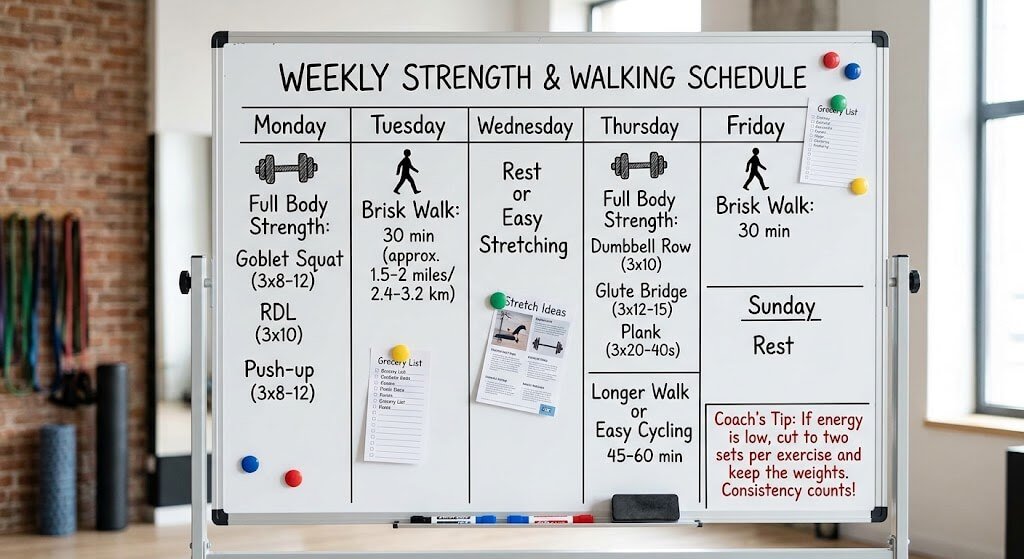
Strength training is especially useful during weight loss. Here’s a simple full-body routine for two non-consecutive days a week.

The routine
| Exercise | Sets | Reps | Rest | Starting weight guide |
| Goblet squat | 3 | 8-12 | 60-90 sec | 15-25 lb (7-11 kg) |
| Dumbbell Romanian deadlift | 3 | 10 | 60-90 sec | 10-20 lb (5-9 kg) each hand |
| Incline push-up | 3 | 8-12 | 60 sec | Bodyweight |
| One-arm dumbbell row | 3 | 10 each side | 60 sec | 10-25 lb (5-11 kg) |
| Glute bridge | 3 | 12-15 | 45-60 sec | Bodyweight or 15-25 lb (7-11 kg) |
| Plank | 3 | 20-40 sec | 45 sec | Bodyweight |
Use a 2-second lowering phase and a 1-second lift. Stop each set with about 2-3 reps left in the tank. Those are starting guides. Adjust to your ability.
How to do each exercise
Goblet squat: Hold one dumbbell at your chest. Stand with feet shoulder-width apart, toes slightly out. Sit down between your hips, keep your chest tall, and push through the whole foot to stand. You should feel it in your thighs and glutes, not your lower back.
Dumbbell Romanian deadlift: Hold dumbbells in front of your thighs. Push your hips back with soft knees, sliding the weights along your legs. Stop when you feel a stretch in the hamstrings, then drive your hips forward.
Incline push-up: Put your hands on a bench or sturdy counter about 24-30 in (60-76 cm) high. Keep your body in a straight line and lower your chest toward the surface.
One-arm dumbbell row: Support one hand and knee on a bench. Pull the dumbbell toward your hip, leading with your elbow. Pause for a beat at the top.
Glute bridge: Lie on your back, knees bent, feet flat. Press through your heels and lift your hips until your body forms a line from shoulders to knees. Squeeze your glutes at the top.
Plank: Forearms down, body straight, ribs pulled in. Don’t let the hips sag.

Easier and harder versions
| Exercise | Regression (easier) | Progression (harder) |
| Goblet squat | Box squat to a bench | Heavier dumbbell or 3-second lowering |
| Romanian deadlift | Bodyweight hip hinge | Add 5 lb (2 kg) or single-leg version |
| Incline push-up | Higher incline (wall) | Lower incline or floor push-up |
| Dumbbell row | Lighter weight, chest-supported | Heavier weight, slower tempo |
| Glute bridge | Smaller range of motion | Single-leg bridge |
| Plank | Knees down, 15 sec | Longer holds or shoulder taps |
Weekly schedule
| Day | Activity |
| Monday | Strength routine |
| Tuesday | Brisk walk, 30 min (about 1.5-2 miles / 2.4-3.2 km) |
| Wednesday | Rest or easy stretching |
| Thursday | Strength routine |
| Friday | Brisk walk, 30 min |
| Saturday | Longer walk or easy cycling, 45-60 min |
| Sunday | Rest |
This totals roughly the CDC’s weekly amounts and leaves space to recover. Add weight only when you can finish all sets with good form.
Coach’s Tip: If energy is low, don’t skip the session. Cut it to two sets per exercise and keep the weights. A shorter session keeps the habit and still counts.
Who Should Be Careful With Magnesium Supplements
Check with your doctor or pharmacist before using magnesium if any of these apply:
- Kidney problems. The NIH notes the risk of magnesium toxicity increases with impaired kidney function.
- You take prescription medicines. Magnesium can interact with some drugs.
- You’re pregnant or breastfeeding. Needs and limits differ.
- You’re older. Both needs and kidney function change.
- You use magnesium-containing antacids or laxatives. These count toward your total.
- You use weight-loss medication. Appetite drops can reduce food intake and nutrient variety, so ask your clinician.
Signs you’re taking too much include loose stools, nausea, and cramping. Stop and ask a professional if they appear.
Safety Notes for Weight Loss
If you’re making a big diet change, have a medical condition, or feel unwell, talk to a doctor first. Weight loss that is too fast can drain energy and cost muscle. The CDC has long suggested steady loss of about 1-2 lb (0.5-1 kg) per week Don’t aim for rapid-fix claims.
Stop exercising and seek care for chest pain, fainting, severe shortness of breath, or an irregular heartbeat.
Related Tips to Keep Your Energy Up During a Diet
- Keep protein steady at each meal to support recovery.
- Eat carbs around training so workouts don’t feel flat.
- Drink water through the day, and pay attention to salt if you’ve cut processed food.
- Protect sleep by setting a regular bedtime.
- Track patterns for two weeks. Note meals, sleep, and energy before making supplement decisions.
- Don’t change five things at once. Change one variable, then watch.
- Take a diet break week at maintenance calories if you feel depleted, ideally with clinician input.
Frequently Asked Questions

Does magnesium give you energy right away?
No. Magnesium isn’t a stimulant like caffeine. It supports the way cells make energy, and any benefit from correcting a low intake would build over weeks, not minutes. If you feel a lift after one dose, other factors are likely involved.
How much magnesium should I take while dieting?
Aim to meet the NIH RDA mostly from food. For supplements, the adult upper limit is 350 mg per day from supplements and medications combined. Ask a doctor or pharmacist before taking any, especially with kidney issues or regular medicines.
Should I take magnesium before or after workouts?
There’s no strong evidence that timing matters for energy. Many people take it with a meal to reduce stomach upset. Consistency and total daily intake matter more than the clock. Ask a pharmacist if you take other medicines.
Which type of magnesium is best for energy?
No form has been proven best for energy. The NIH says forms that dissolve well are absorbed more fully than less soluble ones. Citrate and glycinate are popular and often gentler on the stomach than oxide, but choose based on tolerance and your clinician’s advice.
Can magnesium help with weight loss itself?
The research covered here relates to energy and physical performance, not fat loss. I haven’t found strong evidence in the sources used for this article that magnesium causes weight loss. Treat it as nutrition support, not a fat-loss tool.
Can I get enough magnesium from food while dieting?
Often yes, if you keep nuts, seeds, beans, greens, and whole grains in your plan. Portion them to fit your calories. A very restrictive diet is where gaps can appear, so ask a dietitian if you’re unsure.
Conclusion: So, Can Magnesium Help With Energy During Weight Loss?
It might, but mostly if you’re falling short. Magnesium is essential for energy metabolism, and a low intake could add to fatigue. The best human trial I found was in older women, and broader evidence in well-fed dieters is limited.
So the practical answer to can magnesium help with energy during weight loss is: check your food first, fix calories, protein, carbs, and sleep, train smartly, and talk to a professional before supplementing. Magnesium is a small piece, not the whole puzzle.