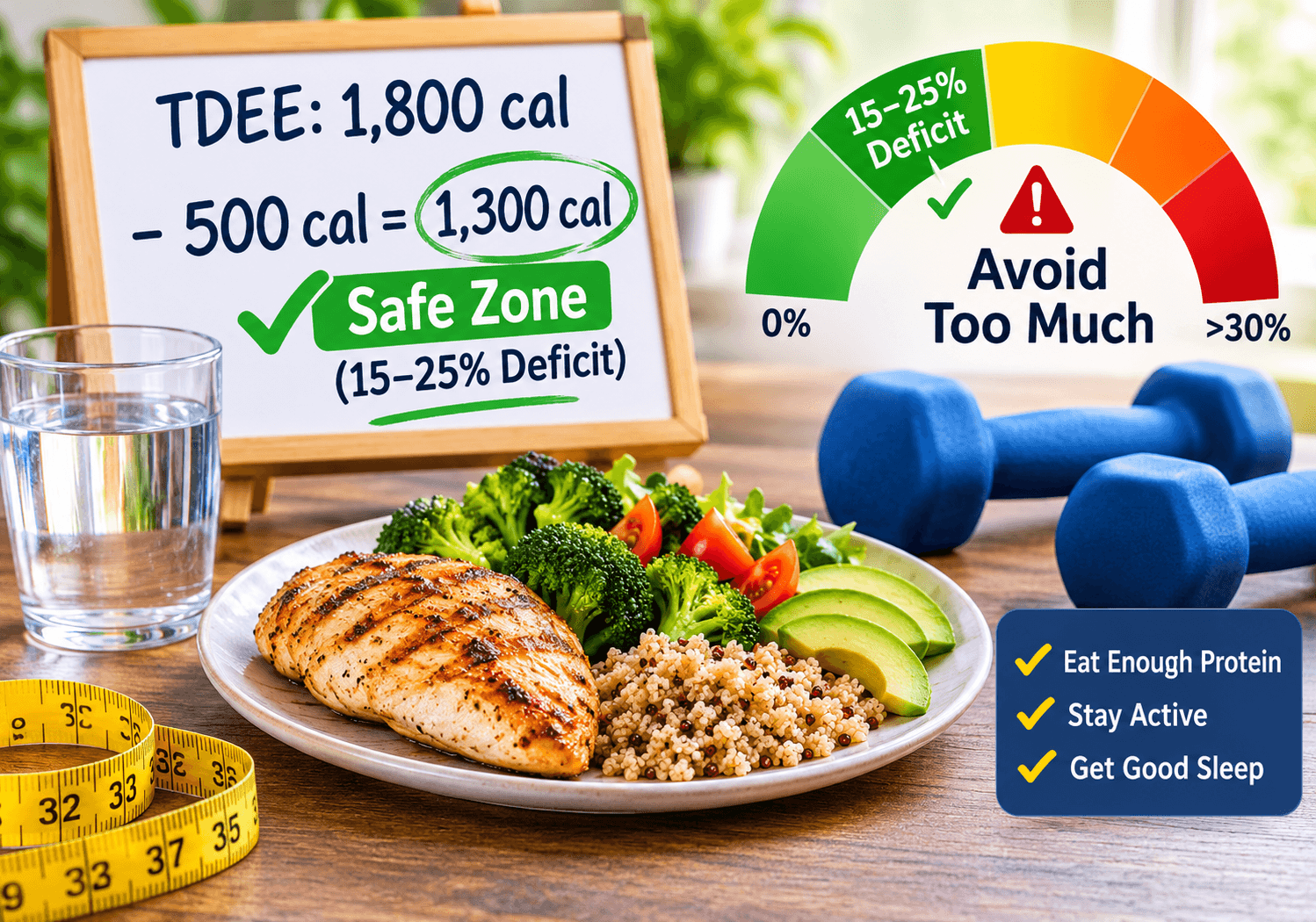
You’ve probably heard the “eat 500 fewer calories a day” rule. Simple, right? But here’s the question that keeps clients in my gym asking me: how much of a calorie deficit is too much before your body starts fighting back? Cut too little and the scale barely moves. Cut too much and you feel wired, hungry, and like your energy has flatlined. Finding that sweet spot between meaningful fat loss and protecting your metabolism, hormones, and muscle is the whole game.
I’ve coached people through every version of this—aggressive cuts, gentle deficits, and the “I’ll just eat 800 calories” crash that usually ends in a doctor’s office. The research is clear: there is a floor, and going below it costs you more than the extra pounds you think you’re saving. This article breaks down exactly where that line is, how to calculate your own safe deficit, and what to do when hunger and fatigue start creeping in.
Quick Answer: For most adults, a daily deficit of 300–500 calories (roughly 15–25% below your TDEE) is the safe, sustainable range. You should never eat below 1,200 calories per day (women) or 1,500 calories per day (men) without direct medical supervision. A deficit larger than 25–30% of your daily energy needs increases the risk of muscle loss, metabolic slowdown, hormonal disruption, and nutrient deficiencies.

What the Research Says About Calorie Deficit Limits
The human body is not a simple calculator. When you create a negative energy balance—burning more calories than you eat—your body adapts. It becomes more efficient. It holds onto muscle. It nudges hormones like leptin and ghrelin in directions that make you hungrier and more fatigued.
The landmark “Biggest Loser” metabolic study published in the New England Journal of Medicine tracked contestants for up to six years after the show and found that participants who lost large amounts of weight in a short period experienced a sustained drop in resting metabolic rate of roughly 500 calories per day, far beyond what the weight loss alone would predict Fothergill et al., 2016, NEJM. That is metabolic adaptation in action: your body is actively trying to restore the energy it lost.
The CDC’s weight-management guidance recommends a deficit of 500 to 1,000 calories per day to lose about one to two pounds per week. The NIH National Institute of Diabetes and Digestive and Kidney Diseases (NIDDK) sets a practical floor: do not go below 1,200 calories per day for women or 1,500 for men unless a physician is monitoring you. Below those numbers, the risk of micronutrient gaps, gallstones, and hormonal disruption climbs sharply.
The American College of Sports Medicine (ACSM) position stands on exercise and nutrition reinforce that gradual, moderate deficits paired with resistance training produce the best body-composition changes while preserving lean mass. In short, the research points to one principle: moderate beats extreme, every time.
The Numbers: Safe Deficit Ranges by Body Weight
The “right” deficit is not a single number. It depends on your starting weight, activity level, sex, and goals. The table below gives you a practical starting framework. Use it as a guide, not a prescription.
| Starting Weight | TDEE (moderately active, est.) | Safe Deficit (15–25%) | Daily Calorie Target | Expected Weekly Loss |
| 120 lb (54 kg) | ~1,800 cal | 270–450 cal | 1,350–1,530 cal | 0.5–1 lb (0.2–0.5 kg) |
| 150 lb (68 kg) | ~2,100 cal | 315–525 cal | 1,575–1,785 cal | 0.5–1 lb |
| 180 lb (82 kg) | ~2,400 cal | 360–600 cal | 1,800–2,040 cal | 0.5–1.5 lb |
| 220 lb (100 kg) | ~2,800 cal | 420–700 cal | 2,100–2,380 cal | 1–1.5 lb |
| 280 lb (127 kg) | ~3,300 cal | 500–825 cal | 2,475–2,800 cal | 1–2 lb |
Key rule of thumb: Your daily intake should never drop below 1,200 calories (women) or 1,500 calories (men). If the math in the table puts you under that floor, your deficit is too aggressive. Close the gap by reducing the percentage or adding a refeed day.

What Happens When You Cut Too Many Calories
I see the same pattern in my gym: someone decides to “do it fast,” drops to 1,000 or 1,200 calories for a few weeks, and within two to three weeks the signs show up. Here is what the literature and my coaching experience say happens when the deficit gets too deep.
- Metabolic slowdown. Your resting metabolic rate drops. Your body reduces non-essential energy expenditure (fidgeting, thermogenesis) and becomes more efficient at the same tasks. You burn fewer calories at rest than you did before the deficit, which means the same food now puts you in a smaller deficit—or none at all.
- Muscle loss accelerates. In a large deficit, especially with low protein intake, your body breaks down muscle tissue for amino acids. A 2017 review in the Journal of the International Society of Sports Nutrition found that deficits exceeding 25–30% of TDEE, without adequate protein (≥1.6 g/kg) and resistance training, significantly increase lean-mass loss Morton et al., 2018, JISSN.
- Hormonal disruption. Leptin (the “I’m full” hormone) drops. Ghrelin (the “I’m hungry” hormone) spikes. Cortisol rises. In women, very low energy availability is linked to irregular or absent menstrual cycles (functional hypothalamic amenorrhea), a well-documented concern in the sports-medicine literature ACSM, 2023.
- Micronutrient gaps. Iron, calcium, vitamin D, B12, zinc, and magnesium are the most common deficiencies in severely restricted diets. Over weeks, this shows up as fatigue, brittle nails, poor sleep, and weakened immunity.
- Psychological strain. Constant hunger, irritability, and obsessive food thinking make adherence miserable. Most people who crash-restrict end up rebounding, often regaining the lost weight plus a little extra.
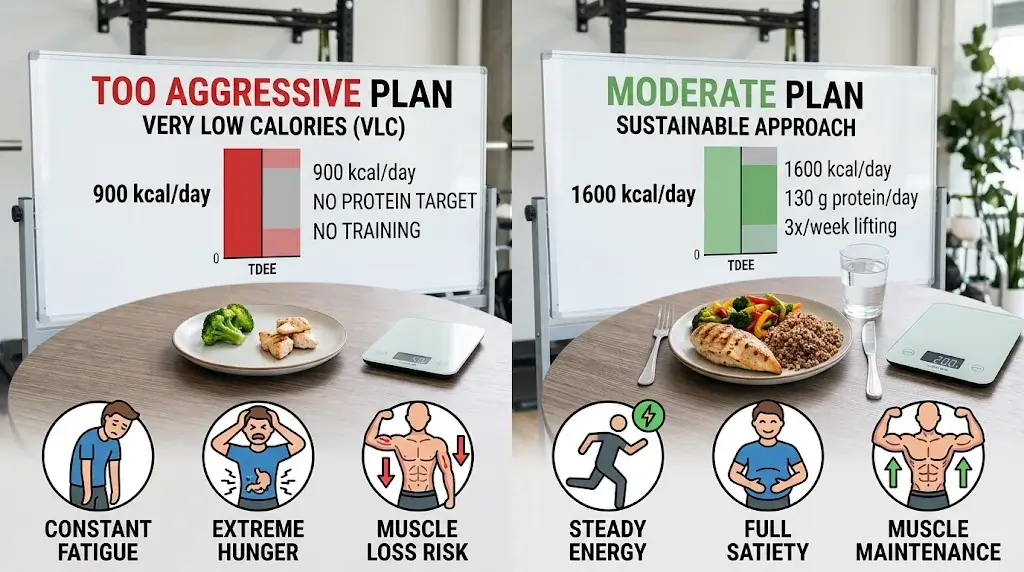
Common Mistake: Going below your caloric floor “just for a week.” One week at 900 calories may not feel catastrophic, but it sets your metabolic and hormonal baseline in a downward direction. The adaptation does not reset the moment you eat a normal meal. Recovery takes days to weeks of consistent, adequate intake.
How to Calculate Your Safe Calorie Deficit (Step-by-Step)
You do not need a fancy app, though one helps. Here is the process I walk new clients through:
- Estimate your TDEE. Use a validated calculator (the Mifflin-St Jeor equation is the most accurate for the general population) or a simple online tool. Multiply your BMR by an activity factor: 1.2 (sedentary), 1.375 (light activity, 1–3 days/week), 1.55 (moderate, 3–5 days/week), 1.725 (very active, 6–7 days/week).
- Subtract 15–25%. For most people aiming for steady, sustainable loss, 20% is a great starting point. If you are significantly overweight and medically cleared, you can start at the higher end (25%). If you are already lean or have a history of disordered eating, start at 15%.
- Check the floor. If your target drops below 1,200 (women) or 1,500 (men), stop. Either reduce the deficit percentage or add a weekly refeed day at maintenance calories.
- Set protein at 0.7–1 g per pound of target body weight (1.6–2.2 g/kg). This is non-negotiable in a deficit. It protects muscle, increases satiety, and adds thermic effect. For a 160-lb (73 kg) person targeting 140 lb, that is about 112–140 g of protein per day. You can learn more about this in our guide to protein intake and weight loss.
- Fill the rest with vegetables, fruit, whole grains, and healthy fats. Aiming for at least 25–30 g of fiber per day helps with fullness and gut health.
- Track for two weeks, then adjust. Weigh yourself daily, take a weekly average, and look at the trend. If the scale is not moving at 0.5–1 lb (0.2–0.5 kg) per week, nudge the deficit down by another 100 calories. If you are losing more than 2 lb (0.9 kg) per week and feel drained, you are in too large a deficit.
Coach’s Tip: Do not calculate your deficit once and forget it. Your TDEE changes as you lose weight. Recalculate every 10–15 lb (4.5–7 kg) of loss. A 250-lb person and a 200-lb person do not burn the same number of calories at rest.

Practical Steps to Stay in a Healthy Deficit
Knowing the number is half the battle. The other half is making the deficit feel manageable so you can stick with it for months, not weeks.
- Prioritize protein at every meal. Aim for 25–40 g of protein per meal. A 6-oz (170 g) chicken breast, a cup of Greek yogurt, or three eggs hit that range. Protein is the most satiating macronutrient and helps blunt the hunger spike that comes with a deficit. Our article on how protein helps control hunger during weight loss breaks down the satiety-hormone mechanism in detail.
- Do not skip meals to “save” calories. Three balanced meals (or four smaller ones) keep blood sugar steadier and hunger more manageable than two huge meals.
- Move your NEAT up, not just your workouts. Non-exercise activity thermogenesis—walking, standing, taking the stairs, fidgeting—can account for 200–500+ calories a day. A 30-minute walk after lunch is a low-stress way to widen the deficit without adding another gym session.
- Pair the deficit with resistance training 2–3 days per week. You do not need to train six days. Two to three full-body sessions with compound lifts (squats, deadlifts, rows, presses) signal your body to hold onto muscle. The ACSM guidelines recommend muscle-strengthening activity at least two days per week as a baseline.
- Sleep 7–9 hours. Poor sleep raises ghrelin, lowers leptin, and increases next-day caloric intake by 10–20% in some studies. Sleep is not optional in a deficit; it is part of the strategy. Our piece on how sleep affects metabolism and weight management covers the hormonal pathway.
- Schedule a weekly refeed or diet break. One day at maintenance calories (or a full week every 6–8 weeks) can help reset leptin, reduce psychological strain, and keep your metabolism from downregulating as aggressively. This is especially useful if you are in a deficit for more than 12 weeks.

Safety Notes: Who Needs Extra Caution
A calorie deficit is not one-size-fits-all. Check with a doctor or registered dietitian before starting a restricted-calorie plan if any of the following apply to you:
- You are under 18 or over 65.
- You have a history of eating disorders, disordered eating, or orthorexia.
- You are pregnant, postpartum, or breastfeeding.
- You take medications that affect blood sugar, thyroid function, or appetite (e.g., insulin, GLP-1 agonists, steroids).
- You have a diagnosed metabolic or endocrine condition (hypothyroidism, diabetes, PCOS).
- You weigh under 120 lb (54 kg) and are considering a deficit.
- You are trying to lose more than 50 lb (23 kg) and want to do it quickly.
For adults over 40, metabolic rate naturally declines by about 1–2% per decade, and muscle mass is more vulnerable to loss in a deficit. A gentler approach (15–20% deficit, higher protein, consistent resistance training) is usually smarter than an aggressive one. Our guide to increasing metabolism naturally after 40 has specific programming for that age group.
If you experience dizziness, persistent fatigue, hair loss, irregular periods (in women), cold intolerance, or a resting heart rate consistently below 55 bpm during a deficit, stop the restriction and see a healthcare provider. These can be signs that your energy intake is below what your body needs to maintain basic function.
Related Tips for Sustaining a Deficit Without Burning Out
- Manage cravings with strategy, not willpower. Pair protein with fiber and a small amount of healthy fat at each meal. If a craving hits, drink a glass of water, wait 15 minutes, and reassess. Our guide on managing cravings during a calorie deficit walks through a practical 15-minute protocol.
- Understand what actually drives your metabolism. It is not just the number on the food scale. Muscle mass, sleep quality, stress levels, and consistency all shape your daily energy expenditure. Our article on what affects metabolism and body weight maps out the full picture.
- Build metabolic flexibility, not just a deficit. The goal is to train your body to switch between fuel sources efficiently. That happens with a moderate deficit, periodic refeeds, and a mix of aerobic and resistance work. Read our guide on boosting metabolic flexibility without crash dieting for a structured approach.
- Track progress beyond the scale. Waist circumference, progress photos, how your clothes fit, and strength numbers in the gym often tell a truer story than a daily weigh-in. In a deficit, water fluctuations can swing the scale by 2–4 lb (0.9–1.8 kg) in a single day.
- Be patient with the “whoosh” effect. After a period of stubborn plateau, you may lose several pounds in a few days. This is water shifting out of cells as glycogen and sodium normalize. It does not mean the previous weeks were wasted.
FAQ
Is a 1,000-calorie deficit too much?
For a person with a TDEE around 2,000–2,500 calories, a 1,000-calorie deficit (40–50%) is aggressive and not sustainable beyond a few weeks. It raises the risk of muscle loss, metabolic adaptation, and nutrient gaps. For most people, a 300–500 calorie deficit produces safer, more durable results.
What is the minimum safe calorie intake?
The NIH/NIDDK guideline is 1,200 calories per day for women and 1,500 for men as a general floor. Going below those numbers without medical supervision increases the risk of gallstones, hormonal disruption, and micronutrient deficiencies. If your calculated deficit puts you under that floor, reduce the deficit size.
Does a large calorie deficit permanently slow your metabolism?
Research suggests that significant metabolic adaptation can persist for months after a large, rapid weight loss, though it is not necessarily permanent. The “Biggest Loser” study found a sustained ~500-calorie drop in resting metabolic rate up to six years post-competition. A moderate deficit (15–25%) with resistance training and periodic refeeds minimizes this risk.
How do I know if my deficit is too big?
Warning signs include persistent hunger that does not ease, dizziness, irritability, loss of strength in the gym, poor sleep, cold intolerance, and (in women) missed or irregular periods. If you hit two or more of these for more than a week, widen the deficit by 100–200 calories and add a refeed day.
Can I lose 2 pounds a week safely?
For people with a higher starting body weight (220 lb / 100 kg and above), losing 1.5–2 lb (0.7–0.9 kg) per week is achievable with a 500–750 calorie deficit and is generally safe. For leaner individuals, 0.5–1 lb per week is a more realistic and sustainable target. Always keep protein high and train with weights.
Should I count calories or just eat “clean”?
Counting (or at least estimating) calories is the most reliable way to ensure you are actually in a deficit. “Eating clean” without a calorie target often leads to underestimating portions, especially with oils, sauces, and “healthy” snacks. A simple app or a food scale for the first two weeks can calibrate your eye.
Conclusion: Find Your Number, Respect the Floor, and Give It Time
So, how much of a calorie deficit is too much? The answer is personal, but the guardrails are consistent. Keep your deficit in the 15–25% range of your TDEE, never drop below 1,200 calories (women) or 1,500 (men) without medical oversight, protect your protein, lift weights, sleep well, and give your body time to adapt. The person who loses 0.75 lb (0.34 kg) a week for six months will be in a far better place—physically, hormonally, and mentally—than the person who “crashes” for three weeks and bounces back.
You do not need a punishing deficit to get results. You need a number you can live with, a plan that keeps your muscle, and the patience to let the scale move at its own pace. That is how fat loss becomes a lifestyle shift instead of a punishment cycle.