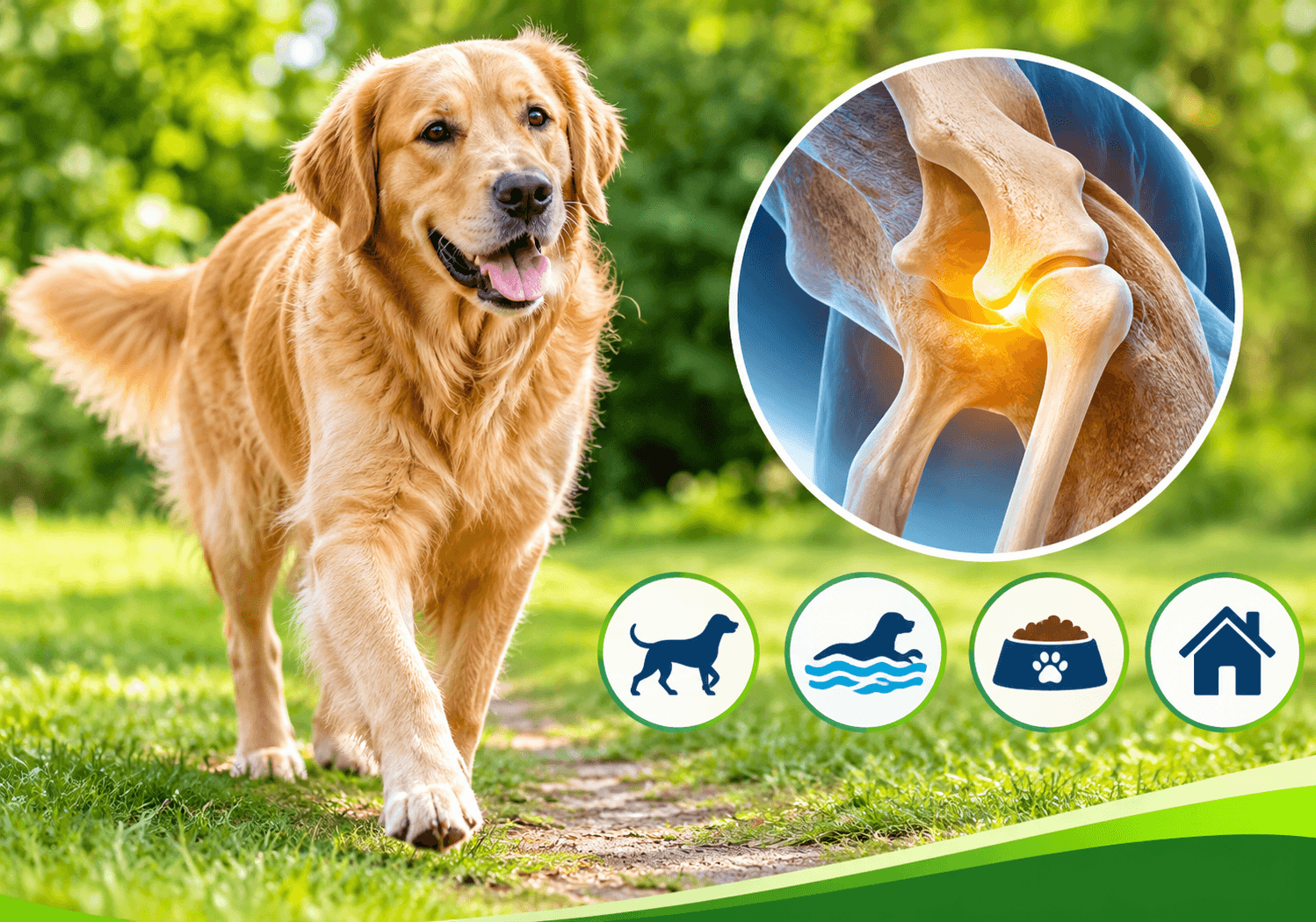
Your dog hesitates at the back door. The stairs that used to be a sprint are now a slow, careful climb. You notice a slight limp after the morning walk that wasn’t there last month. If you own a Labrador, German Shepherd, Golden Retriever, or any large or senior breed, these small changes are probably familiar.
Finding holistic ways to support canine hip and joint health means looking beyond a single pill or a one-size-fits-all vet prescription. It means combining movement, nutrition, environment, and targeted support into a daily routine that protects the joint capsule, keeps synovial fluid flowing, and strengthens the muscles that take load off the hip and knee. Below, I lay out 12 practical strategies you can start this week, with specific details on how to do each one, how often, and what to watch for.
Quick Answer: Holistic ways to support canine hip and joint health include controlled low-impact exercise (short walks, swimming, balance work), an anti-inflammatory diet rich in omega-3s, maintaining a healthy body weight, non-slip flooring and ramps at home, targeted supplements (omega-3s, glucosamine, collagen), veterinary rehabilitation exercises, and regular vet check-ups. No single intervention fixes joint problems, but a layered approach addresses the joint from multiple angles.
Why a “Holistic” Approach Beats a Single Fix
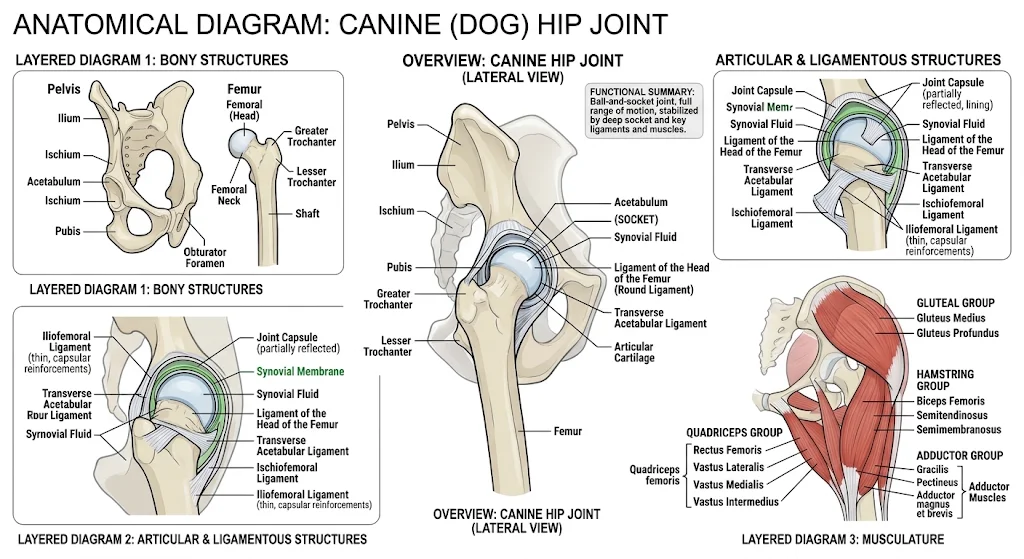
A dog’s hip joint is a ball-and-socket structure where the femoral head sits inside the acetabulum. It’s surrounded by a joint capsule filled with synovial fluid, cushioned by articular cartilage, and stabilized by ligaments and surrounding muscles. When any one of those components weakens—cartilage thins, fluid becomes less viscous, muscles atrophy—the joint takes more stress, inflammation rises, and the cycle accelerates.
Treating only one piece (say, giving a glucosamine chew) while your dog is overweight, walking on slick tile floors, and getting no structured muscle work is like fixing one tire on a car with a misaligned frame. The holistic model says: address every layer at once. That’s what the 12 strategies below do.
1. Controlled Low-Impact Walking
What to do: Short, frequent leash walks on soft ground (grass, packed dirt, mulch) rather than one long walk on concrete or pavement.
- Frequency: 2–3 walks per day, 10–15 minutes each for a senior or arthritic dog.
- Pace: Let your dog set the pace. A slow, steady trot is fine; avoid sprinting or sharp turns.
- Surface: Grass, a dirt trail, or a well-maintained park path. Avoid wet concrete, ice, and steep inclines.
- Progression: If your dog is currently walking 5 minutes before slowing, add 1–2 minutes every 3–4 days until you reach the target.
Why it works: Gentle, repetitive loading stimulates the synovial membrane to produce and circulate synovial fluid, which nourishes cartilage. It also keeps the muscles around the hip and stifle (knee) active without the high-impact forces of running or jumping. Research in veterinary rehabilitation supports controlled walking as a foundational element of canine osteoarthritis management.
Easier version: If your dog struggles with even 10 minutes, try 5 minutes in the morning and 5 in the evening, with a 5-minute rest in between.
Harder version: Add a gentle 5-minute hill (5–10° grade) at the end of the walk to increase quadriceps and gluteal engagement.
Coach’s Tip: Use a front-clip harness rather than a collar for walks. A collar puts pressure on the neck and can alter your dog’s gait, shifting load to the hips. A well-fitted harness distributes force across the chest and shoulders, letting your dog move more naturally.

2. Swimming and Hydrotherapy
What to do: Supervised swimming in a calm lake, a dog-safe pool, or a professional hydrotherapy treadmill.
- Frequency: 1–2 sessions per week, 10–20 minutes per session.
- Water depth: Chest-deep for a dog that can swim comfortably. Shallow (waist-deep) for a dog that is new to water or has limited mobility.
- Supervision: Always be in the water or within arm’s reach. Never leave a dog unattended.
Why it works: Water buoyancy reduces gravitational load on the joints by up to 70–90% depending on depth, while water resistance provides a natural strength-training effect on the muscles. A dog that can barely walk 100 feet on land can often swim for 15 minutes with minimal joint stress. Veterinary rehabilitation programs at university teaching hospitals routinely use hydrotherapy for dogs with hip dysplasia, cranial cruciate ligament rupture, and post-surgical recovery.
Easier version: Start in waist-deep water. Let your dog paddle in place for 2–3 minutes, then walk a short distance. Build up gradually.
Harder version: Add a light weighted vest (1–2% of body weight) in the water to increase resistance, or introduce a small floating ball for your dog to retrieve, adding a mild cardio component.
3. Targeted Strengthening Exercises (At Home)
What to do: Three to five simple exercises that build the muscles around the hip, stifle, and core. A certified canine rehabilitation therapist (CCT) can demonstrate these to you, but the basics are straightforward.
| Exercise | How to Do It | Sets x Reps | Rest |
| Sit-to-stand | Hold a treat just above your dog’s nose. As they rise to stand, keep the treat moving up and slightly forward. Lower back to sit. | 3 x 8–12 | 30 sec |
| Rear-end lift (bridge) | With your dog standing, place one hand under the chest and one under the rear. Gently lift the front paws off the ground, encouraging the hind legs to bear weight and “bridge.” | 3 x 5–8 (hold 5 sec) | 30 sec |
| Slow lateral steps | With your dog on a leash, step sideways slowly, encouraging the dog to follow with small lateral steps. | 2 x 10 steps each direction | 30 sec |
| Balance board / wobble cushion | Place your dog’s front paws on a firm wobble cushion or a folded towel on a smooth floor. Encourage them to stand and maintain balance. | 3 x 15–20 sec | 30 sec |
| Controlled rear-end circles | With your dog on a leash, walk in a slow, wide circle, encouraging the hind legs to track the front. | 2 x 10 steps each direction | 30 sec |
Frequency: 3–4 days per week, on non-consecutive days. Each session takes 10–15 minutes.
Why it works: Strong gluteals, hamstrings, quadriceps, and core muscles act as natural “shock absorbers” for the hip and knee joints. When these muscles are underdeveloped (common in sedentary or overweight dogs), the joint structures bear more force with every step. Progressive resistance work rebuilds that muscular support.
Common Mistake: Rushing the reps. A sit-to-stand done in 0.5 seconds is a bounce, not a strength exercise. Aim for a 2-second descent (sit) and a 2-second rise (stand). If your dog is bouncing, reduce the range of motion or add a 3-second hold at the top.
4. Maintain a Healthy Body Weight
What to do: Weigh your dog monthly. Use a digital scale (step on, step off, subtract your weight) or a vet-visit scale.
- Ideal body condition score (BCS): 4–5 out of 9. You should be able to feel the ribs with light pressure but not see them prominently. The waist should be visible from above. A safe rate of loss is 1–2% of body weight per week. For a 70-lb (32 kg) dog, that’s roughly 0.7–1.4 lb (0.3–0.6 kg) per week.
- Feeding adjustments: Measure food with a calibrated cup. Eliminate table scraps. Switch treats to low-calorie options (a piece of cucumber, a small piece of carrot).
Why it works: Every extra pound of body weight multiplies the force on the hip and stifle joints with each step. A dog that is 20% overweight places roughly 40–50% more load on those joints during walking. Reducing even 10% of excess body weight can noticeably decrease joint stress and slow the progression of osteoarthritis.
For general principles on how body weight and metabolic health interact, our guide on what affects metabolism and body weight covers the underlying mechanics that apply to both humans and animals.
5. Anti-Inflammatory Nutrition
What to do: Build your dog’s daily diet around whole, anti-inflammatory ingredients.
- Omega-3 fatty acids (EPA + DHA): The single most evidence-based dietary intervention for joint inflammation in dogs. Aim for 20–30 mg of combined EPA + DHA per pound (44–67 mg per kg) of body weight per day. A high-quality fish oil supplement or a diet that includes sardines, mackerel, or salmon 2–3 times per week can help you reach this target.
- Lean protein: Chicken, turkey, or fish provide the amino acids needed for connective tissue repair.
- Fiber-rich vegetables: Blueberries, pumpkin, spinach, and sweet potato add antioxidants and fiber without excess calories.
- Limit: Highly processed kibble with corn, wheat, or soy as the first ingredient, excessive sugar, and fatty table scraps.
Why it works: Omega-3 fatty acids compete with arachidonic acid in the production of inflammatory eicosanoids. By shifting the balance toward omega-3-derived prostaglandins and leukotrienes, the overall inflammatory tone in joint tissue decreases. Multiple peer-reviewed studies in dogs have shown reduced lameness scores and improved gait after 8–12 weeks of omega-3 supplementation.
For a deeper look at how omega-3s modulate inflammation at the tissue level, see our article on omega-3 fatty acids and inflammation.
6. Targeted Joint Supplements
What to do: After discussing with your vet, add one or more of the following to your dog’s daily routine:
| Supplement | Typical Dose (medium dog, 40–60 lb / 18–27 kg) | What It Supports |
| Omega-3 (EPA + DHA) | 20–30 mg/lb (44–67 mg/kg) | Reduces joint inflammation |
| Glucosamine sulfate | 20–30 mg/lb (44–66 mg/kg) | Cartilage building block |
| Chondroitin sulfate | 10–15 mg/lb (22–33 mg/kg) | Cartilage structure and fluid retention |
| Hydrolyzed collagen | 5–10 g | Amino acids for connective tissue |
| Green-lipped mussel extract | 10–20 mg/lb (22–44 mg/kg) | Anti-inflammatory, cartilage support |
| Turmeric (curcumin) | 10–20 mg/lb (22–44 mg/kg) | Anti-inflammatory (use with a black pepper extract for absorption) |
Why it works: No single supplement reverses advanced osteoarthritis, but a well-chosen combination can support the joint from multiple angles—reducing inflammation (omega-3s, curcumin), providing structural building blocks (glucosamine, chondroitin, collagen), and supporting synovial fluid quality. Give supplements consistently for at least 8 weeks before judging effectiveness.
For more on how collagen peptides are absorbed and what the research suggests about timing, our guide on collagen powder timing and absorption covers the pharmacokinetics in detail.
7. Non-Slip Flooring and Home Modifications
What to do: Audit your home for surfaces and transitions that stress your dog’s joints.
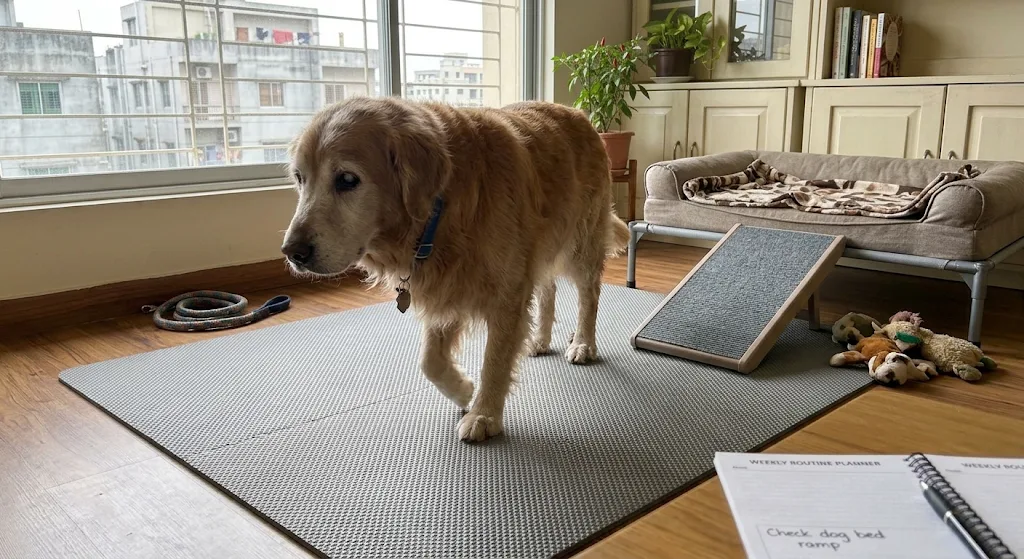
- Flooring: Add non-slip rubber mats, interlocking foam tiles, or area rugs with non-slip backing to hardwood, tile, and laminate floors. A dog that slips and slides on slick floors engages the hip and knee joints in emergency braking, which is a common trigger for acute injury.
- Ramps and steps: If your dog jumps into the car, onto the couch, or up a set of stairs, add a ramp (for the car) or a set of 2–3 low steps (for the couch or bed). The ramp should have a non-slip surface and be wide enough for your dog to walk up without twisting.
- Bed placement: Move your dog’s bed to a ground-floor location if possible. If the bed is on a raised platform, add a small ramp.
Why it works: Reducing the frequency of high-impact landings and sudden directional changes removes two of the biggest mechanical stressors on the hip and stifle joints. This is especially important for dogs with existing hip dysplasia or early osteoarthritis, where even a single slip can worsen cartilage damage.
8. Veterinary Rehabilitation and Physical Therapy
What to do: Ask your vet for a referral to a certified canine rehabilitation therapist (CCT) or a veterinary rehabilitation specialist.
- What a session looks like: A typical session (30–45 minutes) may include a gait assessment, passive range-of-motion stretches, therapeutic exercises (the ones in Strategy #3, but guided and progressed), laser therapy, ultrasound, or cold/hot therapy, depending on your dog’s condition.
- Frequency: 1–2 sessions per week for 4–6 weeks, then taper to maintenance.
- At-home homework: Your therapist will give you a short exercise routine (5–10 minutes) to do daily between sessions.
Why it works: A trained professional can assess your dog’s gait, identify muscle imbalances, and design a progressive exercise plan that targets the specific joints and muscles that need work. They can also introduce modalities (laser, ultrasound, electrical stimulation) that you can’t safely replicate at home. University veterinary teaching hospitals have published protocols showing measurable improvements in lameness scores and gait symmetry after structured rehabilitation programs.
9. Regular Veterinary Check-Ups and Imaging
What to do: Schedule a joint-focused vet visit at least once a year for dogs over 5 years old, or twice a year for large breeds or dogs with a known joint condition.
- What to ask for: A physical orthopedic exam (hip extension/flexion, stifle extension, pelvic tilt test), a discussion of any gait changes you’ve noticed, and, if appropriate, radiographs (X-rays) of the hips and stifles.
- Bloodwork: Annual bloodwork can flag early kidney or liver changes that affect how your dog metabolizes medications or supplements.
Why it works: Early detection of cartilage thinning, joint effusion (fluid buildup), or early osteophyte formation (bone spurs) lets you intervene before the condition progresses. A dog caught at the “mild stiffness” stage responds far better to conservative management (exercise, nutrition, supplements) than one that has progressed to advanced osteoarthritis with significant cartilage loss.
10. Manage Stress and Ensure Quality Rest
What to do: Give your dog a consistent, calm daily routine with adequate rest.
- Sleep: Dogs need 10–14 hours of sleep per day. A quiet, comfortable sleeping area (a supportive orthopedic dog bed, not a thin cushion) helps joints recover from the day’s activity.
- Stress reduction: Chronic stress elevates cortisol, which can increase systemic inflammation and reduce the body’s ability to repair tissue. Keep a predictable feeding and walking schedule. Minimize loud, chaotic environments when possible.
- Mental stimulation: A 10-minute sniffing walk or a puzzle feeder engages the brain without adding physical load to the joints.
Why it works: Rest is when tissue repair happens. Synovial fluid composition, cartilage cell turnover, and muscle protein synthesis all occur primarily during rest and sleep. A dog that is chronically stressed, overstimulated, or sleeping on a hard, unsupportive surface misses out on that recovery window.
11. Avoid High-Impact and High-Risk Activities
What to do: Modify or eliminate activities that place repeated high-impact stress on the hips and stifles.
- Avoid: Jumping on and off furniture or into cars, rough play that involves sudden spinning or twisting, long runs on hard pavement, agility training with repeated jumps (unless cleared by a vet), and playing fetch on slippery surfaces.
- Substitute: Replace a high-energy fetch session with a slow, controlled retrieve on grass. Swap a jump-up greeting for a sit-and-wait. Trade a 3-mile jog for a 20-minute walk plus 10 minutes of swimming.
Why it works: Repetitive high-impact loading accelerates cartilage wear. A single jump from a couch onto a tile floor can generate a ground reaction force 3–5 times the dog’s body weight through the hip joint. Over time, these micro-traumas compound, especially in a joint that already has early degenerative changes.
12. Keep a Mobility and Behavior Log
What to do: Track your dog’s joint health over time so you can spot trends and share data with your vet.
- What to record (daily or every other day):
- Stiffness after waking (rate 1–5)
- Willingness to walk (full walk, shortened, refused)
- Limping (none, mild, moderate, severe)
- Vocalization during movement (none, whine, groan)
- Appetite and energy level
- Any new behaviors (hiding, reluctance to be touched near the hips)
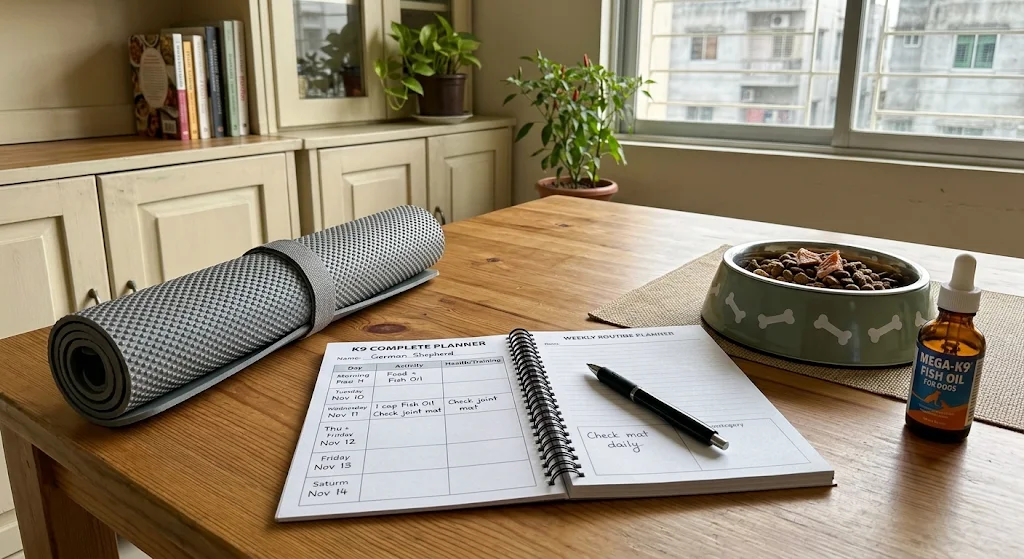
- Format: A simple notebook, a phone notes app, or a spreadsheet. Take a 10-second video of your dog walking toward you from 10 feet (3 m) away once a week. Compare videos over months.
Why it works: Joint changes are gradual. You may not notice a 5% reduction in stride length week to week, but a 3-month video comparison makes it obvious. Having data in hand makes vet conversations more productive and helps you and your vet decide whether the current plan is working or needs adjustment.
Putting It All Together: A Sample Weekly Routine
Here’s how the 12 strategies fit into a realistic weekly schedule for a 7-year-old, 65-lb (29 kg) Labrador with early hip stiffness:
| Day | Activity | Duration |
| Mon | 15-min walk (grass) + 10-min home exercise (sit-to-stands, rear-end lifts, balance board) + omega-3 + collagen supplement with food | ~40 min |
| Tue | 15-min walk (grass) + 20-min supervised swim + supplements | ~50 min |
| Wed | 15-min walk (grass) + 10-min home exercise (lateral steps, rear-end circles, balance board) + supplements | ~40 min |
| Thu | 15-min walk (grass) + rest / mental stimulation (sniffing walk, puzzle feeder) + supplements | ~30 min |
| Fri | 15-min walk (grass) + 10-min home exercise (full circuit) + supplements | ~40 min |
| Sat | 20-min walk (dirt trail) + 20-min swim + supplements | ~55 min |
| Sun | 10-min walk (grass) + full rest + supplements | ~25 min |
Monthly: Weigh your dog. Review your mobility log. Check that non-slip mats and ramps are in good condition.
Quarterly: Vet check-up with orthopedic exam. Adjust supplements or exercise plan based on progress.
Annually (or as recommended): Radiographs of hips and stifles, bloodwork, and a full rehabilitation assessment.
Safety Notes and When to Stop
- Pain is a signal. If your dog resists an exercise, yelps, or refuses to bear weight, stop immediately. Do not “push through” pain. Contact your vet.
- New or worsening symptoms: Sudden limping, visible swelling, heat around a joint, or refusal to move warrants a same-day vet visit.
- Medication interactions: If your dog is on a prescription NSAID (carprofen, meloxicam, firocoxib), confirm with your vet before adding turmeric, omega-3s, or any other supplement. Some combinations increase the risk of gastrointestinal irritation.
- Puppies and young dogs: Do not start structured joint exercises or supplements in puppies under 12 months unless specifically directed by a vet. Their growth plates are still open, and excessive loading can alter bone development.
- Pregnant or nursing dogs: Get vet clearance before changing diet, exercise, or adding supplements.
If your dog has a diagnosed joint condition (hip dysplasia, cranial cruciate ligament rupture, advanced osteoarthritis) or is on any medication, check with your veterinarian or a veterinary rehabilitation specialist before starting any new exercise, diet, or supplement protocol.
This article is for general information and is not a substitute for advice from a veterinarian or veterinary rehabilitation specialist.
FAQ
How do I support my dog’s hip health naturally?
Combine controlled low-impact walking, an anti-inflammatory diet rich in omega-3s, targeted strengthening exercises, and a joint-friendly home environment (non-slip floors, ramps). Maintain a healthy weight and schedule regular vet check-ups. No single natural intervention is sufficient; the layered approach is what makes a difference.
Can exercise actually help a dog with hip dysplasia?
Yes, but the type matters. Controlled, low-impact exercise (walking on soft ground, swimming, gentle strengthening) can help. High-impact activities (jumping, sprinting, rough play) should be avoided. A certified canine rehabilitation therapist can design a safe, progressive plan tailored to your dog’s specific condition.
What is the best diet for canine joint health?
A diet rich in lean protein, omega-3 fatty acids (EPA and DHA from fish oil or fatty fish), fiber-rich vegetables, and antioxidants, while limiting highly processed ingredients and excess calories. The goal is to reduce systemic inflammation and maintain a healthy body weight to minimize joint load.
How long before I see improvement from joint exercises and supplements?
Most veterinary rehabilitation and nutrition guidelines recommend a minimum of 8 weeks of consistent daily effort before evaluating progress. Some dogs notice reduced morning stiffness within 2–3 weeks, but structural changes in cartilage and muscle take longer. Keep a mobility log to track subtle changes.
Can swimming really help a dog with hip problems?
Yes. Water buoyancy reduces gravitational load on the joints by 70–90%, while water resistance builds muscle strength without impact. Swimming is one of the safest and most effective exercises for dogs with hip dysplasia, osteoarthritis, or post-surgical recovery, provided the dog is supervised and the water is calm and safe.
Should I give my dog supplements for joint health?
Supplements like omega-3s, glucosamine, chondroitin, and hydrolyzed collagen can be a reasonable part of a joint-support plan, but they are not a replacement for exercise, weight management, and veterinary care. Always discuss supplements with your vet, especially if your dog is on medication or has a diagnosed condition.
The Bottom Line
Supporting your dog’s hips and joints is not a one-product solution. It’s a daily practice that blends movement, nutrition, environment, and veterinary oversight into a routine that respects the biology of the joint. Start with two or three strategies from the list above—maybe the walking routine, the omega-3 supplement, and the non-slip mats—and build from there. Give each change 4–8 weeks to show its effect. Track what you see. And keep your vet in the loop, because the best holistic plan is the one that’s adjusted as your dog changes.
Your dog can’t tell you that the left hip aches a little more than it did last month. You can. Watch, log, adjust, and advocate. That’s the most holistic thing you can do.