You can crush your workouts, dial in your nutrition, and still stall out completely if you spend ninety minutes staring at the ceiling every night. For lifters, runners, and active adults, poor sleep wrecks muscle protein synthesis, elevates cortisol, and drains training intensity the next day. Many people reach straight for melatonin gummies, only to wake up foggy or realize the hormone stops working after a few weeks.
Fortunately, you do not need exogenous hormones to knock out quickly. Using targeted natural remedies for falling asleep fast without melatonin, you can downshift your nervous system, drop your core body temperature, and trigger your brain’s natural sleep drive in minutes.
Quick Answer: The most effective natural remedies for falling asleep fast without melatonin target your nervous system and body temperature rather than hormones. Combine a 60–67°F (15.5–19.4°C) bedroom, a warm shower 90 minutes before bed, 4-7-8 breathing or progressive muscle relaxation, and non-hormonal nutrients like magnesium glycinate or L-theanine to reduce sleep onset latency naturally.
Note: Before adding new herbal extracts, amino acids, or dietary supplements to your evening routine—especially if you take prescription medications, manage a medical condition, or are pregnant or nursing—check with a doctor or qualified healthcare provider.
Why Skip Melatonin? Understanding Your Natural Sleep Drive
Melatonin is not a sedative; it is a darkness signal produced by your pineal gland that tells your brain what time of day it is. According to the National Center for Complementary and Integrative Health (NCCIH), melatonin primarily helps shift circadian timing—such as during jet lag or shift work—rather than acting as a reliable knock-out pill for general trouble falling asleep.
When you rely on high-dose melatonin supplements nightly, several issues pop up:
- Morning grogginess: Synthetic doses often exceed what your body produces naturally, lingering in your bloodstream past your morning alarm.
- Inconsistent labeling: Over-the-counter supplements are loosely regulated, meaning actual hormone content can vary wildly from the label.
- Ignoring the real bottleneck: Most active people struggle to fall asleep because of sympathetic nervous system hyperarousal (“wired but tired” from evening workouts, work stress, or late caffeine) rather than a melatonin deficiency.
Instead of overriding your endocrine system, natural remedies for falling asleep fast without melatonin work through two physiological levers: sleep pressure (adenosine accumulation) and parasympathetic activation (lowering heart rate, blood pressure, and core temperature).
Behavioral & Nervous System Remedies (Zero Supplements Required)
Before spending a dollar on powders or teas, master the mechanical and neurological habits that signal safety and rest to your brain. In coaching, we treat the evening wind-down just like a post-workout cool-down: you cannot sprint at 100% effort and immediately expect your heart rate to sit at 55 beats per minute.
1. Temperature Manipulation (The Warm-to-Cool Drop)
Your core body temperature must drop by roughly 2 to 3°F (1.1 to 1.7°C) to initiate sleep and stay in deep slow-wave stages. If your bedroom is too warm or your core temperature stays elevated after an evening training session, your brain delays sleep onset.
- Take a warm bath or shower 60–90 minutes before bed: A systematic review published in Sleep Medicine Reviews via PubMed found that water-based passive body heating at 104–109°F (40–42.5°C) for as little as 10 minutes significantly shortened sleep onset latency. Stepping out of warm water draws blood to your hands and feet, rapidly dumping heat from your core.
- Set your thermostat to 60–67°F (15.5–19.4°C): According to the Sleep Foundation and Cleveland Clinic sleep hygiene guidance, a cool room supports your body’s natural nocturnal thermoregulation.
- Wear breathable socks if your feet run cold: Cold extremities constrict blood vessels and slow core heat loss. Light cotton or merino socks dilate peripheral blood vessels and speed up heat release.
2. Progressive Muscle Relaxation (PMR)
Heavy resistance training, desk posture, and daily stress leave low-grade tension locked inside your traps, jaw, hip flexors, and calves. Progressive Muscle Relaxation systematically contracts and releases muscle groups, sending an unmistakable physical signal to your central nervous system that the workday is over.
How to do PMR in bed (5–7 minutes):
- Lie flat on your back with your arms resting comfortably at your sides, palms up.
- Start at your feet: curl your toes and tense your calves at about 60–70% effort for 5 seconds—hard enough to feel clear tension, never enough to cramp.
- Exhale slowly and release all tension completely for 10–15 seconds, noticing the heavy, warm sensation as blood flows back into the muscle.
- Move upward through your quads and glutes, your core and lower back, your hands and forearms, your shoulders (shrug toward ears), and finally your jaw and forehead.
Coach’s Tip: Do not clench at 100% max effort during Progressive Muscle Relaxation. If you treat PMR like a heavy deadlift set, you will spike adrenaline and wake yourself up. Keep contractions smooth at roughly 6 out of 10 effort, and make the relaxation phase twice as long as the squeeze.
3. Parasympathetic Breathing Protocols
Your breath is the only autonomic function you can control consciously. Extending your exhale stimulates the vagus nerve, slows your heart rate, and shifts your nervous system out of “fight-or-flight” mode.
- The 4-7-8 Breathing Cadence: Inhale quietly through your nose for 4 seconds, hold gently for 7 seconds, and exhale steadily through pursed lips for 8 seconds. Repeat for 4 to 8 cycles. The prolonged exhale forces carbon dioxide tolerance and drops cardiac output quickly.
- The Physiological Sigh: Take two quick inhales through your nose (one deep breath, followed immediately by a sharp top-off inhale to pop open collapsed alveoli in the lungs), then let out one long, unhurried exhale through your mouth. Five to ten cycles rapidly lower autonomic arousal.
4. Cognitive Shuffling (Interrupting Racing Thoughts)
When physical exhaustion meets a racing mind, lying quietly in the dark often triggers performance anxiety about losing sleep. Cognitive shuffling occupies your brain’s visual cortex with random, non-emotional imagery so it cannot ruminate over tomorrow’s to-do list.
- Pick a neutral, emotionally flat word like “TABLE” or “GARDEN.”
- Starting with the first letter (T), picture simple objects starting with that letter for 5 to 8 seconds each: tiger, tractor, tennis ball, teacup, tree.
- Once you run out of ideas for T, move to A (apple, anchor, airplane), and continue through the word. Most people drift off before reaching the third or fourth letter because random imagery mimics the fragmented thought patterns of early Stage 1 sleep.
5. Morning Sunlight & Evening Light Discipline
Even without taking melatonin pills, you want your own pineal gland releasing endogenous melatonin on schedule. That clock is set 14 to 16 hours earlier in the morning.
- Get 10–15 minutes of direct outdoor sunlight within 30–60 minutes of waking (20–30 minutes on overcast days) without sunglasses. Sunlight hits specialized retinal ganglion cells that anchor your suprachiasmatic nucleus (SCN) and start a timer for nighttime sleepiness.
- Dim overhead LED lights 90 minutes before bed and switch to warm, low-lamp lighting. If you use screens, enable night-shift filters and drop brightness to under 20%.
Evidence-Based Nutritional & Herbal Remedies (Melatonin-Free)
When lifestyle habits are dialed in, targeted non-hormonal nutrients can help calm neural excitability and ease muscular tension. Unlike melatonin, these compounds work on calming neurotransmitters like GABA (gamma-aminobutyric acid), adenosine receptors, and neuromuscular relaxation pathways.
1. Magnesium Glycinate (or Magnesium L-Threonate)
Magnesium participates in over 300 enzymatic reactions, including regulating NMDA receptors and binding to GABA receptors to quiet nervous system firing. Active adults and heavy sweaters frequently run low on magnesium, which can show up as tight calves, twitchy eyelids, and restless sleep.
- Why Glycinate wins: Magnesium bound to the amino acid glycine absorbs smoothly without the digestive laxative effect of magnesium oxide or citrate. Furthermore, glycine itself helps lower core body temperature slightly.
- Typical Research Dose: 200–400 mg of elemental magnesium taken 30–60 minutes before bed. Note that the NIH Office of Dietary Supplements sets the Tolerable Upper Intake Level (UL) for supplemental magnesium in adults at 350 mg per day unless supervised by a clinician.
2. L-Theanine
L-theanine is a calming amino acid found naturally in green tea leaves (without the caffeine). Clinical research indexed in PubMed / Nutrients indicates that L-theanine promotes alpha-wave brain activity—the same relaxed, alert mental state seen during meditation—while reducing stress-related physiological arousal.
- How it helps you fall asleep: It does not knock you out like a sleeping pill; instead, it takes the sharp edge off mental chatter and evening cortisol spikes so sleep arrives naturally.
- Typical Research Dose: 100–200 mg taken 30–60 minutes before bedtime.
3. Chamomile Extract or Strong Chamomile Tea
Chamomile (Matricaria chamomilla) contains an antioxidant flavonoid called apigenin, which binds to specific benzodiazepine receptors in the brain to produce mild sedative and muscle-relaxing effects.
- Practical use: Brew 1–2 bags (or 1 tablespoon of loose whole flowers) in 8 oz (240 ml) of hot water for 8–10 minutes covered, about 60 minutes before bed. Finishing your tea at least an hour before lying down prevents middle-of-the-night bathroom trips.
4. Lemon Balm (Melissa officinalis)
Lemon balm is a perennial herb in the mint family shown to inhibit the enzyme GABA transaminase, which allows your brain’s natural calming GABA levels to stay active longer. Studies cited by Mount Sinai Health Library note that lemon balm—often paired with chamomile or valerian—can help reduce restlessness and shorten the time it takes to drift off.
- Typical Research Dose: 300–600 mg of standardized extract or 1 cup of brewed lemon balm tea 45–60 minutes before bed.
5. Tart Montmorency Cherry Concentrate (Whole-Food Option)
While tart cherries contain trace, naturally occurring phytochemicals and anti-inflammatory anthocyanins, they function primarily as a whole-food recovery drink rather than a concentrated hormone pill. A randomized controlled trial published in the American Journal of Therapeutics (PubMed) found that older adults with insomnia who drank tart cherry juice experienced improved sleep time and sleep efficiency, partly due to procyanidins that increase tryptophan availability and reduce systemic inflammation.
- Practical use: Mix 1 oz (30 ml) of unsweetened Montmorency tart cherry concentrate into cold sparkling water 60 minutes before bed—especially helpful after tough lower-body training days.
Comparison Table: Best Natural Remedies Without Melatonin
| Remedy | Primary Mechanism | Typical Timing & Dose | Best For | Key Watch-Out |
| Warm Shower + Cool Room | Drops core body temperature via vasodilation | 60–90 min before bed; room at 60–67°F (15.5–19.4°C) | Everyone; especially evening exercisers | Too hot or too close to bed can delay cooling |
| 4-7-8 Breathing / PMR | Activates vagus nerve; lowers heart rate & muscle tone | In bed, lights out (5–8 minutes) | Racing heart, physical tension, stress | Avoid tensing muscles too hard during PMR |
| Magnesium Glycinate | Supports GABA signaling & neuromuscular relaxation | 30–60 min before bed (200–350 mg elemental) | Tight muscles, high training volume, restless legs | Stay under 350 mg supplemental UL unless advised by MD |
| L-Theanine | Boosts alpha brain waves; lowers stress arousal | 30–60 min before bed (100–200 mg) | Busy minds, overthinking, late-day work stress | Generally mild; may lower blood pressure slightly |
| Chamomile / Lemon Balm | Apigenin & GABA enzyme modulation | 60 min before bed (1 cup tea or 300–600 mg extract) | Mild restlessness, establishing an evening ritual | Ragweed allergies (chamomile); avoid excess fluid right before bed |
| Tart Cherry Concentrate | Reduces inflammation & supports tryptophan pathway | 60 min before bed (1 oz / 30 ml concentrate) | Post-workout muscle soreness + sleep quality | Contains natural sugars (~15g per serving) |
You cannot separate what happens at 10:30 PM from how you train, eat, and caffeinate at 2:00 PM. Many people who think they need sleep remedies are actually dealing with daytime habits that block adenosine or spike evening cortisol.
- Respect Caffeine’s Half-Life: Caffeine blocks adenosine receptors—the exact chemical that builds up all day to make you sleepy. According to the FDA guidance on caffeine, caffeine has a half-life of roughly 4 to 6 hours. A 200 mg pre-workout scoop at 4:00 PM still leaves 100 mg active in your brain at 9:00 PM. Set a hard caffeine cutoff 8 to 10 hours before bedtime, and lean on stimulant-free strategies if you train late; you can read more about why caffeine causes energy crashes and how to improve daily energy without caffeine.
- Time High-Intensity Workouts Wisely: Moderate daytime exercise consistently improves sleep quality, as highlighted by Johns Hopkins Medicine. However, max-effort sprints, heavy deadlifts, or competitive sparring within 90 minutes of bedtime keep adrenaline, heart rate, and core temperature elevated. If you must train in the evening, finish intense work at least 2 hours before bed and prioritize a thorough cool-down.
- Watch Large Late Meals & Evening Cravings: Digesting a massive 1,200-calorie dinner right before lying down raises core body temperature through the thermic effect of food and increases acid reflux risk. Aim to finish large meals 2.5 to 3 hours before bed. If genuine hunger keeps you awake, eat a small, easy-to-digest snack (150–200 calories) combining complex carbs and protein—like Greek yogurt with berries or oats—which supports serotonin production without taxing digestion. Understanding how sleep affects metabolism and weight management also reinforces why consistent meal timing helps you manage evening cravings naturally.
- Manage Evening Cortisol: Chronic calorie deficits or high life stress keep evening cortisol elevated when it should be at its lowest point of the day. If stress drives late-night tension, explore evidence-backed approaches to adaptogens and cortisol management alongside consistent sleep scheduling.
If you want a plug-and-play evening checklist, follow this 45-minute sequence for seven consecutive nights before changing anything else.
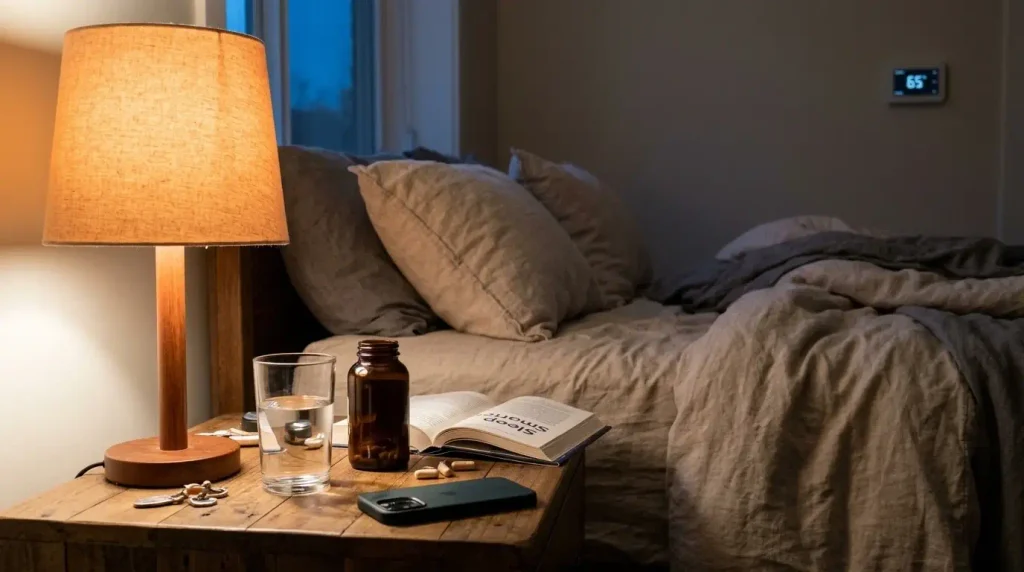
- T-Minus 60 to 45 Minutes (Thermal & Light Shift):
- Turn off bright overhead lights and switch on a single warm bedside lamp.
- Set your bedroom thermostat between 60°F and 67°F (15.5–19.4°C).
- Take a 10-minute warm shower or sip a small cup of chamomile or lemon balm tea (or take 200 mg magnesium glycinate / 100–200 mg L-theanine if cleared by your doctor).
- T-Minus 30 Minutes (Brain Dump & Screen Cutoff):
- Put your phone on a charger outside the bedroom or across the room on Do Not Disturb.
- Spend 3 minutes writing tomorrow’s top 3 priorities on a piece of paper. Offloading open tasks onto paper prevents your brain from rehearsing them in bed.
- T-Minus 15 Minutes (Gentle Mobility or Reading):
- Do 5 minutes of floor-based gentle mobility—such as child’s pose, legs-up-the-wall, or supine spinal twists—moving slowly with zero strain.
- Read a physical book or e-ink reader (no backlight glare) until your eyelids feel heavy.
- Lights Out (In-Bed Nervous System Downshift):
- Run 4 cycles of 4-7-8 breathing.
- Perform a 5-minute Progressive Muscle Relaxation scan from toes to jaw.
- If you are still awake after 10 minutes, start Cognitive Shuffling with a neutral word until you drift off.
Common Mistake: Clock-watching when you do not fall asleep immediately. Every time you check your phone or nightstand clock and calculate “If I fall asleep right now, I only get 5 hours and 12 minutes,” your brain triggers a micro-surge of cortisol and adrenaline. Turn your clock away from the bed. If you feel wide awake after roughly 20–25 minutes, get out of bed, sit in a dim room reading something boring until your eyes droop, and then return to bed. This core principle of Cognitive Behavioral Therapy for Insomnia (CBT-I) trains your brain to associate your mattress strictly with sleep rather than frustration.
Who Should Be Careful & When to See a Doctor
Natural remedies work well for everyday stress, post-workout wiredness, and mild sleep onset trouble, but they are not a cure-all for clinical sleep disorders.
- Medication Interactions: Herbal remedies like valerian, lemon balm, and chamomile can interact with sedatives, blood thinners, blood pressure drugs, and antidepressants. Magnesium can also interfere with the absorption of certain antibiotics and bone medications if taken at the exact same time.
- Underlying Sleep Disorders: If you snore loudly, gasp for air during sleep, wake up with morning headaches, or feel severely exhausted despite spending 8 hours in bed, speak with a physician to screen for obstructive sleep apnea or restless legs syndrome.
- Chronic Insomnia: If trouble falling or staying asleep happens at least three nights per week for three months or longer, ask a doctor about CBT-I (Cognitive Behavioral Therapy for Insomnia), which the American College of Physicians recommends as the first-line treatment for chronic adult insomnia.
Frequently Asked Questions (FAQ)
What are the best natural remedies for falling asleep fast without melatonin?
The most effective natural remedies combine core body cooling with nervous system relaxation. Taking a warm shower 60–90 minutes before bed, keeping your bedroom at 60–67°F (15.5–19.4°C), practicing 4-7-8 breathing or progressive muscle relaxation, and using non-hormonal aids like magnesium glycinate or L-theanine help lower heart rate and trigger sleep naturally.
How can I fall asleep in 5 minutes naturally without pills?
To fall asleep quickly without supplements, focus on rapid autonomic downshifting. Start with five physiological sighs (two quick nasal inhales followed by one long exhale), run a brief progressive muscle relaxation scan from your feet to your jaw, and use cognitive shuffling—visualizing random objects starting with each letter of a neutral word—to quiet racing thoughts.
Does magnesium glycinate help you fall asleep faster?
Magnesium glycinate may help you fall asleep faster if muscle tension, stress, or low dietary magnesium is keeping you awake. Magnesium supports calming GABA receptors in the brain, while the bound amino acid glycine helps relax muscles and slightly lower core temperature. Most studies use 200–350 mg taken 30 to 60 minutes before bed.
What tea helps you fall asleep fast without melatonin?
Chamomile and lemon balm teas are two of the best melatonin-free options before bed. Chamomile contains apigenin, an antioxidant that binds to calming brain receptors, while lemon balm helps maintain natural GABA levels. Brew your tea 60 to 90 minutes before bedtime so you get the calming benefits without waking up to use the bathroom.
Can tart cherry juice replace melatonin supplements?
Tart Montmorency cherry juice is not a direct replacement for high-dose melatonin pills, though it contains trace phytochemicals and anti-inflammatory compounds. Research suggests drinking about 1 oz (30 ml) of tart cherry concentrate before bed may modestly improve sleep duration and recovery by reducing exercise-induced inflammation and supporting natural tryptophan pathways.
Why does melatonin sometimes make me wake up groggy?
Melatonin is a circadian timing hormone rather than a true sedative, and many over-the-counter gummies contain doses far higher than what your brain produces naturally. When excess hormone remains active in your bloodstream the next morning, it can cause daytime drowsiness, vivid dreams, and sluggishness—making non-hormonal sleep strategies a cleaner option for daily use.
Putting It All Together
Building a reliable evening routine does not require megadoses of synthetic hormones or complicated supplement stacks. By pairing natural remedies for falling asleep fast without melatonin—like smart room temperature control, warm-to-cool showers, slow exhale breathing, progressive muscle relaxation, and targeted nutrients such as magnesium glycinate or L-theanine—you work with your body’s built-in biology instead of fighting against it.
Start simple tonight: set your caffeine cutoff earlier, cool your bedroom down, put your phone away 30 minutes before lights out, and practice 4-7-8 breathing once your head hits the pillow. Give your nervous system consistent cues for a full week, and you will notice faster sleep onset, deeper recovery, and better energy for every workout ahead.