
If you lie awake at night with a racing mind and a pounding heart, your body’s stress response might be working against you. Learning how to lower cortisol at night for better sleep is one of the most effective ways to improve your recovery, manage your weight, and wake up feeling refreshed. As a strength and conditioning coach, I work with many gym beginners and women over 40 who train hard but struggle to wind down. High evening cortisol blocks the natural release of melatonin, leaving you tired but wired.
This guide provides practical, evidence-based strategies to calm your nervous system. We will cover specific breathing techniques, gentle stretches, and environmental tweaks you can implement tonight. You do not need fancy equipment or hours of free time. By building a consistent evening wind-down routine, you can signal to your brain that it is safe to rest.
Quick Answer: How to Lower Cortisol at Night
To lower cortisol at night, dim bright lights two hours before bed, practice 5 minutes of diaphragmatic breathing (like the 4-7-8 method), and do 10 minutes of gentle stretching such as legs-up-the-wall. Avoid heavy meals, intense workouts, and screens within 90 minutes of bedtime to support natural melatonin production and parasympathetic nervous system activation.
The Science Behind How to Lower Cortisol at Night for Better Sleep
Cortisol is not the enemy. It is a vital hormone that helps you wake up, mobilize energy, and respond to challenges. Your body follows a natural circadian rhythm where cortisol peaks about 30 to 45 minutes after you wake up and gradually declines throughout the day, reaching its lowest point around midnight.
However, modern life disrupts this pattern. Late-night screen time, intense evening workouts, psychological stress, and poor nutrition can keep the hypothalamic-pituitary-adrenal (HPA) axis activated. When cortisol remains elevated at night, it directly suppresses melatonin production. Research from the National Institutes of Health (NIH) confirms that elevated evening cortisol is strongly linked to delayed sleep onset and reduced slow-wave (deep) sleep.
Understanding this biological mechanism is the first step. You cannot force yourself to sleep, but you can create the physiological conditions for sleep to happen. By actively engaging the parasympathetic nervous system (your “rest and digest” mode), you can manually lower your heart rate and cortisol levels. This is why knowing how to lower cortisol at night for better sleep is a foundational skill for anyone focused on long-term health and how sleep affects metabolism.
10 Evidence-Based Ways to Lower Cortisol at Night
Here are ten practical, coach-approved strategies to transition your body from a state of high alert to deep relaxation.
1. Diaphragmatic Breathing (The 4-7-8 Method)
Controlled breathing is the fastest way to stimulate the vagus nerve, which tells your brain to lower your heart rate and reduce cortisol output.
- How to do it: Sit or lie comfortably. Place one hand on your chest and the other on your belly. Inhale quietly through your nose for 4 seconds, feeling your belly expand. Hold your breath for 7 seconds. Exhale completely through your mouth, making a whoosh sound, for 8 seconds.
- Sets/Reps: Complete 4 to 8 cycles.
- Why it works: Extending the exhale longer than the inhale physically shifts your autonomic nervous system from sympathetic (fight or flight) to parasympathetic dominance.
- Coach’s Tip: If holding for 7 seconds causes anxiety, scale it back to a 4-4-6 ratio. The goal is relaxation, not breath-holding stress.
- Common Mistake: Breathing into the chest instead of the belly. If your top hand is moving more than your bottom hand, reset and focus on deep belly expansion.
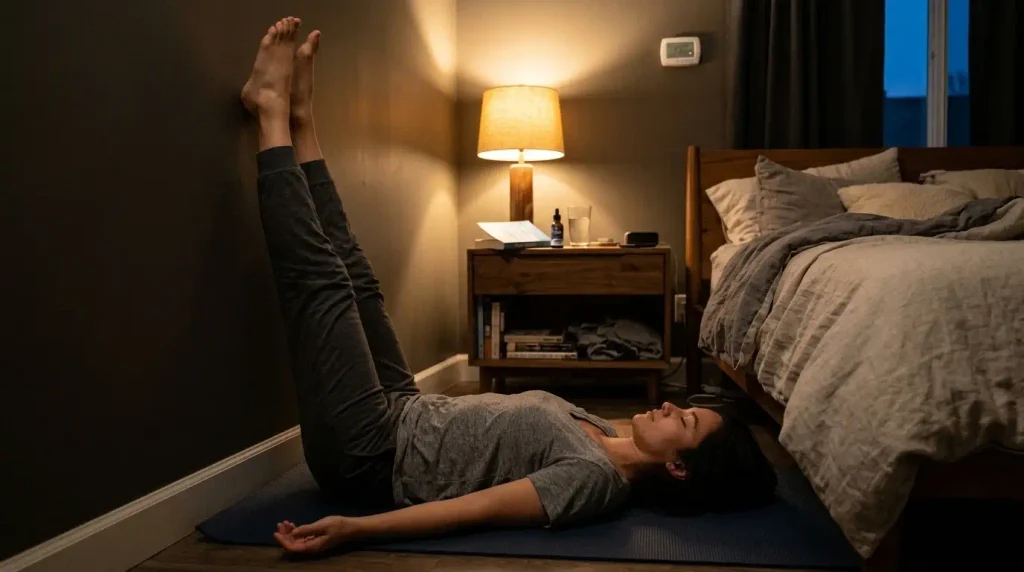
2. Legs-Up-The-Wall Pose (Viparita Karani)
This gentle, restorative yoga pose is a staple in my evening routines for clients who stand or train all day. It requires minimal effort but yields massive nervous system benefits.
- How to do it: Sit sideways with one hip touching a wall. Swing your legs up the wall as you lie back on the floor. Your sitting bones should be 6 to 12 inches (15 to 30 cm) away from the wall. Rest your arms by your sides, palms facing up.
- Duration: Hold for 5 to 10 minutes.
- Regression: If your hamstrings are tight, bend your knees slightly or place a rolled-up towel under your knees.
- Progression: Place a firm pillow or a yoga block (standard size 9 x 6 x 4 inches / 23 x 15 x 10 cm) under your hips for a gentle inversion.
- Why it works: It encourages venous blood return from the legs to the heart, reducing physical swelling and signaling a drop in heart rate and cortisol.
3. Progressive Muscle Relaxation (PMR)
PMR is a clinically proven technique to release physical tension that you might not even realize you are holding, particularly in the jaw, shoulders, and lower back.
- How to do it: Lying in bed, tense a specific muscle group as hard as you comfortably can for 5 seconds. Then, suddenly release the tension and notice the feeling of relaxation for 10 seconds. Move systematically from your toes up to your face.
- Sequence: Feet → Calves → Thighs → Glutes → Abdomen → Chest → Hands → Forearms → Upper Arms → Shoulders → Neck → Face.
- Duration: About 10 to 15 minutes total.
- Why it works: It creates a stark contrast between tension and relaxation, training your brain to recognize and let go of physical stress, which directly lowers HPA axis activity.
4. Strategic Light Exposure Management
Light is the primary zeitgeber (time-giver) for your circadian rhythm. Blue light from phones and overhead LEDs tricks your brain into thinking it is still daytime, halting melatonin and keeping cortisol high.
- How to do it: Two hours before bed, dim your home’s overhead lights to about 10% brightness. Switch to warm-toned lamps (under 3000 Kelvin).
- Device rule: Enable “night shift” or blue-light-blocking modes on all screens 90 minutes before bed. Better yet, stop using screens entirely 60 minutes before sleep.
- Why it works: Protecting your eyes from short-wavelength blue light allows the pineal gland to begin its natural melatonin secretion, which inversely correlates with cortisol levels.
5. Gentle Evening Stretching
High-intensity workouts within three hours of bedtime can elevate core body temperature and cortisol. Instead, opt for slow, mindful movement.
- Child’s Pose: Kneel on the floor, touch your big toes together, and sit on your heels. Separate your knees about hip-width apart (roughly 12 inches / 30 cm). Exhale and lay your torso down between your thighs, reaching your arms forward. Hold for 1 to 2 minutes.
- Cat-Cow Stretch: On hands and knees, inhale to drop your belly and lift your gaze (Cow). Exhale to round your spine, tucking your chin (Cat).
- Sets/Reps: 8 to 10 slow, controlled repetitions of Cat-Cow, matching the movement to your breath.
- Why it works: Gentle stretching relieves muscular stiffness from the day without spiking heart rate or adrenaline, promoting a calm transition to sleep.

6. The 10-Hour Caffeine Cutoff
Caffeine is an adenosine receptor antagonist. It blocks the chemical that makes you feel tired, and it has a half-life of about 5 to 6 hours. If you drink a 16 oz (473 ml) coffee at 4:00 PM, a quarter of that caffeine is still active in your system at 10:00 PM.
- How to do it: Set a hard cutoff for all caffeine (coffee, tea, pre-workout, dark chocolate) at least 10 hours before your target bedtime.
- Why it works: This ensures your adenosine levels can naturally build up, allowing cortisol to drop and sleep pressure to take over. If you struggle with control appetite naturally without stimulants, replacing evening tea with caffeine-free herbal options like chamomile or magnesium-rich blends is a smart swap.
7. Thermoregulation via a Warm Bath or Shower
Your core body temperature needs to drop by about 1 to 2 degrees Fahrenheit (0.5 to 1 degree Celsius) to initiate sleep.
- How to do it: Take a warm bath or shower (around 104°F to 109°F / 40°C to 43°C) about 90 minutes before bed.
- Why it works: The warm water dilates your blood vessels (vasodilation). When you step out into a cooler room, heat rapidly escapes from your skin, causing a swift drop in core body temperature. This temperature drop is a powerful biological signal for melatonin release and cortisol reduction.

8. The “Brain Dump” Journaling Technique
Cognitive arousal—worrying about tomorrow’s to-do list—is a massive driver of nighttime cortisol. Getting thoughts out of your head and onto paper neutralizes their urgency.
- How to do it: Keep a notebook and pen on your nightstand. Spend 5 minutes writing down everything you need to do tomorrow, any worries you have, or three things that went well today.
- Why it works: This practice, often called cognitive offloading, tells your brain, “It is written down. I do not need to actively remember or solve this right now.” It reduces psychological stress and quiets the mind.
9. Strategic Evening Nutrition
Eating a massive, heavy meal right before bed forces your digestive system to work overtime, raising your core temperature and heart rate. Conversely, going to bed starving can trigger a cortisol spike as your body searches for glucose.
- How to do it: Finish your last large meal 2 to 3 hours before bed. If you are hungry closer to bedtime, opt for a small, easily digestible snack containing protein and fiber. Examples: a small apple with 1 tablespoon of almond butter, or a half-cup of cottage cheese.
- Why it works: This stabilizes blood sugar levels throughout the night, preventing nocturnal hypoglycemia, which is a known trigger for adrenaline and cortisol release. Supporting your body this way is a key part of learning to support metabolism naturally without disrupting rest.
10. Consistent Sleep-Wake Schedule
Your HPA axis thrives on predictability. Going to bed and waking up at the same time every day (even on weekends) anchors your circadian rhythm.
- How to do it: Choose a bedtime and wake time that allow for 7 to 9 hours of sleep. Stick to this window within a 30-minute margin of error, seven days a week.
- Why it works: Consistency trains your body to anticipate sleep, naturally initiating the pre-sleep decline in cortisol and the rise in melatonin at the exact same time each night.
Your Action Plan: How to Lower Cortisol at Night for Better Sleep
You do not need to implement all ten strategies on night one. That itself is stressful. Instead, build a 45-minute wind-down routine. Here is a sample schedule you can adapt:
| Time Before Bed | Action | Purpose |
| 90 Minutes | Dim overhead lights, turn on warm lamps. Stop screen time. | Trigger melatonin production. |
| 60 Minutes | Take a warm shower or bath. | Initiate core body temperature drop. |
| 45 Minutes | Write a 5-minute “brain dump” journal entry. | Offload cognitive stress and worries. |
| 30 Minutes | Perform 10 minutes of Legs-Up-The-Wall and Child’s Pose. | Activate parasympathetic nervous system. |
| 15 Minutes | Get into bed and complete 4 to 8 cycles of 4-7-8 breathing. | Lower heart rate and prepare for sleep onset. |
For women over 40 or those managing high-stress jobs, this routine is non-negotiable for recovery. If you are also focusing on fitness, remember that proper recovery is when your body actually builds muscle and regulates hormones. This is especially true if you are trying to increase metabolism naturally after 40, as poor sleep directly sabotages metabolic health.
Safety Tips and Who Should Be Careful
While these techniques are generally safe for most people, a few precautions apply:
- Injuries or Joint Pain: If Legs-Up-The-Wall causes lower back or hamstring pain, use the regression (bent knees) or skip it entirely in favor of seated breathing exercises. Never push through sharp pain.
- Pregnancy: Pregnant individuals should avoid lying flat on their backs for extended periods after the first trimester. Opt for side-lying breathing exercises or seated stretches instead.
- Dizziness: When coming out of Legs-Up-The-Wall or any floor stretch, roll to your side and sit up slowly to prevent orthostatic hypotension (a sudden drop in blood pressure).
- Chronic Insomnia or Anxiety: If you consistently struggle with severe insomnia, panic attacks at night, or suspect HPA axis dysregulation, consult a healthcare provider.
Note: Chronic stress and poor sleep can have wide-ranging effects on overall health, making professional guidance valuable if lifestyle tweaks are not enough.
Frequently Asked Questions (FAQ)
1. Can high cortisol cause insomnia?
Yes. Elevated cortisol at night directly opposes melatonin, the hormone responsible for sleepiness. When cortisol remains high, your brain stays in a state of hyperarousal, making it difficult to fall asleep or stay asleep, leading to insomnia.
2. What time does cortisol naturally peak?
Cortisol naturally peaks in the early morning, typically 30 to 45 minutes after you wake up. This is known as the Cortisol Awakening Response (CAR), and it helps provide the energy you need to start your day.
3. Does magnesium help lower cortisol at night?
Research suggests magnesium may support nervous system relaxation and improve sleep quality. It plays a role in regulating neurotransmitters and the HPA axis. However, it should complement, not replace, good sleep hygiene practices.
4. How long before bed should I stop working out?
For most people, finishing moderate to high-intensity exercise at least 2 to 3 hours before bedtime is recommended. This allows core body temperature, heart rate, and cortisol levels to return to baseline before you try to sleep.
5. Can adaptogens help lower cortisol at night?
Some adaptogenic herbs, like ashwagandha, have shown promise in clinical studies for reducing perceived stress and lowering serum cortisol levels. Always consult a doctor before starting supplements, and review research on adaptogens for cortisol management to make informed choices.
6. Will drinking green tea at night ruin my sleep?
It might. While green tea has less caffeine than coffee, it still contains enough to disrupt sleep in sensitive individuals. Furthermore, some studies explore green tea extract and metabolism, but its caffeine content makes it a poor choice for an evening wind-down drink. Opt for caffeine-free herbal teas instead.
Conclusion
Mastering how to lower cortisol at night for better sleep is not about adding more stress to your life with rigid rules. It is about sending consistent, gentle signals to your nervous system that the day is over and it is safe to rest. By incorporating simple practices like diaphragmatic breathing, light management, and gentle stretching, you can take control of your evening routine.
Remember that sleep is the foundation of your fitness, metabolic health, and overall well-being. Start with one or two changes from this guide tonight, and gradually build a routine that works for your body. If you want to explore further, learning how to boost metabolic flexibility also pairs perfectly with a well-rested, low-stress physiology. Prioritize your rest, and your daytime performance will naturally follow.