Best Prebiotic Fiber Supplements for IBS and Digestive Discomfort: A Coach’s Buying Guide
If you deal with bloating, irregular bowels, or that uncomfortable “something’s off” feeling after meals, you already know how frustrating it is to try a new fiber supplement and end up with more gas than before. IBS makes this harder because the fibers that work beautifully for one person can trigger cramping in another. The right best prebiotic fiber supplements for IBS and digestive discomfort aren’t just about adding bulk to your stool. They’re about feeding your gut bacteria gently, without flooding your colon with fermentable sugars that spike gas production.
In my coaching practice, I talk to clients every week who want to “just add more fiber” but get worse. The fix is usually picking the right type of fiber at the right dose, introduced slowly. This guide walks you through the most well-tolerated prebiotic fiber options, how to read the label, and how to build a fiber routine that supports your gut without making symptoms flare.
Quick Answer: The most IBS-friendly prebiotic fiber supplements use partially hydrolyzed guar gum (PHGG), psyllium husk, or methylcellulose because they ferment slowly and produce less gas than inulin or FOS. Top picks: FiberCon (PHGG) for IBS-C, Metamucil Original (psyllium) for general regularity, and Citracel (methylcellulose) for IBS-D. Start at half the label dose and increase over 2–3 weeks.
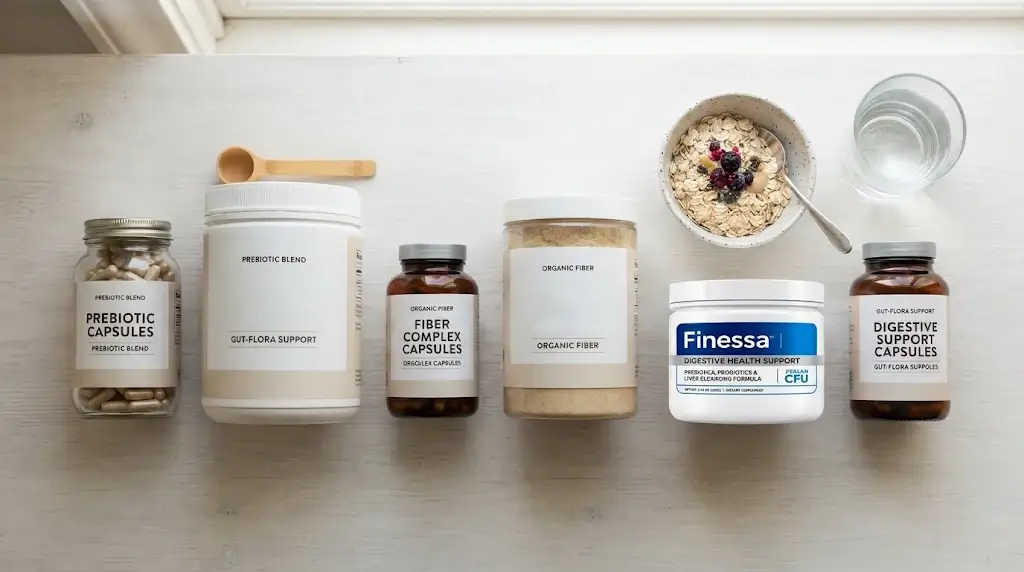
Comparison Table at a Glance
| Product | Primary Fiber | Form | Best For | Price Range |
| FiberCon | PHGG (guar gum) | Capsules | IBS-C, sensitive stomach | $[VERIFY] |
| Metamucil Original | Psyllium husk | Powder / capsules | General regularity, IBS-C | $[VERIFY] |
| Citracel | Methylcellulose | Powder / capsules | IBS-D, mild bulk | $[VERIFY] |
| Benefiber | Wheat dextrin | Powder / chewable | Mild fiber boost, picky palates | $[VERIFY] |
| Solafibe | PHGG (guar gum) | Powder | IBS-C, athletes needing quick mix | $[VERIFY] |
| Garden of Life Prebiotic Fiber | Acacia fiber | Powder | Whole-food approach, IBS-D | $[VERIFY] |
| NOW Foods Inulin | Inulin (chicory root) | Capsules / powder | Non-IBS gut support, advanced users | $[VERIFY] |
| Metamucil Advance | Psyllium + simethicone | Powder / capsules | IBS with gas/bloating | $[VERIFY] |
Prices vary by retailer and package size. Check current pricing before purchase.
1. FiberCon (Partially Hydrolyzed Guar Gum)
Who it’s for: People with IBS-C (constipation-predominant) or a very sensitive stomach who react badly to inulin or psyllium.
Key features:
- PHGG is a soluble fiber that dissolves in water and forms a gel, adding bulk without heavy fermentation.
- Available in capsule form (typically 500 mg per capsule), making dosing easy.
- No added sugars, flavors, or fillers in the standard formula.
Pros:
- Slowly fermented, so less gas than inulin or FOS.
- Gentle on the colon lining; often recommended in IBS dietary guidance.
- Capsule format avoids the “gulp a powder” step.
Cons:
- You need multiple capsules per day to hit a meaningful fiber dose.
- Less well-known than Metamucil, so not every pharmacy stocks it.
Coach’s Tip: If you’re new to fiber, start with one capsule a day with a full 8 oz (240 ml) glass of water. After 10–14 days, add a second capsule. Track your bowel pattern in a simple note on your phone—time of day, consistency, any bloating. You’ll spot patterns faster than you think.
2. Metamucil Original (Psyllium Husk)
Who it’s for: Anyone who needs reliable daily bulk and is managing IBS-C or general irregularity. It’s the “default” fiber most gastroenterologists mention first.
Key features:
- 100% psyllium husk (Plantago ovata), a soluble, viscous fiber.
- Available as flavorless powder (stir into water or juice) and as capsules.
- Each serving (one packet) provides roughly 3–5 g of fiber [VERIFY exact grams per serving].
Pros:
- Decades of safety data; one of the most studied bulk-forming agents.
- Helps slow gastric emptying slightly, which can smooth out IBS-D urgency.
- Flavorless powder mixes into smoothies, yogurt, or applesauce.
Cons:
- Must be mixed and drunk immediately, or it thickens into a gel that’s hard to swallow.
- Some IBS patients report mild bloating in the first week.
- Powder form can be gritty if you don’t stir well.
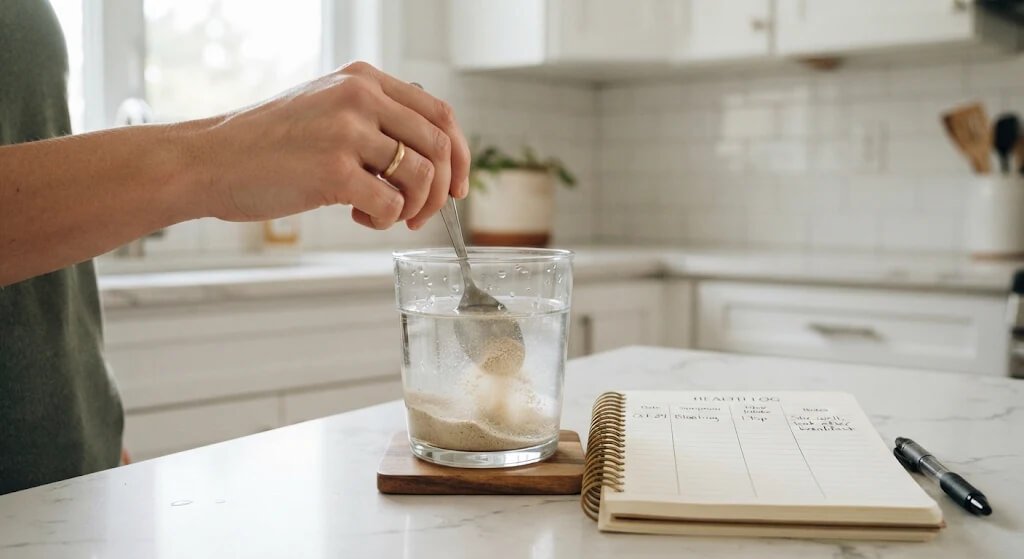
Common Mistake: Pouring the powder into a small amount of water and trying to drink it before stirring. You’ll get a thick, sticky glob stuck in your throat. Always pour water (or juice) into the cup first, then add the powder, then stir for 10–15 seconds. Drink within 5 minutes.
3. Citracel (Methylcellulose)
Who it’s for: People with IBS-D (diarrhea-predominant) who need gentle bulk without the gel-forming stickiness of psyllium.
Key features:
- Methylcellulose is a synthetic soluble fiber that adds bulk but doesn’t form as thick a gel.
- Available as powder (stir into water) and capsules.
- No caloric contribution; not fermented significantly by gut bacteria.
Pros:
- Less fermentable than psyllium or inulin, so less gas.
- Can help firm up loose stools without causing constipation.
- Good option if psyllium makes you feel “stuck.”
Cons:
- Less studied than psyllium for long-term IBS management.
- Not as effective at slowing transit time as psyllium.
- Slightly less available in some stores.
4. Benefiber (Wheat Dextrin)
Who it’s for: People who want a very mild fiber boost and hate the taste or texture of traditional fiber powders.
Key features:
- Wheat dextrin is a soluble fiber that’s minimally fermented.
- Comes as a clear, flavorless powder that dissolves in almost any liquid, plus chewable tablets.
- Each serving provides about 3 g of fiber [VERIFY].
Pros:
- Virtually tasteless; dissolves in coffee, tea, or water without grit.
- Low fermentation means less gas than inulin or FOS.
- Chewable option is handy for travel or gym bags.
Cons:
- Lower fiber per serving than psyllium or PHGG products.
- You may need 2–3 servings to reach a meaningful daily fiber dose.
- Wheat-derived (generally safe for celiac, but check the label if you have a wheat sensitivity).
5. Solafibe (Partially Hydrolyzed Guar Gum)
Who it’s for: Athletes and active clients who want a quick-mix PHGG powder to add to their post-workout shake or morning smoothie.
Key features:
- PHGG in powder form (typically 5 g per scoop) [VERIFY scoop size].
- Flavorless, mixes easily in water, juice, or protein shakes.
- No added sweeteners or artificial flavors.
Pros:
- Higher fiber per serving than capsule-based PHGG.
- Mixes cleanly without clumping.
- Convenient for people who already make a daily smoothie.
Cons:
- Powder form means you need a shaker cup or blender.
- Less widely available than Metamucil or Citracel.
- Cost per gram of fiber can be higher than bulk psyllium.
6. Garden of Life Prebiotic Fiber (Acacia Fiber)
Who it’s for: People who prefer a whole-food, minimally processed fiber source and want a prebiotic that’s gentle on IBS-D.
Key features:
- Acacia fiber (from Vachellia nilotica) is a soluble fiber with low fermentability.
- Powder form, typically 5 g per serving [VERIFY].
- No added sugars, gluten, or dairy.
Pros:
- Acacia is one of the least fermentable prebiotic fibers, making it a good fit for IBS-D.
- Whole-food sourcing appeals to clients who avoid synthetic ingredients.
- Can be added to oatmeal, yogurt, or smoothies.
Cons:
- More expensive per gram of fiber than psyllium or wheat dextrin.
- Slightly grainy texture in liquids.
- Less clinical data specifically for IBS compared to psyllium or PHGG.
7. NOW Foods Inulin (Chicory Root)
Who it’s for: People who do not have active IBS flare-ups and want a more potent prebiotic to feed Bifidobacterium and Lactobacillus. Not recommended during an IBS flare.
Key features:
- 100% inulin from chicory root, a highly fermentable prebiotic.
- Available in capsules (typically 500 mg) and bulk powder.
- No fillers, binders, or artificial ingredients.
Pros:
- Strong prebiotic effect; well-studied for increasing beneficial bacteria.
- Inexpensive per serving.
- Easy to add to coffee, smoothies, or baking.
Cons:
- High fermentability means significant gas, bloating, and cramping in IBS patients.
- Can worsen IBS-D and IBS-M symptoms.
- Not a good “first fiber” for anyone with a sensitive gut.
Important: If you have active IBS symptoms (bloating, cramping, altered bowel habits more than 3 days a week), skip inulin and FOS. They are high-FODMAP fibers and can trigger symptoms. Stick with PHGG, psyllium, methylcellulose, or acacia until your gut calms down.
8. Metamucil Advance (Psyllium + Simethicone)
Who it’s for: IBS patients whose main complaint is gas and bloating on top of irregularity.
Key features:
- Combines psyllium husk with simethicone (a gas-relief agent that breaks up gas bubbles).
- Available in powder and capsule form.
- Each serving provides psyllium fiber plus 75 mg simethicone [VERIFY].
Pros:
- Addresses two problems at once: bulk and gas.
- Simethicone is not absorbed; it works locally in the gut.
- Convenient if you don’t want to take a separate gas-relief tablet.
Cons:
- Simethicone doesn’t prevent gas; it just makes existing bubbles smaller and easier to pass.
- Slightly more expensive than plain Metamucil.
- If your bloating is from food intolerances (lactose, fructose) rather than fermentation, this won’t solve the root cause.
How to Choose: Buyer’s Checklist
Before you buy, run through this list. I use it with clients every time they ask, “Which fiber should I get?”
- What type of IBS do you have? IBS-C → psyllium or PHGG. IBS-D → methylcellulose, acacia, or PHGG. IBS-M → start with PHGG or acacia and adjust.
- Do you react to inulin or FOS? If yes, avoid chicory root and fructooligosaccharide products entirely.
- Capsules or powder? Capsules are easier to dose and travel with. Powder is cheaper per gram and easier to mix into a smoothie.
- Daily fiber gap. Most adults need 25–35 g of fiber per day, according to NIH/NIDDK dietary guidelines. If you’re getting 15 g from food, you need 10–20 g more. Don’t over-supplement.
- Budget. Psyllium and methylcellulose are the most affordable. PHGG and acacia cost more per gram.
- Allergies and sensitivities. Check for wheat, dairy, soy, or gluten in the label.
- Medication interactions. Fiber can reduce absorption of certain medications (thyroid meds, lithium, some antibiotics). Take fiber at least 1–2 hours away from meds.
How We Picked These Products
I evaluated each option against five criteria:
- Fermentability / gas potential: Lower is better for IBS. PHGG, methylcellulose, and acacia score lowest. Inulin and FOS score highest.
- Safety and evidence base: Products with decades of human safety data (psyllium, methylcellulose) rank higher than newer fibers with limited IBS-specific trials.
- Form and convenience: Capsules, powders, and chewables all have a place. I prioritized products available in at least two forms.
- Ingredient simplicity: Fewer additives, no artificial sweeteners, no unnecessary fillers.
- Accessibility and price range: Products available at major pharmacies, grocery stores, or mainstream online retailers.
I did not include products that make specific IBS “cure” claims or that combine fiber with untested proprietary blends. If a label says “clinically proven to eliminate IBS,” walk away.
Tips for Using Prebiotic Fiber with IBS
Think of fiber like a new exercise. You wouldn’t walk into the gym and deadlift 315 lb (143 kg) on day one. You ramp up.
Week 1: Take half the label dose. Example: if the label says 5 g, take 2.5 g. Use with a full glass of water (8 oz / 240 ml minimum).
Week 2: Increase to 75% of the label dose. Add a second glass of water with the dose.
Week 3: Move to the full label dose if you’re not experiencing new bloating, cramping, or urgency.
Ongoing:
- Take fiber at the same time each day (I usually tell clients to pair it with breakfast so it becomes a habit).
- Drink at least 64 oz (1.9 L) of water throughout the day. Fiber without water makes constipation worse.
- Pair your fiber supplement with a balanced diet that includes whole grains, vegetables, and lean protein rather than relying on the supplement as your only fiber source.
- If you’re also taking probiotics, look at how probiotics and prebiotics work together to support the gut microbiome.
- Track symptoms for 3–4 weeks before deciding a product “doesn’t work.” Fiber effects build gradually.
Coach’s Tip: If you’re an athlete or lift weights, take your fiber supplement at least 90 minutes before training. A full stomach with a gel-forming fiber can cause cramping during heavy sets or sprint intervals. I have clients who discovered their “random” mid-set cramps were from a fiber powder they’d taken 20 minutes before a leg day.
Who Should Be Cautious
- IBS-D with active diarrhea: High-dose psyllium can slow things down too much. Start with methylcellulose or acacia at a low dose.
- History of bowel obstruction or strictures: Do not take bulk-forming fiber without a doctor’s clearance.
- Swallowing difficulties (dysphagia): Capsules or powders can be a choking risk. Ask your doctor or a speech-language pathologist first.
- Medications: Psyllium and other soluble fibers can bind to drugs like levothyroxine, lithium, metformin, and some antibiotics. Separate dosing by at least 2 hours.
- Pregnancy or postpartum: Check with your OB or midwife before starting any new supplement.
If your symptoms include blood in stool, unexplained weight loss, fever, or symptoms that wake you from sleep, see a doctor before self-treating with fiber. Those are not IBS.
FAQ
What is the best prebiotic fiber for IBS?
PHGG (partially hydrolyzed guar gum) and psyllium husk are the most well-tolerated options for IBS. PHGG is especially gentle for IBS-C, while psyllium works well for general regularity. Avoid inulin and FOS during active flares, as they are highly fermentable and can increase gas and cramping.
Can I take fiber supplements if I have IBS-D?
Yes, but choose carefully. Methylcellulose and acacia fiber are less fermentable and less likely to worsen diarrhea. Start at a low dose (half the label amount) and increase slowly. Psyllium can help firm loose stools, but some IBS-D patients find it makes them feel “stuck.” Listen to your gut.
How long until fiber supplements help IBS symptoms?
Most people notice a change in bowel pattern within 1–2 weeks of consistent daily use. Full adaptation of the gut microbiome to a new fiber source can take 3–4 weeks. If you see no improvement after 4 weeks, or if symptoms worsen, talk to your gastroenterologist.
Is psyllium safe for IBS?
Yes. Psyllium husk is one of the most studied and safest bulk-forming fibers. It’s recommended in ACG/AGA clinical guidelines for IBS management. The key is starting low, going slow, and drinking plenty of water. If you get bloating in the first week, reduce the dose.
Can inulin make IBS worse?
It can. Inulin and FOS are high-FODMAP, highly fermentable fibers. In IBS patients, they can increase gas, bloating, and abdominal pain. If you’re in an active IBS flare, skip inulin-based products. Once symptoms are well-managed, a very small dose (1–2 g) may be tolerated, but test carefully.
How much prebiotic fiber should I take for IBS?
Start with 2–5 g of a gentle fiber (PHGG, psyllium, or acacia) per day and increase by 1–2 g every 5–7 days until you reach your target (usually 10–20 g supplemental, on top of dietary fiber). Never jump to the full label dose on day one.
Conclusion
Finding the best prebiotic fiber supplements for IBS and digestive discomfort comes down to matching the fiber type to your specific symptoms, starting at a low dose, and giving your gut time to adapt. PHGG, psyllium, methylcellulose, and acacia fiber are your safest starting points. Inulin and FOS are powerful prebiotics but too aggressive for a sensitive colon.
You don’t need the most expensive bottle on the shelf. You need the right fiber, the right dose, and consistency. Pair your supplement with adequate water, a varied diet, and the stress-management and sleep habits we talk about in how sleep affects metabolism and weight management, and you’ll give your digestive system the best chance to settle down.
If you’re also working on overall gut and metabolic health, explore how soluble fiber supports fullness and satiety or how psyllium husk can help you feel full before meals. Small, consistent changes beat dramatic overhauls every time.