
Probiotics are everywhere: yogurt cups, gummies, capsules, even sparkling drinks. Many labels hint that gut bacteria can calm cravings or help you drop pounds. So do probiotics affect appetite and weight management, or is it mostly marketing?
The honest answer sits in the middle. Some well-run trials show small drops in weight, waist size, and belly fat. Others show little or nothing, and results change a lot by strain, dose, and study length.
In this guide, I’ll walk you through what the research shows, why results differ, and how to test probiotics fairly if you want to try them. You’ll also get a safety checklist and a simple 8-week plan that keeps the basics (food, sleep, and training) in charge. Probiotics are an add-on at best, not a shortcut.
Quick Answer
Probiotics may have a small effect on weight and waist size, but the evidence for appetite is mixed. Results depend on the strain, dose, and length of use. Pooled studies show average losses near 1 pound (0.5 kg). Probiotics are not a replacement for sleep, protein, fiber, and movement.
Talk to your doctor before starting any supplement, especially if you have a medical condition, take medication, or are pregnant.
First, What Are Probiotics, Prebiotics, and Synbiotics?
Probiotics are live microorganisms intended to have health benefits when you eat or take them, according to the National Center for Complementary and Integrative Health (NCCIH). You’ll find them in yogurt, other fermented foods, and supplements. The most common groups are Lactobacillus and Bifidobacterium, and some products use a yeast called Saccharomyces boulardii.
Prebiotics are different. They are nondigestible food components that selectively feed helpful microbes, and a synbiotic combines both in one product.
Here is the point most labels skip: different probiotics can have different effects. If one Lactobacillus strain helps with one problem, that doesn’t mean another Lactobacillus or any Bifidobacterium will do the same, as the NCCIH explains. “Probiotics” is a huge category, and a study on one strain can’t be applied to every product on the shelf.
How Might Probiotics Influence Appetite?
Your gut does more than digest food. It releases hormones that tell your brain whether you’re full. Two of them, GLP-1 and PYY, enhance satiety, probably by slowing how fast the stomach empties.
Researchers think probiotics might nudge this system through the compounds gut bacteria make. The benefits for appetite have been linked to short-chain fatty acids, which are produced when microbes ferment fiber and which may affect satiety signals in the brain and gut. Think of it as a message chain: bacteria make compounds, gut cells release hormones, and the brain gets a “we’ve eaten” signal.
Two other hormones come up often. Ghrelin is tied to hunger, and leptin is tied to body fat stores. A 2023 systematic review of clinical trials looked at how probiotics and synbiotics affect these appetite-related markers.
One caution: this chain is a proposed explanation, not proof that every product works this way in every person. Much of the mechanism work comes from lab and animal studies, and the human trials below are what matter for real life. If you want to see how everyday food choices fit into this picture, our guide on protein and fullness hormones is a good companion read.

Do Probiotics Affect Appetite and Weight Management? What the Evidence Says
Let’s separate three questions: Do probiotics change hunger? Do they change body weight? And does the strain matter? The answers differ, so I’ll take them one at a time.
Appetite and Hunger: Small Studies, Mixed Signals
The appetite research is promising but thin. In a small randomized, double-blind study of 16 healthy men, researchers compared four dairy drinks: a prebiotic (16 g of inulin), a probiotic (Lactobacillus paracasei 431), a combination, and a control. Energy intake at lunch was lowest after the prebiotic drink, then the probiotic, the combination, and the control. Over 24 hours, intake was also lower after the prebiotic and probiotic drinks than after the control.
Notice the detail that often gets lost. The plain prebiotic fiber drink did at least as well as the probiotic. That fits with what we cover in our guide on dietary fiber and appetite. With only 16 participants, though, nobody should build a diet plan on it.
Another trial followed 140 adults with obesity on a low-calorie diet for 10 weeks. They were split into four groups: regular yogurt, probiotic yogurt, vitamin D–fortified yogurt, and probiotic plus vitamin D yogurt. Fasting GLP-1 differed between groups after 10 weeks, and the paper’s title reports that probiotic yogurt and vitamin D–fortified yogurt increased it. Since vitamin D was part of the design, we can’t give all the credit to the bacteria.
The bigger picture is less tidy. A 2023 meta-analysis of 26 randomized trials (1,536 people) found that probiotics and synbiotics lowered leptin. It also found a slight increase in desire to eat (SMD 0.34, 95% CI 0.03 to 0.66). The leptin results also varied a lot between studies (I² = 69.4%), which means the trials didn’t agree closely.
So can we say probiotics reliably reduce appetite? Not yet. They may shift some hormone markers, but hunger itself didn’t clearly drop.

Body Weight and Waist Size: Small Average Changes
Weight is where most of the data sits, and the pattern is consistent: the effects are small and not always present.
An early 2015 meta-analysis pooled four randomized trials with 196 people and found no significant effect on body weight or BMI. It called for better-designed studies. Later reviews, with more trials, found small benefits:
A 2018 meta-analysis in adults with overweight or obesity found probiotics produced a larger reduction in body weight than placebo, by about 0.60 kg (1.3 lb). BMI and body fat percentage also dropped slightly. The authors described the effect sizes as small, and the change in fat mass was not significant.
A 2019 meta-analysis of 12 trials (821 adults) found a drop of about 0.55 kg (1.2 lb) in body weight. Waist circumference fell by about 1.2 cm (0.5 inch), and fat mass fell by about 0.91 kg (2.0 lb).
A 2021 meta-analysis found lower weight, BMI, and waist circumference in people with overweight or obesity. Changes in body fat appeared only in studies using at least 10 billion CFU and lasting at least 8 weeks.
A 2025 meta-analysis of 8 trials (412 patients with obesity) reported more weight loss and a larger drop in waist size with probiotics than with control.
Put simply, if probiotics help, the average gain is about a pound or so, plus a slightly smaller waist. That’s real but modest, and it’s far from the “melt belly fat” promises on some labels.
Strain Matters: The Lactobacillus gasseri Example
The best-known single-strain trial used Lactobacillus gasseri SBT2055 in fermented milk. In a double-blind, placebo-controlled trial of 87 adults with higher BMI and belly fat, people drank 200 g (about 7 oz) of fermented milk a day for 12 weeks.
Those who got the strain saw their visceral (deep belly) fat area fall by an average of 4.6% and their subcutaneous fat area fall by 3.3%. The control group did not change significantly. Fat area was measured by CT scan, which makes it a solid measurement.
Two cautions apply. It was one strain in one product, so it doesn’t prove that every yogurt or capsule does the same. Also, several authors worked for the dairy company behind the product, which is common in this field but worth knowing.
Evidence at a Glance
| Study | Who | What it found |
| Nutr Res 2015 | 4 trials, 196 people | No significant effect on weight or BMI |
| Obes Rev 2018 | Adults with overweight or obesity | About 0.60 kg (1.3 lb) more weight loss than placebo; small effects |
| Evid Based Complement Alternat Med 2019 | 12 trials, 821 adults | About 1.2 lb weight loss; waist down about 0.5 inch (1.2 cm) |
| Clin Nutr 2021 | Overweight or obesity | Lower weight, BMI, waist; body fat changes only with higher doses and 8+ weeks |
| Sci Rep 2025 | 8 trials, 412 patients with obesity | More weight loss and smaller waist than control |
| Pharmacol Res 2023 | 26 trials, 1,536 people | Lower leptin; slight rise in desire to eat |
| Appetite 2022 | 16 healthy men | Lower 24-hour intake after probiotic or prebiotic drink vs control |
| Eur J Clin Nutr 2010 | 87 adults | Visceral fat area down 4.6% in 12 weeks with one strain |
Why Do Results Differ So Much?
If the trials all studied “probiotics,” why don’t they agree? Because “probiotics” isn’t one thing. Here are the main reasons.
Strain. As noted above, the NCCIH says one strain’s effects don’t automatically carry over to another. Studies that lump many strains together can hide a real effect or create a false one.
Dose and length. The 2021 review tied body fat changes to higher doses and at least 8 weeks of use. A short trial of a low dose may simply miss an effect.
Study quality. Small trials, short follow-up, and mixed products all add noise. The NCCIH notes that for most conditions we still don’t know which probiotics help, how much to take, or who benefits most.
For a wider look at how supplements fit into long-term results, see our guide on long-term weight management supplements.
Do Probiotics Affect Appetite and Weight Management in Real Life? How to Test Them Fairly
If you’re curious, treat probiotics like an experiment, not a promise. A fair test is cheap, safe for most healthy adults, and gives you real data on your own body. Here’s how I’d set it up as a coach.
Start With Food
Fermented foods are the simplest place to begin. Yogurt is one of the foods where probiotics are commonly found, and the L. gasseri trial used 7 oz (200 g) of fermented milk a day. Look for plain yogurt with “live and active cultures” on the label, and skip the ones loaded with added sugar.
Be honest with yourself about what this proves. Regular yogurt has not been shown to do what that specific strain did. You’re testing, not treating.
Fiber is the other half of the food story, since prebiotics are the “food” for helpful microbes. Oats, beans, fruit, and vegetables all count, and so does a fiber source such as psyllium husk. Add fiber slowly and drink water as you go.
If You Choose a Supplement
Supplements are harder to judge. Many probiotics are sold as dietary supplements, which don’t need FDA approval before they’re marketed, and some products have been found to contain organisms other than those listed on the label. So read labels like a skeptic.
Use this checklist:
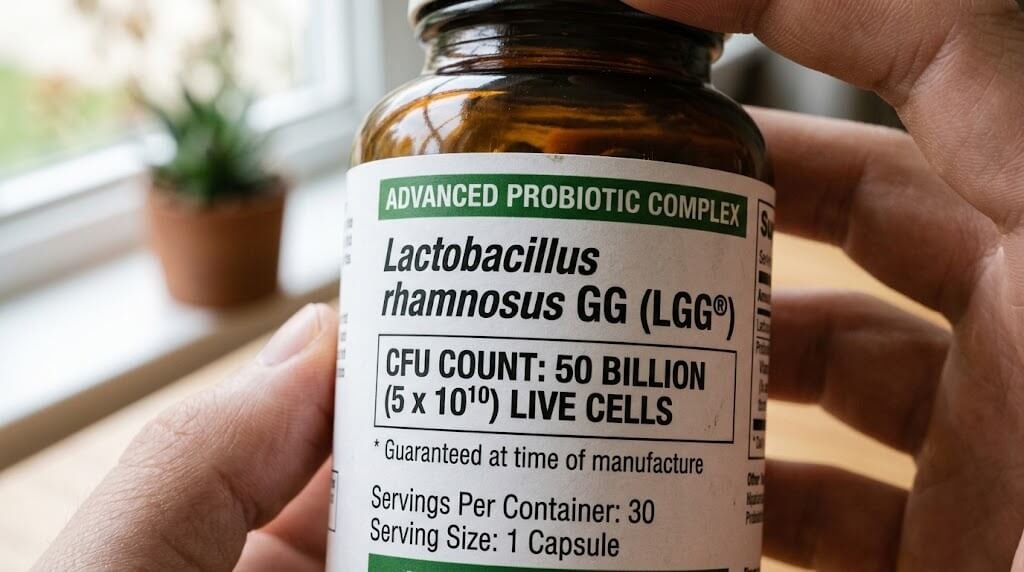
- Full strain name. Look for genus, species, and strain (for example, Lactobacillus gasseri SBT2055), not just “probiotic blend.”
- CFU count. The number of live organisms per serving should be listed clearly.
- Clear serving size. Avoid vague “proprietary blends” that hide amounts.
- Storage instructions. Some products need refrigeration, so follow them.
- Third-party testing. Look for a testing seal from an independent lab.
- No big claims. Be wary of “burns belly fat” or “melts pounds” language.
Our guide on how to evaluate supplement ingredients goes deeper on reading labels.
Coach’s Tip
Change one thing at a time. If you start a probiotic, a new diet, and a new workout plan in the same week, you’ll never know which one moved the needle. Keep everything else steady for the first 8 weeks.
An 8-Week Self-Test Plan
Studies that found body fat changes ran at least 8 weeks, so give any trial that long.
| When | What you do | What you track |
| Week 0 (baseline) | Don’t start yet. Measure your waist at the navel in inches (cm), weigh yourself in the morning in lb (kg), and rate hunger 1–10 before lunch and dinner | Write down all numbers |
| Weeks 1–2 | Keep eating and training as usual. Add one probiotic option: either a daily serving of plain live-culture yogurt (about 7 oz / 200 g) or one supplement, not both | Weekly waist and weight; hunger score 3 days a week |
| Weeks 3–7 | Change nothing else | Same measures once a week |
| Week 8 | Compare with baseline | Is the change bigger than normal ups and downs? |
Weight swings day to day, so look at the trend over weeks, not a single reading. If your numbers moved by less than your usual swing, there’s no clear sign the product did anything for you.
Easier version: Skip the hunger scores and track only waist size once every two weeks.
Harder version: Run the test for 12 weeks, add a simple food log, and take a progress photo every 4 weeks.

Common Mistake
Judging the product after two weeks. Studies that found body fat changes ran at least 8 weeks. Quitting early, or switching products every few days, makes it impossible to tell what’s working.
Keep the Basics in Charge
Whatever you decide about probiotics, the big levers stay the same. Protein, fiber, sleep, and movement do the heavy lifting for most people. Our guides cover protein and hunger control and how sleep affects metabolism in detail.
Safety Notes: Who Should Talk to a Doctor First
For most healthy adults, probiotics have an extensive history of apparently safe use. But the NCCIH also points out that few studies have looked closely at safety, so we lack solid data on how often side effects occur and how serious they are.
Here is who should be especially careful:
- People with severe illness or weakened immune systems. The risk of harm is greater in these groups, and anyone with a serious underlying condition should be monitored closely.
- Premature infants. Severe and sometimes fatal infections have been reported, and the FDA has warned health care providers about this risk.
- Anyone on medication or managing a medical condition. Check with your doctor or pharmacist before adding a supplement.
- Pregnant or breastfeeding women. Ask your health care provider first.
Possible harms listed by the NCCIH include infections, harmful substances produced by the microorganisms, and the transfer of antibiotic resistance genes. The agency also advises that you don’t use probiotics as a reason to delay seeing your health care provider about any health problem. If a product causes stomach pain, fever, or anything that worries you, stop it and call your provider.
Related Tips for Realistic Expectations
Measure more than the scale. Studies of probiotics tracked waist size and body fat, not just weight. Your tape measure and how your clothes fit may tell you more than the scale.
Don’t chase every new strain. Switching products constantly resets your test. Pick one, run the 8 weeks, and decide.
Know what else moves your weight. Hormones, sleep, stress, muscle mass, and age all play a role, and our guide on what affects body weight breaks down the big ones.
Be wary of marketing. The average effect in the trials is about a pound. If a label promises more, ask where the data is.
Save your money for the basics. A good pair of shoes, quality protein, and enough sleep will likely do more than any capsule.
FAQ
Do probiotics make you less hungry?
Not reliably. Some small trials found lower food intake after probiotic or prebiotic drinks, while a larger review found probiotics slightly raised desire to eat. Results depend on the strain and the person. Probiotics alone are not a proven appetite suppressant.
Can probiotics help you lose weight?
They may help a little. Pooled results from randomized trials show average losses near 1 pound (0.5 kg) and slightly smaller waists, though one earlier review found no significant effect. The gain is small and varies by strain, so treat probiotics as a minor add-on to diet and training.
How long do probiotics take to affect weight?
Body fat changes appeared only in studies lasting at least 8 weeks, and the one strain trial ran 12 weeks. Don’t expect quick shifts. If you try a product, track waist size and weight for 8 to 12 weeks, then decide whether it’s worth continuing.
What is the best probiotic strain for weight management?
No strain has been proven best. Lactobacillus gasseri SBT2055 showed lower belly fat in one 87-adult trial using fermented milk, but different strains act differently. Results from one product can’t be applied to another. Ask a doctor or dietitian before choosing a supplement.
Are probiotic supplements safe to take daily?
Probiotics have a long record of apparent safe use in healthy people, according to the NCCIH, but few studies looked closely at side effects. Risk is higher with severe illness or weak immunity, and some products contain organisms not on the label. Check with your doctor first.
Can probiotics replace diet and exercise for weight loss?
No. Average effects in trials are small, so a probiotic cannot do the main work. Pooled results sit near 1 pound (0.5 kg) over the study periods. Think of it as a possible small extra, while meals, sleep, strength training, and daily movement stay in charge.
Conclusion: So, Do Probiotics Affect Appetite and Weight Management?
Do probiotics affect appetite and weight management? The research says maybe, in a small way. Pooled trials show average weight changes of about a pound and slightly smaller waists, but one early review found no effect. Appetite results are even less clear, with some lower-intake findings and some signals pointing the other way.
What matters most is the strain, the dose, and how long you use it. The strongest single-strain result, L. gasseri SBT2055 in fermented milk, can’t be assumed to apply to the capsule on your pharmacy shelf.
If you want to try them, run a clean 8-week test, change one thing at a time, and read the label like a skeptic. Keep protein, fiber, sleep, and training as your foundation, and talk with your doctor before starting a supplement.