You can lose a set to a wandering mind. You miss your tempo, you lose count, and you forget which weight you just loaded. Focus is a trainable skill, and it also depends on what your brain has to work with.
That is why people ask how citicoline supports brain health and focus. Citicoline is a supplement form of a molecule your cells already make. It has a long history as a prescription drug in some countries and now sells as an over-the-counter supplement. The research is interesting but far from settled.
As a strength coach, I treat supplements as the last 1–2% of a plan. Sleep, food, and smart training come first. This guide explains what citicoline does in the body and what human trials found. It also covers doses, safety, and how to run a fair four-week test on yourself.
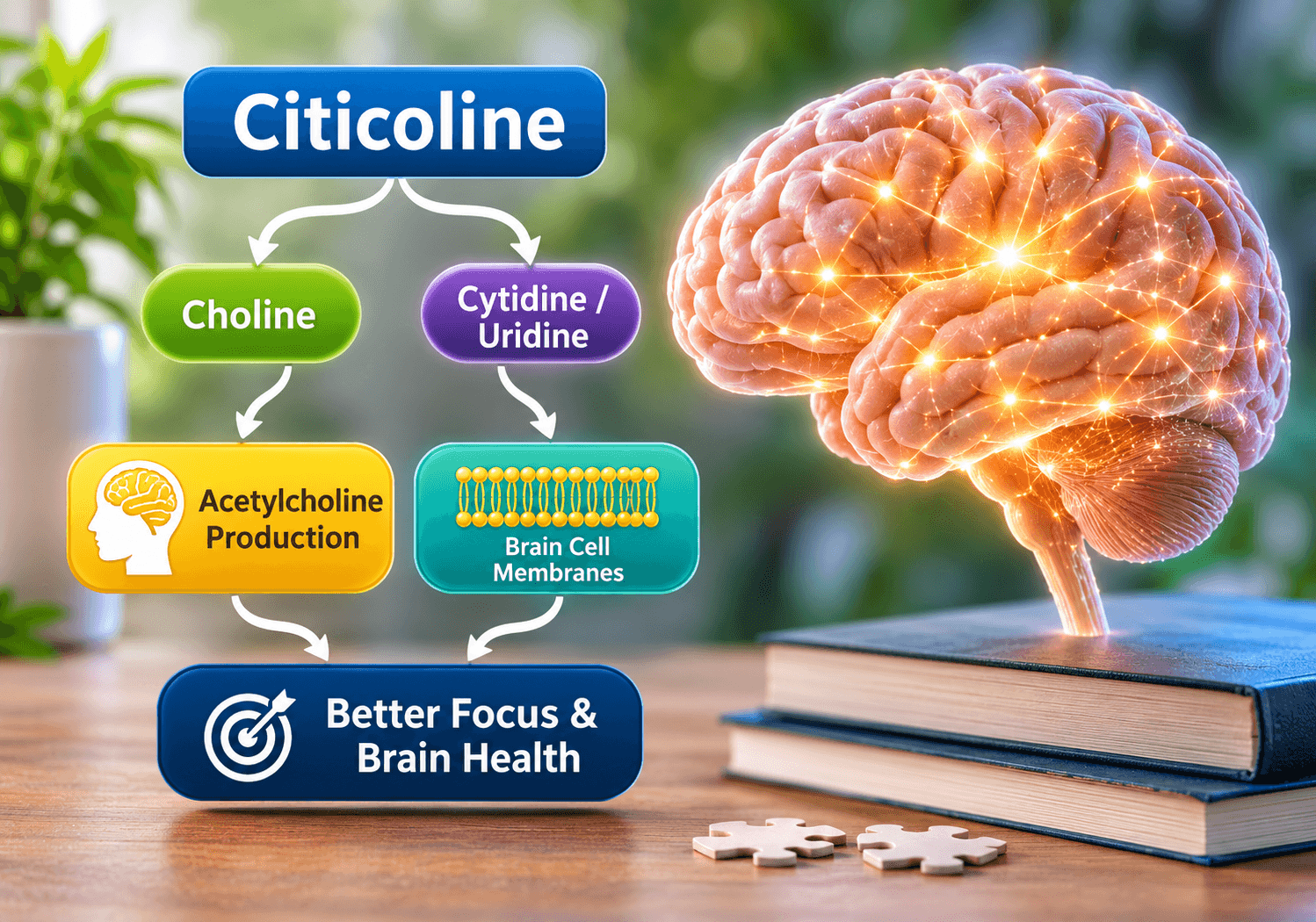
Quick Answer Citicoline breaks down into choline and cytidine, which your body uses to build acetylcholine, a memory and attention chemical, and to maintain brain cell membranes. Small trials using 250–500 mg daily link it to better attention and memory. The evidence is limited, and several key trials involve the manufacturer, so view it as possible support, not a proven fix.
How Citicoline Supports Brain Health and Focus: The Mechanism
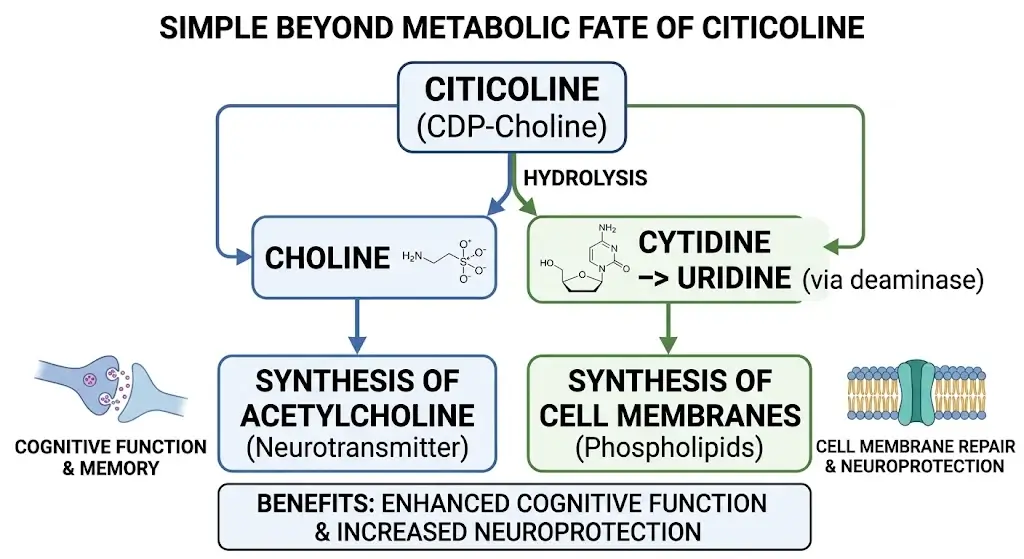
Citicoline is the supplement name for CDP-choline, a molecule found in tiny amounts inside every living cell. After you swallow it, it is well absorbed and quickly broken down into choline and cytidine (Świątkiewicz et al., 2023). In humans, cytidine is quickly converted to uridine. Choline and uridine then enter cells and join normal metabolic pathways.
Three jobs that matter for the brain
Acetylcholine production. Choline is a building block for acetylcholine, a neurotransmitter that is important for learning and memory (Świątkiewicz et al., 2023). Acetylcholine levels in the brain appear to decline with age. The logic behind citicoline is simple: if the brain has more raw material, it may make more of this chemical.
Membrane building. Choline and cytidine also feed the pathway that makes phosphatidylcholine. This fat is a major part of brain cell membranes and of myelin, the insulation around nerve fibers that speeds up signals (Świątkiewicz et al., 2023). Think of it as maintenance supplies for the wiring.
Possible effects on other brain chemicals. One small trial paper describes citicoline as stimulating acetylcholine production and activating tyrosine hydroxylase, an enzyme involved in dopamine release (Al-kuraishy and Al-Gareeb, 2020). Dopamine is tied to motivation and alertness. This mechanism is described as a possibility and is not firmly proven in healthy people.
What brain imaging suggests
In middle-aged adults, 500 mg of citicoline daily for six weeks was linked to a 7.3% rise in brain phosphodiesters, which the authors read as more phosphatidylcholine synthesis (Świątkiewicz et al., 2023). This is a lab marker, and it is not the same as feeling sharper. It does show that oral citicoline can change brain chemistry in measurable ways.
An honest caveat on the mechanism
A critical pharmacology review concluded that there is no adequate description of exactly how citicoline works. It noted that only a small share of a choline dose reaches the brain, and one MRS study found brain choline fell slightly in older adults after citicoline (Grieb, 2014). So the “more choline in, more acetylcholine out” story is a reasonable theory. It is not a certainty.
What Research Says About How Citicoline Supports Brain Health and Focus
Most human trials fall into three groups: attention in healthy younger people, memory in healthy older adults, and cognition in people with diagnosed brain conditions. Keep those groups separate, because results from one do not automatically apply to another.
Attention and speed in healthy people
A trial of 75 healthy adolescent males gave them 250 mg or 500 mg of citicoline, or placebo, for 28 days. The citicoline group improved on attention (p = 0.02) and psychomotor speed (p = 0.03) compared with placebo. Higher weight-adjusted doses were linked to lower impulsivity (McGlade et al., 2019). Several authors work for the manufacturer of the branded ingredient tested, which is worth knowing.
A separate two-week study of 40 healthy volunteers aged 21–22 gave 500 mg daily. It reported faster reaction times and better working memory scores than placebo, plus a lower blood marker of oxidative stress (Al-kuraishy and Al-Gareeb, 2020). The authors listed the small sample and short duration as limitations.
Memory in healthy older adults
In a 12-week trial, 100 healthy men and women aged 50–85 with age-associated memory impairment took 500 mg of citicoline daily or placebo. The citicoline group improved more on episodic memory (the memory of everyday events) and on a composite memory score (Nakazaki et al., 2021). Those were secondary outcomes, and the study team included manufacturer employees.
People with diagnosed brain conditions
A 2023 meta-analysis pooled six studies in people with mild cognitive impairment, Alzheimer’s disease, or post-stroke dementia. It found improved cognitive status, but the authors rated the overall quality of the studies as poor, with a risk of bias favoring the treatment (Bonvicini et al., 2023). That population differs from a healthy lifter who wants better focus.
Summary table
| Study | Who | Dose and length | Main finding | Key caveat |
| McGlade 2019 | 75 healthy adolescent males | 250 or 500 mg, 28 days | Better attention and psychomotor speed | Young males only; manufacturer-linked authors |
| Al-kuraishy 2020 | 40 healthy adults, age 21–22 | 500 mg, 2 weeks | Faster reactions, better working memory | Small and short |
| Nakazaki 2021 | 100 adults, age 50–85, with memory complaints | 500 mg, 12 weeks | Better episodic and composite memory | Secondary outcomes; manufacturer-linked |
| Bonvicini 2023 | Patients with MCI, Alzheimer’s, post-stroke dementia | Varied | Improved cognitive status | Poor overall study quality |
What the Evidence Does Not Show
A fair article has to include the limits. Here are the main ones.
Citicoline did not help in two large stroke and brain-injury trials. The COBRIT trial (1,213 patients with traumatic brain injury) and the ICTUS trial (2,298 patients with acute ischemic stroke) found no benefit (Grieb, 2014). Those are acute emergencies, not everyday focus. Still, they show that early promise does not always hold up.
General choline supplements have mixed results. The NIH notes that some studies link higher choline intake to better verbal and visual memory. It also notes that other studies found choline supplements did not improve cognition in healthy adults (NIH Office of Dietary Supplements). One review argues citicoline may work better than plain choline, but that remains a hypothesis (Synoradzki and Grieb, 2019).
Regulators have not approved a brain claim. In the European Union, no nutrition or health claim has been authorized for citicoline. The same review also notes that claims about choline and normal cognitive function were rejected for lack of established cause and effect (Synoradzki and Grieb, 2019).
Healthy-adult trials are few and small. There is no long-term data on lifters or athletes. Nothing here shows that citicoline improves lifting performance, and I would not claim it does.
Put simply, citicoline may modestly support attention and memory in some adults. It is not a stimulant, and it is not a replacement for sleep.
Citicoline vs. Choline From Food
Choline is an essential nutrient. Your brain and nervous system need it to regulate memory, mood, and muscle control, and your cells need it to build membranes (NIH Office of Dietary Supplements). Most of your choline comes from food, because you make only a small amount in the liver.
The NIH lists these daily amounts for adults: 550 mg for men and 425 mg for women. It also says most people in the United States get less than the recommended amount (NIH Office of Dietary Supplements).
Good food sources include meat, eggs, poultry, fish, and dairy. Potatoes, cruciferous vegetables like broccoli, beans, nuts, seeds, and whole grains also contribute (NIH Office of Dietary Supplements). Natural foods do not contain any significant amount of citicoline itself (Synoradzki and Grieb, 2019). That is why citicoline is sold as a supplement.
Coach’s Tip: Fix the food gap first. Two eggs at breakfast and a protein source at each meal already move you toward your choline target. If you are eating well and want to test citicoline anyway, you are working from a better baseline. For more on the nutrients behind steady energy, see this guide on nutrients that support energy metabolism.
Dose, Timing, and Form
Trial doses give the best guide. The adolescent study used 250 or 500 mg daily for 28 days (McGlade et al., 2019). The older-adult study used 500 mg daily for 12 weeks (Nakazaki et al., 2021). The recommended maximum for citicoline inner salt as a food supplement is 500 mg per day (Świątkiewicz et al., 2023).
Higher doses of 500–2,000 mg daily are used in clinical settings, mostly with medical supervision (Grieb, 2014). Do not copy those doses on your own.
I could not verify specific timing guidance, such as morning versus pre-workout dosing, from allowed sources, so I will not state one. A simple approach is to take it at the same time each day, with food if your stomach is sensitive. That keeps your test consistent.
Check the label for the exact form. “Citicoline” or “CDP-choline” should list the milligrams of citicoline per serving, not just a blend total. A product with a proprietary blend makes any dose comparison impossible. For a label-reading framework, see this guide on evaluating supplement ingredients.
How to Apply It: A 4-Week Focus Test
If you and your doctor agree a trial makes sense, run it like a coach would run a program. Change one thing, track it, and judge it on data and not on hype. Without tracking, expectation alone can make any supplement feel like it works.
Step-by-step test plan
- Get clearance first. Talk to your doctor or pharmacist, especially if you take medication or have a medical condition.
- Pick one product. Choose a single-ingredient citicoline supplement with a clear dose of 250–500 mg per serving. Avoid multi-ingredient “focus stacks” so you know what you are testing.
- Run a one-week baseline. Before starting, track your focus without any supplement. Use the log described below.
- Start at the low end. Begin with 250 mg daily and stay there for the first week. Move to 500 mg only if you tolerate it well and your doctor agrees.
- Keep everything else steady. Hold your sleep schedule, caffeine intake, and training plan as constant as you can for four weeks.
- Review at week four. Compare your log with the baseline. If you see no clear change, stop. That is a useful result too.
The focus log
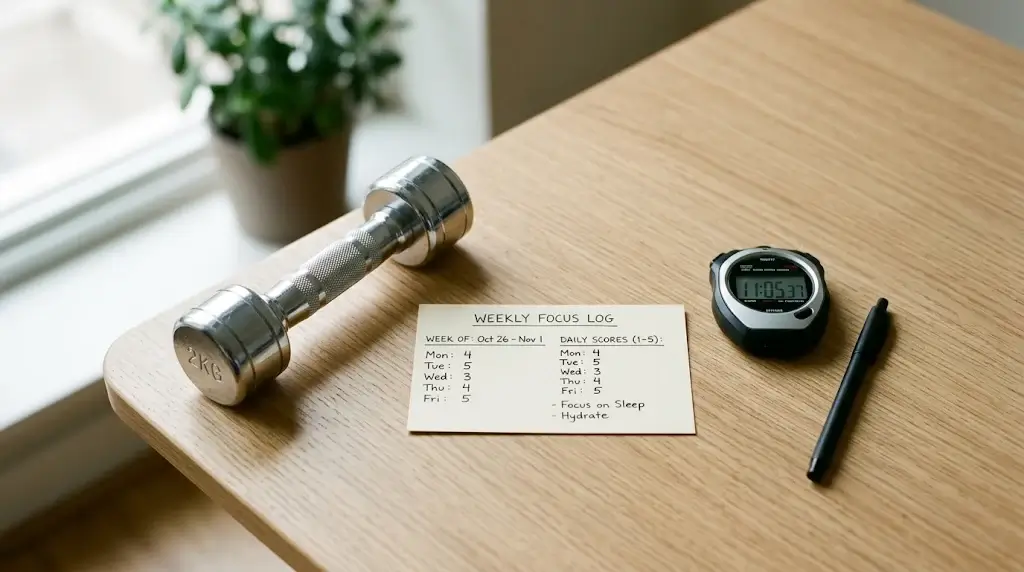
Use a 3 x 5 inch (7.6 x 12.7 cm) index card or a notes app. After each training session and each workday, record three things: a focus score from 1 to 5, the number of times you lost count or tempo, and any side effects.
For an objective check, use a tempo drill once a week. Do 3 sets of 8 goblet squats with a 20 lb (9 kg) dumbbell, lowering for 3 seconds and pausing 1 second at the bottom. Rest 90 seconds between sets. Count how many reps you rushed or lost count on. This is a personal tracking tool and not a clinical test.

Easier and harder versions of the test
Easier (regression): Track only the 1–5 focus score once a day for two weeks. No drills, no weights. It takes about 30 seconds per day.
Harder (progression): Add a second weekly measure, like a 5-minute timed attention task or a reaction-time app. Keep the same time of day, the same device, and the same room each week. Extend the test to eight weeks, which is closer to the 12-week length of the older-adult trial (Nakazaki et al., 2021).
Common Mistake: Changing three things at once. Many people start citicoline in the same week as a new pre-workout, a new training split, and a new sleep schedule. If they feel sharper, they have no idea why. Change only one variable at a time.
Safety Notes
Citicoline appears well tolerated in studies. A clinical pharmacology review reported only a few adverse events, mostly digestive upset after oral intake. It also noted that the overall rate of adverse effects was comparable between 1,652 treated and 686 placebo patients in a meta-analysis of trials (Grieb, 2014). In the 12-week trial in older adults, safety measures included body weight, blood pressure, and blood panels (Nakazaki et al., 2021).
That said, “well tolerated in trials” does not mean “safe for everyone.” Please speak with a doctor or pharmacist before trying citicoline if any of these apply:
- Kidney disease: The same review found no data on how liver or kidney insufficiency affects citicoline. It also suggested that a higher risk of high blood phosphate may be predicted in kidney failure (Grieb, 2014).
- Pregnancy or breastfeeding: I did not find safety data from the allowed sources, so ask your doctor.
- Dementia or memory medicines: Citicoline has been studied alongside cholinesterase inhibitors in patients (Synoradzki and Grieb, 2019). That is a decision for a clinician, not a self-experiment.
- Children and teens: The adolescent trial was a research setting. Do not give supplements to a child without a pediatrician’s guidance.
- Heart health concerns: The NIH notes that some research links high choline amounts to higher cardiovascular risk, and more research is needed (NIH Office of Dietary Supplements). One review suggests citicoline may be less prone than other choline forms to conversion into TMAO, a gut-bacteria byproduct, but calls this a hypothesis (Synoradzki and Grieb, 2019).
Also keep your total choline in perspective. The NIH upper limit for adults is 3,500 mg per day from all sources, and too much can cause fishy body odor, vomiting, heavy sweating, low blood pressure, and liver damage (NIH Office of Dietary Supplements). A 500 mg citicoline serving supplies much less choline than that, but food and other supplements add up.
Stop and call your doctor if you notice new headaches, stomach problems, dizziness, or anything that worries you.

Related Tips: Build Focus Before You Buy a Supplement
No capsule beats the basics. These habits cost little and have a bigger effect on how sharp you feel in the gym.
Protect your sleep. Short sleep makes everything feel harder, from your first warm-up set to your last rep. Hormones that affect hunger and energy also shift with poor sleep, which this piece on sleep and hormones explains.
Use caffeine on purpose. Caffeine and citicoline work differently. Caffeine is a stimulant, and I did not find evidence that citicoline acts like one. If you rely on caffeine pills, learn why energy crashes happen and how to avoid them. If you want a break from caffeine, try these ideas to improve daily energy.
Look at other focus nutrients. Amino acids like tyrosine are discussed for energy and mental sharpness during dieting. This guide on L-tyrosine and energy covers it.
Simplify your training for focus. Slow tempo work, a set routine, and fewer exercises per session all reduce mental clutter. Write your sets and weights before you start. Put your phone in a bag or locker for the session.
Check your whole supplement list. If you want options that avoid stimulants, see which non-stimulant supplements may support energy. For habits beyond pills, this guide to natural energy and stamina is a good next step.
FAQ
What does citicoline do for the brain? Citicoline breaks into choline and cytidine, which the body uses to make acetylcholine and phosphatidylcholine. Acetylcholine supports learning and memory, and phosphatidylcholine helps build brain cell membranes. Small trials link it to better attention and memory, but the exact mechanism is not fully understood.
How long does citicoline take to work? Trials used 2 weeks, 28 days, and 12 weeks, so there is no single answer. One study saw changes in reaction time and working memory after two weeks, and others measured results at 28 days and 12 weeks. A four-week personal test is a reasonable minimum.
How much citicoline should I take per day? Trials in healthy people used 250–500 mg daily. The recommended maximum for citicoline inner salt as a food supplement is 500 mg per day. Higher doses are used in medical settings. Ask your doctor before choosing a dose, especially if you take medication.
Does citicoline improve focus in healthy adults? Some small trials say yes. One found better attention and psychomotor speed in adolescent males after 28 days, and another found faster reactions in young adults after two weeks. Studies are small, short, and sometimes manufacturer-linked, so the evidence is promising but not conclusive.
Is citicoline safe to take every day? In trials, citicoline was generally well tolerated, with mostly digestive complaints reported. A 12-week study in older adults tracked blood pressure and blood panels for safety. Long-term data in healthy people is limited. People with kidney disease or on certain medicines should check with a doctor first.
Can you get citicoline from food? Not in meaningful amounts. Natural foods do not contain any significant amount of citicoline, which is why it is sold as a supplement. You can, however, eat foods rich in choline, such as eggs, meat, fish, dairy, beans, and cruciferous vegetables, to supply the building block.
Conclusion: How Citicoline Supports Brain Health and Focus
So, how does citicoline support brain health and focus? It gives your body choline and cytidine, which feed acetylcholine production and the building of brain cell membranes. A few small, short trials link 250–500 mg daily to better attention, reaction time, and memory. That is a real signal.
The limits are just as real. Several trials involved the manufacturer, the healthy-adult studies are small, and large trials in stroke and brain injury found no benefit. No evidence shows it improves lifting performance.
My coaching advice is to build the basics first: sleep, protein and choline-rich food, and a distraction-free training routine. If you still want to test citicoline, get your doctor’s approval, change one variable, and track your results for four weeks. Keep what works, drop what does not.