
You bump your fiber up to be healthier, and a few days later your stomach is cramping and you are running to the bathroom. So, does fiber cause diarrhea? Sometimes, yes. It usually happens because of how much fiber you add, how fast you add it, and which type you choose.
Think of it like adding weight to a barbell. Load too much too soon and your body protests, even though the lift itself is a good one. Your gut works the same way, and the fix is a smart ramp-up, not quitting fiber.
This guide explains why loose stools happen, which fibers are gentler, how much is too much, and a simple four-week plan to build up. If you are curious about the bigger benefits, our guide on dietary fiber and appetite covers that side.
Quick Answer: Yes, fiber can cause diarrhea, mostly when you add too much too fast, take large doses of fermentable fibers like inulin, or have a sensitive gut. For most healthy adults, fiber helps form softer, bulkier stool. Increase intake slowly, drink fluids, and see a doctor if loose stools last more than two days.

Does Fiber Cause Diarrhea? What the Research Says
The honest answer is “it depends.” Fiber is the part of plant foods your body cannot digest, so it travels to your colon. What happens there depends on the fiber type, the dose, and your gut.
First, a quick definition so we are on the same page. The NIDDK defines diarrhea as loose, watery stools three or more times a day, or more often than what is normal for you. Acute diarrhea typically lasts less than a week, persistent diarrhea lasts two to four weeks, and chronic diarrhea lasts at least four weeks.
Fiber often firms up and bulks stool
In many trials, fiber adds bulk and weight to stool. A systematic review of intervention trials found that wheat fiber increased total stool weight in a dose-related way and improved measures of bowel function in generally healthy people.
That is why fiber is a standard tool for constipation. It also explains why fiber is sometimes used when stools are too loose. Soluble fibers hold water, which may help improve the consistency of liquid stools, according to a meta-analysis of tube-fed adults.
In that same analysis, fiber-supplemented feeds reduced the incidence of diarrhea in non-critically ill adults, although the effect on stool frequency was debatable. A separate meta-analysis in hospitalized patients found that fiber supplements helped lessen post-feeding diarrhea, but not every fiber type worked. Partially hydrolyzed guar gum and mixed soluble/insoluble fiber were the ones that reduced diarrhea significantly.
Note that these tube-feeding studies are in clinical settings. They do not prove that fiber will fix your loose stools at home. They do show that fiber and diarrhea have a two-way relationship, not a one-way one.
When fiber loosens stool instead
So why do some people get loose stools after adding fiber? Mostly because of speed and dose. Mayo Clinic notes that as you increase fiber, you may get abdominal discomfort, bloating, and gas, and that adding it gradually rather than all at once lessens those symptoms.
Mayo Clinic also explains that fermentable fiber is broken down by gut microbes and used as fuel, while nonfermentable fiber mainly adds bulk. Slowly increasing intake gives your gut and its microbes time to adapt, and symptoms usually improve after a short while.
In plain terms, a sudden jump in fiber gives your gut bacteria a lot of new material to ferment. That can mean gas, cramping, and looser stools until things settle.
Coach’s Tip: Treat fiber like a new training load. Change one variable at a time. If you add a new fiber supplement and a bean-heavy dinner on the same day, you will not know which one caused the problem.
Why Fiber Can Cause Loose Stools: 5 Common Triggers
Most fiber-related diarrhea traces back to one of five causes. Knowing which one fits your situation tells you what to change.
1. Adding fiber too fast
This is the most common one, and the easiest to fix. Going from a low-fiber diet to a big salad, a bean chili, and a fiber supplement in one day is a big jump for your gut.
Mayo Clinic suggests increasing intake by about 3 grams per week. Their examples include adding half a cup of peas, squash, or cauliflower, one cup of carrots, or one medium sweet potato.
2. Large doses of fermentable prebiotic fibers
Inulin, chicory root fiber, and oligofructose are common in protein bars, “high-fiber” snacks, and powders. They ferment quickly. A randomized crossover trial of 26 healthy adults found doses up to 10 g/day of native inulin and 5 g/day of oligofructose were well tolerated, while the two inulin fibers tended to increase symptoms mildly.
A review of fructan tolerance reported that some studies saw flatulence at higher doses, with cramps and diarrhea at much higher ones. It also noted that more recent studies suggest the tolerance threshold may be as low as 10 g/day for inulin and 5 g/day for oligofructose. Tolerance varies a lot from person to person. [VERIFY: confirm the journal name and year for this PMC review before publishing]
The practical lesson for gym-goers: check labels on protein bars and shakes. A bar can deliver a large dose of added fiber in a few bites.
3. Sugar alcohols that ride along with “high-fiber” foods
Sometimes the fiber is not the problem. The NIDDK lists sugar alcohols such as sorbitol, mannitol, and xylitol as a possible cause of diarrhea in some people. They are often found in sugar-free candies and gum.
Many low-sugar bars and “fiber gummies” use similar sweeteners. If you get loose stools after one specific product, read the ingredient list for names ending in “-ol” before you blame the fiber.

4. Big supplement doses
Food is hard to overdo. Concentrated powders, capsules, and gummies are easy to overdo. It is simple to stack a fiber supplement, a fiber-fortified bar, and a high-fiber meal in the same day.
If you use powders, start below the label dose and build up. Our guides on psyllium husk and how glucomannan works cover how these gel-forming fibers behave and how to dose them cautiously.
5. A sensitive gut or another cause
Fiber is not always the culprit. The NIDDK says acute diarrhea most often comes from viral gastroenteritis, food poisoning, and medicine side effects. Chronic diarrhea can also come from food intolerances, celiac disease, Crohn’s disease, and other digestive tract problems.
If your loose stools began around the same time as a new medicine, a stomach bug, or a change in other foods, fiber may only be a bystander. If you have IBS, the picture is different, which we cover below.
Common Mistake: Doubling down on fiber when your stomach is already upset. If you already have loose stools, adding more fermentable fiber on top can make things worse. Pause the new fiber, stabilize, then restart at a lower dose.
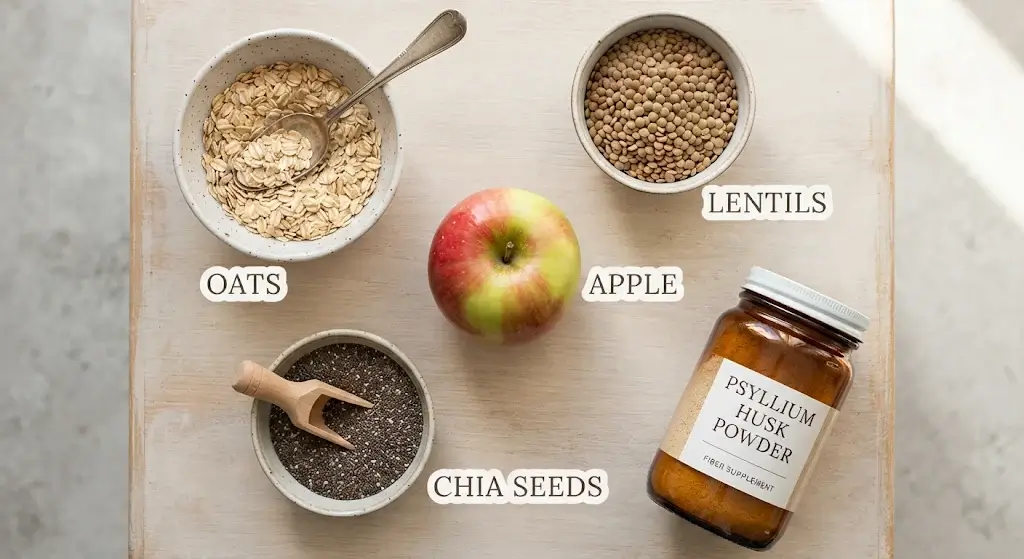
Soluble, Insoluble, and Fermentable Fiber: Which Type Is Gentler?
You have probably heard fiber split into soluble and insoluble. That is useful, but Mayo Clinic points out that how fiber functions in the body, such as whether it is fermentable, matters more than solubility alone for overall health. Use both lenses.
Here is a practical way to think about the main types. The “loose-stool risk” column is a general coaching guide based on the research above, not a guarantee. Your own tolerance may differ.
| Fiber type | Common sources | How it behaves | Loose-stool risk when added fast |
| Soluble, viscous (gel-forming) | Oats, psyllium, chia, barley | Dissolves in water, forms a gel, holds water | Lower to moderate |
| Insoluble, bulking | Wheat bran, skins of fruits and vegetables, nuts, seeds | Adds bulk and speeds movement in many people | Moderate, especially wheat bran in large amounts |
| Highly fermentable prebiotic | Inulin, chicory root, oligofructose | Fermented fast by gut bacteria | Higher at larger doses |
| Whole-food mixed fiber | Beans, lentils, vegetables, fruit | Mix of types; fermentation varies by food | Moderate if you jump from low intake |
One more detail for IBS. A review of IBS diet evidence reported that soluble fiber was slightly better than placebo for symptoms, while insoluble fiber was ineffective. [VERIFY: the source is a table in a PMC article; confirm the article title, journal, and year before citing]
The NIDDK says fiber may improve IBS constipation but that some people with IBS feel a bit more discomfort after adding fiber. They advise adding it a little at a time.
If you want to understand how soluble fiber supports fullness, see our deep dive on soluble fiber and fullness.
How Much Fiber Is Too Much? Numbers to Know
There is no single “too much” number for everyone. The risk depends on your starting intake, the type of fiber, your gut, and how fast you ramp up. Here are the reference points from the sources above.
| Reference point | What the source says | Source |
| General adult target | Most healthy adults may aim for 30 to 40 g per day, with needs varying by age and health | Mayo Clinic |
| Weekly ramp-up | Add about 3 g per week | Mayo Clinic |
| Ramp-up for IBS | Add 2 to 3 g per day to prevent gas and bloating | NIDDK |
| Inulin tolerance (healthy young adults) | Up to 10 g/day native inulin and 5 g/day oligofructose were well tolerated in one small trial | J Am Diet Assoc, 2010 |
| Highest-dose fructan symptoms | Cramps and diarrhea reported at much higher intakes in older studies | PMC review |
Notice the gap between a 30 to 40 g target and a 3 g per week ramp. If you currently eat very little fiber, reaching a high target could take months. That is normal and is a feature, not a bug.
The weekly ramp-up numbers also differ by source (3 g per week versus 2 to 3 g per day). That is fine. Pick the slower pace if you have a sensitive gut, and move faster only if you feel good.
How to Add Fiber Without Diarrhea: A 4-Week Plan
Here is a coach-style progression you can follow. It uses the Mayo Clinic idea of small, steady increases. Adjust it to your own baseline.
Step-by-step ramp
- Find your baseline. For three days, write down roughly how much fiber you eat using food labels. Use that as your starting point, not an ideal number.
- Week 1: add one fiber food per day. Add about 3 g, such as half a cup of cooked peas or one cup of carrots. Keep everything else the same.
- Week 2: add a second serving. Spread fiber across meals, not all at dinner. Drink water with each meal, such as 8 fl oz (240 ml).
- Week 3: add variety. Swap in a different source, like oats at breakfast or a sweet potato at lunch. Variety gives you different fiber types, which Mayo Clinic notes is optimal for health.
- Week 4: reassess. If stools are normal, add one more serving. If they are loose, hold at your current level for another week before adding anything.
Weekly progress table
| Week | Goal | What to add | Check-in question |
| 1 | About +3 g over baseline | One serving of a gentle whole food (carrots, peas, sweet potato) | Are stools normal? |
| 2 | About +6 g | A second serving at a different meal | Any new gas or cramping? |
| 3 | About +9 g | A new source, such as oats | Is hydration steady? |
| 4 | About +12 g or hold | One more serving if stools are normal | Do I feel good 24 hours later? |
Easier version (regression): Move at half speed, adding about 3 g every two weeks, or add only one new food at a time. Choose gentler soluble sources first. This pace suits a sensitive gut or a very low starting intake.
Harder version (progression): Once stools stay normal for two weeks at a new level, add 3 g to your weekly step and start experimenting with mixed sources like beans or whole grains. Keep supplements and fortified bars for last.

Timing, hydration, and cooking
Spread fiber through the day. A big dose in one meal is harder on your gut than the same amount split into three. Drink fluids along with it, since Mayo Clinic notes staying well hydrated helps you reach fiber goals sustainably.
Choose whole foods first. Supplements can help later, but they work best after your gut has adapted. For a closer look at when they make sense, read our guide on protein and fiber supplements.
What to Do If Fiber Already Gave You Diarrhea
If you are already dealing with loose stools, here is a calm, practical response. These steps come from basic digestive logic and the sources above.
- Pause the newest fiber source. Remove the last thing you added, especially a powder, bar, or gummy.
- Check labels for sugar alcohols. Names ending in “-ol,” like sorbitol, are worth ruling out, per the NIDDK.
- Drink fluids. Diarrhea can lead to dehydration, because loose stools remove more fluid and electrolytes, according to the NIDDK.
- Restart lower and slower. After your stools normalize, try half your previous step.
- Keep a simple log. Note what you ate, the fiber source, and your stools. Patterns show up fast.
If this is your first time, most mild, diet-related loose stools settle within days after you back off. If they do not, move to the next section.
Does Fiber Cause Diarrhea in IBS or Other Digestive Conditions?
If you have irritable bowel syndrome, fiber can go either way. The NIDDK says that large meals can cause cramping and diarrhea in IBS and that eating smaller meals more often may help. It also says too much fiber at once can cause gas that triggers IBS symptoms.
The NIDDK also notes that some doctors recommend a low FODMAP diet, which limits carbohydrates that are hard to digest. That diet is a medical strategy that is best done with a doctor or registered dietitian, since cutting too many foods can also cut your fiber.
Other conditions can look like “fiber trouble.” The NIDDK lists celiac disease, Crohn’s disease, and food intolerances among possible causes of chronic diarrhea. If your symptoms are stubborn, a clinician should sort that out, not a fiber experiment.
Safety Notes: When to Call a Doctor
Most fiber-related loose stools are mild. Still, diarrhea can become dangerous if it leads to severe dehydration, and it can signal a more serious problem, per the NIDDK. The NIDDK recommends seeking a doctor’s help for diarrhea lasting more than two days, high fever, or six or more loose stools per day.
The NIDDK also says people who are pregnant, over age 65, taking antibiotics, or who have a weakened immune system are more likely to have health problems from diarrhea. Check with a doctor or physical therapist before changing your diet if you have a medical condition, are pregnant, or take regular medicines.
Call a doctor promptly if you have bloody stools, severe belly pain, signs of dehydration, or weight loss you cannot explain.
Related Tips for Gym-Goers Using Fiber Products
If you train regularly, fiber often arrives through products rather than whole foods. Here is how to keep it gentle.
- Read the bar label first. Look at grams of fiber and for sugar alcohols and inulin or chicory root.
- Test new products on a rest day. Do not try a new fiber bar before a long session, where bathroom access is limited.
- Introduce one product at a time. This is the same “change one variable” rule from earlier.
- Do not stack products. A fiber bar, a fiber shake, and a fiber gummy in one day add up quickly.
- Look at your overall fullness strategy. Our guide on ingredients that support fullness shows how to compare options without overloading your gut.
If you are curious about gut-friendly add-ons, we also cover probiotics and appetite.
Frequently Asked Questions
Can too much fiber cause diarrhea?
Yes. Adding a lot of fiber quickly can cause gas, cramping, and loose stools while your gut adapts. Large doses of fermentable fibers like inulin and sugar alcohols in “high-fiber” products can also loosen stools. Slow increases, steady fluids, and one change at a time usually prevent the problem.
Does fiber help or stop diarrhea?
It can do either. Soluble fibers hold water and may help firm loose stool, and some fiber types reduced diarrhea in tube-fed patients in clinical studies. But a sudden fiber jump can loosen stool in healthy people. The dose, type, and your gut all matter.
Is soluble or insoluble fiber worse for diarrhea?
Insoluble fiber, like wheat bran, tends to add bulk and speed movement, so large amounts may be less gentle. Soluble fiber is often better tolerated. But highly fermentable soluble fibers like inulin can still cause loose stools at higher doses, so the type matters more than the label.
How long does fiber diarrhea last?
Diet-related loose stools often settle within a few days once you reduce the new fiber and keep hydrated. The NIDDK advises seeing a doctor if diarrhea lasts more than two days, comes with a high fever, or means six or more loose stools per day.
Can fiber supplements cause diarrhea?
Yes. Concentrated powders, capsules, and gummies make it easy to overshoot your dose. Some also contain inulin or sugar alcohols, which are known to loosen stools in some people. Start with a small amount, build slowly, and stop if loose stools appear.
Does fiber cause diarrhea in people with IBS?
It can for some. The NIDDK says some people with IBS feel more discomfort after adding fiber, and that increasing by two to three grams a day may help prevent gas and bloating. A doctor or dietitian can help you choose the right type and pace.
Conclusion: So, Does Fiber Cause Diarrhea?
So, does fiber cause diarrhea? It can, but it is rarely fiber itself that is the problem. Speed, dose, fiber type, hidden sugar alcohols, and your own gut sensitivity usually explain it.
The coach’s playbook is simple. Build up about 3 grams per week, favor whole foods first, spread fiber through the day, drink fluids, and change one thing at a time. If loose stools appear, back off, stabilize, and restart at a lower step.
And if diarrhea lasts more than two days or comes with warning signs, get medical advice rather than pushing through. Fiber is worth having in your diet, and a patient ramp-up gets you there with far fewer bathroom surprises.