You have quit smoking. That single decision does more for your lungs than any product, tea, or gadget ever will, because quitting is what allows real lung repair to begin. The confusing part is what comes next: you cough up mucus, your chest feels tight, and you start to wonder whether your lungs will ever feel normal again. Here is the encouraging truth. Your lungs run a built-in self-cleaning system, and it switches back on fast once the smoke stops. This guide explains how to detox lungs after quitting smoking with a practical 12-week plan built on breathing drills, smart cardio, and strength work, so you actively support that natural cleaning process instead of sitting around waiting for it.
Quick Answer: There is no shortcut that flushes toxins out of your lungs. Detoxing after quitting means backing your lungs’ own cleaning system: stay smoke-free, practice deep breathing drills daily, build cardio up gradually, and strengthen the muscles that drive breathing. Lung function and circulation typically improve within 2 weeks to 3 months.
What “Detoxing Your Lungs” Actually Means
No smoothie, capsule, or salt-pipe scrub rinses tar out of your airways. What you can influence is your lungs’ own cleaning crew. Your airways are lined with millions of tiny, hair-like cells called cilia. They beat in coordinated waves, pushing a thin layer of mucus upward so trapped dust, tar, and germs get swept toward your throat and swallowed or coughed out. Cigarette smoke paralyzes and damages these cells, which is one reason smokers carry more mucus, cough more, and pick up more chest infections.
Once you quit, that system reboots quickly. Your blood carbon monoxide level, a gas that crowds oxygen out of your blood, returns to normal within 12 to 24 hours, according to the World Health Organization. Within about 48 hours your lungs begin clearing out accumulated mucus, and by around 72 hours your bronchial tubes start to relax, so breathing feels easier, as the Cleveland Clinic explains. The cilia themselves start recovering within the first two days.
One warning up front: a temporary increase in coughing and phlegm is normal. It is your airways finally clearing years of backed-up gunk. Pulmonologists point out that this early “smoker’s cough” uptick is usually a sign of healing, not damage, and it typically eases over the following weeks.
The Lung Healing Timeline After Your Last Cigarette
Your body starts repairing within minutes, and the gains keep stacking for years. The American Lung Association and the CDC lay out the milestones like this:
Table
| Time After Quitting | What Happens |
| 20 minutes | Heart rate drops toward normal |
| 12 to 24 hours | Carbon monoxide in your blood returns to normal |
| 2 days | Cilia begin to recover; lungs start clearing mucus |
| 2 weeks to 3 months | Circulation improves and lung function begins to rise |
| 1 to 9 months | Coughing and shortness of breath decrease as cilia work better |
| 1 year | Added risk of coronary heart disease is roughly half that of a smoker |
| 10 to 15 years | Lung cancer risk falls to about half; heart disease risk approaches a non-smoker’s |
Two honest caveats. First, everyone’s timeline differs, so do not panic if you still cough at week six. The ranges above are wide on purpose. Second, some damage, especially emphysema where the delicate air sacs are destroyed, cannot be reversed. The CDC stresses that quitting benefits health at any age and any pack history, so even if everything does not repair, stopping smoking halts the ongoing assault and cuts your risk of COPD, cancer, and heart disease going forward.

Can You Actually Speed It Up? What the Research Says
You cannot scrub your airways, but you can condition the system that does the scrubbing. Here is what the evidence shows.
Physical activity protects lung function. A large European analysis following smokers over repeated lung-function tests found a protective causal effect of physical activity on lung function, with active people showing roughly 58 mL better FEV1 (forced expiratory volume in one second) and 83 mL better FVC (forced vital capacity) than inactive people, even after accounting for reverse causation, according to research published in PLOS ONE.
Exercise measurably improves lung numbers in smokers and ex-smokers. In a 16-week trial, sedentary male smokers who combined aerobic training with resistance training improved FVC, FEV1, peak expiratory flow, and peak inspiratory flow more than groups doing either type alone, which suggests a real synergy between cardio and lifting, per the study in PubMed. A separate study of low-intensity continuous running, about 20 to 30 minutes at 40% of max aerobic capacity, improved FEV1 in all participants and forced vital capacity specifically in the cigarette smokers, according to the trial reported in PMC.
The payoff may be biggest for ex-smokers. In a German cohort study that measured daily activity with accelerometers, the lung-function advantage of being active was stronger among ever-smokers than never-smokers, suggesting physical activity gives people with smoking-related risk the most headroom, per BMC Pulmonary Medicine.
Breathing drills have trial support. Smokers who added diaphragmatic breathing to an 8-week aerobic program showed improved pulmonary function and respiratory muscle strength compared with aerobic training alone, according to a peer-reviewed trial on smokers referred through a quitline.
Exercise also helps you stay quit. A systematic review of randomized trials found that while exercise did not consistently raise quit rates on its own, it reliably improved cardiorespiratory fitness and reduced withdrawal symptoms, anxiety, and mood swings during cessation, according to the meta-analysis in PMC. That matters, because every craving you ride out without a cigarette is another day of cilia recovery.
Translation: movement is not cosmetic here. It is the closest thing to a lung detox you can actually train for.
How to Detox Lungs After Quitting Smoking: Your 3-Part Plan
Think of recovery like rehab after an injury. You would not jump straight into competition; you would rebuild range of motion, base capacity, then strength. Same logic. The plan has three parts, layered over 12 weeks:
- Breathing drills (daily, 5 to 10 minutes). Re-teach your diaphragm to do its job and keep mucus moving.
- Cardio (3 to 5 sessions per week). Build the lung and blood-vessel capacity that makes breathing feel easy.
- Strength training (2 sessions per week). Strengthen the postural and breathing muscles, the diaphragm, intercostal muscles between your ribs, and the upper back, that keep your rib cage moving freely.
No equipment beyond a sturdy chair, a set of light dumbbells, and a resistance band is required, and every piece has an easier and a harder version below.
Part 1: Daily Breathing Drills
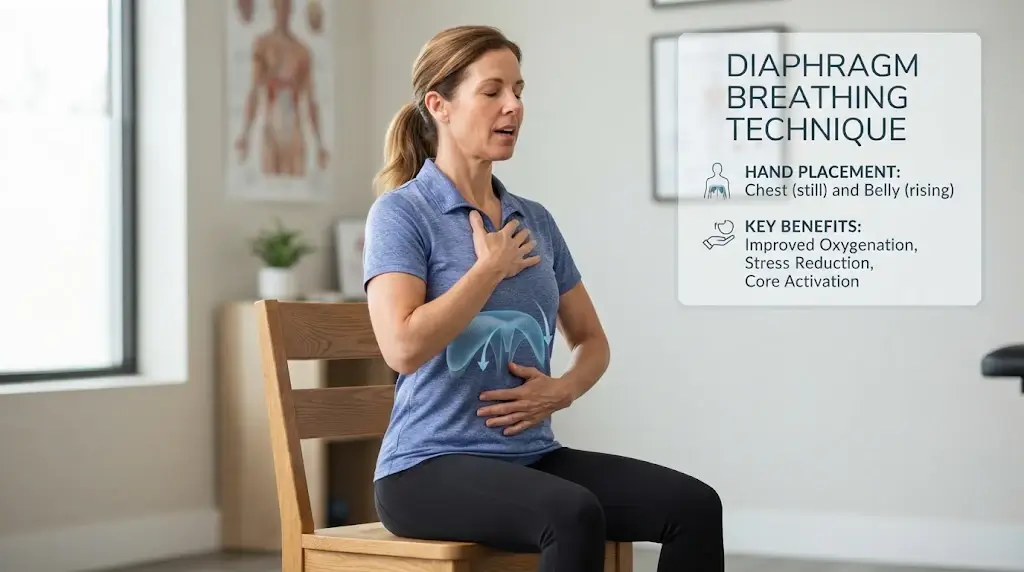
Drill 1: Diaphragmatic (belly) breathing. This is the foundation. When you smoked, shallow chest breathing often became the default, and your diaphragm got lazy.
- Sit upright in a chair, or lie on your back with knees bent, feet flat on the floor.
- Place one hand on your chest and one on your belly, just below your ribs.
- Inhale slowly through your nose for about 3 seconds so your belly hand rises while your chest hand barely moves.
- Exhale slowly through your mouth for 4 to 6 seconds, feeling the belly fall.
- Repeat 8 to 10 breaths, rest, and do 2 more rounds.
Sets and reps: 3 rounds of 8 to 10 breaths, once or twice daily. Rest: 30 seconds between rounds. Tempo: slow, silent inhale through the nose; a 2-second-longer exhale than inhale.
Easier version: lie down and place a light book, around 2 pounds (1 kg), on your belly so you get clear feedback as it rises and falls.
Harder version: move the drill to a brisk walk and try to keep the belly-breathing pattern going for 5 minutes.
Coach’s Tip: In my coaching sessions, the cue that fixes this fastest is “breathe into the bottom of your ribs, not into your shoulders.” If your chest hand is flying up on every breath, slow the inhale down further. Air should feel like it is filling downward, not upward.
Drill 2: Pursed-lip breathing. This drill keeps your airways open longer on the exhale, which helps you empty stale air and take the next breath with less effort. Pulmonary rehab programs have used it for decades.
- Inhale through your nose for 2 counts.
- Purse your lips like you are about to whistle.
- Exhale through the pursed lips for 4 counts, slow and steady.
- Continue for 2 to 5 minutes.
Use it any time you feel winded, such as after stairs or a hard interval. There is no prescribed daily dose; use it as a tool, and during cardio below.
Drill 3: The huff cough. A hard dry cough can irritate airways. The huff cough moves mucus up gently.
- Sit tall and take a medium-depth breath in through your nose.
- Exhale through an open mouth in a sharp “ha” sound, as if fogging a mirror, keeping your throat open.
- Repeat 2 to 3 huffs, then cough lightly if mucus has risen, and spit it out.
- Do 2 to 3 rounds in the morning, when mucus has pooled overnight.
Easier version: one huff per round. Harder version: pair each round with a full diaphragmatic breath cycle before and after.
Drill 4: Box breathing for cravings. Inhale through the nose 4 seconds, hold 4, exhale through the mouth 4, hold 4, and repeat for 5 rounds. Nicotine urges often crest and fade inside a few minutes, and a focused breathing pattern gives them nothing to grab onto. It will not raise your quit odds on its own, but as the review above showed, structured activity patterns during cessation are linked with lower withdrawal symptoms.
Common Mistake: Treating breathing drills like a stretch you skip. They feel too easy to matter, so people drop them after three days. They matter precisely because they are trainable volume for your breathing muscles, and the trial evidence above tied diaphragmatic work to stronger respiratory muscles. Ten minutes daily, every day, beats an ambitious twenty minutes you quit.
Part 2: Cardio That Rebuilds Breathing Capacity
Cardio is where most ex-smokers feel the change first: stairs stop burning, and recovery between efforts gets quicker. The goal for the first month is not intensity. It is consistency, because your VO2 max (the ceiling of your aerobic fitness) and your circulation respond to regular, repeatable work.
Walk-jog intervals (the default session).
- Warm up 5 minutes with an easy walk, neck and shoulders relaxed.
- Walk briskly, at a pace where you can talk but not sing, for 3 minutes. That is roughly 3.0 to 3.5 miles per hour (4.8 to 5.6 km/h) for most adults.
- Jog or walk very fast for 1 minute, at roughly 4.5 to 5.5 miles per hour (7.2 to 8.9 km/h) if jogging.
- Repeat the 3-and-1 block 5 times.
- Cool down 5 minutes easy, then do 2 minutes of pursed-lip breathing.
Total: about 30 minutes. Rest between sessions: at least one easy day.
Easier version: extend the brisk walk blocks to 4 minutes and shorten the fast blocks to 30 seconds, or drop the fast blocks entirely and walk 30 to 40 minutes.
Harder version: flip the ratio to 2 minutes fast, 1 minute easy for 8 rounds, which pushes toward the interval-training style used in the trials above.
Coach’s Tip: Rate your breathlessness on a 0 to 10 scale where 0 is lying on the couch and 10 is all-out. Live between 4 and 6 on brisk blocks. If you hit 8 or 9 and start gasping, that is your cue to lengthen the easy block, not to quit the session. In the early weeks, pursed-lip breathing on the easy blocks turns a gaspy workout into a controlled one.

How much weekly volume? Health authorities recommend at least 150 minutes of moderate aerobic activity per week, and the strong heart and lung benefits stack up well beyond that as you progress. The CDC notes that quitting improves circulation and quality of life broadly, and the activity guidelines are the practical target to aim at once you are a few weeks in.
Part 3: Strength Work for Breathing and Posture
Heavy legs matter for health, but your rib cage mechanics matter for breathing. Rounded upper backs from desk work and years of smoking posture lock the ribs down. These five moves open the chest, strengthen the upper back and diaphragm support, and take about 25 minutes, twice a week.
Table
| Exercise | Sets | Reps | Rest |
| Resistance-band rows | 3 | 12 to 15 | 60 seconds |
| Wall or knee push-ups | 3 | 8 to 12 | 60 seconds |
| Goblet squats | 3 | 10 to 12 | 60 to 90 seconds |
| Band pull-aparts | 3 | 15 | 45 seconds |
| Farmer’s carry | 3 | 30 to 40 steps | 90 seconds |
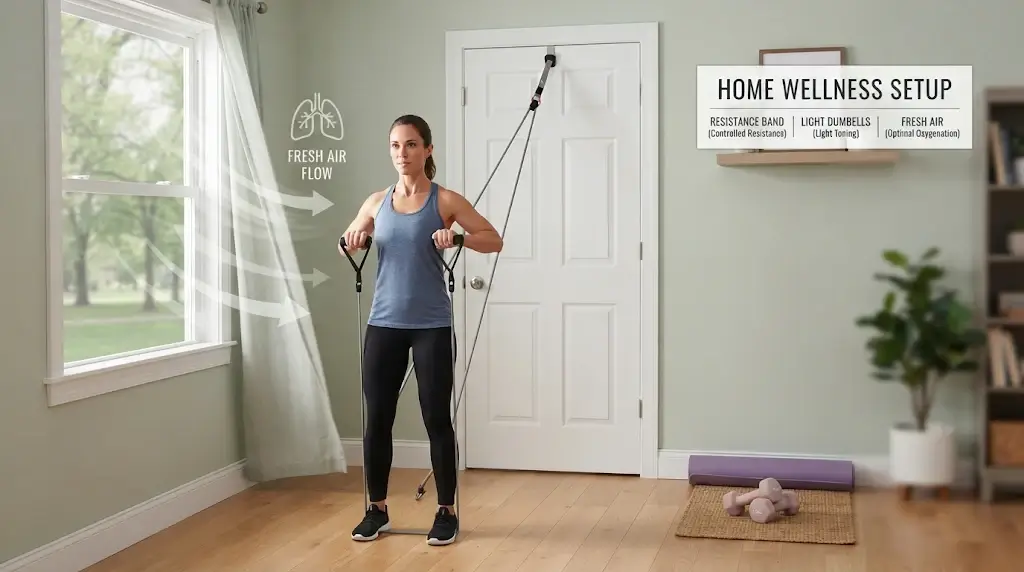
Resistance-band rows. Anchor a light band, about 15 to 25 pounds (7 to 11 kg) of resistance, at chest height. Stand tall, pull the band toward your lower ribs, and squeeze your shoulder blades together for a full second before returning. Cue: “proud chest, elbows past the ribs.” This is the single best move for reversing the smoker’s slump.
Easier version: sit on a chair and use a lighter band. Harder version: stand farther from the anchor so the band tension climbs, or use a heavier band around 40 pounds (18 kg).
Wall or knee push-ups. Hands on a wall at shoulder height (easier) or on the floor from your knees. Lower your chest with control, 2 seconds down, and push up in 1. Keep your ribs from flaring; that is you breathing with your neck instead of your diaphragm.
Progression: full push-ups from the floor, then feet elevated on a stair step.
Goblet squats. Hold a light dumbbell, 15 to 25 pounds (7 to 11 kg) to start, vertically against your chest. Sit down between your heels to a depth where your thighs are near parallel, and stand up tall. Your breathing should stay rhythmic: inhale on the way down, exhale on the way up. Squats drive the big circulation response that carries oxygen through recovering tissue.
Band pull-aparts. Hold a band at shoulder height with straight arms, pull it apart until it touches your chest, and return with control. 15 reps, three sets. Think of it as active posture armor.
Farmer’s carry. Grab a moderate weight, 20 to 30 pounds (9 to 14 kg) per hand to start, stand tall, and walk 30 to 40 steps without leaning or holding your breath. Holding your breath under load is exactly the habit we are training out.
Common Mistake: Pushing cardio so hard in week one that quitting feels linked to misery, then skipping the gym because everything aches. Your lungs are recovering from a genuine injury to their cleaning system. The 16-week trial data above shows real gains take months, not days. Slow consistency wins this.
Your 12-Week Progression Plan
Table
| Weeks | Breathing Drills | Cardio | Strength |
| 1 to 2 | All 4 drills daily, 5 to 8 minutes | Walk 20 to 30 min, 4 days; no intervals yet | 1 day, first 3 exercises only |
| 3 to 4 | Drills daily; add huff cough after waking | Walk-jog 3:1 blocks, 3 days, 30 min | 2 days, full circuit |
| 5 to 8 | Drills daily; box breathing during cravings | 3:1 blocks to 2:1 blocks, 3 to 4 days, 35 min | 2 days; add load 5 lb (2.3 kg) when all reps feel easy |
| 9 to 12 | Drills daily; diaphragmatic breathing while walking | 2:1 blocks, then light steady jogging, 4 days, 40 min | 2 days; add a fourth set or harder band |
Progression rule: add one thing at a time, never all three. If a week goes sideways (illness, cravings, bad sleep), repeat the previous week. Nobody fails this plan for moving slowly; people fail it for rushing.
Daily Habits That Support Lung Cleaning
The three-part plan is the engine; these habits are the fuel.
Hydration and warm fluids. Your airway mucus needs to stay thin enough to move. Fluids in, sensible fluids out; there is no magic “lung cleanse drink,” but warm liquids in particular feel soothing while your airways clear, which makes it easier to keep coughing productively instead of suppressing it.
Sleep like it is part of the program. Mucus clearance and tissue repair run on sleep. It also matters for a second reason: quitting commonly collides with cravings, fatigue, and the weight gain many ex-smokers fear, and poor sleep makes all three harder. How your sleep hormones drive hunger and recovery is covered in the hormonal connection between sleep and metabolism.
Clean air in, smoke never. Secondhand smoke, vaping clouds, heavy traffic fumes, and dust all give your recovering cilia new work at the exact moment they are rebuilding. The CDC calls quitting the single best way to protect the people around you from secondhand smoke, and the protection runs both directions: your own airways too. Open windows, use the kitchen fan, and skip wood-burning fires for a while.
Watch the weight, gently. Many ex-smokers gain a few pounds because nicotine was quietly suppressing appetite and revving metabolism. If that worries you, the levers are the boring ones: protein at meals, daily walks, and patience. The evidence-based basics are covered in what affects metabolism and body weight and how to support metabolism naturally.
Ride out cravings with movement. Cravings and exercise cues collide in a useful way. A 10-minute brisk walk at craving onset gives you the breathing drill, the cardio dose, and the distraction in one. For food cravings, which often show up alongside nicotine cravings in the first months, the playbook in managing food cravings without supplements transfers directly.
Energy dips are normal, and fixable. Nicotine withdrawal makes the first weeks feel flat, and many people reach for coffee to compensate. If caffeine makes the jitters worse, the options in improving daily energy without caffeine and building stamina naturally line up well with this plan.
Safety Notes: When to See a Doctor
Talk to your doctor or a pulmonary specialist before starting this plan if you have any diagnosed lung condition such as COPD or asthma, heart disease, chest pain, or you are over 40 and completely new to exercise. That is a green light for most people, but it should be an informed green light.
Get medical attention promptly, at any point in your recovery, for these red flags:
- A cough that lasts more than 3 weeks or keeps getting worse
- Coughing up blood, even a streak
- Chest pain, pressure, or a racing heart during mild activity
- Shortness of breath that does not match your effort level
- Unexplained weight loss alongside ongoing cough
- Wheezing or noisy breathing that does not settle
These are the situations where “my lungs are healing” is not the answer, and a stethoscope and a spirometry test beat any article, including this one.
FAQ. How to Detox Lungs After Quitting Smoking
1. How long does it take for lungs to heal after quitting smoking?
Carbon monoxide normalizes within a day, cilia start recovering in about two days, and measurable lung function and circulation improvements show up in the 2-week to 3-month window, with coughing and shortness of breath continuing to improve for up to 9 months, per the American Lung Association. Full repair of severe damage is not guaranteed, but function improves steadily.
2. Why am I coughing more after quitting than when I smoked?
Your cilia are coming back online and finally moving the mucus that used to sit in your airways, so you cough it up. Cleveland Clinic’s pulmonologists describe this early cough increase as a temporary, expected sign of healing. Use the huff cough above, stay hydrated, and it typically eases within weeks.
3. Can exercise really help my lungs recover, or does it just feel that way?
The evidence favors a real effect: physical activity shows a protective, causal relationship with lung function in smokers in longitudinal analysis, and structured training trials in smokers improved FEV1, FVC, and airflow measures. The PLOS ONE analysis and the concurrent training trial are good starting points.
4. What can I drink to clean out my lungs?
Water is the honest answer, because airway mucus moves best when you are well hydrated, and warm fluids feel soothing on irritated airways. No tea, juice, or detox drink has been shown to remove tar or repair cilia. Products claiming to “flush” your lungs are marketing, not medicine.
5. What are the signs my lungs are actually healing?
Easier breathing during daily tasks like stairs, less morning chest tightness, a shift from dry hacking to productive coughs that then taper off, better tolerance of your walk-jog intervals week to week, and food starting to taste noticeably better. Most of these appear within the first few weeks to months.
6. When can I start running after quitting smoking?
Let effort, not a calendar, decide. If 2:1 walk-jog blocks (2 minutes fast, 1 minute easy) for 30 minutes leave you talking in short sentences rather than gasping, you are ready to extend the running blocks. Most people who follow the progression above reach continuous 20-minute jogs somewhere between weeks 8 and 12, but taking longer costs you nothing.
Conclusion: Your Lungs Are Already Working on This
The most useful mindset shift is this: you do not detox lungs after quitting smoking by attacking them with products. You support a cleaning system that reactivates within days and keeps improving for months and years. Your job is to be a good training partner for that system. Do the breathing drills daily, build your cardio patiently, strengthen the muscles that keep your rib cage moving, sleep enough, and keep the smoke out for good. The plan above gives you the structure; the timeline table gives you the patience; and every walk-jog session you complete is a small, direct deposit into the lung function you are rebuilding. The CDC puts it plainly: quitting brings health benefits at any age, no matter how long you smoked, and every smoke-free day compounds them.
Talk to your doctor before starting this plan if you have any lung condition, heart disease, or other medical concerns, or if any of the red-flag symptoms above appear.