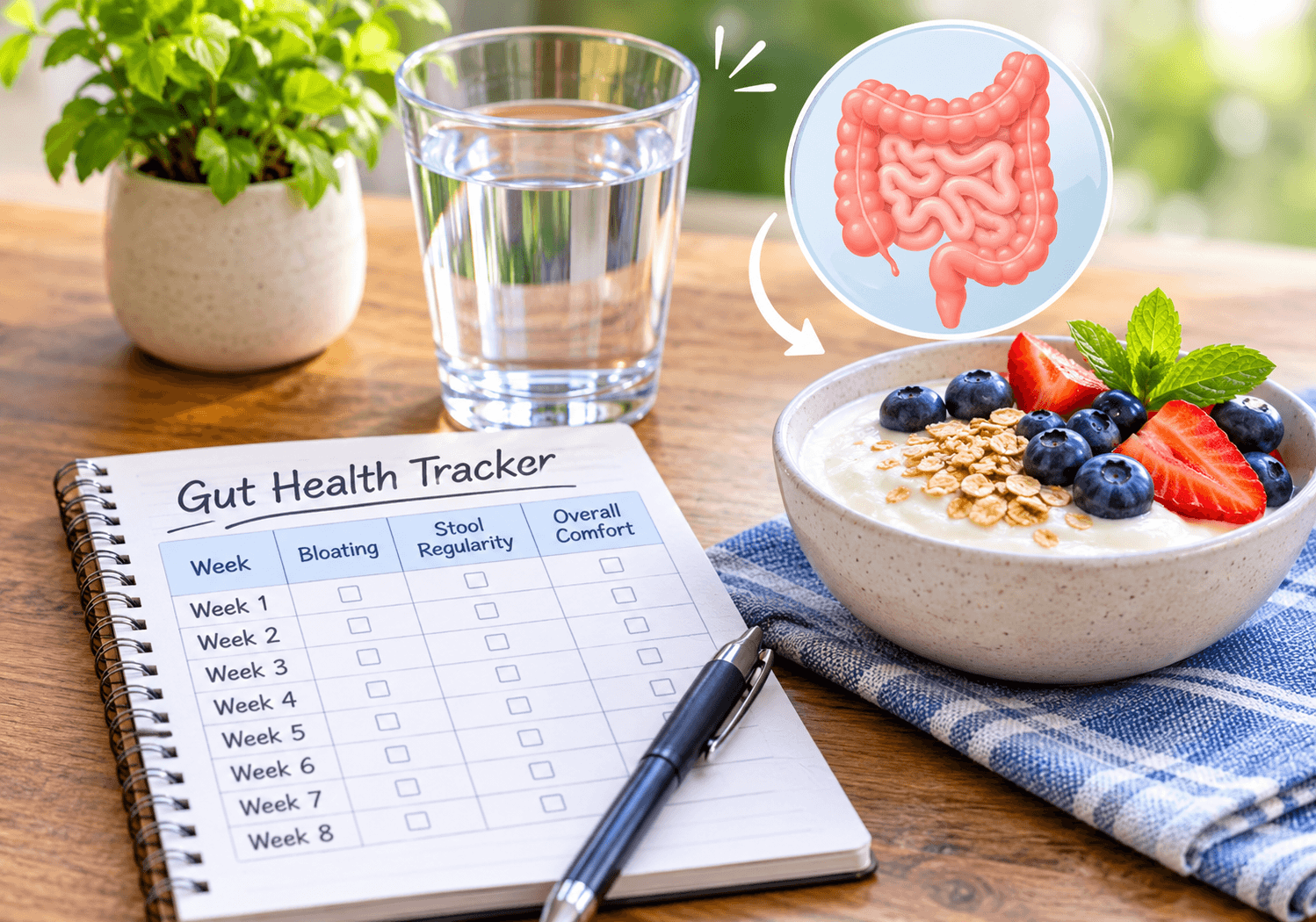
How Long Do Probiotics Take to Improve Gut Health and Reduce Bloating?
You start a probiotic on Monday. By Wednesday your stomach feels the same, or a little worse, and you wonder if you wasted your money. This is one of the most common questions people ask about gut health, and the honest answer is that it depends.
Researchers don’t have a single universal timeline. How long probiotics take to improve gut health and reduce bloating depends on the strain, the dose, and what is causing your symptoms. Most trials run somewhere between two and eight weeks, so that is a sensible window to plan around.
This guide walks you through what the research says and what a realistic first month looks like. It also covers how to track your progress and when to stop guessing and call a doctor. Think of it as a coaching plan for your gut: consistent, measured, and honest about what we don’t know yet.
Check with your doctor first if you have a medical condition, a weakened immune system, or severe or persistent symptoms. Probiotics are not right for everyone.
Quick Answer: Give a probiotic about 2 to 4 weeks to judge changes in gut health and bloating, and up to 8 weeks for a fair trial. Some people feel better sooner, and some get extra gas at first. Results depend on the strain, dose, and cause of bloating, so no timeline is guaranteed.
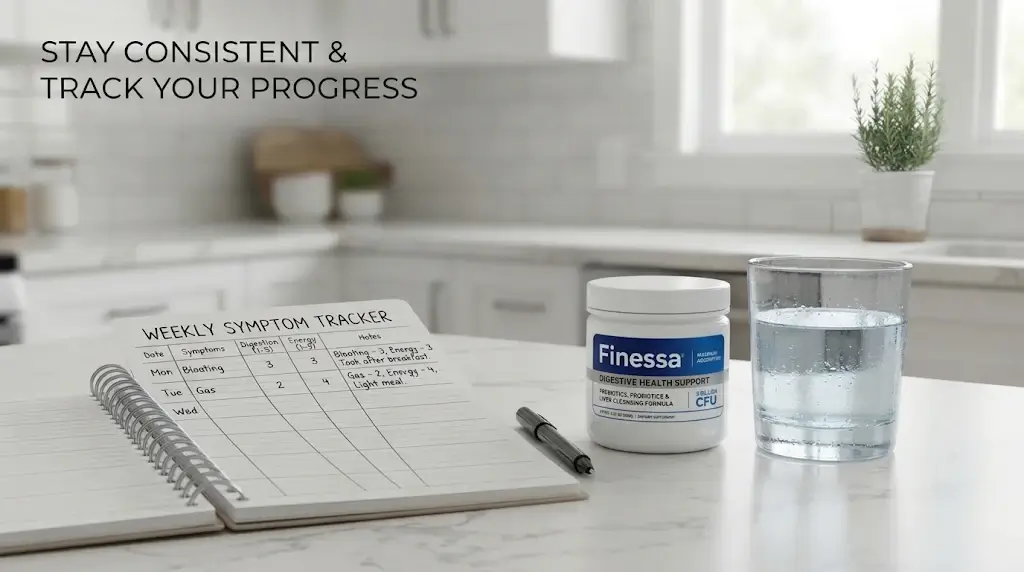
What Probiotics Are (and What They Can Realistically Do)
Probiotics are live microorganisms that are meant to benefit your health when you consume them. The National Center for Complementary and Integrative Health notes that different probiotics may act in different ways.
That one fact explains much of the confusion about timelines. A product with one strain of Bifidobacterium and a product with a blend of Lactobacillus strains are not interchangeable. Each product is its own experiment.
Probiotics also don’t “reset” your gut overnight. Your gut microbiome is a large, established community. A capsule adds a small number of new bacteria, and benefits (if they happen) usually build over days to weeks.
It also helps to separate three words people mix up:
- Probiotics: live bacteria or yeasts (capsules, yogurt, kefir).
- Prebiotics: fibers that feed gut bacteria (inulin, certain starches).
- Synbiotics: products that combine both.
If you’re curious how probiotics fit into the bigger picture of appetite and weight, our guide on probiotics and appetite covers that angle.
How Long Do Probiotics Take to Improve Gut Health? What the Research Says
Here is the part most blog posts skip: most of the strongest evidence on bloating comes from people with irritable bowel syndrome (IBS), not from healthy adults with occasional gas. That matters, so keep it in mind as you read the numbers below.
Trial lengths cluster around 2 to 8 weeks
A large 2023 systematic review and meta-analysis in Gastroenterology looked at randomized trials of probiotics in IBS. For abdominal bloating or distension, the authors found very low certainty in the evidence for a benefit of combination probiotics and Bacillus strains. In plain language, there may be a benefit, but we can’t be confident yet. The same review found that adverse events were not significantly higher with probiotics, across 55 trials and more than 7,000 patients. nihnih
A separate three-level meta-analysis of 72 randomized trials found that probiotics had a medium effect on global IBS symptoms compared with placebo, and that treatment durations shorter than four weeks were linked to larger effects. An earlier meta-analysis in Frontiers in Pharmacology reached a similar conclusion, suggesting that single-strain products at higher daily doses and shorter durations (under 8 weeks) may be a better choice, though more trials are needed. nihfrontiersin
An umbrella meta-analysis of gastrointestinal disorders also reported that effects were more pronounced in studies with shorter durations (up to 2-4 weeks) and in multi-strain formulas. Notice that these reviews don’t agree on single-strain versus multi-strain. That disagreement is a good reminder that this science is still moving. nih
Why “shorter is better” doesn’t mean “stop after two weeks”
It’s tempting to read “shorter trials show bigger effects” as “probiotics work fast and then fade.” That is not what the studies prove. Short trials are often smaller and may be more likely to report positive results. Longer trials tend to show smaller averages.
The practical takeaway is simple. If a probiotic is going to help you, you may notice something within the first few weeks. That is why a 4-week checkpoint makes sense.
Bloating is one of the symptoms researchers keep flagging
A systematic review of probiotics in IBS reported that a significant effect on individual symptoms was found only for bloating and flatulence, although the trials varied a lot in dose and duration. An older review of bloating treatments in Alimentary Pharmacology & Therapeutics concluded that probiotics, along with a few other treatments, demonstrate efficacy for bloating or distension in certain functional GI disorders. nihnih
The word “certain” matters there. Probiotics are not a universal fix for every kind of bloating.

How Long Do Probiotics Take to Reduce Bloating?
Bloating has many causes. It can come from trapped gas, constipation, food intolerances, eating too fast, hormonal shifts, IBS, or small intestinal bacterial overgrowth (SIBO). A probiotic only helps if your bloating is the kind that responds to a change in gut bacteria.
Because of that, “how long do probiotics take to reduce bloating” has a split answer.
The early phase (days 1-14): Possible adjustment
Some people notice a little extra gas or fullness in the first days. Research reviews report that probiotics don’t raise the overall rate of side effects compared with placebo, as in the Gastroenterology review above. Even so, a temporary bump in gas for some individuals is commonly described by clinicians.
If that happens, it should be mild. Sharp pain, vomiting, fever, or blood in your stool are not “adjustment.” Those are reasons to stop and call a doctor.
The middle phase (weeks 2-4): The first fair checkpoint
This is when many people judge whether a probiotic is helping. Most meta-analyses above found their strongest effects in trials of about four weeks or less. If your bloating is clearly better, your stools are more regular, and you feel more comfortable after meals, that is a good sign.
If nothing has changed by week four, don’t automatically assume you need more time. Change one thing at a time (see the plan below) or talk to a professional.
The later phase (weeks 4-8): A longer trial
If you have seen partial improvement, running the trial up to eight weeks is reasonable. This lines up with the under-8-weeks range in the Frontiers meta-analysis. It is not a guarantee that waiting longer helps.
A practical timeline table
This table is a coaching checkpoint plan, not a research-proven schedule. Individual responses vary.
| Time on probiotic | What you might notice | What to do |
| Days 1-3 | Little to no change; possibly mild gas | Take it consistently; start a symptom log |
| Days 4-14 | Possible adjustment, or early comfort | Keep dose steady; don’t add new products |
| Weeks 2-4 | First fair checkpoint for bloating and stool regularity | Compare your log to baseline |
| Weeks 4-8 | Slower, partial gains for some people | Continue only if you see clear benefit |
| After 8 weeks | Little to no change | Stop and consult a clinician |
Why Your Results May Differ From Someone Else’s
Two people can take the same bottle and get opposite results. Here are the main reasons.
1. Strain and species
Probiotic research is strain-specific. A benefit shown for one Bifidobacterium strain doesn’t automatically apply to another strain with a similar name. The 2023 network meta-analysis in Nutrients noted that it is still unclear which strain or combination of probiotics is effective for global IBS symptoms and compared strains and mixtures across specific symptoms, including bloating. nih
2. Dose (CFU)
CFU means colony-forming units, a count of live organisms. The Frontiers review flagged daily doses of 10^10 or more as possibly better, but trials in this area differ widely in dose, so don’t assume that more is always better. frontiersin
3. The cause of your bloating
Probiotics won’t fix bloating caused by constipation from low fluid intake, an intolerance to a specific food, or a swallowed-air habit like fast eating. Matching the tool to the cause is basic coaching logic.
4. Your baseline diet
Fiber helps feed gut bacteria, but a sudden jump in fiber can also increase gas. If you want to build up fiber gradually, our explainers on dietary fiber and appetite and soluble fiber and fullness explain the types.
5. Product quality
NCCIH has noted that probiotic products can vary in what they contain. Look for the strain names (genus, species, and strain code), a CFU count at the end of shelf life, and third-party testing if available.
6. The placebo effect
Many trials of bloating show a real improvement in the placebo group too. This is one reason a simple symptom log is so valuable. It keeps you honest about whether your results are real.
Coach’s Tip: Rate your bloating from 0 to 10 at the same time each evening for one week before you start the probiotic. That baseline is the only way to tell if the product is doing anything.
How to Run a 4-Week Probiotic Trial (Step by Step)
This is the same approach a coach would use to test a new training variable: change one thing, track it, and review on a set date.
Step 1: Choose one product and one purpose
Pick a single probiotic. Write down your goal, such as “less evening bloating” or “more regular stools.” Avoid starting several new supplements the same week. Our guide on evaluating ingredients in supplements shows how to read a label without getting lost in marketing.
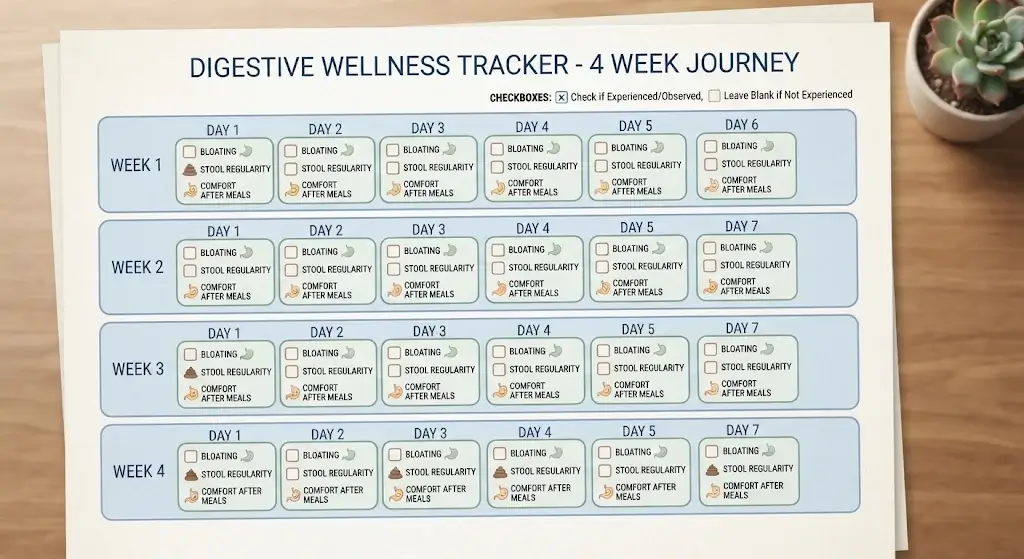
Step 2: Record a one-week baseline
Each evening, score these three things from 0 to 10:
- Bloating
- Gas
- Overall comfort after dinner
Also note your stool pattern (daily, every other day, loose, hard).
Step 3: Start at the label dose
Follow the directions on the product label. Take it at the same time every day. Some products say to take them with food and others say empty stomach, so follow the label for your product.
Step 4: Keep everything else steady
For four weeks, try not to change your diet, water intake, or exercise routine in big ways. If you change five things, you won’t know which one helped.
Step 5: Review at the end of week 2 and week 4
At each check-in, compare your average scores to baseline. A change of about two points or more on the 0-10 bloating scale, held for a week, is a meaningful signal for most people. [This threshold is a coaching rule of thumb, not a clinical standard.]
Step 6: Decide what to do next
- Clear improvement: Continue and reassess at week 8.
- No change: Stop, wait a few days, and consider a different approach or see a doctor.
- Worse symptoms: Stop and talk to a clinician.

Easier version (regression)
If supplements feel like too much, start with fermented foods like plain yogurt or kefir with live cultures. Add one small serving a day for two weeks. Food-based probiotics vary a lot, so expect a slower and less predictable test.
Harder version (progression)
If you want a tighter experiment, track two extra variables: your food log and your stress or sleep rating. This helps you spot patterns, such as “bloating is worse on high-stress days no matter what I take.” Share the log with your doctor or dietitian if you are working toward a diagnosis.
Probiotic Types and Where They Show Up
You’ll see three main places probiotics appear. Each has trade-offs.
| Source | Examples | Pros | Cons |
| Capsules, tablets, powders | Single-strain or multi-strain products | Defined strains and CFU; easy to track | Cost; quality varies by brand |
| Fermented dairy | Yogurt, kefir with live cultures | Easy to add to meals | Strains and counts vary; lactose may bother some |
| Fermented vegetables | Sauerkraut, kimchi (unpasteurized) | Also provide fiber | Strains vary; can be salty |
None of these is automatically best. The right choice is the one you can take consistently and that your gut tolerates.
Common Reasons Probiotics Seem Not to Work
Common Mistake: Switching brands every week. Each switch resets your timeline. Pick one product and give it a fair 4-week test before you judge it.
Other frequent problems include:
- Inconsistent use. Taking it a few times a week isn’t the same as daily use.
- Underlying constipation. If stools are hard and infrequent, bloating usually persists.
- A food trigger. Dairy, certain sweeteners, or high-FODMAP foods may be the real cause. A registered dietitian can guide you through a structured elimination plan.
- Unrealistic expectations. Probiotics aren’t designed to “detox” you or flatten your stomach. Bloating from normal digestion will still happen after a big meal.
- Heat-damaged or expired product. Store products as the label directs and check the expiration date.
If you are using fiber products at the same time, note that some can make gas worse in the first weeks. Our guides on psyllium husk and fullness cover how to ramp up slowly.
Safety Notes: Who Should Be Careful
Probiotics are generally well tolerated in healthy adults. The 2023 Gastroenterology meta-analysis found that the risk of any adverse event was not significantly higher with probiotics. The Frontiers meta-analysis similarly concluded that probiotics seem to be safe based on adverse-event analysis. nihfrontiersin
That said, safety data in people with serious illness is more limited. Talk to a doctor before starting a probiotic if you:
- Have a weakened immune system or are on immune-suppressing medicine
- Have a central line, a recent major surgery, or severe illness
- Are pregnant or breastfeeding
- Are giving probiotics to an infant or young child
- Have a history of SIBO or severe gastrointestinal disease
When bloating is a warning sign
See a doctor promptly if bloating comes with any of the following:
- Unintentional weight loss
- Blood in the stool or black stools
- Persistent vomiting
- Severe or worsening abdominal pain
- Fever
- Symptoms that wake you at night
- New bloating after age 50 that doesn’t go away
These are not “wait and see” symptoms, and no probiotic should replace a medical evaluation.
Related Tips That May Help You Get More From a Probiotic
A probiotic works best as one piece of a wider routine. These habits are low-risk and supportive.
Eat slowly and chew well
Swallowed air and big bites can add to bloating. Slowing down is free and works regardless of what’s in your gut.
Build fiber gradually
Aim to add a small amount of fiber every few days rather than all at once. Gradual increases give your gut time to adapt.
Stay hydrated
Fluids help fiber do its job and can support more comfortable stools. Keep a water bottle where you can see it.
Move after meals
A gentle 10-15 minute walk (roughly half a mile, or 0.8 km) after dinner is a popular habit for digestive comfort.
Manage stress and sleep
Gut symptoms and stress often travel together. Prioritizing sleep and stress management supports your routine more broadly. Our article on sleep and metabolism explains why rest matters for overall health.
Be careful with supplement stacking
Adding a probiotic, a fiber powder, and a weight-management product in the same week makes it impossible to know which one caused what. If you are comparing products, our overview of which supplements may support weight management safely can help you choose one step at a time.

A Sample 8-Week Plan
Use this as a template and adjust it with your clinician.
| Week | Focus | Action |
| 0 | Baseline | Score bloating, gas, and comfort daily for 7 days |
| 1-2 | Start | Begin one probiotic at the label dose; change nothing else |
| 2 | Check-in | Compare scores to baseline; note any side effects |
| 3-4 | Stay consistent | Continue daily; keep diet steady |
| 4 | Main checkpoint | Decide: continue, stop, or see a clinician |
| 5-8 | Optional extension | Only if you saw partial progress; reassess at week 8 |
| 8+ | Decision | If no clear benefit, stop and try other strategies |
FAQ
How long does it take for probiotics to start working?
Some people notice changes within a few days, while others need two to four weeks. Many clinical trials run between two and eight weeks, so give a product a consistent trial of about four weeks. If you see no change after eight weeks, it is reasonable to stop and talk to a clinician.
Why do probiotics make some people more bloated at first?
Some people report extra gas when they begin a probiotic, and it usually settles as the body adjusts. Reviews of trials haven’t found more overall side effects than with placebo. If bloating is severe or lasts beyond a few weeks, stop the product and check with your doctor.
Can probiotics reduce bloating in a week?
It’s possible for some people, but it isn’t typical or guaranteed. Research on bloating mostly comes from trials lasting several weeks, and evidence quality is often rated low. A week is usually too short to judge, so keep tracking your symptoms for about four weeks.
What is the best time of day to take probiotics?
The best time is the one you can follow every day. Some labels recommend taking the product with a meal and others recommend an empty stomach, so follow your product’s directions. Consistency matters more than the clock, and research hasn’t established one best time for everyone.
Do probiotics work for IBS bloating?
Some do, but results depend on the strain and the person. Large reviews suggest possible benefits for bloating, though the certainty of the evidence is often low. If you have IBS, work with your clinician to pick a product and set a trial length rather than guessing.
When should I stop taking a probiotic?
Stop if you have severe pain, vomiting, fever, blood in the stool, or an allergic reaction. Also stop if you see no clear benefit after about four to eight weeks. People with weakened immune systems or serious illness should check with a doctor before starting at all.
Conclusion
So, how long do probiotics take to improve gut health and reduce bloating? For most people, the practical answer is about two to four weeks for a first judgment, and up to eight weeks for a full trial. Some people feel better sooner, some feel no difference, and some get extra gas early on. The research is encouraging for certain people and certain strains, but the certainty of the evidence is often low, and it’s strongest in IBS rather than everyday bloating.
Your best move is to run a fair, simple experiment. Pick one product, track your symptoms before and after, keep everything else steady, and review at weeks two and four. If you don’t see a clear benefit, you’ve learned something useful and saved money. And if your bloating comes with red-flag symptoms, skip the experiment and see a doctor.