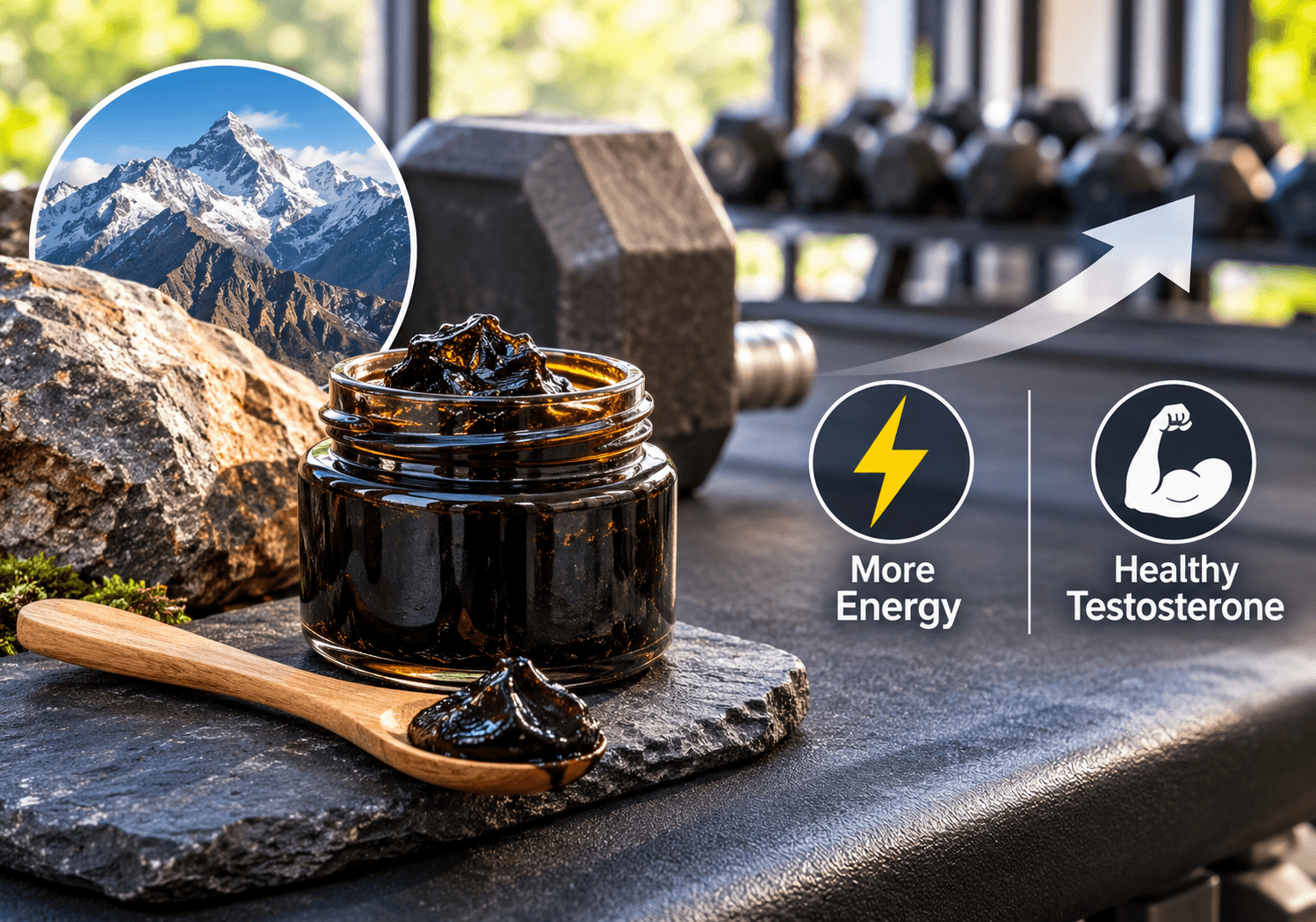
You walk into the gym at 6 a.m. and your legs feel like concrete. By the third set of squats, your focus is gone. You check your bloodwork and total testosterone sits at the low end of “normal.” You’ve heard a buddy mention shilajit—that dark, tar-like resin scraped from Himalayan rock—and you want to know if it’s worth a try.
The honest answer: shilajit benefits for men energy and testosterone are real, but they’re narrower than the marketing claims suggest. A handful of peer-reviewed studies point to modest improvements in testosterone and cellular energy markers, not a dramatic hormonal overhaul. As a strength and conditioning coach who works with men in their 30s through 50s on energy, recovery, and performance, I’ve seen clients ask about shilajit more in the last two years than ever before. Here’s what the evidence actually supports, what it doesn’t, and how to fit it into a routine if you decide to try it.
Quick Answer: Shilajit is a mineral-rich resin used in Ayurvedic medicine. Limited research suggests it may modestly support total and free testosterone levels and improve mitochondrial energy production in men. Effects are gradual (4–12 weeks), not instant, and it is not a replacement for medical treatment of hypogonadism. Always talk to your doctor before starting any supplement.
What Exactly Is Shilajit?
Shilajit is a sticky, asphalt-like substance that seeps from rock faces in high-altitude regions, most notably the Himalayas, Altai Mountains, and parts of Central Asia. It forms over centuries as organic plant material breaks down under heat and pressure, mixing with minerals leached from surrounding stone.
The active components researchers study include fulvic acid, dibenzo-alpha-pyrones (DBP), malic acid, and a wide range of trace minerals such as iron, copper, and magnesium. Fulvic acid is the most studied compound because of its ability to chelate (bind and transport) minerals into cells more efficiently than the minerals alone.
In traditional Ayurvedic practice, shilajit has been used for thousands of years as a general tonic for vitality, strength, and reproductive health. Modern research is still catching up to those claims, and the evidence base is small but growing.
How Shilajit May Support Male Energy
Energy in a physiological sense comes down to how well your mitochondria produce ATP (adenosine triphosphate), the cell’s energy currency. When mitochondrial function drops—through poor sleep, chronic stress, aging, or nutrient gaps—you feel fatigued, your training performance dips, and recovery slows.
Mitochondrial Function and ATP Production
Fulvic acid, the primary active compound in shilajit, has been studied for its role in supporting mitochondrial electron transport. In a 2016 study published in the Journal of Ethnopharmacology, researchers found that fulvic acid supplementation improved markers of mitochondrial function in animal models, suggesting a potential pathway for improved cellular energy .
For a practical example: if your mid-afternoon energy crash is making it hard to focus through a second training session or a work meeting, the mitochondrial support angle is the one most relevant. You’re not looking for a caffeine spike; you’re looking for your cells to produce energy more efficiently over the course of a day.
Mineral Delivery and Cellular Energy
Shilajit contains bioavailable forms of iron, copper, and other trace minerals. Iron is a core component of hemoglobin and cytochromes in the electron transport chain. Copper supports superoxide dismutase, an antioxidant enzyme that protects mitochondria from oxidative damage.
A 2014 review in the Journal of Ethnopharmacology summarized shilajit’s mineral content and noted that fulvic acid enhances the absorption of these minerals compared to taking them in isolation This means the “energy” benefit may partly come from better mineral utilization, especially in men who are borderline deficient in iron or copper.
Coach’s Tip: If you’re training hard four or more days a week and your energy is consistently low, don’t reach for a supplement first. Check your sleep (7–9 hours), protein intake (aim for about 0.7–1 g per lb of body weight, or 1.6–2.2 g/kg), and whether your training volume is too high. Shilajit is a potential add-on, not a fix for overtraining or poor recovery habits.
What the Research Says About Shilajit and Testosterone
This is the claim that drives most of the search interest, so let’s separate what’s been studied from what’s been extrapolated.
The 2012 Andrologia Study
The most-cited human trial on shilajit and testosterone was published in Andrologia in 2012. Researchers gave 63 infertile men with low testosterone either 250 mg of purified shilajit daily or a placebo for 90 days. The shilajit group showed a statistically significant increase in total testosterone, free testosterone, luteinizing hormone (LH), and sperm parameters compared to baseline, while the placebo group did not show the same changes.
A few important caveats:
- The sample size was modest (63 men split into groups).
- The men were specifically infertile with documented low testosterone, not healthy men with “normal” levels.
- The study was conducted in India and used a specific purified shilajit preparation. Results may not generalize to every commercial product.
- The study did not include a long-term follow-up beyond the 90-day window.
Even with those caveats, it’s the strongest human data we have, and it supports the idea that shilajit may nudge testosterone production upward in men who are already running low.
Fulvic Acid and Hormonal Pathways
Luteinizing hormone (LH) from the pituitary gland signals the Leydig cells in the testes to produce testosterone. The 2012 study noted increased LH in the shilajit group, suggesting the resin may support the hypothalamic-pituitary-gonadal (HPTA) axis rather than acting as a direct testosterone source.
Fulvic acid’s role in this pathway is not fully mapped. Animal studies suggest it may reduce oxidative stress in testicular tissue and support steroidogenic enzymes, but human data on this specific mechanism is still limited.
Common Mistake: Reading a blog post that says “shilajit boosts testosterone by 30%” and assuming that’s what will happen to you. The 2012 study showed an increase from a low baseline in infertile men. If your testosterone is already in the mid-to-upper normal range (400–700 ng/dL), the realistic expectation is a small shift, not a dramatic jump. No supplement will turn a 400 ng/dL level into 800.
Shilajit Benefits for Men: A Practical Breakdown
Here’s a summary of what the current evidence supports, what’s plausible but unproven, and what’s marketing hype:
| Claim | Evidence Level | What to Expect |
| Modest increase in total and free testosterone in men with low levels | Moderate (one small RCT, 2012) | 10–20% increase from a low baseline over 8–12 weeks; minimal change if levels are already normal |
| Improved sperm count and motility | Moderate (same 2012 study) | Small improvements in semen parameters over 90 days |
| Enhanced mitochondrial / cellular energy | Low–Moderate (animal + in-vitro studies) | Subjective energy improvement may be noticeable after 4–6 weeks; not a stimulant effect |
| Better mineral absorption (iron, copper, zinc) | Low–Moderate (fulvic acid studies) | May help if you’re borderline deficient; unlikely to matter if your diet is already adequate |
| Anti-inflammatory and antioxidant effects | Low (mostly preclinical) | Possible small reduction in exercise-induced oxidative stress |
| Replaces testosterone replacement therapy (TRT) | Not supported | Shilajit is not a substitute for medical treatment of clinical hypogonadism |
| Dramatic muscle gain or “mass” increase | Not supported | No evidence for anabolic effects comparable to anabolic steroids or TRT |
How to Take Shilajit: Dosage, Timing, and Form
If you’ve talked to your doctor and decided to try shilajit, here’s how to approach it practically.
Dosage Guidance
The 2012 Andrologia study used 250 mg per day of purified shilajit. Most commercial products recommend 300–500 mg daily. Start at the lower end (250 mg) for the first two weeks to see how your stomach reacts, then increase to 500 mg if tolerated.
- Form: Purified resin (the traditional form) is generally preferred over powder or capsule, because the resin contains the full spectrum of fulvic acid and DBP compounds. If you use capsules, look for products that list fulvic acid content (aim for at least 60–80% fulvic acid).
- How to measure: A pea-sized amount of resin (roughly 250–500 mg) dissolved in warm water, milk, or a smoothie. Don’t use boiling water, as it may degrade some active compounds.
- Duration: Give it at least 8–12 weeks before judging whether you notice a difference. The 2012 study ran for 90 days.
Best Time to Take It
There’s no strong research pinning down an optimal time. Most users take it in the morning on an empty stomach or with a light meal. If you’re training in the morning, taking shilajit 30–60 minutes before your session is a reasonable approach, though the energy effect (if any) is not stimulant-like.
Quality and Sourcing
This is where most products fail. Raw, unprocessed shilajit can contain heavy metals, free radicals, and microbial contaminants. Look for:
- Third-party lab testing (heavy metals, microbial purity)
- A stated fulvic acid percentage
- Source transparency (Himalayan origin, altitude)
- No added fillers, binders, or “proprietary blends” that hide actual shilajit content
If a product doesn’t publish a certificate of analysis (COA), be cautious.
Shilajit vs. Other Male Health Supplements
Men often ask me how shilajit stacks up against other supplements they’ve heard about. Here’s a quick comparison:
| Supplement | Primary Claim | Evidence for Testosterone | Evidence for Energy | Notes |
| Shilajit | General vitality, hormonal support | One small RCT (2012) | Preclinical mitochondrial data | Natural resin; quality varies widely |
| Ashwagandha | Stress reduction, hormonal balance | Several RCTs showing modest T increase | May reduce cortisol-related fatigue | Well-studied; KSM-66 and Sensoril are standardized extracts |
| Zinc | Testosterone cofactor | Corrects deficiency-related low T | Supports immune and muscle function | Only helpful if you’re actually deficient |
| Vitamin D | Hormonal and bone health | Corrects deficiency-related low T | General well-being | Get bloodwork first; most men in northern latitudes are low |
| Maca root | Libido and stamina | No clear T increase in RCTs | Subjective energy/libido reports | Effects appear more on desire than hormones |
For a deeper look at how ashwagandha compares, check out our guide on ashwagandha and testosterone in men. And if you’re wondering whether zinc is worth adding, our article on zinc and healthy testosterone levels breaks down the data.
The bottom line: shilajit is not a magic bullet, and it’s not the only tool in the shed. A man in his 40s with low energy and borderline testosterone is more likely to see meaningful improvement from fixing sleep, managing stress, lifting heavy compound lifts, and correcting nutrient gaps than from any single supplement.
Safety, Side Effects, and Who Should Skip It
Shilajit is generally well-tolerated at the studied doses, but “generally well-tolerated” doesn’t mean “risk-free for everyone.”
Known or reported side effects:
- Mild stomach upset or nausea (usually at higher doses or in the first few days)
- Increased iron absorption, which can be a concern for men with hemochromatosis or iron-overload conditions
- Potential heavy metal exposure if the product is untested or from an unreliable source
- Possible interaction with blood-thinning medications (theoretical, based on mineral content)
Who should talk to a doctor before taking shilajit:
- Men with diagnosed hypogonadism or on testosterone replacement therapy (TRT)
- Men with kidney or liver conditions
- Men with hemochromatosis or known iron-overload
- Anyone taking anticoagulant or blood-pressure medications
- Men with a history of gout (shilajit contains uric acid precursors)
If you’re experiencing persistent low energy, low libido, or other symptoms that could point to a hormonal issue, get a full blood panel (total testosterone, free testosterone, LH, FSH, estradiol, thyroid panel, CBC, iron/ferritin) before adding a supplement. A doctor or endocrinologist can tell you whether your levels are genuinely low or whether the issue is sleep, stress, or training load.

Building a Routine Around Shilajit
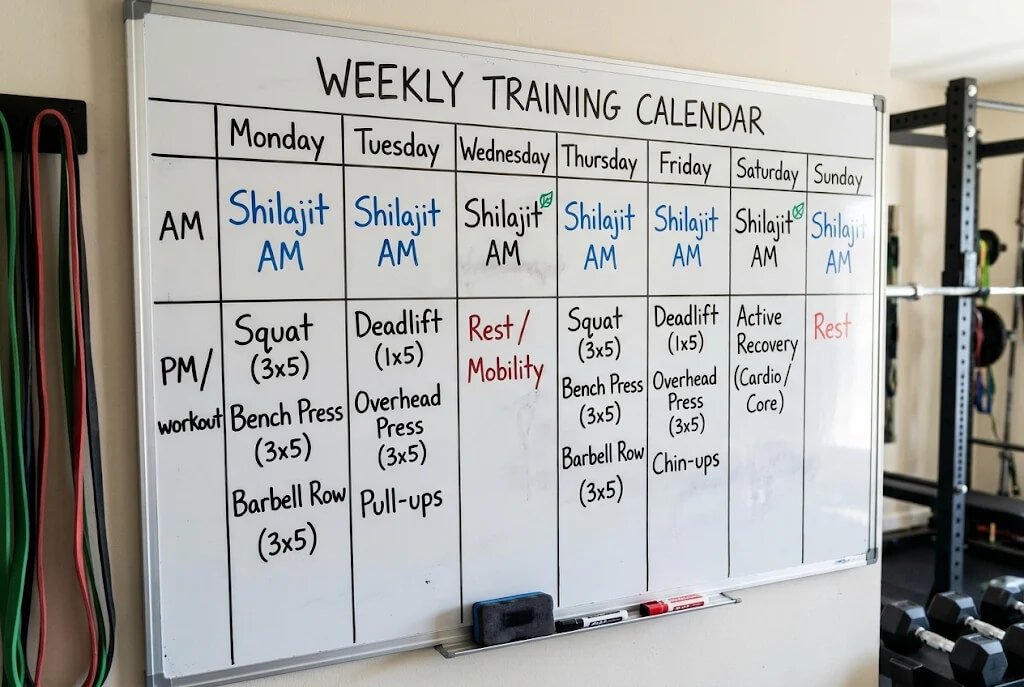
Supplements work best when they sit on top of a solid training and nutrition foundation. Here’s a practical weekly framework for a man in his 30s or 40s who wants to support energy and hormonal health:
Training (4 days/week, compound-lift focused):
| Day | Focus | Example Exercises | Sets × Reps | Rest |
| Mon | Lower body / Squat pattern | Back squat, Romanian deadlift, walking lunges | 4×5, 3×8, 3×10 | 2–3 min |
| Tue | Upper body / Push | Bench press, overhead press, dips | 4×5, 3×8, 3×10 | 2 min |
| Thu | Lower body / Hinge pattern | Deadlift, hip thrust, leg curl | 4×5, 3×8, 3×12 | 2–3 min |
| Fri | Upper body / Pull | Pull-ups, barbell row, face pulls | 4×6, 3×8, 3×12 | 2 min |
Progressive overload matters more than any supplement. Add 5 lb (2.3 kg) to the bar or one rep to a set each week when possible. Heavy compound work is one of the most reliable natural drivers of acute testosterone release during and after training, according to research in the Journal of Strength and Conditioning Research.
Nutrition and recovery:
- Protein: 0.7–1 g per lb of body weight daily (1.6–2.2 g/kg)
- Sleep: 7–9 hours, consistent schedule
- Fruits and vegetables: at least 5 servings daily for antioxidant and micronutrient support
- Shilajit: 250–500 mg in the morning, 8–12 weeks minimum trial
For more on how to support your daily energy through training and nutrition rather than pills, see our guide on increasing energy and stamina naturally.
FAQ
Does shilajit actually increase testosterone in healthy men?
The strongest human evidence (a 2012 RCT in Andrologia) showed a modest increase in total and free testosterone in infertile men with already-low levels. In men with normal testosterone, the expected effect is small. No study has shown shilajit producing testosterone levels comparable to TRT or anabolic steroids.
How long does shilajit take to work for energy?
Most users and the available research suggest 4–12 weeks for noticeable changes. The 2012 study used a 90-day protocol. You won’t feel a “kick” the way you would with caffeine. Any energy benefit is likely gradual and tied to improved mineral utilization and mitochondrial support.
Can shilajit replace testosterone therapy?
No. If a doctor has diagnosed clinical hypogonadism, shilajit is not a substitute for prescribed treatment. It may be a complementary option in some cases, but only under medical supervision. Never stop or alter a prescribed TRT protocol without talking to your endocrinologist.
What’s the best form of shilajit to buy?
Purified resin is the traditional and most studied form. Look for products with a stated fulvic acid percentage (60–80%+), third-party heavy-metal testing, and a clear Himalayan origin. Avoid “proprietary blend” capsules where you can’t verify the actual shilajit content.
Is shilajit safe to take long term?
At 250–500 mg daily, shilajit has not been associated with serious adverse effects in the available studies. However, long-term safety data beyond 6–12 months is limited. If you have kidney, liver, or iron-overload conditions, get medical clearance first.
Shilajit vs. ashwagandha: which is better for men’s hormonal health?
They work through different pathways. Ashwagandha has more RCTs supporting modest testosterone increases and cortisol reduction. Shilajit has one solid RCT plus strong traditional use. They are not mutually exclusive, and some men use both. For a deeper comparison, see our article on supplements for libido and energy in men.
Conclusion
The shilajit benefits for men energy and testosterone are real but modest. One well-designed RCT supports a small increase in testosterone and sperm parameters in men who were already running low. Fulvic acid’s role in mineral transport and mitochondrial function offers a plausible mechanism for improved cellular energy, though human data is still thin.
If you’re a man in your 30s, 40s, or 50s dealing with persistent fatigue, suboptimal training performance, or borderline testosterone, shilajit is a reasonable, low-risk supplement to trial for 8–12 weeks—provided your doctor gives the green light. It will not replace heavy training, quality sleep, adequate protein, or stress management. It’s a small piece of a larger puzzle.
Start at 250 mg, buy a tested product, track how you feel, and recheck bloodwork at the 12-week mark if you want objective data. And if your energy and hormonal markers aren’t where you want them, the first things to fix are almost always sleep, training consistency, and nutrition—not another supplement bottle.