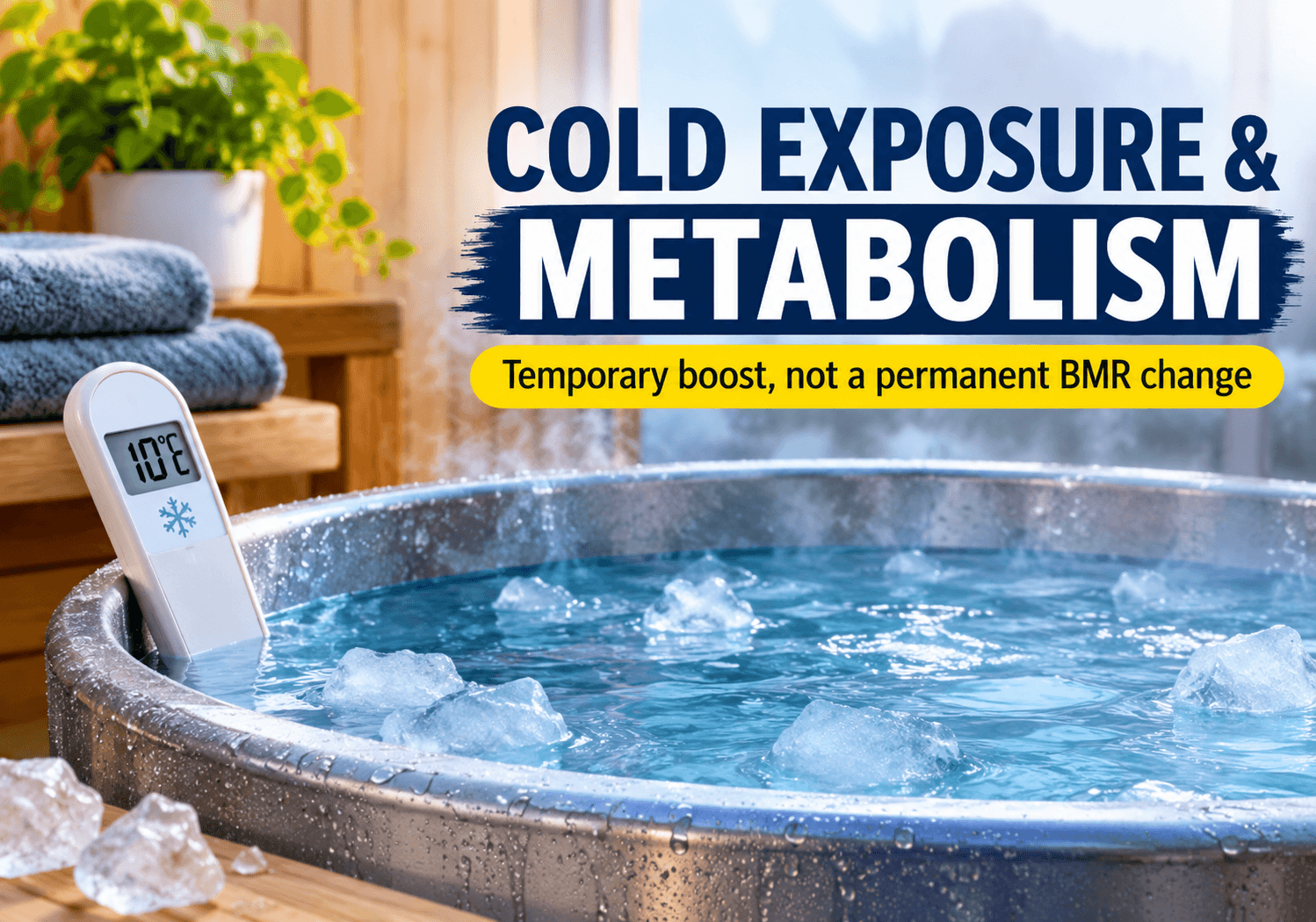
Does cold exposure increase basal metabolic rate? It’s one of the most common questions I hear about cold plunges and cold showers. The short version is that cold makes your body burn extra calories while you’re cold, but that is not the same as permanently raising your basal metabolic rate (BMR).
The distinction matters. Social media often says that ice baths “rev up your metabolism” and melt fat. The research is more modest, and a little more interesting.
In this guide, we’ll cover how your body makes heat, what studies show about calories burned, and whether regular cold exposure changes anything long term. You’ll also get a practical, cautious way to try it.
Quick Answer
Cold exposure can raise your energy expenditure for as long as you are cold, mostly through shivering and brown fat heat production. But it does not appear to permanently raise your true basal metabolic rate, and the extra calories are small. Research on lasting effects is limited and mixed.
BMR vs. RMR vs. Cold-Induced Thermogenesis: What Is Being Measured?
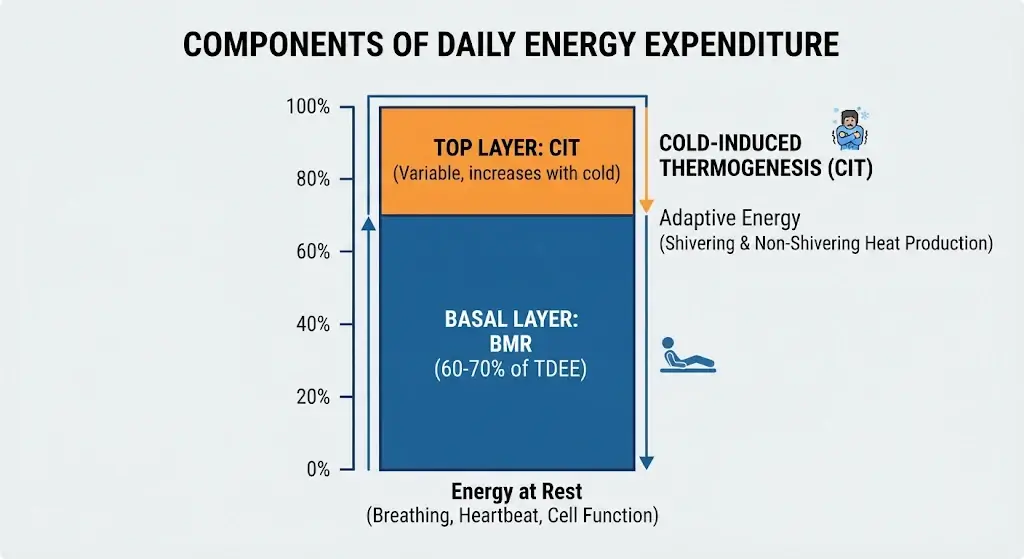
Before we judge the claim, we need clear definitions. Cleveland Clinic describes basal metabolic rate as the minimum number of calories your body needs for basic functions like breathing, circulation, and body temperature. It is measured in a lab while you are at complete rest and mentally and physically calm.
A clinical review adds that BMR testing is done in a thermally neutral room [VERIFY: URL, authors, and year; the PMC link format looks unusual]. The same review notes that BMR makes up roughly 60-80% of total energy expenditure in free-living people. Resting metabolic rate (RMR) is measured with fewer restrictions.
That “thermally neutral” detail is the key. By definition, BMR is measured when you are not cold. When researchers study cold, they describe the extra heat production as cold-induced thermogenesis, which they define as the rise in energy expenditure above BMR.
So technically, cold doesn’t change your BMR. It adds a temporary energy cost on top of it. For a deeper look at the heat-making side of metabolism, see our guide on what thermogenesis is.
The Three Terms in Plain English
- BMR: your minimum energy needs at rest in a comfortable temperature.
- RMR: a similar number measured under looser conditions.
- Cold-induced thermogenesis: the extra heat your body makes when you’re cold.
How Your Body Makes Heat When You Are Cold
Your body defends a core temperature of roughly 98.6°F (37°C). When skin temperature drops, it responds in a few ways.
- Vasoconstriction. Blood vessels near the skin narrow to keep heat in the core. This costs almost no calories.
- Shivering. Muscles contract rapidly to generate heat. This is a real calorie burn, but it’s uncomfortable.
- Non-shivering thermogenesis. Heat is produced without muscle shaking, mainly in brown fat and possibly skeletal muscle.
Brown Fat: The Heat-Producing Tissue
Brown adipose tissue (BAT) burns fuel to make heat instead of storing it. A review in Frontiers in Endocrinology explains that BAT’s role in energy expenditure is dominant in rodents but more controversial in humans.
Other work suggests skeletal muscle and BAT both contribute to cold-induced heat production. The relative share of each is still being worked out.
Another review in the Journal of Diabetes Investigation points out a catch. Cold triggers several adaptive responses, and some of them actually reduce energy expenditure. These include heat-conserving responses that keep you from losing as much heat in the first place.
Coach’s Tip: Think of cold exposure as a “heat tax.” Your body pays extra only if it can’t hold heat in. Warm clothing, a warm room, and a fast post-plunge warm-up all shrink that tax.
What the Research Says: Does Cold Exposure Increase Basal Metabolic Rate?
The best single summary is a 2022 systematic review and meta-analysis in Frontiers in Physiology. It pooled randomized trials comparing people at room temperature (about 75°F / 24°C) with people briefly exposed to 61-66°F (16-19°C).
Energy expenditure was higher after cold exposure. The pooled mean difference was about 188 kcal per day, with a 95% confidence interval of roughly 140 to 237 kcal per day [VERIFY: confirm units in the paper]. BAT volume and activity also increased.
The authors still call the evidence limited and inconsistent because many of the studies were small.
A Quick Reality Check on the Numbers
That “per day” figure is a rate, not a daily total you earn from one cold session. If you spend only a short time in the cold, you only get the boost during that time.
Here’s my own rough arithmetic. If cold raised energy use at about 188 kcal per day, that works out to roughly 8 kcal per hour. A 20-minute exposure at that rate adds only about 2-3 kcal. Colder water or shivering would raise this, but the principle holds: the effect scales with time spent cold.
Summary of Key Findings
| Finding | What researchers observed | Source |
| Mild cold (61-66°F / 16-19°C) vs. room temperature | Energy expenditure higher by roughly 188 kcal/day (rate) | Huo et al., 2022 |
| Coldest tolerable temperature before overt shivering, lean men | Cold-induced thermogenesis about 300 kcal/day (17%) | Cold-induced thermogenesis study [VERIFY authors/year] |
| Same test, men with obesity | About 125 kcal/day (6%) | Same study |
| Daily cold-water immersions for 7 days | Shivering dropped about 20% without a change in total heat production | Gordon et al., 2019 [VERIFY journal/year] |
Why Results Differ From Person to Person
Not everyone responds the same way. In the study above, lean men had a larger cold response than men with obesity, and the spread between individuals was wide. Brown fat amount, body composition, age, clothing, and how cold the exposure is all play a part.
That’s why a friend may swear a plunge “fires up” their metabolism while you notice little. Both can be true.
Does Cold Exposure Increase Basal Metabolic Rate Long Term? Cold Acclimation Explained
This is the question behind most searches. Can repeated cold exposure permanently turn up your metabolism?
A well-known trial found that a 10-day cold acclimation protocol increased BAT activity along with non-shivering thermogenesis. Participants also felt more comfortable in the cold and reported less shivering.
Sounds promising, but there’s a twist. In a 7-day cold-water immersion study, shivering fell by about 20% while total heat production stayed the same. In other words, the body shifted how it made heat. It didn’t clearly make more of it.
So what does this mean for BMR? Acclimation seems to make you more efficient at handling cold. There’s no solid evidence that it permanently lifts your resting energy needs in a thermally neutral room. Larger, longer trials are still needed.
Common Mistake: Assuming that feeling “revved up” after a plunge means your resting metabolism has changed. The adrenaline rush and alertness are real, but they aren’t proof of a higher BMR.
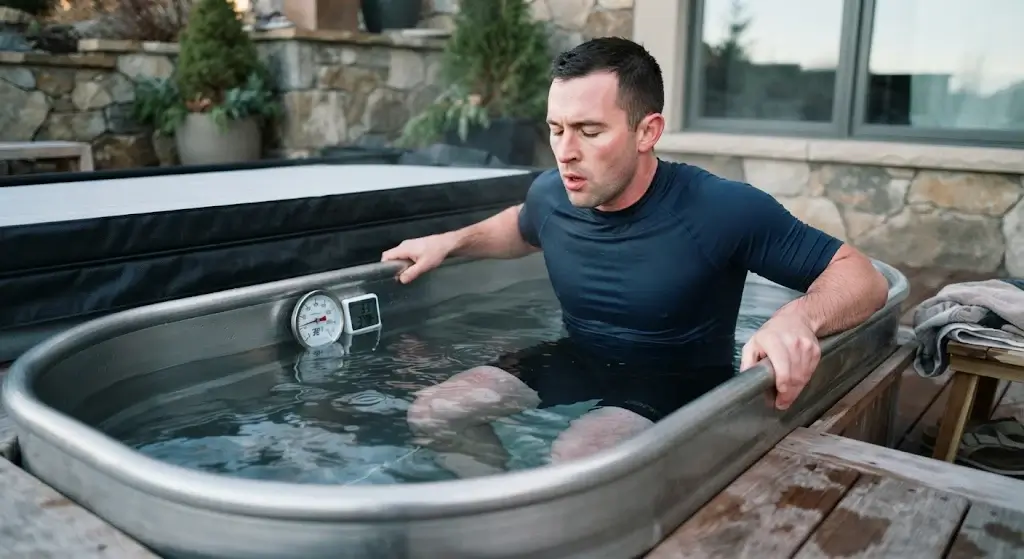
Cold Plunges, Cold Showers, and Appetite
Even if cold burns a few extra calories, what happens afterward matters for weight management.
Cleveland Clinic’s team says that cold showers aren’t the best route to weight loss. They call any effect a small bonus rather than a strategy.
There is also a possible appetite effect. A university study on cold-water immersion [VERIFY: confirm the published journal version and final findings] reported that people ate more after cold-water immersion than after thermoneutral water or air. The researchers tested this with a buffet-style meal.
If you eat even one extra snack after a plunge, it can outweigh the calories you burned. If post-cold cravings are a problem, our guide on managing cravings during a calorie deficit can help.
How to Apply It: A Practical, Cautious Cold Exposure Routine
If you’d like to try cold exposure for alertness, recovery, or curiosity, here’s a conservative way to start. These are coaching guidelines, not results from a specific trial [VERIFY before publishing as exact protocols].
- Check with your doctor first if you have heart, blood pressure, or circulation concerns.
- Start with a shower. Finish your normal warm shower with 15-30 seconds of cool water.
- Breathe slowly. Aim for steady exhales and don’t hold your breath.
- Build gradually. Add 15-30 seconds each week as comfort allows.
- Keep it mild. Studies in the meta-analysis used about 61-66°F (16-19°C), so you don’t need ice.
- Warm up gradually afterward. Use dry clothes, a light walk, or easy movement.
- Never plunge alone or in unsupervised open water.
Easier and Harder Versions
- Easier (regression): 15 seconds of cool water at the end of a shower, 2-3 days per week.
- Standard: 1-2 minutes of cold shower water, 3 days per week.
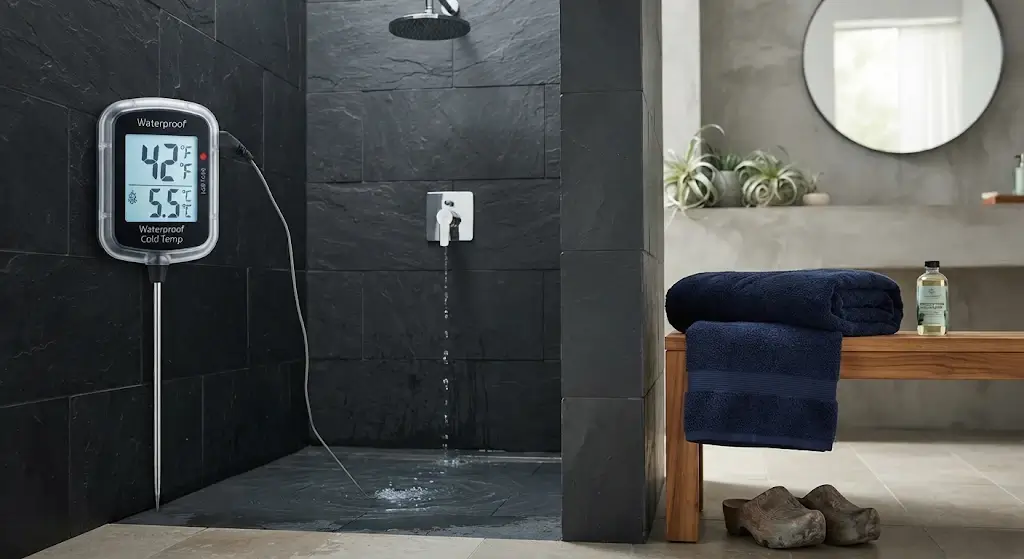
- Harder (progression): A supervised immersion at about 59-68°F (15-20°C) for a few minutes, with a thermometer and a warm-up plan.
Sample Weekly Plan
| Day | Activity | Notes |
| Mon | Strength training + cool shower finish | 15-30 seconds |
| Tue | Walk, no cold | Rest day for your nervous system |
| Wed | Strength training + cold shower | 30-60 seconds |
| Thu | Easy cardio | Skip cold if you feel run down |
| Fri | Strength training + cold shower | Progress only if comfortable |
| Sat | Optional supervised plunge | Short and mild |
| Sun | Rest | Warm and relaxed |
Coach’s Tip: Don’t schedule cold exposure right after a muscle-building session if hypertrophy is your main goal. Some research raises questions about cold plunges and muscle recovery, so [VERIFY and cite a peer-reviewed source] before giving timing advice to readers.
Safety Notes: Who Should Be Careful
Cold exposure is a stress on the body. Sudden cold can raise heart rate and blood pressure, and prolonged exposure can cause hypothermia.
Check with a doctor before trying it if you have:
- Heart disease, high blood pressure, or an irregular heartbeat
- Circulation problems or Raynaud’s
- Diabetes or neuropathy
- Pregnancy
- Any condition that affects temperature regulation
Stop right away if you feel dizzy, chest pain, numbness, confusion, or uncontrolled shivering. And remember that Cleveland Clinic advises easing in and talking to a healthcare provider if you have medical concerns.
Better Ways to Support Your Metabolism
If your real goal is a higher daily energy burn, these habits do more than cold exposure ever will.
- Build and keep muscle. Cleveland Clinic notes that lower lean muscle mass lowers BMR. Two to three strength sessions a week is a solid base.
- Eat enough protein. See our guide on protein intake, metabolism, and weight loss.
- Protect your sleep. Learn how sleep affects metabolism.
- Stay active all day. Walking and daily movement add up.
- Avoid crash dieting. Try building metabolic flexibility instead.
For a broader look, our complete guide to supporting metabolism naturally and the article on what affects metabolism and body weight are good next reads. If you’re over 40, start with our metabolism guide for adults over 40. For the basics, see how to increase metabolism naturally.
Frequently Asked Questions
Does a cold shower boost metabolism?
A cold shower may cause a brief rise in energy use while you’re cold, but it’s short and small. Cleveland Clinic says cold showers aren’t a good weight-loss route on their own. Consider it a small bonus for alertness, not a metabolism fix.
How many calories does a cold plunge burn?
It depends on water temperature, time, body size, and shivering. Research suggests cold can raise expenditure by roughly 188 kcal per day as a rate in mild cold. A short plunge therefore adds only a few calories unless you shiver heavily.
Can cold exposure raise metabolism permanently?
Evidence doesn’t show a permanent increase in resting metabolism. In one 7-day acclimation study, shivering dropped about 20% while total heat production stayed the same. The body adapted its heat-making method rather than clearly raising overall output.
Does shivering burn more calories?
Yes, shivering is a muscle-driven way to make heat and raises energy use. But it’s uncomfortable and adapts over time. Studies show that after repeated cold exposure, people reported less shivering and more comfort, which can reduce that calorie cost.
Do cold plunges make you hungrier?
Possibly. A university experiment on cold-water immersion [VERIFY final published version] found people ate more afterward than after thermoneutral conditions. Plan a balanced meal or snack in advance so the calories you burn aren’t quickly replaced.
Who should avoid cold exposure?
People with heart conditions, blood pressure problems, circulation issues, or pregnancy should talk to a doctor first. Cleveland Clinic advises easing in and checking with a provider if you have medical concerns. Never plunge alone or in unsafe water.
Conclusion: So, Does Cold Exposure Increase Basal Metabolic Rate?
Does cold exposure increase basal metabolic rate? Strictly speaking, no. BMR is measured in comfortable conditions, and cold adds a temporary energy cost on top of it.
Studies do show that being cold raises energy expenditure, and that acclimation can shift how your body makes heat. But the calories are small and the long-term effects aren’t proven. Any boost can also be erased by eating more afterward.
If you enjoy cold showers or plunges, use them for how they make you feel, and start gently. For lasting metabolic support, lean on strength training, protein, sleep, and daily movement.