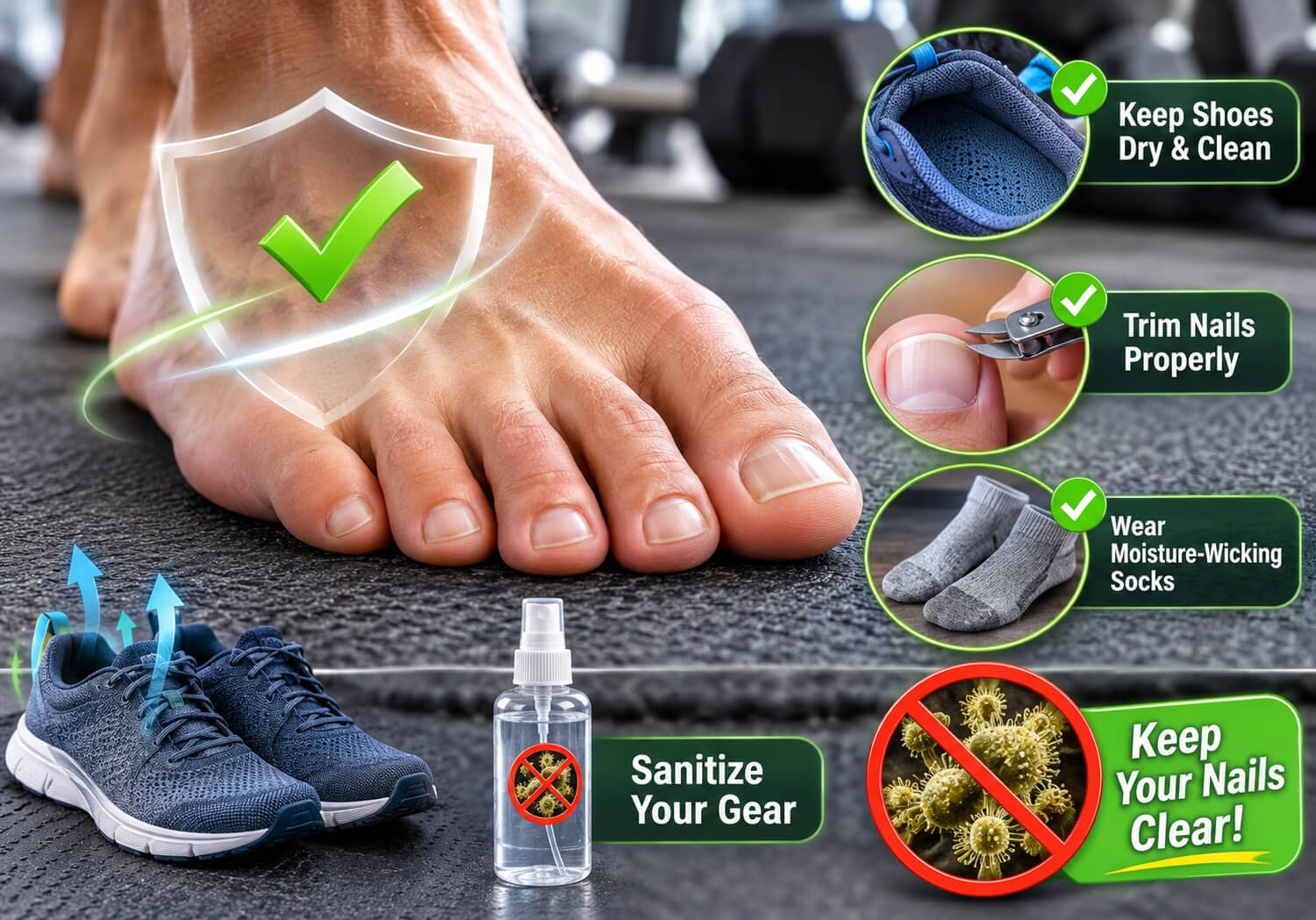
Clearing a stubborn toenail infection takes months of patience, discipline, and daily care. Learning how to prevent toenail fungus from coming back is the most important step once your new, clear nail finally grows out. For lifters, runners, pickleball players, and regular gym-goers, the training environment creates a constant battle against heat, sweat, and repetitive toe impact.
Most recurring infections happen because microscopic fungal spores survive inside your favorite training shoes or hide in dry skin between your toes. At the same time, tight footwear and heavy lower-body training can bruise the nail bed and weaken its natural seal. Because fungal infections involve medical skin and nail tissue, check with a doctor, podiatrist, or physical therapist before starting any new treatment or foot rehabilitation routine.
Quick Answer: How to Prevent Toenail Fungus From Coming Back
Learning how to prevent toenail fungus from coming back requires a three-part defense: keep your feet cool and dry with moisture-wicking socks, sanitize your shoes and nail clippers after every use, and protect your nail beds from repetitive micro-trauma by wearing wide toe-box shoes and strengthening your intrinsic foot muscles.
Why Does Toenail Fungus Keep Returning? What the Research Says
Toenail fungus, known medically as onychomycosis, is notorious for returning just when you think you have beaten it. Clinical data shows that recurrence rates range from 10% to 53% within a few years of successful treatment, according to research published on NCBI StatPearls on Onychomycosis. Understanding why this happens helps you build a defense that actually lasts.
Recurrence falls into two distinct categories: relapse and reinfection. A relapse means the original infection was never 100% cleared from deep underneath the nail plate. Reinfection means your nail was completely cured, but you picked up fresh fungal spores from your shoes, shower floor, or gym locker room.
Dormant Spores Inside Shoes and Gym Bags
The primary culprits behind nail infections are microscopic organisms called dermatophytes, which thrive in dark, warm, and damp spaces. Even after topical drops or oral medications clear your nail bed, dormant fungal spores can survive for months inside the foam insoles and fabric linings of your athletic shoes. Every time your feet warm up during a workout, that trapped moisture wakes those spores right back up.
Leaving sweaty training shoes inside a zipped gym bag accelerates fungal growth. Without airflow or UV light, the inside of a sneaker acts like an incubator. Putting a cured foot back into an untreated shoe is the fastest way to trigger a second round of infection.
Repetitive Micro-Trauma From Running, Lifting, and Court Sports
A healthy, intact nail plate forms a tight physical barrier that blocks fungi from entering the nail bed. When you run 3 miles (4.8 km) on pavement, play three sets of pickleball, or perform heavy lunges, your toes repeatedly slide forward or press hard against the shoe. This friction causes microscopic lifting of the nail plate, known as onycholysis.
Even a tiny gap of 0.04 inches (0.1 cm) between the nail plate and the skin underneath creates an open door for dermatophytes. Athletes who wear narrow shoes often mistake bruised, thickened nails for normal training wear and tear. In reality, that damaged tissue is prime real estate for fungal spores waiting inside your socks.
Untreated Athlete’s Foot Spreading to the Nail Bed
Many people treat their toenails while ignoring mild peeling, itching, or redness between their toes. Athlete’s foot (tinea pedis) is caused by the exact same family of fungi that infects the toenail, as noted by the CDC guidelines on fungal nail infections. If fungal skin scales remain between your fourth and fifth toes, they will eventually migrate back under the nail plate.
Skin infections move much faster than nail infections. You might clear your big toenail over nine months, only to have a mild case of dry, flaky skin on your heel re-seed the nail bed a week later. Treating the skin and the nails as one connected unit is mandatory for long-term success.
Circulation, Blood Sugar, and Systemic Recovery
Your immune system relies on strong blood flow to deliver white blood cells and nutrients down to your toes. Because your toes are the farthest point from your heart, lower-leg circulation naturally slows down if you sit all day or have tight calf muscles. Slower blood flow means slower nail growth and weaker local immunity against invading microbes.
Metabolic health also plays a major role in foot resilience. High blood sugar levels and poor glucose regulation can damage tiny blood vessels in the feet and impair immune response, according to the Mayo Clinic guide on nail fungus. Taking steps to improve insulin sensitivity through regular strength training and smart nutrition helps keep those small blood vessels open and responsive.
How to Prevent Toenail Fungus From Coming Back With a Daily Hygiene and Gear Protocol
Knowing how to prevent toenail fungus from coming back comes down to what you do in the 15 minutes immediately after training and showering. Fungi need moisture, dead keratin, and an entry point to establish a foothold. Your daily routine must strip away all three factors every single day.
Use the reference chart below to audit your current locker room and home foot-care habits.
| Daily Habit or Gear Factor | High-Risk Habit (Invites Recurrence) | Low-Risk Protocol (Prevents Recurrence) | Target Frequency |
| Post-Shower Drying | Stepping onto a damp bathmat and putting socks on within 30 seconds | Blotting between every toe with a clean paper towel and air-drying for 3 minutes | Every shower |
| Athletic Shoe Rotation | Wearing the same pair of gym shoes on back-to-back training days | Rotating between 2–3 pairs so each pair dries for 24–48 hours | Daily |
| Sock Material | 100% cotton socks that trap sweat against the skin and nail bed | Moisture-wicking merino wool, bamboo, or synthetic polypropylene blends | Every workout & daily wear |
| Nail Clipper Hygiene | Using the same unwashed clippers on all ten toes for years | Scrubbing clippers with soap, then soaking in 70%–90% isopropyl alcohol for 10 minutes | After every trim |
| Shoe Sanitization | Leaving sweaty shoes in a dark gym bag or closet floor | Removing insoles, using a UV-C shoe sanitizer or antifungal spray | After every workout |
| Nail Trimming Length | Cutting nails deep into the corners or tearing edges by hand | Cutting straight across, leaving 0.04–0.08 inches (0.1–0.2 cm) of white free edge | Every 2–3 weeks |
The Post-Workout Wash and 3-Minute Dry Rule
Never stay in damp socks after finishing a workout or a run. Even waiting 30 minutes for the drive home gives fungal spores a warm, humid environment to multiply against softened nail keratin. Take off your training shoes and sweaty socks as soon as your cool-down ends.
When you shower, wash your feet directly with soap and water rather than letting soapy water just run down your legs. Use a dedicated washcloth or your hands to clean between each toe. Once you step out of the shower, dry your feet last so you do not transfer any lingering spores from your toes to the rest of your body.
Blot carefully between every toe using a clean towel or a disposable paper towel. Then, sit for 3 full minutes with your bare feet exposed to the air or a bedroom fan before putting on fresh socks. Skin and nails absorb water like a sponge during a warm shower, and putting socks on immediately traps that residual moisture inside.

Precision Nail Trimming and Tool Sterilization
How you trim your nails determines whether the seal between the nail plate and nail bed stays intact. Always trim your toenails straight across using heavy-duty, straight-edge stainless steel clippers. Never round the corners down into the skin fold, as this causes ingrown nails and creates tiny tears where fungi can enter.
Leave a small white edge of about 0.04 to 0.08 inches (0.1 to 0.2 cm) at the tip of the toe. Cutting too short exposes the delicate skin of the nail bed and increases pain when your toes press against the front of your shoes. If a nail is thick, clip it in several small bites rather than forcing one big cut, which can crack the nail plate down the middle.
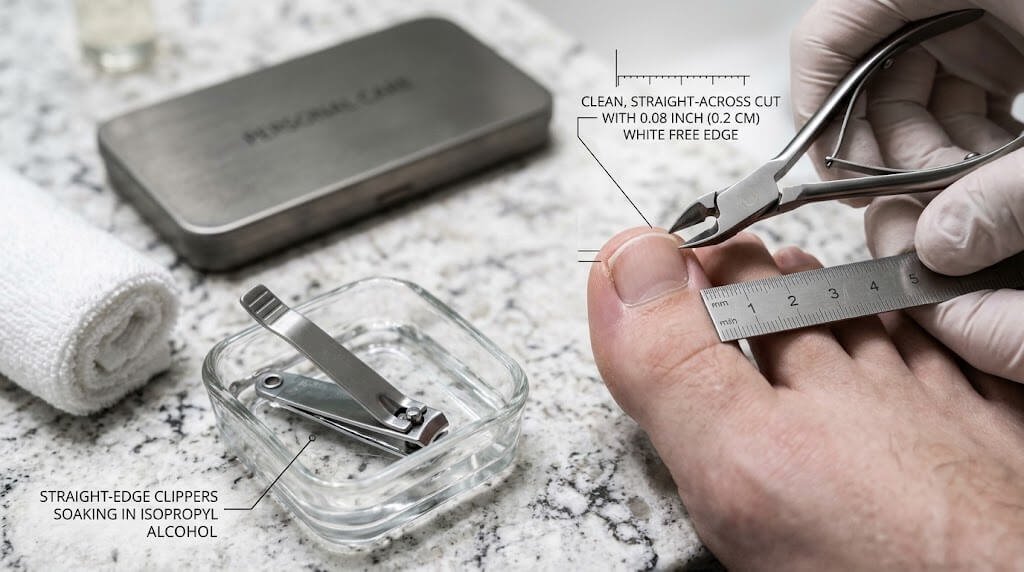
If you still have one suspicious nail, keep two separate sets of clippers and files: one strictly for healthy nails, and one for the recovering nail. After every single trim, scrub your metal tools with warm soapy water to remove any microscopic keratin debris. Submerge the metal blades in 70% to 90% isopropyl alcohol for at least 10 minutes, then let them air-dry completely before storing them in a dry case.
Sanitizing Footwear, Insoles, and Gym Floors
When clients finish a long course of antifungal treatment, they often ask if they need to throw away all their shoes. If you have a worn-out pair of running shoes with over 300 miles (483 km) on them, replacing them is the safest choice, as recommended by the Cleveland Clinic guide on toenail fungus. For newer lifting shoes or expensive court sneakers, you must sanitize them thoroughly before wearing them again.
Pull the removable insoles out of your shoes after every training session so air can reach the toe box. Treat the inside of the shoes and both sides of the insoles with an over-the-counter antifungal spray containing tolnaftate or miconazole, or use an electronic UV-C shoe sanitizer for 15 to 30 minutes. Never put damp shoes back into a gym bag; place them in a well-ventilated room with low humidity.
Wash your fabric gym bag and bathmats in hot water at least once a week. At home, wipe down your shower floor weekly with an EPA-registered disinfectant or a diluted bleach solution so family members do not pass spores back and forth.
Footwear, Socks, and Locker Room Rules for Athletes
Gym-goers put far more stress on their feet than sedentary individuals. If you want to master how to prevent toenail fungus from coming back, your athletic gear must work with your foot anatomy rather than against it.
Choosing the Right Toe Box Dimensions and Breathable Uppers
Take the insole out of your current gym shoe, place it flat on the floor, and stand on it with your full body weight. If your toes hang over the sides or reach the very tip of the foam insert, your shoe is too narrow or too short. Every step you take in that shoe jams your nails into the upper material and causes micro-trauma.
Look for athletic shoes that provide at least 0.5 inches (1.3 cm) of open space between your longest toe and the front end of the shoe when you are standing up. Your feet swell by up to half a shoe size during a 60-minute lifting session or a 5-mile (8 km) run. That extra 0.5 inches (1.3 cm) of clearance prevents your big toenail from slamming into the front bumper during lunges, box jumps, or downhill runs.
Choose shoes built with engineered mesh uppers rather than heavy leather or solid synthetic plastics. Breathable mesh lets heat and water vapor escape with every step. For lifters who wear rigid squat shoes with non-breathable straps, take them off immediately after your heavy squat or clean sets and switch into airy mesh trainers for the rest of your workout.
Moisture-Wicking Socks vs. Cotton Traps
Standard 100% cotton socks are the enemy of healthy toenails. Cotton absorbs sweat quickly and holds it right against your skin, turning your shoe into a soggy steam room within 20 minutes of training. Wet skin softens and macerates, making it easy for dermatophytes to penetrate both the skin between your toes and the cuticle seal.
Switch to technical socks made from merino wool, bamboo rayon, or synthetic blends like polypropylene and nylon. These fibers pull moisture away from your skin and push it toward the outer surface of the shoe where it can evaporate. Merino wool also offers natural temperature regulation, keeping feet cool during summer workouts and dry in winter boots.
If your feet sweat heavily, pack an extra pair of clean socks in your gym bag and change them halfway through a long training session. Always wash athletic socks inside out in warm or hot water, and dry them completely on high heat (unless the care label states otherwise for wool) to help eliminate lingering microbes.
Smart Locker Room, Pool Deck, and Shower Habits
Public gym locker rooms, sauna floors, swimming pool decks, and communal showers are high-traffic reservoirs for fungal spores. Walking barefoot for even 10 feet (3 meters) from the locker bench to the shower stall is enough to pick up dermatophytes shed by another gym member.
Keep a dedicated pair of waterproof rubber flip-flops or shower slides in a separate breathable mesh pouch on the outside of your gym bag. Put them on before your bare feet ever touch the locker room floor, wear them inside the shower stall, and keep them on while you dry off. Rinse and sanitize your shower slides with disinfectant spray once a week so the sandals themselves do not become a carrier.
How to Prevent Toenail Fungus From Coming Back by Fixing Foot Mechanics and Circulation
Most articles on nail health stop at hygiene, but as a strength and conditioning coach, I look closely at how your feet move under load. Poor foot mechanics and weak lower-leg circulation are hidden drivers behind recurring nail issues. Understanding how to prevent toenail fungus from coming back means training your feet to stop jamming into your shoes and pumping fresh, oxygen-rich blood down to the nail matrix.
When your foot arch collapses during a squat or a run, your foot elongates and slides forward inside your shoe. At the same time, weak intrinsic foot muscles cause your toes to claw or crowd together, pinching the skin between them and trapping sweat. By strengthening your arches, spreading your toes, and working your calf muscle pump, you protect your nails from mechanical damage and boost local blood flow.
Foot Mechanics & Circulation Routine
Perform this 15-minute routine 3 days per week—ideally at home on a clean, sanitized exercise mat after your main training session or on active recovery days.
| Exercise Name | Primary Target | Sets | Reps / Duration | Rest Time | Tempo (Eccentric-Pause-Concentric-Hold) |
| 1. Seated Dumbbell Calf Raise | Soleus & Distal Venous/Arterial Pump | 3 | 15–20 reps | 45 sec | 2-1-1-2 |
| 2. Short-Foot Arch Dome | Abductor Hallucis & Intrinsic Arch | 3 | 10 reps (5-sec holds) | 30 sec | 1-0-1-5 |
| 3. Toe Yoga & Big Toe Abduction | Hallux Control & Interdigital Spacing | 3 | 12 reps per pattern | 30 sec | 1-0-1-3 |
| 4. Tibialis Anterior Wall Raise | Tibialis Anterior & Eccentric Foot Control | 3 | 15–20 reps | 45 sec | 2-0-1-2 |
| 5. Loaded Wide-Toe Farmer’s Walk | Full Foot Tripod Stability & Grip | 3 | 100 feet / 0.02 miles (30 m) | 60 sec | Steady, controlled walk |
Step-by-Step Exercise Breakdown and Coaching Cues
1. Seated Dumbbell Calf Raise for Distal Blood Flow
Your soleus muscle sits deep in your lower leg and acts as a powerful “second heart,” pumping blood through your feet and back up toward your torso. Strong, high-rep contractions flush fresh blood into the tiny capillaries feeding your nail beds, supporting faster and healthier nail growth, a critical factor noted by the NIH National Institute on Aging foot care guidelines.
- How to do it: Sit tall on a flat bench of about 17 inches (43 cm) in height with your feet flat on the floor or the balls of your feet elevated on a 2-inch (5 cm) weight plate. Place a 25 lb (11.3 kg) to 45 lb (20.4 kg) dumbbell vertically or horizontally across each knee, just above the kneecap. Slowly lower your heels for 2 seconds until you feel a mild stretch in your Achilles tendon, pause for 1 second, press firmly through the ball of your big toe and pinky toe to raise your heels as high as possible, and hold the top squeeze for 2 full seconds.
- What it should feel like: A deep, warm muscular pump in the lower half of your calves and a gentle warming sensation across the soles of your feet—never cramping in your toes.
- Easier Version (Regression): Perform the movement seated with bodyweight only and your feet flat on the floor, focusing on a smooth 2-second hold at the top for 15 reps.
- Harder Version (Progression): Elevate the balls of your feet on a 3-inch (7.6 cm) aerobic step and increase the load to 50 lb (22.7 kg) to 70 lb (31.8 kg) dumbbells, or perform the exercise one leg at a time with a 3-second lowering phase.
2. Short-Foot Arch Dome (Preventing Toe Jamming Inside Shoes)
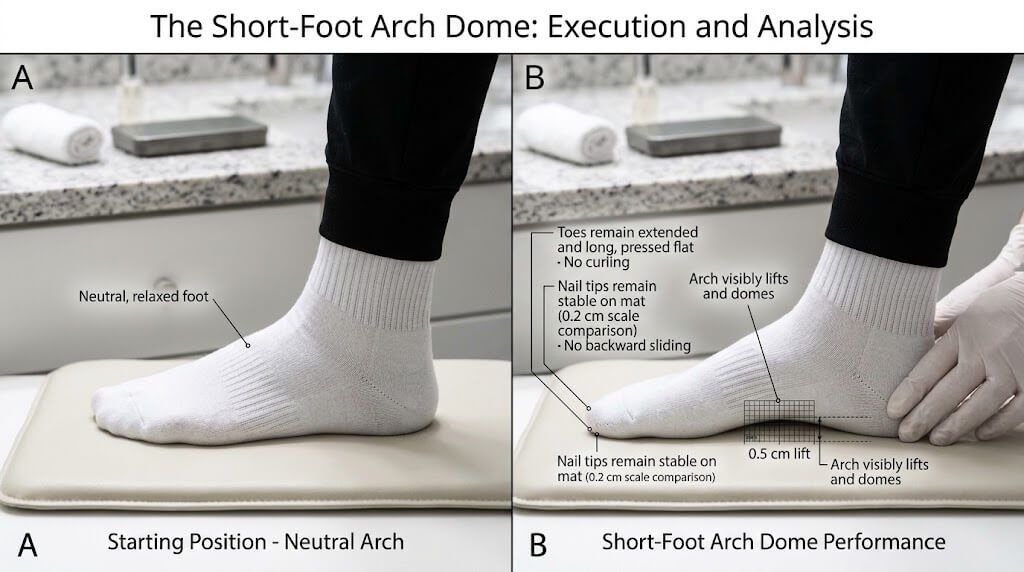
When your arch flattens under load, your foot stretches forward and slams your big toenail into the front of your sneaker. The short-foot drill trains your deep arch muscles to hold your foot length steady during squats, lunges, and runs.
- How to do it: Sit or stand tall with your bare feet on a sanitized mat, feet hip-width apart at about 8 inches (20.3 cm). Keep your heel, the ball of your big toe, and the ball of your little toe planted firmly on the floor. Gently draw the ball of your big toe backward toward your heel by about 0.25 inches (0.6 cm) so the middle of your foot arch domes upward, WITHOUT curling or gripping with your toes. Hold this lifted arch for 5 seconds while breathing normally, then relax for 2 seconds.
- What it should feel like: A subtle, deep contraction right inside the arch of your foot. Your toenails should remain flat and relaxed, not turning white from pressing hard into the floor.
- Easier Version (Regression): Perform the drill seated in a chair with only about 20% of your body weight resting on your feet so you can master lifting the arch without curling your toes.
- Harder Version (Progression): Perform the drill standing on one leg while holding a 15 lb (6.8 kg) dumbbell in the opposite hand for 10 reps of 5-second holds.
3. Toe Yoga and Big Toe Abduction Holds (Improving Interdigital Airflow)
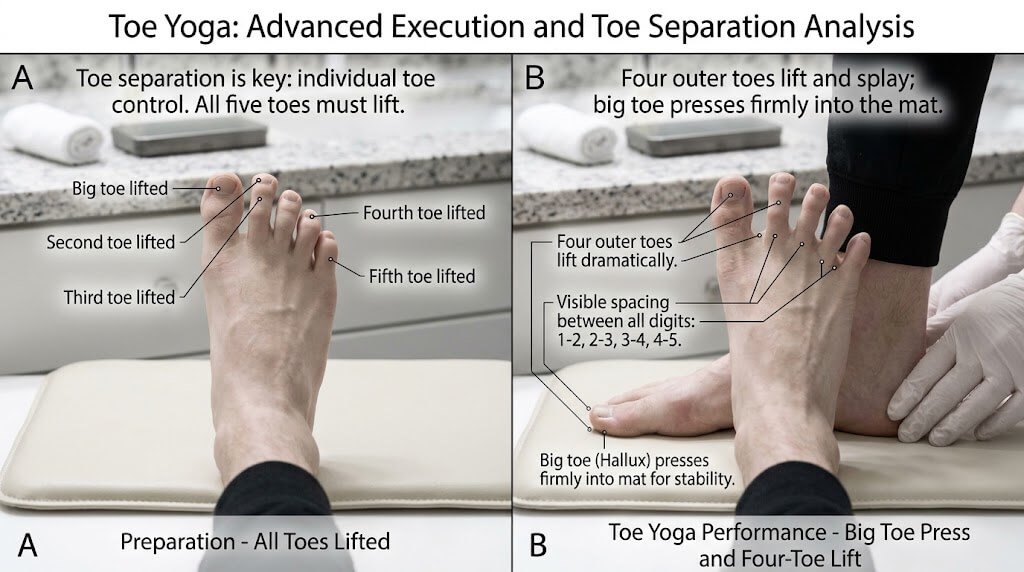
Many gym-goers have toes that pinch tightly together, creating dark, airless pockets where sweat and fungal spores collect. Training your toes to move independently restores natural spacing between the digits.
- How to do it: Stand or sit with your feet flat on the floor. First, press your four smaller toes down into the mat while lifting only your big toe 1 inch (2.5 cm) into the air and holding for 3 seconds. Next, press your big toe firmly into the floor while lifting your four smaller toes up and spreading them wide apart for 3 seconds. Repeat this alternating pattern for 12 reps, trying to create visible space between every toe.
- What it should feel like: Strong neurological focus and mild fatigue in the small muscles on the top and bottom of your feet.
- Easier Version (Regression): Sit in a chair and gently hold your four smaller toes down with your fingers while practicing lifting just your big toe until your brain builds the connection.
- Harder Version (Progression): Place a light mini-loop resistance band around both big toes, pull your heels slightly apart to create tension, and practice lifting and spreading your toes against the band’s resistance.
4. Tibialis Anterior Wall Raises (Controlling Foot Slap and Nail Trauma)
Weakness in the front shin muscle (tibialis anterior) causes your foot to slap down hard when running or walking downhill, increasing shear force inside your shoe and bruising the nail plate.
- How to do it: Lean your upper back and glutes flat against a sturdy wall with your heels placed 12 to 16 inches (30.5 to 40.6 cm) away from the baseboard. Keeping your knees straight, pull your toes and forefeet up toward your shins as high as you can, hold the top position for 2 seconds, and lower your feet back down over 2 seconds without letting the soles rest completely on the floor between reps.
- What it should feel like: A strong, targeted burn along the front of your shins, right next to your shinbone.
- Easier Version (Regression): Move your heels closer to the wall—about 6 to 8 inches (15.2 to 20.3 cm) out—or perform the movement seated in a chair.
- Harder Version (Progression): Walk your heels out to 18 inches (45.7 cm) from the wall, or perform single-leg tibialis raises while standing on a 2-inch (5 cm) step.
5. Loaded Farmer’s Walk With Wide Toe Spread
This drill ties your arch stability and lower-leg circulation together under real gym load, teaching your feet to grip the ground through the foot tripod rather than clawing with your nails.
- How to do it: Wearing clean socks on a sanitized turf strip or wide toe-box training shoes, pick up a pair of 30 lb (13.6 kg) to 50 lb (22.7 kg) dumbbells—one in each hand. Stand tall with your shoulders pulled back, spread your toes wide inside your shoes, and walk slowly in a straight line for 100 feet, or about 0.02 miles (30 meters). Roll smoothly from your heel through your midfoot and push off evenly across all five toes.
- What it should feel like: Solid, balanced pressure across your heel and forefoot with zero toe pinching or forward sliding inside your shoe.
- Easier Version (Regression): Walk 50 feet (15.2 meters) carrying lighter 15 lb (6.8 kg) dumbbells, or walk unweighted while focusing 100% on heel-to-toe mechanics.
- Harder Version (Progression): Increase the dumbbells to 60 lb (27.2 kg) to 75 lb (34 kg) per hand, or carry a single 45 lb (20.4 kg) kettlebell in one hand (suitcase carry) to challenge single-side foot stability.
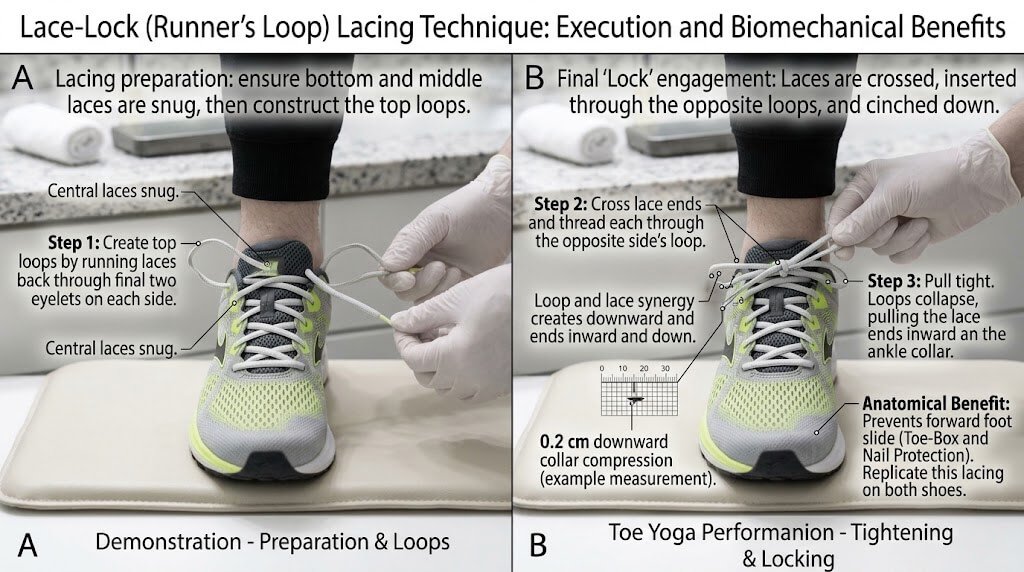
Coach’s Tip: Use the Lace-Lock (Runner’s Loop) Technique
Even if you buy a shoe with a wide toe box and 0.5 inches (1.3 cm) of front clearance, your foot will still slide forward and bruise your toenails if your heel is loose. Use the extra pair of eyelets at the very top of your running or court shoes to tie a “heel lock” or “runner’s loop.” This anchors your ankle bone back into the heel cup so your toes float freely at the front of the shoe during sprints, stops, and lunges.
Common Mistake: Gripping the Floor With Your Toes During Squats and Deadlifts
When lifters hear the cue “grip the floor with your feet,” many respond by curling their toes hard like bird talons. Curling your toes bends the distal phalanx downward and presses the tip of your toenail straight into the shoe sole under hundreds of pounds of load. Over weeks of training, this causes micro-separation of the nail plate. Instead, think about pressing the ball of your big toe, the ball of your pinky toe, and your heel into the floor while keeping your toes long and flat.
Safety Notes and When to See a Doctor or Podiatrist
While smart gym hygiene and better foot mechanics are powerful tools for how to prevent toenail fungus from coming back, certain situations require prompt medical care. Never ignore changing symptoms in your feet or attempt aggressive self-treatment with harsh household chemicals.
Avoid Harsh Home Remedies That Damage the Skin Barrier
Many athletes try soaking their feet in undiluted household bleach, hydrogen peroxide, or strong vinegar mixtures they read about online. Undiluted bleach and harsh chemicals burn the delicate skin around the nail fold and destroy the natural cuticle seal, as warned by the MedlinePlus medical encyclopedia on fungal nail infections. Once that skin barrier cracks or peels, bacteria and fungal spores have an even easier path into your tissue. Stick to clinically tested antifungal sprays, powders, or physician-prescribed maintenance lacquers.
Red Flags That Require a Podiatrist Visit
Schedule an appointment with a doctor or podiatrist right away if you notice any of the following warning signs:
- A new white, yellow, or brown streak appearing at the tip or side of a previously cleared nail.
- Redness, swelling, warmth, or pus around the nail border, which can signal a secondary bacterial infection (paronychia).
- Pain when walking, putting on shoes, or pressing gently on the nail plate.
- Peeling, cracking, or itching skin between the toes that does not clear up after 1 to 2 weeks of over-the-counter athlete’s foot cream.
If you have diabetes, peripheral artery disease, neuropathy (reduced sensation in your feet), or a weakened immune system, even a minor fungal nail recurrence can lead to serious foot ulcers or bacterial infections, according to Harvard Health guidance on toenail fungus. Check your feet every evening in good lighting, and use a small hand mirror to inspect the bottoms of your feet and spaces between your toes. Have a podiatrist handle your routine nail trimming if your nails are thick or hard to reach.
Related Nutrition and Recovery Tips to Support Nail Health
Your toenails grow much slower than your fingernails—averaging only about 0.06 inches (1.5 mm) per month. Because growing a strong, resilient nail plate is an energy-intensive cellular process, your internal nutrition and recovery habits play a supporting role in how to prevent toenail fungus from coming back.
Keep Blood Sugar Steady and Curb Excess Sugar
Dermatophytes and yeasts thrive when blood glucose levels stay chronically elevated. Managing your carbohydrate intake and learning how to stop sugar cravings naturally supports healthy micro-circulation and keeps your immune cells firing at full capacity. Pairing complex carbohydrates with lean proteins and fiber around your workouts prevents sharp glucose spikes that can slow down tissue repair.
Address Micronutrient Gaps for Strong Keratin Growth
Your nail matrix builds the nail plate out of hardened protein called keratin. To build dense, crack-resistant keratin that seals tightly to the nail bed, your body needs adequate dietary protein along with iron, zinc, biotin, and B vitamins. Understanding which vitamins support metabolism when you have a nutritional gap—and how key nutrients support normal energy metabolism—helps ensure your body has the raw materials to grow smooth, healthy nails without ridges or brittle edges.
Prioritize Sleep and Gut Microbiome Balance
Your immune system performs the bulk of its cellular patrol and tissue repair while you sleep. Consistently getting less than 7 hours of sleep raises evening cortisol levels, which suppresses local skin and mucosal immunity. Learning how sleep affects metabolism and recovery hormones gives you another reason to protect your bedtime routine. Additionally, maintaining a diverse gut flora through fermented foods and understanding the role of probiotics in appetite and weight management can support broader systemic immune resilience.
Frequently Asked Questions (FAQ)
Why does toenail fungus keep coming back after treatment?
Toenail fungus usually returns because dormant fungal spores survive inside old shoes, socks, or on unsterilized nail clippers and reinfect the nail. It also comes back if an underlying case of athlete’s foot is left untreated or if tight athletic shoes cause repetitive micro-trauma to the nail bed.
How do I sanitize my gym shoes after toenail fungus?
Remove the insoles after every workout and let both the shoes and insoles air-dry for at least 24 to 48 hours. Spray the inside of the shoes with an over-the-counter antifungal spray or use a UV-C shoe sanitizer device for 15 to 30 minutes to neutralize lingering spores.
Can running or heavy lifting cause toenail fungus to return?
Running and lifting do not create the fungus itself, but they can cause repetitive pressure and friction against the toenails. This mechanical stress causes microscopic lifting of the nail plate from the nail bed, creating an open entry point for fungal spores hiding in sweaty socks or locker rooms.
How often should you change socks to prevent nail fungus?
Change your socks at least once a day, and always switch into a clean, dry pair immediately after finishing a workout or run. If your feet sweat heavily during the day, changing into moisture-wicking merino wool or synthetic socks midday keeps moisture away from the nail bed.
Does alcohol or bleach kill toenail fungus on clippers?
Yes, scrubbing metal nail clippers with soap and water to remove debris and then soaking them in 70% to 90% isopropyl alcohol or a 10% bleach-and-water solution for 10 minutes effectively disinfects the blades. Always rinse and dry metal tools thoroughly after a bleach soak to prevent rust.
Should you throw away shoes after curing toenail fungus?
If you have old, heavily worn running shoes or boots that absorbed months of sweat during an active infection, throwing them away is the safest way to avoid reinfection. Newer or expensive athletic shoes can be kept if you replace the foam insoles and sanitize the interiors regularly.
Conclusion: Your Game Plan on How to Prevent Toenail Fungus From Coming Back
Once you have put in the work to clear a stubborn nail infection, keeping your feet healthy comes down to consistent daily habits. Knowing how to prevent toenail fungus from coming back does not require complicated routines—just smart gear management, strict post-workout hygiene, and strong foot mechanics.
Start today by auditing your shoe closet: toss out worn-out insoles, set up a two-pair shoe rotation, and stock your gym bag with moisture-wicking socks and waterproof shower slides. Add the 15-minute foot and lower-leg circulation routine three times a week to keep your arches strong, your toes spaced out, and fresh blood pumping down to your nail beds. Stay consistent with the 3-minute post-shower dry rule and tool sterilization, and your nails will stay clear, strong, and ready for every mile and heavy set ahead.