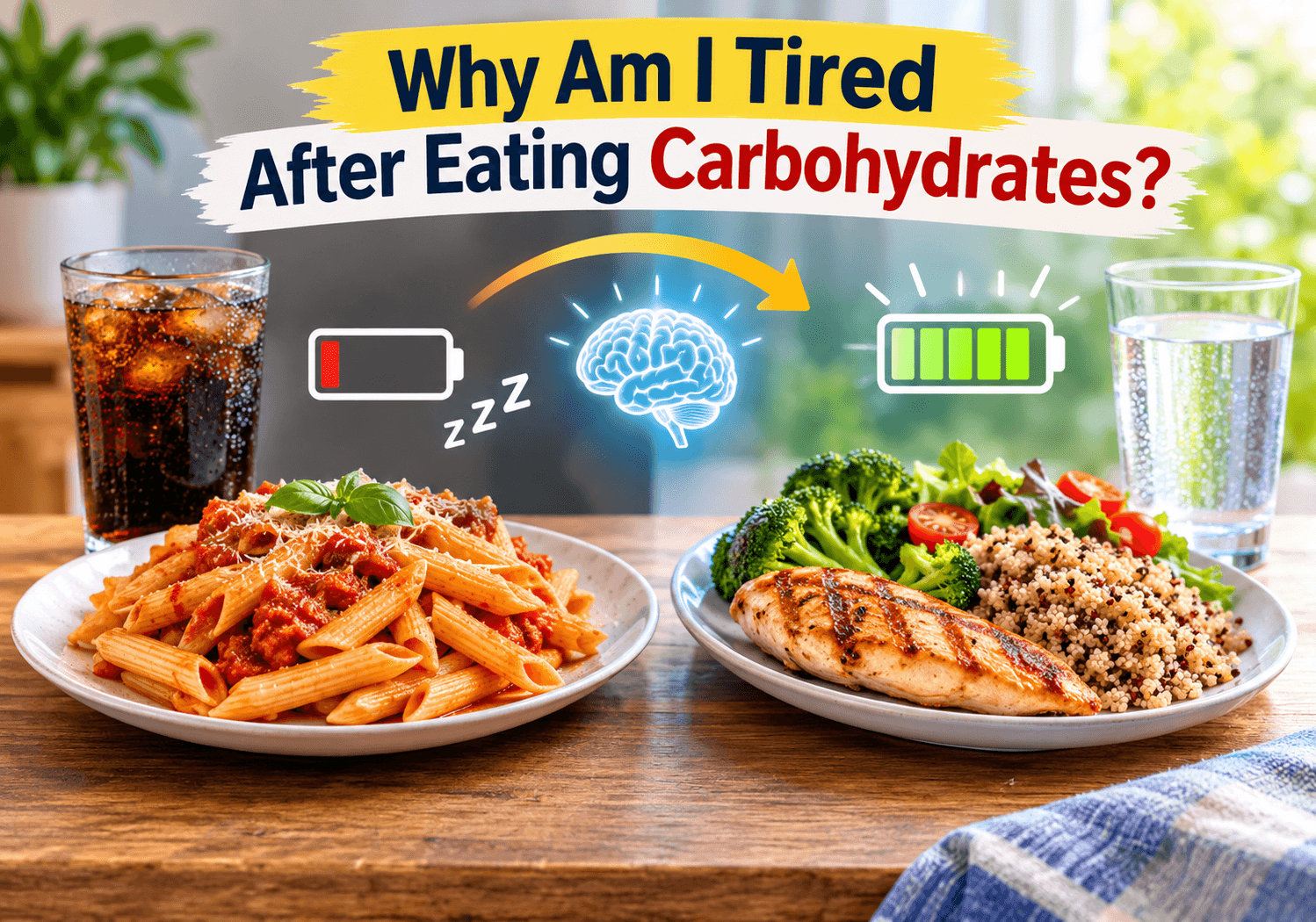
If you have ever finished a big bowl of pasta, a stack of pancakes, or a sandwich at lunch and immediately wanted to take a nap, you are not alone. Many active people and gym beginners ask me, “Why am I tired after eating carbohydrates?” during nutrition check-ins. That heavy, sluggish wave that hits 30 to 90 minutes after a meal has a real medical name: postprandial somnolence, often called a “food coma.”
While carbohydrates are your body’s preferred fuel source for hard workouts and daily movement, eating the wrong types—or eating too many at once without protein and fiber—triggers a chain reaction in your hormones and brain chemistry. Understanding how your body processes starch and sugar lets you keep carbs in your diet for workout energy without sacrificing your afternoon focus.
Quick Answer: Feeling tired after eating carbohydrates happens primarily because fast-digesting carbs cause a rapid spike in blood sugar and insulin, followed by a sudden energy drop. At the same time, insulin helps the amino acid tryptophan enter your brain, boosting sleep-inducing serotonin and melatonin while temporarily shutting down wakefulness neurons called orexin.
The Science: Why Carbs Make You Sleepy
To fix post-meal fatigue, it helps to look at what happens inside your body the moment you swallow a bite of bread, rice, or sugary snacks. Your digestive system, pancreas, and brain all respond to carbohydrates within minutes.
1. The Blood Sugar and Insulin Rollercoaster
When you eat refined or simple carbohydrates—like white bread, pastries, soda, or white rice—your digestive tract breaks them down into glucose very quickly. This floods your bloodstream with sugar. In response, your pancreas releases a large surge of insulin to shuttle that glucose into your muscle and fat cells.
When the insulin surge is too aggressive, it can clear glucose out of your blood a little too fast. According to the Mayo Clinic guide on reactive hypoglycemia, a rapid drop in blood sugar within four hours of eating can leave you feeling shaky, weak, irritable, and deeply fatigued. Even if your blood sugar stays within a normal medical range, the steep drop from a high peak feels like hitting a brick wall.
2. Brain Chemistry: Tryptophan, Serotonin, and Melatonin
Carbohydrates do not contain high amounts of tryptophan on their own, yet they play a major role in helping it reach your brain. Under normal conditions, tryptophan has to compete with other large amino acids to cross the blood-brain barrier.
When you eat a high-carbohydrate meal, the resulting insulin spike clears most of those competing amino acids into your skeletal muscles. Tryptophan is left behind in the bloodstream with an open path straight into your brain. Once inside, your brain converts tryptophan into serotonin (a calming neurotransmitter) and then into melatonin (the hormone that regulates your sleep-wake cycle), as explained in research hosted by the National Center for Biotechnology Information (NCBI).
3. Glucose Shuts Down Wakefulness Neurons
Deep inside your hypothalamus sits a small group of brain cells that produce orexin (also called hypocretin). Orexin neurons keep you alert, focused, and energized. Research published through PubMed Central (PMC) shows that rising blood glucose levels directly inhibit the firing of orexin neurons. In simple terms, high blood sugar tells your brain’s “stay awake” switch to dim the lights.
4. Digestive Workload and Blood Flow Shifts
Digesting a heavy, calorie-dense meal requires significant energy. Your autonomic nervous system shifts into “rest and digest” mode (parasympathetic dominance) to break down food and absorb nutrients. While blood flow to your brain remains protected, blood flow to your gastrointestinal tract increases substantially, and your body slows down physical drive so it can focus on digestion.

High-Glycemic vs. Low-Glycemic Carbohydrates
Not all carbohydrates trigger the same level of fatigue. The speed at which a food raises your blood sugar is measured by the glycemic index (GI) on a scale from 0 to 100, while glycemic load (GL) accounts for both the GI and the actual portion size you eat. Understanding this difference is key if you want steady energy.
| Carbohydrate Type | Examples | Digestion Speed | Blood Sugar & Insulin Impact | Fatigue Risk |
| Refined Sugars | Candy, soda, sweetened coffee, pastries, fruit juice | Very fast (15–30 minutes) | Sharp spike followed by a rapid crash | Very High |
| Refined Starches | White bread, white rice, regular pasta, crackers, chips | Fast (30–60 minutes) | High glucose surge and strong insulin response | High |
| Whole Grains | Rolled oats, quinoa, brown rice, 100% whole-wheat bread | Moderate (1.5–3 hours) | Gradual rise in blood glucose; steady insulin | Low to Moderate |
| Legumes & Beans | Lentils, black beans, chickpeas, kidney beans | Slow (2–4 hours) | Minimal spike due to high fiber and protein content | Very Low |
| Non-Starchy Vegetables | Broccoli, spinach, bell peppers, zucchini, cauliflower | Very slow | Negligible impact on blood sugar | Minimal |
Coach’s Tip: You do not need to eliminate white rice or pasta forever, especially if you lift weights or run. Instead, treat fast-digesting carbs as “workout fuel.” Eat them 60 to 90 minutes before training or right after a hard session when your muscles are primed to soak up glucose without causing a sleep-inducing crash.

7 Common Culprits Behind Your Post-Carb Energy Crash
When clients tell me they feel exhausted after eating, we usually find one or more of these seven daily habits behind the slump.
- Eating “Naked” Carbohydrates: Having a plain bagel, a bowl of cereal, or a plate of fries without protein or healthy fats leaves nothing in your stomach to slow down digestion. Glucose hits your bloodstream all at once.
- Oversized Portions at Lunch: Eating a 1,000-calorie carbohydrate-heavy lunch creates a massive glycemic load. The larger the total carb dose, the harder your pancreas has to work to clear it.
- Poor Sleep the Night Before: According to the CDC sleep and chronic disease guidelines, sleep deprivation temporarily impairs insulin sensitivity. If you only slept five hours, your body handles a bowl of oatmeal much worse than it would after eight hours of rest.
- Dehydration: Mild dehydration concentrates the glucose in your bloodstream and reduces blood volume, making sluggishness after a meal feel twice as heavy.
- Hidden Sugars in Sauces and Drinks: A meal that looks balanced—like a chicken teriyaki bowl with a sweetened iced tea—can pack over 60 grams (2.1 oz) of added sugar, triggering an unexpected insulin spike.
- Sitting Still Immediately After Eating: When you sit at a desk right after eating, your large leg and back muscles stay inactive. Active muscles absorb glucose without needing as much insulin, whereas resting muscles force your pancreas to do all the heavy lifting.
- Low Overall Muscle Mass or Metabolic Inflexibility: Skeletal muscle is your body’s largest storage tank for carbohydrates (stored as glycogen). If you have low muscle mass or rarely exercise, your glycogen tanks stay full, causing excess carbs to linger in your bloodstream longer. Improving your ability to switch between burning carbs and fat—known as how to boost metabolic flexibility—helps flatten those energy swings.
How to Stop Feeling Tired After Eating Carbs: 6 Practical Strategies
You can stop the afternoon slump without going on an extreme zero-carb diet. Use these six evidence-based adjustments at your very next meal.
1. Follow the “Fiber First, Protein Second, Carbs Last” Order
The order in which you eat the food on your plate changes your blood sugar curve. Research indexed by NIH / PubMed demonstrates that eating vegetables and protein before carbohydrates significantly lowers post-meal glucose and insulin spikes compared to eating carbs first.
- Step 1: Eat your non-starchy vegetables (salad, broccoli, green beans) first. The fiber forms a gentle mesh in your stomach.
- Step 2: Eat your lean protein and healthy fats (chicken, fish, eggs, tofu, olive oil) next to slow stomach emptying.
- Step 3: Eat your starches or fruit (rice, potatoes, bread) last.
2. Pair Every Carb with Protein and Soluble Fiber
Aim for at least 25 to 35 grams (0.9 to 1.2 oz) of protein and 8 to 10 grams (0.3 to 0.35 oz) of fiber at your main meals. Understanding how protein intake affects hunger and fullness shows why this pairing works: protein slows gastric emptying and triggers satiety hormones that stabilize energy. Adding viscous fiber is equally effective, as explained in our breakdown of how soluble fiber supports fullness.
3. Take a 10-to-15-Minute Post-Meal Walk
One of the fastest ways to prevent a carb crash is light movement right after you put your fork down. A review in Sports Medicine (via PubMed) found that even brief bouts of light walking after a meal significantly blunt post-meal blood sugar spikes compared to sitting.
- Distance & Pace: Walk 0.5 to 0.75 miles (0.8 to 1.2 km) at an easy, conversational pace of about 2.5 to 3.0 mph (4.0 to 4.8 km/h).
- Why It Works: Contracting your leg muscles pulls glucose directly out of your bloodstream using GLUT4 transporters, reducing the insulin spike that causes drowsiness.

4. Build More Muscle with Resistance Training
Lifting weights expands your glycogen storage capacity and improves how well your cells respond to insulin for up to 24 to 48 hours after a session. When you combine regular strength workouts with good nutrition, your muscles act like a sponge for carbohydrates.
5. Watch Your Daytime Portion Sizes
Instead of eating 120 grams (4.2 oz) of carbs at lunch and almost none at dinner, split your intake evenly across meals. Keeping daytime meals around 40 to 60 grams (1.4 to 2.1 oz) of complex carbohydrates gives your brain steady fuel without overwhelming your digestive system.
6. Prioritize 7 to 9 Hours of Quality Sleep
Good sleep is foundational for blood sugar control. If you constantly wake up groggy and rely on sugary snacks to push through the day, explore how sleep affects metabolism and weight management to break the fatigue cycle.
Common Mistake: Reaching for a sugary energy drink or a second large latte to fight off a carb crash. While caffeine temporarily blocks sleepiness receptors, adding more sugar triggers a second insulin spike 60 minutes later, leaving you even more exhausted by late afternoon. Learn more about why caffeine causes energy crashes before grabbing another cup.
A Coach’s 15-Minute Post-Meal Movement Routine (No Equipment)
If you work from home or cannot walk outside due to bad weather, use this quick bodyweight circuit 15 to 20 minutes after eating. It activates your largest muscle groups—quads, glutes, hamstrings, and back—to clear blood glucose gently without upsetting your stomach.
- Goal: Improve post-meal glucose uptake and boost alertness.
- Equipment: None (just comfortable shoes or a mat).
- Intensity: Light to moderate (RPE 4–5 out of 10; you should easily hold a conversation).
Warm-Up (2 Minutes)
- March in Place with Arm Swings: 60 seconds at a relaxed tempo.
- Standing Torso Twists: 60 seconds, rotating gently from side to side to wake up your spine.
Main Circuit (Complete 3 Rounds)
| Exercise | Sets / Rounds | Reps / Duration | Tempo | Rest Between Moves |
| 1. Bodyweight Box Squats | 3 | 12–15 reps | 2 sec down, 1 sec up | 15 seconds |
| 2. Incline Push-Ups (Desk or Wall) | 3 | 10–12 reps | 2 sec down, 1 sec up | 15 seconds |
| 3. Alternating Reverse Lunges | 3 | 8–10 reps per leg | Controlled, steady pace | 15 seconds |
| 4. Standing Calf Raises | 3 | 20 reps | 1 sec up, 1 sec squeeze | 15 seconds |
| 5. Brisk Hallway March or Step-Ups | 3 | 60 seconds | Continuous light pace | 30 seconds after round |

Step-by-Step Form Cues
- Bodyweight Box Squats: Stand in front of a sturdy chair with feet shoulder-width apart. Push your hips back, keep your chest proud, lightly tap the seat with your glutes, and stand back up. What it should feel like: Gentle tension in your thighs and glutes without straining your lower back or stomach.
- Incline Push-Ups: Place your hands slightly wider than shoulder-width on a sturdy desk, countertop, or wall. Keep your body in a straight line from head to heels, lower your chest toward the surface, and press back up.
- Alternating Reverse Lunges: Step one foot back about 24 to 30 inches (60 to 76 cm), lower your back knee toward the floor until both knees form roughly 90-degree angles, and push through your front heel to return to standing.
- Standing Calf Raises: Hold onto a wall or chair back for balance. Rise onto the balls of your feet, pause for one full second at the top, and lower slowly. Your soleus muscle (the deep calf muscle) is remarkably efficient at burning blood glucose during low-intensity movement.
Regressions and Progressions
- Easier Version (Regression): Skip the reverse lunges and perform seated knee extensions in your chair (12 reps per leg). Do wall push-ups instead of desk push-ups, and shorten the march to 30 seconds.
- Harder Version (Progression): Hold a pair of 10 to 15 lb (4.5 to 6.8 kg) dumbbells during your squats and lunges, perform standard floor push-ups, and add a 5-minute brisk walk at the end.
Meal Swaps to Prevent Afternoon Fatigue
Small ingredient upgrades keep your meals satisfying while flattening your blood sugar curve. Here is how to rebuild common high-crash meals into steady-energy fuel:
- Breakfast Swap: Trade two sweetened waffles with maple syrup for two scrambled eggs, one slice of sprouted whole-grain toast, and half an avocado.
- Lunch Swap: Trade a large white-flour burrito with white rice and sour cream for a burrito bowl with a base of shredded lettuce, black beans, grilled chicken breast, salsa, and a modest 0.5-cup portion of brown rice.
- Snack Swap: Trade a vending-machine muffin or bag of pretzels for plain Greek yogurt topped with a handful of berries and 1 oz (28 g) of walnuts.
- Dinner Swap: Trade a massive bowl of white spaghetti with marinara for a half-portion of chickpea or whole-wheat pasta tossed with lean ground turkey, spinach, garlic, and olive oil.
If you struggle with intense sweet cravings right after meals, learning how to manage cravings during a calorie deficit and exploring how to improve daily energy without caffeine can help you build sustainable nutrition habits.
When Should You Talk to a Doctor?
Occasional drowsiness after a big holiday dinner or a heavy pasta lunch is completely normal. However, persistent, severe exhaustion after normal-sized meals can sometimes point to an underlying medical issue.
Schedule a visit with your healthcare provider if your post-carb fatigue is accompanied by any of these symptoms:
- Extreme thirst or frequent urination
- Shakiness, sweating, dizziness, or confusion 1 to 3 hours after eating (signs of reactive hypoglycemia)
- Blurred vision or unexplained weight changes
- Brain fog, bloating, or digestive pain after eating gluten-containing grains (which may warrant testing for celiac disease or food intolerances)
According to the National Institute of Diabetes and Digestive and Kidney Diseases (NIDDK), recurring post-meal fatigue can be an early sign of insulin resistance or prediabetes. A simple fasting blood glucose test or HbA1c test from your doctor can give you clear answers and peace of mind.
(Note: If you have diabetes, prediabetes, a history of hypoglycemia, or another medical condition, check with your doctor or registered dietitian before making major changes to your diet or exercise routine.)
Frequently Asked Questions (FAQ)
Why do carbs make me sleepy immediately after eating?
Fast-digesting carbohydrates spike your blood sugar quickly, which triggers a large release of insulin. Insulin clears competing amino acids from your bloodstream, allowing tryptophan to enter your brain and increase serotonin and melatonin production. Simultaneously, rising blood glucose suppresses orexin neurons in your brain that normally keep you alert and awake.
Is being tired after eating carbs a sign of diabetes?
Not necessarily. Occasional sleepiness after a large, high-carb meal is a normal physiological response in healthy people. However, if you feel severely exhausted, dizzy, or unusually thirsty after small or balanced meals, it can be a sign of insulin resistance or prediabetes, and you should ask your doctor for a blood glucose screening.
How long does a carb coma usually last?
A typical post-meal energy slump lasts anywhere from 45 minutes to 2 hours, depending on the size of your meal and how fast you digest it. Taking a 10-minute brisk walk or doing light bodyweight movement right after eating can cut that sluggish window down significantly by helping your muscles absorb glucose faster.
What foods prevent a blood sugar crash after eating carbs?
Pairing carbohydrates with lean protein (chicken, fish, eggs, Greek yogurt), soluble fiber (beans, oats, chia seeds, broccoli), and healthy fats (olive oil, avocado, nuts) slows down digestion. Eating your vegetables and protein before touching the starches on your plate further blunts the insulin spike and keeps your energy steady.
Does walking after eating carbs really stop fatigue?
Yes. Light walking for just 10 to 15 minutes after a meal activates your leg muscles, which pull glucose directly out of your bloodstream without requiring a massive insulin surge. Clinical research shows that post-meal walking lowers blood sugar peaks, prevents reactive crashes, and improves alertness compared to sitting still.
Conclusion
Asking “why am I tired after eating carbohydrates?” is the first step toward taking control of your daily energy. Carbs are not the enemy—they are vital fuel for your brain and your workouts. When you eat refined starches or sugars by themselves in large portions, the resulting insulin spike, tryptophan shift, and orexin slowdown naturally make you want to nap.
Start with two simple changes today: eat your vegetables and protein first before diving into your carbs, and take a 10-minute walk after your largest meal. Over time, building muscle through regular strength training and prioritizing quality sleep will make your body far more resilient to carbohydrates.