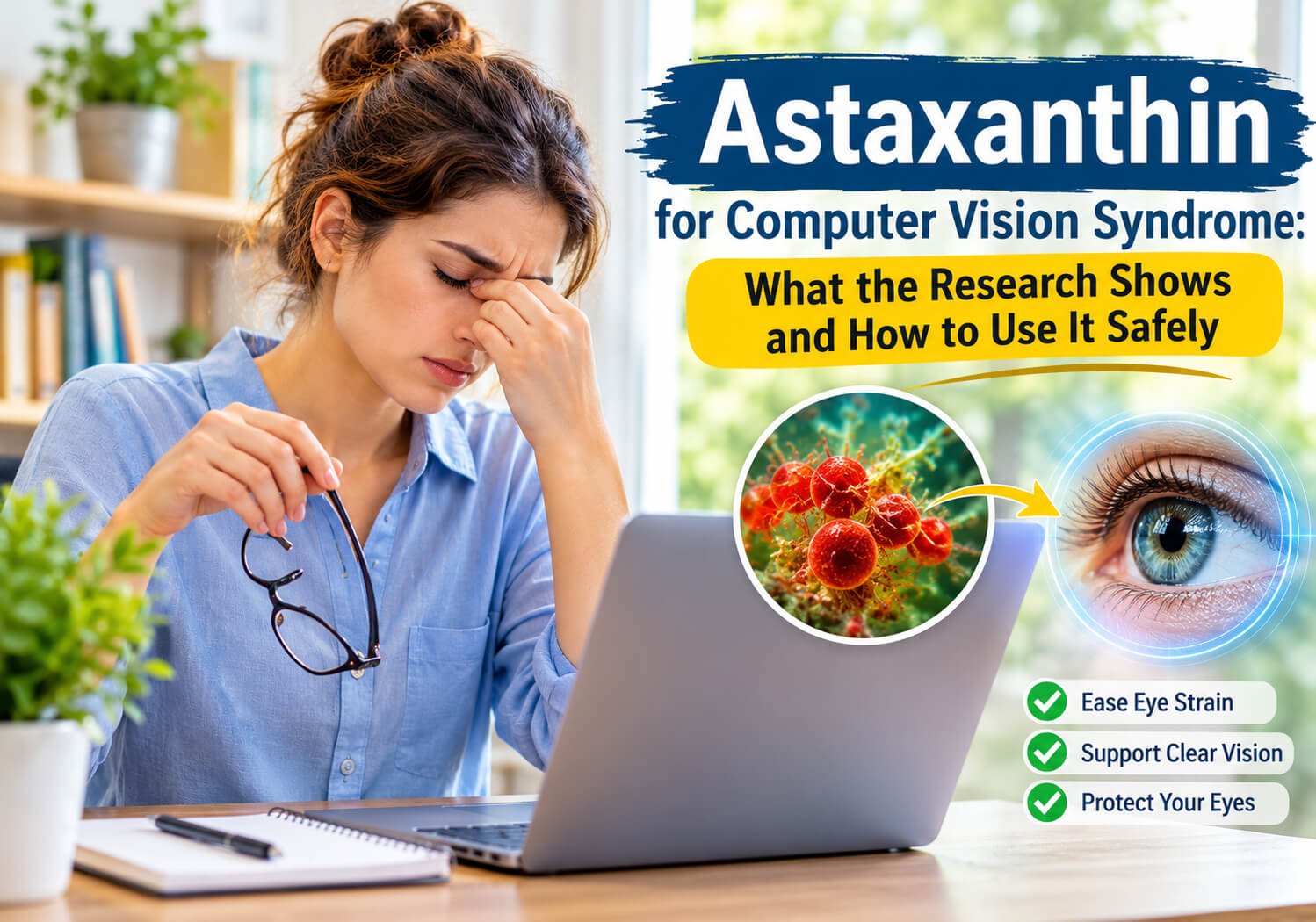
By mid-afternoon, many desk workers notice sore eyes, a dull headache, and tight shoulders. That cluster of symptoms has a name: computer vision syndrome, also called digital eye strain. Lately, a lot of people ask whether astaxanthin for computer vision syndrome is worth trying.
I look at this the way I look at any recovery tool. What do the studies show, how big is the effect, and what should you fix first? This guide covers the research, a realistic dose range, safety, and a desk routine that does more than any capsule.
Quick Answer
Astaxanthin for computer vision syndrome shows early promise, but it is not proven. Small human trials suggest about 9 mg a day for six weeks may ease focusing fatigue, especially in adults over 40. Treat it as an add-on to screen breaks, good lighting, and eye exams, not a replacement for them.
What Is Computer Vision Syndrome?
Computer vision syndrome is a group of eye and body complaints linked to long screen use. According to Mayo Clinic, signs of eyestrain include:
- Sore, tired, burning, or itching eyes
- Watery or dry eyes
- Blurred or double vision
- Headache
- Sore neck, shoulders, or back
- Increased sensitivity to light
- Difficulty concentrating
Notice that half of that list is not about the eyes at all. Neck and shoulder tension travels with eye strain because we crane forward, freeze our posture, and stare for hours. That is where my coaching background comes in, and we will use it later in this guide.
Researchers often call this problem “visual display terminal work” (VDT work) in the older literature. The same idea shows up as asthenopia, the medical word for eye fatigue. One common cause is the effort of keeping your eyes focused at a fixed, close distance for a long time.
Mayo Clinic notes that eyestrain usually goes away once you rest your eyes or take other steps to reduce discomfort. It also says that in some cases the symptoms can point to an underlying eye condition that needs treatment. So persistent symptoms deserve an eye exam, not just a supplement.

What Is Astaxanthin and How Might It Work?
Astaxanthin is a red-orange pigment called a carotenoid. It gives salmon, shrimp, and krill their pink color. Most supplements use a form made from a microalgae called Haematococcus pluvialis, which is often labeled “natural astaxanthin.”
Why would a pigment help tired eyes? Researchers have proposed a few ideas. The authors of a 2021 trial in the Journal of Clinical Biochemistry and Nutrition pointed to astaxanthin’s possible effects on blood vessel dilation and blood flow. They also noted reports that it may support the ciliary muscle, the small muscle inside the eye that changes focus from far to near.
A 2023 trial from the same journal suggested that astaxanthin may recover ciliary body function and improve focusing and eye fatigue by improving blood circulation. It also suggested that astaxanthin may reduce oxidative stress caused by screen work. These are proposed mechanisms, not proven ones. Think of them as the “why it might work” theory, not the guarantee.
Coach’s Tip: Think of your ciliary muscle like a muscle you hold in a static position all day. Holding a plank for eight hours would wreck anyone. Short breaks matter more than any supplement.
What the Research Says About Astaxanthin for Computer Vision Syndrome
The most useful way to judge astaxanthin for computer vision syndrome is to look at what was tested, in whom, and for how long. I focused on randomized, placebo-controlled trials, which are the stronger study type.
The 2023 trial in 60 screen workers
This is the most direct study I found. Researchers ran a randomized, double-blind, placebo-controlled trial in 60 healthy adults aged 20 to 64. All were regular screen workers at high risk of eye fatigue, and they took a diet containing astaxanthin (9 mg/day) or placebo for six weeks. The team measured visual acuity, functional visual acuity, and pupil constriction before and after screen work.
Here is what the abstract reports:
- In participants aged 40 and older, corrected visual acuity of the dominant eye after screen work was better protected in the astaxanthin group than in the control group (p<0.05).
- In participants under 40, there was no significant difference between groups.
- The published version also reports no significant difference in functional visual acuity or pupil constriction rate between groups.
So the result was real but narrow. It showed up in one measure, in one age group, over six weeks.
The 2021 trial of a three-ingredient formula
A second randomized, double-blind, placebo-controlled study tested a combination of anthocyanin (from bilberry), astaxanthin, and lutein in adults with eye fatigue after screen work. According to the journal abstract, 44 people took two capsules a day for six weeks, with 20 per group in the efficacy analysis. The active group improved their pupil response after screen work and reported less trouble focusing and less difficulty seeing nearby objects and fine print.
The big caveat is that it was a blend. You cannot say how much of the benefit came from astaxanthin alone. That matters if you are buying a single-ingredient product.
What the broader reviews say
A recent systematic review of nine randomized trials looked at nutrition for myopia. It found that carotenoids, including astaxanthin, produced modest benefits such as reduced visual fatigue. The authors also said the trials were generally small, varied in design, and short. That is a fair summary of the whole field.
A separate meta-analysis of 11 randomized trials with 346 healthy participants looked at astaxanthin and general fatigue, not eye fatigue specifically. Its reported results were mixed: it described a positive trend for subjective fatigue relief in two existing studies. I mention it only to show that the wider fatigue evidence is still limited.
The honest limits
Here is what we do not know:
- Trial size and length. The trials I could verify had 44 to 60 people and lasted six weeks.
- Who benefits. The clearest signal was in adults over 40. Younger workers did not show a clear difference in the 2023 study.
- Industry links. Several astaxanthin trials involve ingredient suppliers. Check each paper’s funding and conflict-of-interest statement [VERIFY].
- Real-world symptoms. Some measures were lab tests such as pupil response, not how people feel at 4 p.m.
I would call the current evidence promising but early. That is a good reason to try simple habits first.
Evidence at a Glance
| Study | Who | What they took | Length | Main finding |
| Sekikawa et al., 2023 | 60 screen workers, ages 20–64 | Astaxanthin diet, 9 mg/day | 6 weeks | Better protected acuity of dominant eye after screen work in ages 40+; no difference under 40 |
| Kizawa et al., 2021 | 44 adults with screen eye fatigue | Bilberry + astaxanthin + lutein blend | 6 weeks | Better pupil response and focusing symptoms; cannot isolate astaxanthin |
| Myopia supplement review | 9 randomized trials | Various carotenoids and anthocyanins | Varied | Modest benefits, including less visual fatigue; trials small and short |
How to Use Astaxanthin for Computer Vision Syndrome: Dose, Timing, and Product Choice
If you decide to try astaxanthin for computer vision syndrome, a few practical choices matter more than the brand name.
Dose and timing
The trial I could verify most clearly used 9 mg a day for six weeks. Earlier Japanese trials reportedly used lower daily amounts, roughly 4 to 6 mg. Many commercial products sit in the 4 to 12 mg range.
Because this is a supplement, always follow the label and talk with your doctor. Mayo Clinic specifically advises talking with a healthcare provider if you are considering supplements for eyestrain.
Plan on at least six weeks before judging whether it helps, since that is how long the trials ran. Track one or two simple signs, such as how your eyes feel at the end of the workday and how often you get screen headaches. If you notice nothing after two months, stop and spend your money on an eye exam or better desk gear instead.
Astaxanthin is fat-soluble, so many labels suggest taking it with a meal that contains some fat . Keep the timing consistent, such as with lunch.
Natural versus synthetic
Most human studies use natural astaxanthin from algae. A 2019 safety review in Phytotherapy Research examined 87 human studies and reported that none found safety concerns with natural astaxanthin, including 35 with doses of 12 mg/day or more. The authors also noted that synthetic astaxanthin is chemically different and should not be assumed to have the same safety record. They noted that recommended or approved doses vary by country, from about 2 to 24 mg.
For you, the takeaway is simple. Choose a product that clearly says “natural” and names its source.
A label checklist
Before you buy, check for:
- The form and source. It should say natural astaxanthin from Haematococcus pluvialis.
- The amount per serving. It should list astaxanthin in milligrams, not just “algae extract.”
- Extra ingredients. If it is a blend with lutein or bilberry, you are buying a different thing than the single-ingredient trials.
- Third-party testing. Look for an independent testing seal.
- Allergens. Some products use oils or capsule shells that matter for allergies.
For a deeper checklist, see our guide on how to evaluate supplement ingredients.
Common Mistake: Buying a “complete eye formula” and assuming the astaxanthin dose is meaningful. Many blends contain a tiny amount of each ingredient. Check the milligrams, not the front label.
Safety Notes: Who Should Talk to a Doctor First
Based on the 2019 safety review, natural astaxanthin has a reassuring record in studies. Still, “studied” is not the same as “right for you.” Check with a doctor or pharmacist before starting if you:
- Are pregnant, breastfeeding, or trying to conceive
- Take blood pressure, blood sugar, or blood-thinning medicines
- Have a seafood or shellfish allergy and the product uses marine sources
- Have an existing eye condition or have not had a recent eye exam
- Take several supplements already
Stop taking it and get medical advice if you notice allergic symptoms, such as swelling or trouble breathing, or any persistent stomach problems. One commonly mentioned effect at higher doses is reddish stool . Do not assume it is harmless if you also see other symptoms.
Also remember that eye strain can hide other problems. Mayo Clinic notes that symptoms can sometimes signal an underlying condition that needs treatment. See an eye doctor if you have eye pain, sudden vision changes, double vision that does not go away, or symptoms that persist after you rest.

Astaxanthin for Computer Vision Syndrome Works Best With Desk Habits
Here is where my coaching lens is most useful. Even if astaxanthin helps, the trials tested people who were also working at screens. Habit changes cost nothing and have no side effects. Do these first.
Step 1: Use the 20-20-20 rule
Mayo Clinic suggests the 20-20-20 rule. Every 20 minutes, look at something 20 feet (6 m) away for at least 20 seconds. Set a repeating timer. If you use the Pomodoro method, build the look-away into every work block.
Step 2: Blink fully and often
Mayo Clinic also recommends blinking often to refresh your eyes. When you focus hard, you tend to blink less. Try a slow, full blink every time you finish an email or change tabs.
Step 3: Fix lighting and screen settings
Mayo Clinic recommends checking the lighting and reducing glare. It also suggests enlarging type and adjusting contrast and brightness to a comfortable level.
Place your screen about an arm’s length from your eyes, roughly 25 inches (64 cm), with the top of the screen at or slightly below eye level. If you tilt your head back to read through your glasses, raise the monitor or ask your eye doctor about computer glasses.

Step 4: Add two-minute movement snacks
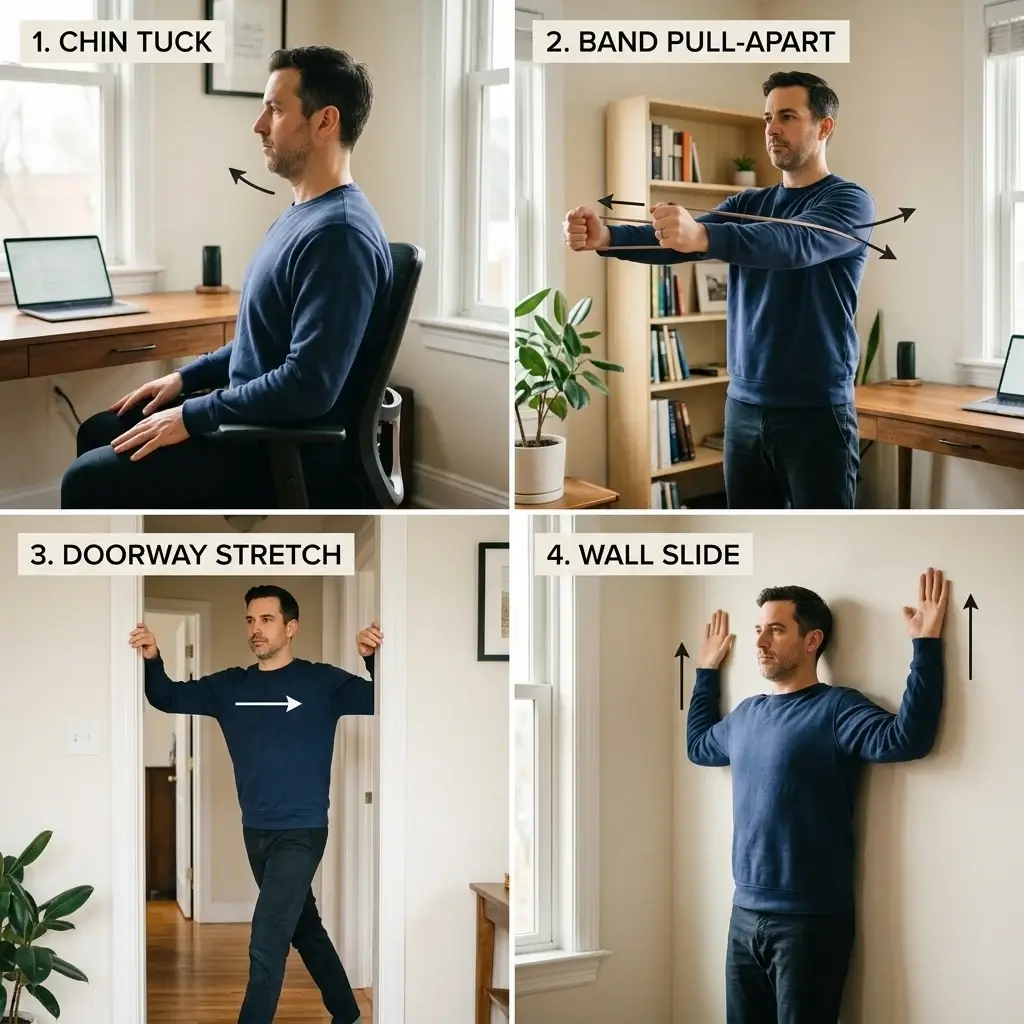
Neck and shoulder tension is part of the computer vision syndrome picture. These moves take two minutes and need almost no equipment. I do not claim they treat eye strain. They simply break up the frozen posture that goes with long screen sessions.
1. Chin tuck
- How: Sit tall. Gently glide your head straight back, as if making a double chin. Keep your eyes level.
- Dose: 2 sets of 8 reps, 3-second hold, rest 20 seconds.
- It should feel like: A mild stretch at the base of your skull, not pain.
- Easier: Do it lying on your back with a small towel under your head.
- Harder: Hold for 5 seconds and add light fingertip pressure on your chin.
2. Band pull-apart
- How: Hold a light resistance band at chest height, arms straight. Pull it apart by squeezing your shoulder blades back and together.
- Dose: 2 sets of 12–15 reps, 2 seconds out, 2 seconds back, rest 30 seconds.
- It should feel like: Work between your shoulder blades, not in your neck.
- Easier: Use a very light band or do the same motion with no band.
- Harder: Use a stronger band or pause 2 seconds at the end of each rep. If you prefer weights, use one-arm dumbbell rows with 8–12 lb (3.5–5.5 kg), 2 sets of 10 per side.
3. Doorway chest stretch
- How: Place your forearm on a door frame with your elbow at about shoulder height. Step through gently until you feel a stretch across your chest.
- Dose: 2 rounds of 30 seconds per side. Breathe slowly.
- It should feel like: A comfortable pull in the front of your shoulder, with no tingling in your arm.
- Easier: Lower your elbow and take a smaller step.
- Harder: Raise your arm higher and add a gentle rotation away from the wall.
4. Wall slide
- How: Stand with your back and forearms against a wall. Slide your arms up and down, keeping your ribs down.
- Dose: 2 sets of 8–10 slow reps, 3 seconds up, 3 seconds down, rest 30 seconds.
- Easier: Keep your elbows lower and move a shorter range.
- Harder: Hold a light band stretched between your wrists.
Coach’s Tip: Attach movement to something you already do. Do the chin tuck every time you refill your water. Habit stacking works better than willpower.
Common Mistake: Doing the 20-20-20 look-away while scrolling your phone. Your eyes are still focusing close. Look out a window or down a hallway.
A simple four-week plan
| Week | Habit focus | Daily target |
| 1 | 20-20-20 rule and blinking | Timer set for every 20 minutes |
| 2 | Screen setup and lighting | Fix distance, height, and glare |
| 3 | Add movement snacks | Two movement snacks per workday |
| 4 | Review | Note symptoms; decide if you want to discuss astaxanthin with your doctor |
If you do decide to add astaxanthin, start it after you have these habits in place. That way you can tell whether the supplement made any difference.
Related Tips
Lutein and other nutrients. Lutein is another carotenoid you will see in “eye formulas.” The 2021 trial combined it with astaxanthin, so it is hard to separate effects. Treat blends as a different product from single-ingredient astaxanthin.
Omega-3s. People often ask whether to pair astaxanthin with fish oil. Our guide covers omega-3 fatty acids and inflammation, but it focuses on skin, and I did not find solid trial evidence in this research pass linking the combination to screen eye strain.
Skin is a separate topic. Astaxanthin is popular for other reasons too. If you are curious, read about astaxanthin and skin health, but note that the eye studies above do not tell you whether it helps skin.
Afternoon slump. Eye strain often arrives with fatigue. If your afternoons drag, see our tips on daily energy without caffeine and how to build energy naturally.
Get your eyes checked. An up-to-date eye exam can catch uncorrected vision problems that make screen work harder.
When to See an Eye Doctor Instead of Buying a Supplement
Skip the supplement aisle and book an exam if you have:
- Eye pain or a feeling of pressure
- Sudden changes in vision, flashes, or floaters
- Double vision that does not clear with rest
- Red eyes that persist, or discharge
- Headaches that keep getting worse
- Symptoms that continue after a weekend without screens
These can point to problems that a capsule will not fix.
Frequently Asked Questions
Does astaxanthin help with computer eye strain?
It may help some people, but the evidence is early. A six-week randomized trial in screen workers found a protective effect on visual acuity after screen work in adults aged 40 and older, but not under 40. Results were limited to certain measures. Screen breaks and an eye exam should come first.
How much astaxanthin should I take for eye fatigue?
The clearest trial I verified used 9 mg a day for six weeks. Many products list 4 to 12 mg. Follow the label and ask your doctor or pharmacist first, especially if you take medicines or have an eye condition. More is not necessarily better, and long-term data are limited.
How long does astaxanthin take to work for eyes?
The trials I could verify lasted six weeks, so give it at least that long and track your symptoms. Do not expect an overnight change. If you notice nothing after about two months, it is reasonable to stop and focus on desk habits, lighting, and an eye exam.
Can astaxanthin replace the 20-20-20 rule?
No. The 20-20-20 rule is a free, no-risk habit recommended by Mayo Clinic. Astaxanthin trials tested people who still did screen work, and the evidence is small. Think of astaxanthin as a possible extra, not a substitute for breaks, blinking, and good lighting.
Is astaxanthin safe to take every day?
A review of 87 human studies found no safety concerns with natural astaxanthin supplementation, though study quality varied. Safety depends on your health, medicines, and the product. Check with a doctor if you are pregnant, take blood pressure, blood sugar, or blood-thinning medicines, or have allergies.
Does astaxanthin work for people under 40?
The evidence is less clear. In the 2023 trial, adults 40 and older showed a protective effect on corrected visual acuity of the dominant eye, while participants under 40 showed no significant difference. Younger workers may get more value from breaks, setup changes, and an eye exam.
Conclusion
Astaxanthin for computer vision syndrome is an interesting idea with early, limited support. The best-verified trial used 9 mg a day for six weeks and found a benefit in one measure, mainly in adults over 40. A second trial used a blend, so it cannot credit astaxanthin alone.
My advice as a coach is to build the foundation first. Use the 20-20-20 rule, blink fully, fix your screen setup, and move your neck and shoulders every day. Get an eye exam. Then, if you still want to try astaxanthin, talk with your doctor, choose a natural-source product with a clear dose, and give it six weeks while you track how your eyes feel.