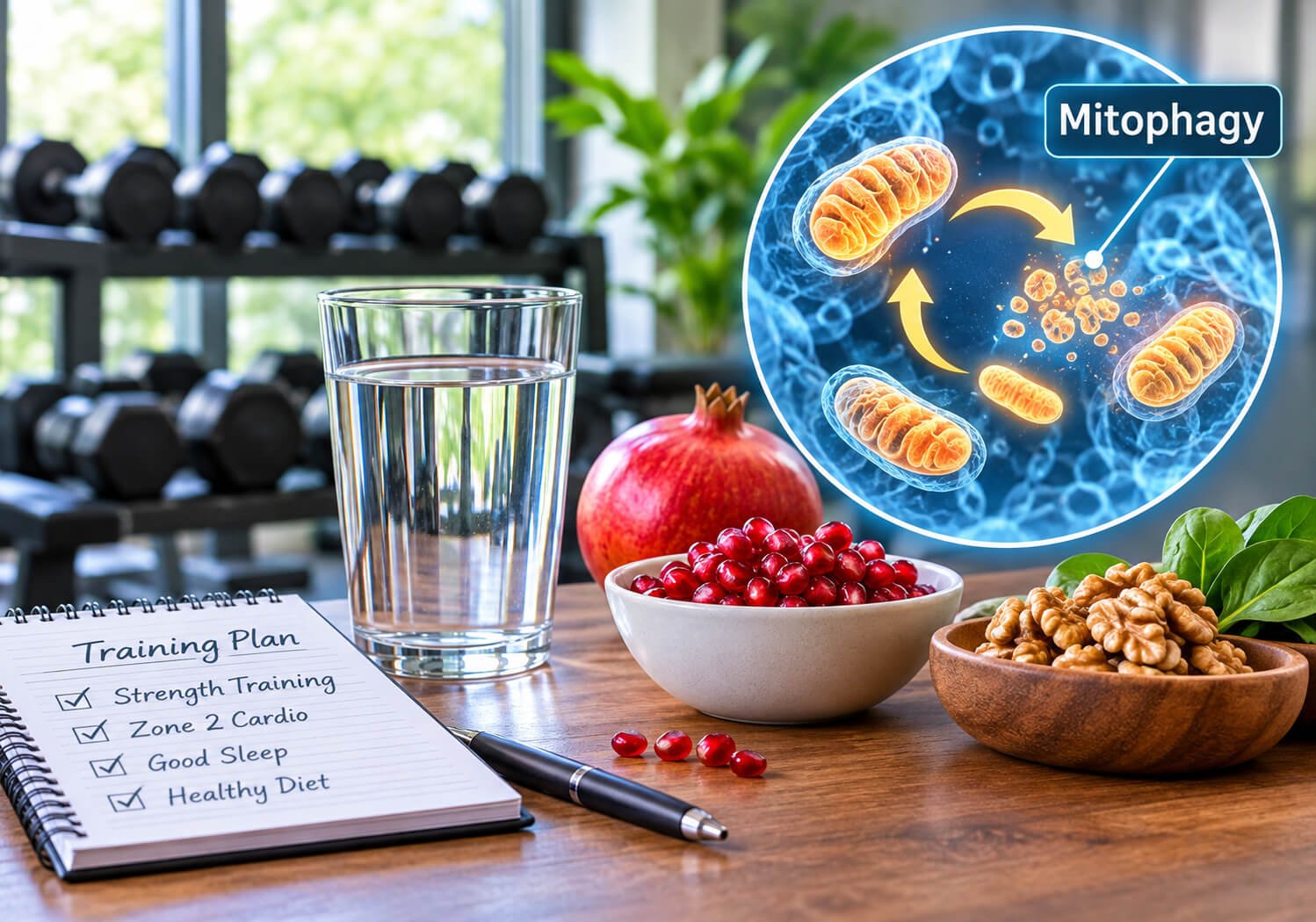
As a strength and conditioning coach, I constantly evaluate tools that help clients recover faster, train harder, and maintain vitality as they age. One of the most promising, science-backed compounds emerging in sports nutrition is urolithin A. The urolithin A benefits for mitochondrial health are rooted in its unique ability to trigger mitophagy, the cellular process of recycling damaged energy factories. If you are over 40, experiencing slower recovery, or simply want to optimize your cellular energy production, understanding this compound is essential. This guide breaks down the exact science, practical dosing, and how to pair it with your training for maximum results.
Quick Answer
The urolithin A benefits for mitochondrial health center on its ability to trigger mitophagy, recycling damaged mitochondria to improve cellular energy production. Research shows that supplementing with 500 to 1,000 mg daily can enhance muscle endurance, support healthy aging, and improve recovery, especially when combined with regular resistance training and adequate protein intake.

What Is Urolithin A and How Does Mitophagy Work?
To understand why this compound matters, we must first look at your mitochondria. Mitochondria are the microscopic powerhouses inside your cells responsible for producing adenosine triphosphate (ATP), the primary energy currency of your body. Every time you lift a weight, go for a run, or even digest a meal, your mitochondria are working.
However, mitochondria degrade over time. Exposure to oxidative stress, poor sleep, and the natural aging process cause them to become dysfunctional. Dysfunctional mitochondria produce less ATP and more free radicals, leading to cellular fatigue, slower muscle recovery, and accelerated aging.
This is where mitophagy comes in. Mitophagy is a highly regulated cellular cleanup process. It identifies damaged mitochondria, breaks them down, and recycles their components to build new, healthy ones. Think of it as taking out the cellular trash so your body can build a more efficient energy system.
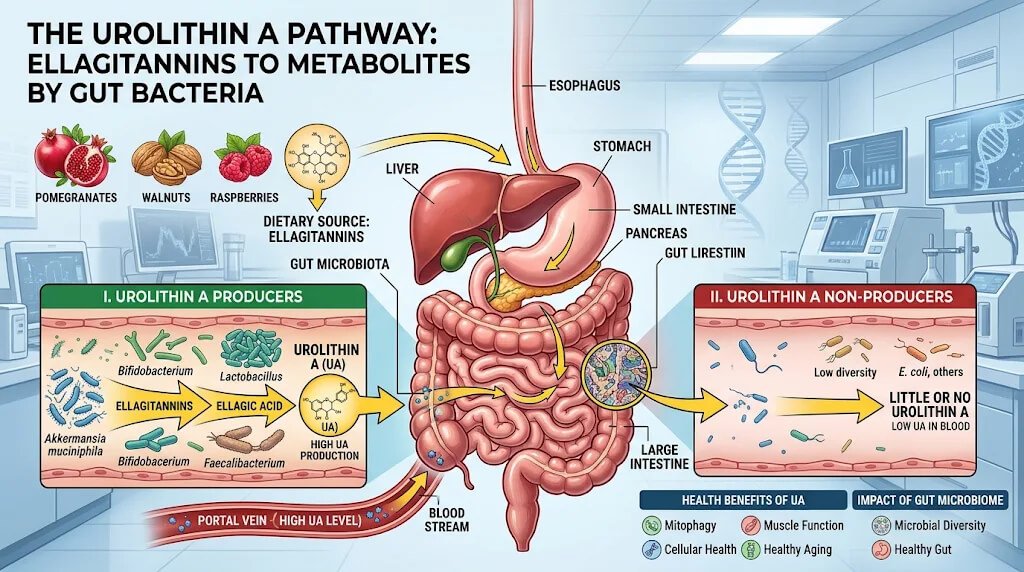
Urolithin A is a postbiotic metabolite. It is not found directly in food. Instead, it is produced in your gut when specific strains of bacteria break down ellagitannins, a type of polyphenol found in certain plant foods. Once absorbed into the bloodstream, urolithin A travels to muscle and other tissues, where it directly activates the mitophagy pathway. This targeted action is what drives the primary urolithin A benefits for mitochondrial health.
The Gut Microbiome Factor: Why Diet Alone Often Falls Short
You might be wondering if you can simply eat more pomegranates to get this effect. The science says it is not that simple. The conversion of ellagitannins into urolithin A depends entirely on your unique gut microbiome composition.
Research indicates that only about 30% to 40% of the population possesses the specific gut bacteria (such as Gordonibacter species) required to make this conversion efficiently. For the remaining majority, eating pomegranates, walnuts, or berries provides general antioxidant benefits, but it does not result in significant urolithin A production.
Furthermore, even for “producers,” the amount of urolithin A generated from dietary sources is highly variable and often too low to reach the therapeutic thresholds observed in clinical trials. This biological bottleneck is why targeted supplementation has become a practical strategy for athletes and aging adults seeking reliable urolithin A benefits for mitochondrial health.
The Science: Clinical Evidence for Urolithin A Benefits for Mitochondrial Health
As a coach, I do not recommend supplements based on marketing hype. I look for peer-reviewed, human clinical trials. The research surrounding urolithin A has grown significantly, with several high-quality studies validating its efficacy and safety.
A landmark 2019 study published in Nature Metabolism investigated the effects of urolithin A supplementation in healthy, older adults. The randomized, double-blind, placebo-controlled trial found that participants taking urolithin A daily for four months showed significant improvements in mitochondrial biomarkers. The supplement was well-tolerated and successfully induced a molecular signature of improved cellular health without adverse effects.
Building on this, a 2023 randomized clinical trial published in JAMA Network Open specifically examined muscle function. Older adults supplemented with 1,000 mg of urolithin A daily for 16 weeks. The results demonstrated a statistically significant improvement in muscle endurance compared to the placebo group. Participants could perform more repetitions during standardized leg press and knee extension tests. Importantly, the study noted that while muscle strength (peak force) did not drastically change, muscle endurance (the ability to sustain effort) improved markedly. This is a critical distinction for functional longevity and daily vitality.
These studies confirm that the urolithin A benefits for mitochondrial health translate directly to measurable improvements in physical performance, particularly in sustaining effort over time.
Food vs. Supplements: Can You Get Enough From Diet?
Let us look at the numbers. Ellagitannins are the precursor compounds found in foods like pomegranates, walnuts, strawberries, and blackberries.
To get a therapeutic dose of urolithin A through diet alone, a “producer” would need to consume massive, impractical quantities of these foods daily. For example, one medium pomegranate contains roughly 200–300 mg of ellagitannins. You would need to eat several pomegranates every single day to even approach the lower end of the supplemental dose, and that assumes your gut bacteria convert it perfectly.
Consuming that much fruit also introduces a high load of natural sugars and calories, which can counteract your body composition goals. Additionally, high intakes of certain fibers and polyphenols can cause gastrointestinal distress, including bloating and diarrhea, in some individuals.
Therefore, while a diet rich in diverse polyphenols is excellent for overall health and supports a robust microbiome, a purified urolithin A supplement is the only reliable way to guarantee the dosage required to activate mitophagy consistently.
How to Apply It: A Coach’s Practical Protocol
Knowing the science is only half the battle. As a coach, my job is to translate research into actionable steps. Here is how to integrate urolithin A into your routine for maximum effect.
1. Dosing and Timing
Clinical trials typically use doses ranging from 500 mg to 1,000 mg per day.
- Starting Dose: 500 mg daily.
- Optimal Dose: 1,000 mg daily for enhanced muscle endurance and mitochondrial support.
- Timing: Take it with a meal that contains some dietary fat. Urolithin A is fat-soluble, meaning its absorption is significantly improved when consumed alongside fats like avocado, olive oil, or nuts.
2. Pairing with Resistance Training
Supplements do not replace training; they amplify the adaptations from training. Resistance training naturally stimulates mitochondrial biogenesis (the creation of new mitochondria). When you combine this stimulus with urolithin A’s ability to clear out the old, damaged mitochondria, you create a highly efficient cellular environment.
Sample Weekly Mitochondrial Support Routine:
- Monday: Lower Body Resistance (e.g., Goblet Squats: 3 sets of 10 reps with a 25 lb / 11.3 kg dumbbell; Romanian Deadlifts: 3 sets of 10 reps with 35 lb / 15.8 kg dumbbells). Rest 90 seconds between sets.
- Tuesday: Zone 2 Cardio. 3 miles (4.8 km) brisk walk or light jog, maintaining a heart rate where you can still hold a conversation.
- Wednesday: Upper Body Resistance (e.g., Dumbbell Bench Press: 3 sets of 10 reps with 20 lb / 9 kg dumbbells; Seated Rows: 3 sets of 12 reps).
- Thursday: Active Recovery. 30 minutes of mobility work or yoga.
- Friday: Full Body Resistance. Focus on compound movements.
- Saturday: Zone 2 Cardio. 4 miles (6.4 km) cycling or rowing at a steady, moderate pace.
- Sunday: Complete Rest.

Coach’s Tip: Track your endurance, not just your max weight. The research shows urolithin A improves the number of repetitions you can perform at a given submaximal weight. If you normally fail at 10 reps with a 25 lb (11.3 kg) dumbbell, test if you can safely push to 12 or 13 reps after 8–12 weeks of consistent supplementation and training.
Common Mistake: Expecting the supplement to replace foundational health habits. Taking urolithin A will not fix poor sleep, chronic stress, or a diet lacking in essential nutrients. It is an optimizer, not a magic bullet.
3. Synergistic Lifestyle Factors
To maximize urolithin A benefits for mitochondrial health, you must support your body’s natural metabolic processes.
- Prioritize Protein: Adequate protein is required to repair the muscle tissue stressed during training. Aim for 0.7 to 1.0 grams of protein per pound of body weight daily. Learn more about how protein intake metabolism plays a role in your overall recovery and body composition.
- Optimize Sleep: Cellular repair and mitophagy are highly active during deep sleep. Poor sleep disrupts hormonal balance and increases oxidative stress. Discover exactly how sleep affect metabolism and recovery at the cellular level.
- Support Metabolic Flexibility: Training your body to efficiently switch between burning carbohydrates and fats enhances mitochondrial efficiency. Read our guide on how to boost metabolic flexibility without resorting to extreme crash diets.
- Consume Adequate Fiber: A healthy gut microbiome is the foundation of natural polyphenol conversion. Dietary fiber feeds beneficial gut bacteria. See the research on how dietary fiber help with appetite and overall gut health.
Safety Notes and Who Should Be Careful
Urolithin A has demonstrated an excellent safety profile in clinical trials, with no serious adverse events reported at doses up to 1,000 mg daily over several months. Mild gastrointestinal discomfort is the most commonly reported side effect, though it is rare.
However, certain populations should exercise caution:
- Pregnant or Breastfeeding Women: There is currently insufficient clinical data on urolithin A supplementation during pregnancy or lactation. Avoid use unless explicitly directed by a healthcare provider.
- Individuals on Medication: If you take blood thinners, blood pressure medications, or drugs metabolized by the liver, consult your doctor. Polyphenol metabolism can sometimes interact with hepatic enzymes.
- Those with Chronic Gastrointestinal Conditions: Because urolithin A production is tied to gut bacteria, individuals with severe IBS, IBD, or recent antibiotic use may experience unpredictable digestive responses.
Always choose supplements from reputable brands that undergo third-party testing for purity and heavy metals. Look for products that clearly state the exact milligram amount of pure urolithin A per serving, rather than just “pomegranate extract,” which is not standardized for urolithin A yield.
Related Tips for Long-Term Vitality
Mitochondrial health is a long-term project. Beyond urolithin A, consider these evidence-based strategies to maintain your energy and physical capacity as you age.
- Micronutrient Sufficiency: Deficiencies in B vitamins, magnesium, and CoQ10 can impair mitochondrial function. Check out which vitamins support metabolism when you have a deficiency.
- Natural Energy Management: Relying on high doses of caffeine can lead to adrenal fatigue and energy crashes. Explore natural methods to increase energy and stamina naturally through breathwork, pacing, and nutrient timing.
- Holistic Metabolic Support: True metabolic health requires a multi-faceted approach. Review our complete guide on how to support metabolism naturally for weight management and sustained vitality.
- Craving Management: Stable blood sugar reduces cellular stress. If you struggle with energy dips and sugar cravings, learn how to manage food cravings without supplements using whole-food strategies and meal timing.
Frequently Asked Questions (FAQ)
What is urolithin A and how does it work?
Urolithin A is a postbiotic metabolite produced when gut bacteria break down ellagitannins from foods like pomegranates. It works by entering the bloodstream and activating mitophagy, the cellular process that recycles damaged mitochondria to improve overall cellular energy production and muscle endurance.
Does urolithin A really improve mitochondrial health?
Yes. Peer-reviewed clinical trials, including studies published in Nature Metabolism and JAMA Network Open, show that daily urolithin A supplementation improves mitochondrial biomarkers and significantly enhances muscle endurance in older adults by clearing out dysfunctional cellular components.
How long does it take for urolithin A to work?
Clinical trials typically observe measurable improvements in muscle endurance and mitochondrial biomarkers after 8 to 16 weeks of consistent daily supplementation. It is not an acute stimulant like caffeine; it works gradually by improving cellular infrastructure over time.
Can you get enough urolithin A from food alone?
For most people, no. Only about 30% to 40% of the population has the specific gut bacteria required to convert dietary ellagitannins into urolithin A. Even for those who do, the amount produced from food is highly variable and generally too low to reach therapeutic levels.
What are the side effects of urolithin A supplements?
Urolithin A is generally well-tolerated. In clinical trials, the most commonly reported side effects were mild and infrequent, such as minor gastrointestinal discomfort. No serious adverse events have been linked to standard doses of 500 mg to 1,000 mg daily.
Who should avoid taking urolithin A?
Pregnant or breastfeeding women should avoid it due to a lack of safety data. Individuals with chronic gastrointestinal conditions or those taking medications metabolized by the liver should consult a healthcare provider before starting supplementation.
Conclusion
Optimizing your cellular energy is one of the most impactful investments you can make for long-term health and physical performance. The urolithin A benefits for mitochondrial health are well-supported by emerging clinical science, highlighting its unique role in activating mitophagy and improving muscle endurance. However, supplements are only one piece of the puzzle. To truly thrive, pair this targeted nutritional support with consistent resistance training, adequate protein intake, quality sleep, and a fiber-rich diet. By building a strong foundation and strategically using evidence-based tools, you can maintain your vitality, strength, and energy for decades to come.