
You are setting up for a routine deadlift or bending over to tie your lifting shoes, and suddenly a sharp, electric jolt shoots down your glute, past your hamstring, and into your calf. That lightning strike is a classic sign of sciatic nerve distress. Understanding what causes sciatic nerve inflammation and pain is the first step toward getting off the sidelines and moving without fear.
The sciatic nerve is the largest and thickest single nerve in the human body. When surrounding tissues compress or chemically irritate its nerve roots, simple daily tasks like sitting in your car or walking 0.5 miles [0.8 km] can feel agonizing.
Before jumping into corrective movements, note that nerve pain requires careful assessment. Check with a doctor or physical therapist before attempting new rehabilitation exercises if you have severe or worsening symptoms.
QUICK ANSWER
Sciatic nerve inflammation and pain occur when the sciatic nerve roots are mechanically compressed or chemically irritated. Primary causes include lumbar disc herniations (L4-S1), spinal stenosis, degenerative disc disease, and bone spurs. Secondary causes include muscular entrapment, such as piriformis syndrome, pelvic instability, prolonged sitting, and systemic low-grade inflammation that sensitizes neural pathways.
The Anatomy of the Sciatic Nerve: How It Travels
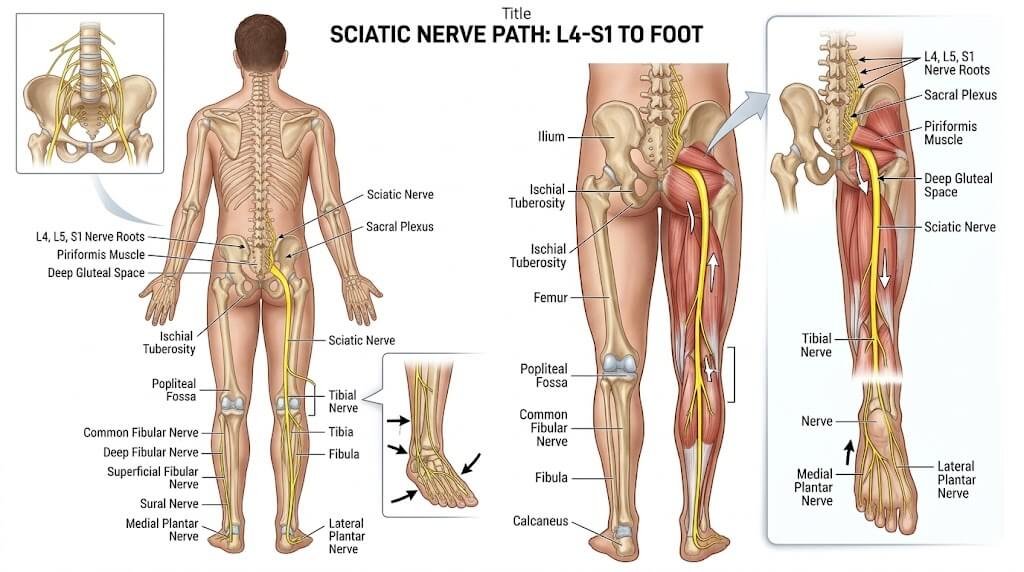
To understand why this nerve flares up, you must look at its anatomical highway. The sciatic nerve originates in your lower back from the spinal nerve roots of L4, L5, S1, S2, and S3. These individual nerve cables bundle together near the front of your piriformis muscle in the deep gluteal space.
From the pelvis, the nerve runs down the back of each leg, traveling underneath or through deep hip rotators. It spans roughly the width of an adult thumb—about 0.75 inches [2 cm] thick at its origin. Near the back of the knee, it splits into the tibial and common fibular nerves, supplying motor control and sensation all the way down to your toes.
Because this nerve spans such a long distance, a problem anywhere along its path can trigger pain down the line. A disc issue at L5 can make your foot feel numb, while a spasming piriformis muscle can mimic a spinal injury.
What Causes Sciatic Nerve Inflammation and Pain: The Primary Mechanical Triggers
When clients ask what causes sciatic nerve inflammation and pain, they often assume they pulled a muscle in their hip. However, the root cause is rarely a simple muscle strain. True sciatica involves mechanical compression, chemical irritation, or a combination of both.
1. Lumbar Disc Herniations and Protrusions
A herniated disc is the single most common culprit behind radicular nerve pain. Research published in the National Center for Biotechnology Information (NCBI) Bookshelf indicates that over 90% of sciatica cases stem from a lumbar disc herniation pressing on an L4, L5, or S1 nerve root.
Your spinal discs consist of a tough, fibrous outer ring (annulus fibrosus) and a jelly-like center (nucleus pulposus). When you subject your spine to repeated flexion under load—like rounding your lower back during heavy deadlifts—the outer wall can tear.
When the inner jelly pushes out, it creates a physical obstruction that pinches the adjacent nerve root. Even worse, the fluid inside the disc contains acidic inflammatory proteins. When this chemical fluid touches the bare nerve, it triggers immediate, burning neural inflammation without requiring extreme physical pressure.
2. Degenerative Disc Disease and Loss of Disc Height
As we age, spinal discs naturally lose water content and thin out. This dehydration reduces the clearance space between your vertebrae.
When disc height drops by 0.1 to 0.2 inches [2.5 to 5 mm], the openings where nerves exit the spine (neuroforamina) narrow. This collapse forces spinal joints to carry more compressive load, irritating nerve roots during common movements like standing or backward bending.
3. Lumbar Spinal Stenosis
Spinal stenosis is a condition characterized by the narrowing of the spinal canal or neuroforaminal spaces. This narrowing is often caused by a combination of bulging discs, thickened ligaments (ligamentum flavum), and facet joint enlargement.
Athletes over 50 years old frequently experience this issue. Stenosis typically causes bilateral or unilateral leg pain that worsens with prolonged standing or walking, but improves when leaning forward on a shopping cart or bike handlebars.
4. Spondylolisthesis
Spondylolisthesis occurs when one vertebra slips forward over the one beneath it, most commonly L5 slipping over S1. This slippage can pinch the exiting nerve roots between the misaligned bones.
Weightlifters who perform excessive lumbar hyperextension under heavy spinal loads—such as arched-back bench pressing or uncontrolled overhead pressing—are at an increased risk of pars interarticularis stress fractures that lead to this instability.
5. Bone Spurs (Osteophytes)
When spinal joints endure chronic friction or instability, your body tries to stabilize the area by producing extra bone. These bone spurs (osteophytes) can protrude directly into the spinal canal or nerve exits.
If an osteophyte rubs against the sciatic nerve sheath, every movement of your spine can cause friction, leading to chronic neural swelling and pain.
Secondary Causes: Piriformis Syndrome and Deep Gluteal Entrapment
Not all sciatic pain originates in the spinal column. When nerve symptoms stem from problems outside the spinal cord, coaches refer to it as “pseudo-sciatica” or deep gluteal syndrome.
Piriformis Syndrome Mechanics
The piriformis is a small, band-like muscle located deep in the buttock behind the gluteus maximus. It runs diagonally from your sacrum to the top of your femur, helping rotate your hip outward.
In roughly 15% to 20% of the population, the sciatic nerve passes directly through the belly of the piriformis muscle rather than underneath it. However, even with standard anatomy, a piriformis that is spasming, hypertrophied, or chronically shortened can squeeze the sciatic nerve against the pelvis.
Deep Gluteal Space Entrapment
Modern physical therapy recognizes that other deep hip structures can entrap the nerve as well. Fibrous bands near the obturator internus, gemelli muscles, or hamstring tendon origins can trap the nerve during hip extension and flexion.
If you spend 8 hours a day seated at a desk on hard surfaces, you place sustained compressive pressure on these deep tissues. This reduces local blood flow and glues soft tissue layers together, creating friction points when you stand up to train.
Systemic and Lifestyle Factors: What Causes Sciatic Nerve Inflammation and Pain to Linger
Mechanical compression is often just the spark; your overall systemic health dictates how large the fire becomes. Many athletes struggle with recurring symptoms because their overall recovery and metabolic health are compromised.
Excess Body Weight and Lumbar Shear Forces
Excess body mass, particularly visceral abdominal fat, alters your pelvic biomechanics. Carrying extra weight around your midsection pulls your pelvis into an anterior pelvic tilt, creating excessive lumbar lordosis (swayback).
This posture increases the compressive load on the posterior edges of your lumbar discs and narrows the intervertebral foramina. Understanding what affects metabolism and body weight can help lifters regulate their body composition, taking mechanical stress off their spinal column. Adopting strategies to support metabolism naturally for weight management helps alleviate the baseline shear forces placed on the L4-S1 region.
Systemic Low-Grade Inflammation
Nerves are sensitive to chronic systemic inflammation. Elevated inflammatory cytokines (such as TNF-alpha and Interleukin-6) lower your nervous system’s pain threshold, making a minor disc bulge feel like a major injury.
Poor metabolic health and insulin resistance impair the small blood vessels (vasa nervorum) that supply oxygen and nutrients to the sciatic nerve. Research on metabolic biomarkers suggests that managing systemic health can support nerve resilience; for example, learning how berberine supports metabolic health highlights the clear link between metabolic balance and balanced inflammatory pathways.
Poor Sleep and Impaired Neural Recovery
Your body repairs peripheral nerves and rehydrates spinal discs primarily during slow-wave deep sleep. When you shortchange sleep, you increase inflammatory markers and blunt natural tissue remodeling.
Reviewing how sleep affects metabolism and recovery shows that chronic sleep restriction slows down tissue repair. Without adequate sleep, an irritated nerve root remains inflamed and hypersensitive day after day.
Age-Related Changes After 40
Tissue elasticity, disc hydration, and muscle mass decline as we age. Lifters over 40 face a dual challenge: their spinal discs are less resilient, and their recovery times are longer.
Following a structured approach on how to increase metabolism naturally after 40 helps athletes preserve lean muscle mass without overloading worn joints and spinal segments.
Comparison Table: Common Causes of Sciatic Nerve Irritation
| Condition | Primary Mechanism | Defining Symptom | Aggravating Factor | Relieving Factor |
| Lumbar Disc Herniation | Disc nucleus extrudes and compresses L4-S1 nerve roots | Sharp, electric pain past the knee; sneezing hurts | Lumbar flexion, sitting, coughing | Standing tall, walking, gentle extension |
| Spinal Stenosis | Narrowing of spinal canal or exit holes | Aching, heavy legs; cramping in both calves | Walking uphill, standing backward | Leaning forward (“shopping cart sign”), sitting |
| Piriformis Syndrome | Deep gluteal muscle spasms onto the nerve trunk | Deep buttock ache; pain rarely travels past the knee | Prolonged sitting on hard chairs | Hip external rotation, walking on flats |
| Spondylolisthesis | Vertebra slips forward, pinching exiting nerves | Instability sensation; deep low back and thigh ache | Standing extensions, back arches | Neutral spine, slight knee bend |
| Bone Spur (Osteophyte) | Bony growth rubs against exiting nerve root | Consistent pinprick sensations; localized radiating pain | Specific directional movements | Avoiding end-range joint positions |
Recognizing the Symptoms: Irritation vs. Neurological Deficits
Sciatic nerve problems can produce a wide range of symptoms. Some athletes experience a dull ache in their hip, while others deal with severe, shooting pain that makes walking impossible.
Typical Radicular Symptoms (Sensory Irritation)
- Burning or Electric Sensation: A hot, wire-like pain running down the back or side of your thigh, calf, and foot.
- Paresthesia (Pins and Needles): Tingling sensations in your toes or outer foot, often corresponding to specific nerve roots (L5 affects the big toe; S1 affects the pinky toe).
- Numbness: Patches of skin on your leg that feel cold, dull, or muffled when touched.

Objective Neurological Deficits (Motor Impairment)
- True Muscular Weakness: Difficulty raising your big toe toward your shin (L5 motor root weakness).
- Foot Drop: Inability to clear your toes while walking, causing you to drag your foot or lift your knee abnormally high.
- Loss of Reflexes: A diminished or absent Achilles tendon reflex (S1 root) or patellar tendon reflex (L4 root) during a clinical evaluation.
Red Flags: When to Stop Lifting and Seek Immediate Medical Care
While most bouts of sciatic nerve inflammation resolve with conservative care, certain symptoms require urgent medical evaluation. The most critical spinal emergency is Cauda Equina Syndrome, which occurs when the massive bundle of nerve roots at the base of the spinal cord is severely compressed.
Ignoring these red flags can lead to permanent nerve damage, chronic incontinence, or long-term lower-limb paralysis. According to Mayo Clinic clinical guidelines on sciatica, rapid surgical decompression within 24 to 48 hours is often required when cauda equina syndrome strikes.
How to Calm Down an Irritated Sciatic Nerve: A Coach’s Protocol
When your nerve is actively inflamed, pushing through the pain will only make it worse. Aggressive stretching, deep tissue massage, and heavy lifting will further irritate an already sensitive nerve.
Instead, use this three-phase approach: calm the nerve down, build stability around it, and reintroduce movement safely.
Phase 1: Gentle Nerve Mobilization (Nerve Flossing)
Nerves need to slide and glide smoothly through surrounding tissues. When tissues swell, the nerve can get caught, creating painful tension. Nerve flossing gently pulls one end of the nerve while relaxing the other, sliding it back and forth without overstretching it.
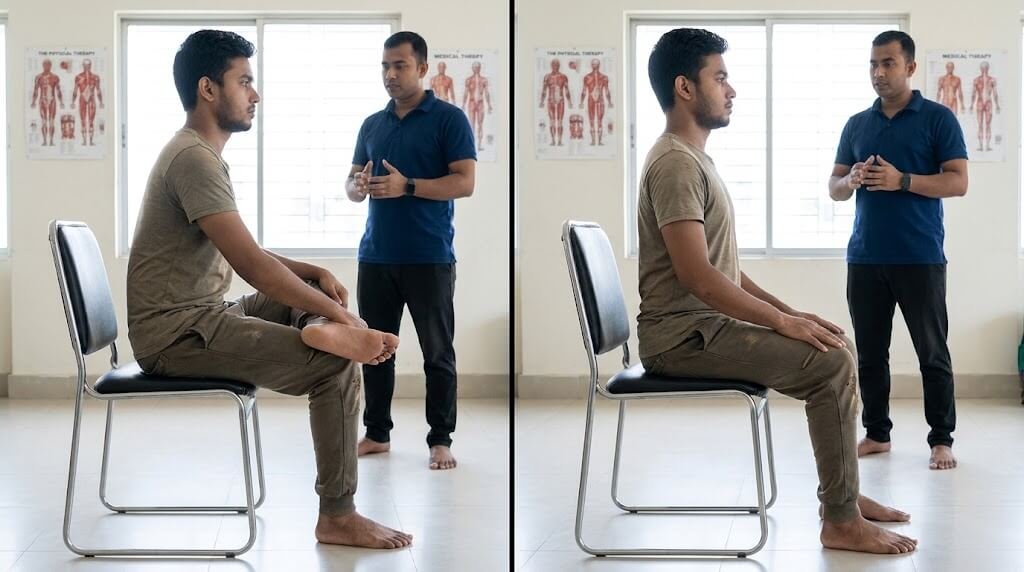
How to Perform the Seated Sciatic Nerve Glide
- Sit tall on the edge of a sturdy bench or chair with your hands resting on your thighs.
- Slump your mid-back slightly, look down toward your chest, and keep your affected foot flat on the floor.
- As you look up toward the ceiling with your head, slowly extend your affected knee and bring your toes upward toward your shin.
- As you lower your foot back to the ground, bring your head back down toward your chest.
- Move through this sequence smoothly: head up as the leg extends, head down as the leg bends.
- Dosing: 2 sets of 10 to 12 smooth reps, performed 2 times per day.
- Regression (Easier): Perform the movement lying on your back. Support your thigh with your hands and gently straighten your knee without flexing your neck.
- Progression (Harder): Pause for 1 second at the top position with your toes pulled toward you, then lower smoothly.

Phase 2: Spinal-Sparing Core Stabilization (The Modified McGill Big 3)
Renowned spine biomechanist Dr. Stuart McGill developed three key exercises designed to build core endurance and protect the lumbar spine without loading the discs. Research highlighted in the Journal of Strength and Conditioning Research demonstrates that these exercises provide high muscular activation with minimal spinal compressive loads.
1. The McGill Modified Curl-Up
Unlike traditional sit-ups that bend your lower back and squeeze your discs, this movement locks your lumbar spine in a safe, neutral position while working your deep core.
- Setup: Lie flat on your back. Bend one knee with your foot flat on the floor; keep the other leg straight. Place your hands palm-down under your lower back to support your natural spinal curve.
- Execution: Brace your abs as if you are about to take a light punch. Lift your head and shoulders off the floor just 1 to 2 inches [2.5 to 5 cm], keeping your neck stable. Imagine your head resting on a bathroom scale—you only want to lift enough to zero out the scale.
- Hold: Hold for 8 to 10 seconds while breathing normally, then lower down.
- Dosing: Perform a descending pyramid: 4 reps, then 3 reps, then 2 reps, resting 20 seconds between sets.
2. The Side Plank (Torso Bracing)
This exercise strengthens your quadratus lumborum and obliques, protecting your spine against dangerous rotational twisting forces.
- Setup: Lie on your side, supporting your weight on your forearm with your elbow directly beneath your shoulder. Bend your knees to 90 degrees (regression) or keep your legs straight with your top foot placed in front of your bottom foot (standard).
- Execution: Drive through your forearm and feet to lift your hips off the floor until your body forms a straight line from your ears to your ankles.
- Hold: Hold for 8 to 10 seconds per rep.
- Dosing: 3 to 4 reps per side, holding each for 8 to 10 seconds.
3. The Bird-Dog (Posterior Chain Stability)
The bird-dog engages your glutes and lower back muscles without putting unwanted flexion or extension stress on your lumbar spine.
- Setup: Start on all fours with your hands directly under your shoulders and your knees directly under your hips. Keep your back flat like a tabletop.
- Execution: Brace your abs. Slowly extend your right arm straight forward and your left leg straight back until both are parallel to the floor. Do not raise your leg higher than hip level, as that arches your lower back.
- Hold: Hold for 5 to 8 seconds at the top while squeezing your glute. Return to the floor and repeat on the opposite side.
- Dosing: 3 sets of 4 reps per side.

Daily Movement Habits: How to Prevent Flare-Ups
Rehabilitating an irritated nerve inside the gym means very little if you spend the other 23 hours of the day stressing your lower back. Small changes to how you sit, stand, and move throughout the day can keep symptoms from returning.
1. Morning Spinal Hygiene
When you sleep, your spinal discs absorb fluid and swell to their maximum volume. This natural overnight swelling means your discs are under higher internal pressure during your first hour out of bed.
If you bend forward to touch your toes or do sit-ups right after waking up, you put unnecessary stress on your disc walls. Give your spine 45 to 60 minutes to normalize before doing heavy exercise or deep bending.
2. Ergonomics and Desk Posture
Sitting hunched over a desk doubles the compressive pressure inside your lumbar discs compared to standing upright.
- Use a small lumbar cushion or rolled-up towel behind your lower back to support its natural curve.
- Set an alarm to stand up and walk for 60 seconds every 30 to 45 minutes.
- Keep your hips set slightly higher than your knees to open your hip angle and reduce hamstring tension on your pelvis.
3. Proper Hip-Hinge Mechanics
Many lifters round their backs when picking light everyday objects off the floor, even if their gym form is solid. Practice bracing your core and hinging through your hips whenever you reach down to pick up groceries, tie your shoes, or pet your dog.
Let your hips and glutes handle the workload, and keep your spine locked in a stable, neutral position.
Nutritional and Metabolic Support for Nerve Health
Tissues need the right raw materials to heal. While nutrition alone cannot fix a physically pinched nerve, a targeted diet can support nerve function and keep systemic inflammation in check.
- Prioritize Dietary Protein: Getting enough protein supplies the amino acids your body needs to rebuild connective tissues and maintain stabilizing muscle mass. Check our breakdown of protein intake and tissue management to ensure you are hitting your daily targets.
- Address Micronutrient Deficiencies: Your nerves rely on B-complex vitamins (especially B1, B6, and B12) to maintain their protective myelin sheaths. Reviewing which vitamins support metabolism and deficiencies helps ensure your nerve cells have the micronutrients they need to function properly.
- Hydrate Consistently: Spinal discs are mostly water. Staying well-hydrated helps your discs absorb shock and distribute daily spinal loads evenly.
Frequently Asked Questions
What does an inflamed sciatic nerve feel like?
An inflamed sciatic nerve typically feels like a sharp, burning, or electric shock that travels from your lower back or hip down through your leg. Many people also experience tingling, a “pins-and-needles” sensation in their calf or foot, and a persistent deep ache in the glute.
Can tight glutes or piriformis muscles cause sciatic pain?
Yes. When your deep hip rotators—especially the piriformis muscle—spasm or tighten, they can compress the underlying sciatic nerve. This condition is called piriformis syndrome or deep gluteal syndrome. It produces symptoms similar to a spinal disc bulge, but the irritation begins in the hip rather than the spine.
How long does it take for sciatic nerve inflammation to settle down?
Most mild to moderate cases of sciatica begin improving within 4 to 6 weeks of smart conservative care. Using gentle nerve flossing, practicing spinal-sparing core exercises, and avoiding painful positions helps the inflammation subside. However, severe disc herniations can take 8 to 12 weeks or longer to heal completely.
Is walking good for sciatic nerve inflammation?
Walking is generally one of the best low-impact activities for calming an irritated sciatic nerve. It promotes healthy blood flow, pumps healing nutrients into your spinal discs, and avoids prolonged sitting. Keep your strides short, wear supportive shoes, and walk on flat surfaces for 10 to 15 minutes at a time.
What sleeping position is best for sciatica?
Sleeping on your side with a pillow between your knees is usually the most comfortable position because it keeps your pelvis and lumbar spine aligned. If you prefer sleeping on your back, place a pillow under your knees to take tension off your hamstrings and relieve pressure on your lower back.
Should I use heat or ice for an inflamed sciatic nerve?
Use ice for the first 48 to 72 hours of a sudden flare-up to dull sharp nerve pain and bring down local tissue swelling. After that initial period, switch to moist heat to loosen tight gluteal and spinal muscles, improve blood flow, and relieve protective muscle spasms.
Conclusion
Understanding what causes sciatic nerve inflammation and pain helps take the fear out of recovery. Whether your symptoms stem from a lumbar disc bulge, spinal stenosis, or a tight piriformis muscle, healing takes time, patience, and smart movement choices.
Avoid painful bending and stretching, use gentle nerve flossing to restore healthy movement, and build core stability with the McGill Big 3. Protect your spine throughout the day, and let your body do what it is designed to do: adapt, heal, and get stronger.